The short answer
The single most important Scottish Terrier health fact is a notably elevated risk of bladder cancer (transitional cell carcinoma), among the highest of any breed. That makes knowing the warning signs, blood in the urine, straining, and frequent or difficult urination, essential, because early detection matters. Beyond that, the breed can have Scottie cramp (a movement disorder), von Willebrand disease (a bleeding disorder), and jaw, joint, and skin issues. This is general information, not veterinary advice: build a plan with your Calgary vet, watch closely for urinary changes, and price pet insurance while your dog is young.
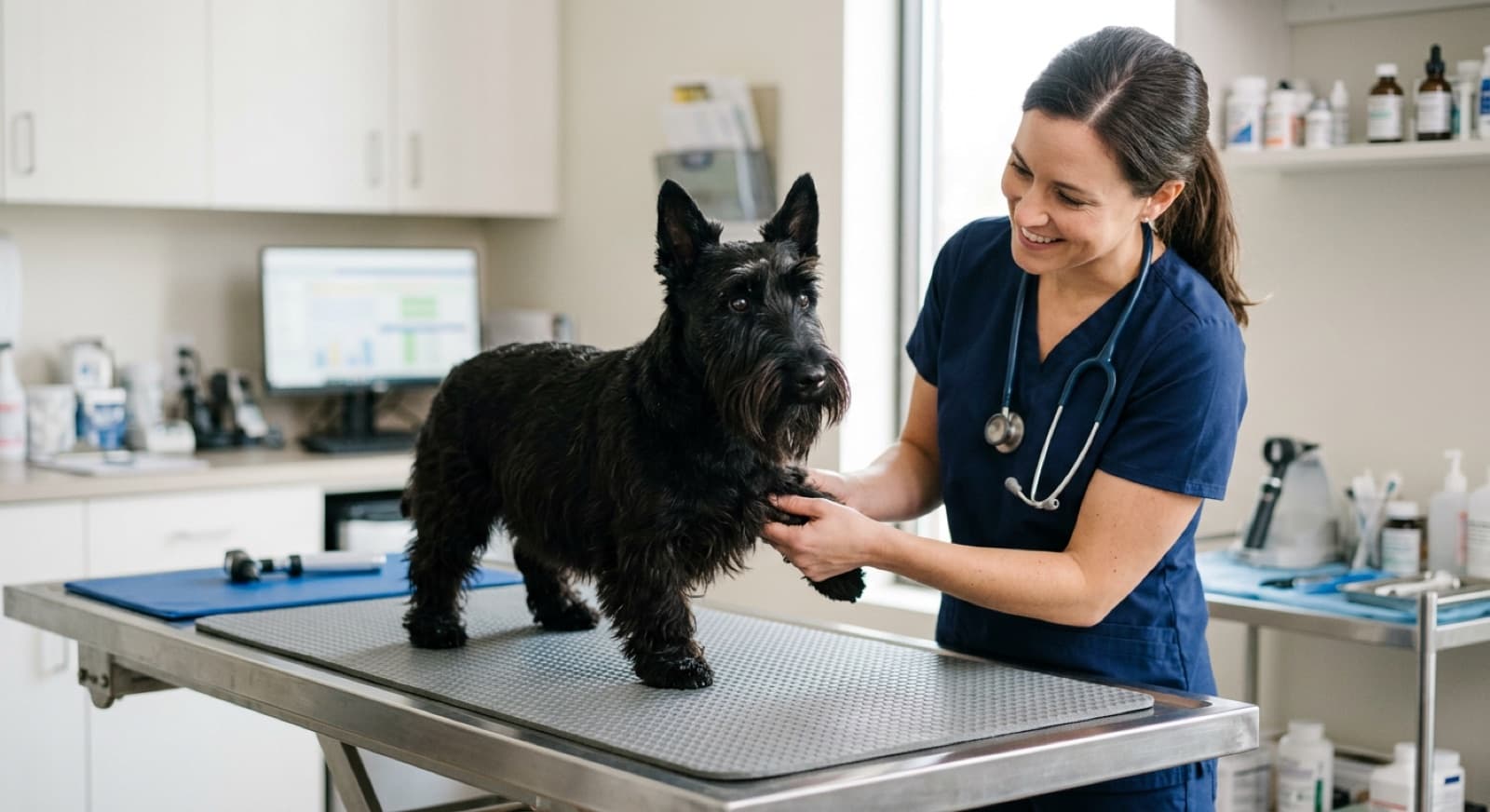
Scottish Terriers are generally hardy little dogs, but this is one breed where a single health issue stands out enough that every owner should know it in advance. Understanding the bladder-cancer risk, and the handful of other breed-specific conditions, is what lets an owner catch problems early rather than late. This guide walks through each with authoritative sources, then covers the preventive care that matters most in Calgary.
Bladder cancer: the breed's defining risk
This is the health fact that sets the Scottie apart. The breed has one of the highest risks of bladder cancer, specifically transitional cell carcinoma (TCC), of any breed. Research from Purdue University's canine bladder cancer program has reported that Scottish Terriers carry roughly an eighteen-to-twenty-fold higher risk than other breeds. That is not a prediction that any individual dog will get it, but it is a reason for every owner to stay alert.
Know the warning signs and act on them:
- Blood in the urine
- Straining to urinate, or difficulty urinating
- Frequent urination or accidents in a house-trained dog
- Recurrent urinary tract infections that keep coming back
Any of these is a prompt vet visit, not something to wait out, and it is worth mentioning the breed's cancer risk so your vet keeps it in mind. Research linked to the Purdue program has also associated exposure to certain lawn and garden herbicides with higher TCC risk in Scotties, so limiting your dog's contact with chemically treated lawns is a reasonable precaution. Talk with your vet about whether periodic urine screening makes sense for your individual dog. Diagnosis and treatment are entirely a veterinary matter; the owner's job is vigilance and early action.
Scottie cramp and bleeding disorders
Two more breed-specific things to know. Scottie cramp is a hereditary movement disorder fairly particular to the breed: an affected dog develops stiffness or a cramping, awkward gait, usually triggered by excitement or hard exercise, that typically eases with rest. It can look alarming but is generally not painful and is not a seizure, and many dogs live normal lives with it. Because other conditions can look similar, any episodes like this deserve a proper veterinary diagnosis rather than a guess at home.
The breed also carries von Willebrand disease, an inherited blood-clotting disorder in which a dog may bleed more than expected from an injury or during surgery. A DNA test exists and good breeders screen for it. The practical takeaway for an adopted Scottie is simple: mention the breed to your vet before any planned surgery so they can take appropriate precautions. Screening for several of these conditions is registered through databases like the Orthopedic Foundation for Animals (OFA).
Other concerns and preventive care in Calgary
Young Scotties can experience craniomandibular osteopathy, an abnormal growth of the jaw bones that usually resolves with maturity but needs veterinary management while it is active, and the breed can also have patellar luxation and skin allergies. The American Kennel Club describes a sturdy, spirited breed, and with good care most Scotties are hardy companions well into their teens.
Preventive care comes down to routine vet visits, attention to the urinary warning signs above all, good dental and skin care, and a lean body. Price pet insurance while your dog is young and healthy, before anything becomes pre-existing, since cancer care in particular can be costly. For the grooming side of owning a Scottie, see our grooming and coat care guide, and for the full adoption picture, our Scottish Terrier adoption guide.
Considering a Scottish Terrier?
Adopting an adult through a rescue that has done a vet workup means much of the health history is already known, a real advantage in a breed with specific predispositions. See who is available across Calgary rescues.
See Calgary Scottish Terriers →Frequently Asked Questions
What health problems are Scottish Terriers prone to?↓
Do Scottish Terriers get bladder cancer?↓
Can I reduce my Scottie’s bladder cancer risk?↓
What is Scottie cramp?↓
How long do Scottish Terriers live?↓
Continue reading
Temperament, cost, and who the breed suits.
Hand-stripping vs clipping, and the classic silhouette.
Live listings across Calgary rescues.
Caring for a short-legged terrier through the cold.
New dog? Start with these care guides
Everything a new adopter needs to set up a safe, happy home.