The short answer
Border Collie reactivity has two underlying drivers. Herding-drive is intense focus on fast-moving triggers, frustrated by the leash. Fear is under-socialised or trauma-based behaviour. Identifying which dominates determines the training approach. Both respond to force-free methods: LAT (Look At That) for drive-based, BAT (Behaviour Adjustment Training) for fear-based. Threshold work is foundational. Train below the distance where your dog reacts. Edmonton urban triggers (river-valley cyclists, LRT, off-leash dogs at Mill Creek) make this hard. Choose low-density environments first: residential side streets pre-7am, empty parking lots Sunday morning, private field rentals. Work with an Edmonton IAABC, CCPDT, or KPA-credentialed force-free trainer ($1,500 to $3,000 over 6 to 12 months). For severe cases, escalate to a board-certified vet behaviourist with MDR1-aware medication framework. Realistic timelines: mild 3 to 6 months, moderate 6 to 12, severe 12 to 24+. Many cases plateau at “manageable” rather than “resolved,” and that is a successful outcome.
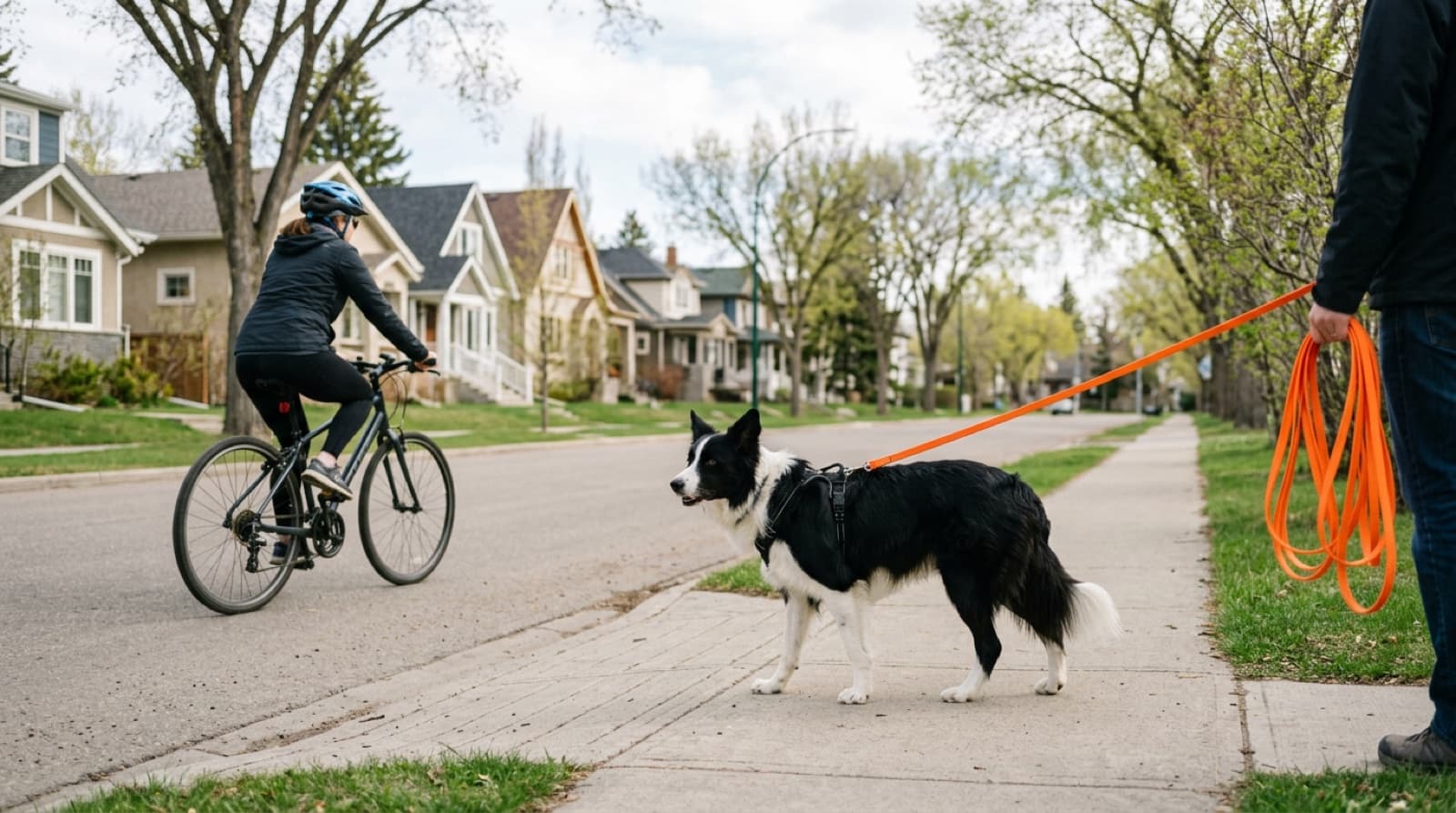
The two drivers of BC reactivity
Border Collies were genetically selected for centuries to monitor and control fast-moving objects. Reactivity in adopted Border Collies usually combines two underlying drivers, and identifying which one dominates determines the training approach.
Herding-drive reactivity
The dog sees a fast-moving stimulus, the genetic chase-and-control instinct activates, and they escalate because they cannot complete the herding sequence on a leash. Not afraid. Frustrated.
Body language: ears forward and pricked, hard predatory eye, lowered head with raised hindquarters (the stalk), goes silent before the lunge. After the trigger passes, recovers within minutes.
Typical triggers: bicycles, cars, joggers, scooters, e-scooters, skateboarders, leaves blowing across the trail, sometimes birds.
Fear reactivity
The dog is trying to make the trigger go away. Causes include under-socialisation in the 3 to 16 week critical window, or traumatic events in a previous home.
Body language: ears back or pinned, tucked tail, whale eye, lip-licking, air-snapping, vocal build-up (whining, growling). After the trigger passes, the dog may pant excessively, shake, or hide.
Typical triggers: unfamiliar stimuli at close range, men in hats, vacuum, doorbell, strangers approaching, other dogs sniffing.
Most adopted Edmonton rescue Border Collies show a mix. An Edmonton force-free certified trainer with reactivity experience can identify the dominant pattern in a single session. The dominant pattern dictates whether to start with LAT or BAT.
Threshold work: the foundation everything builds on
Threshold is the distance or intensity at which your Border Collie notices a trigger but has not yet escalated to barking and lunging. Working below threshold is the foundational principle of modern reactivity training.
The International Association of Animal Behaviour Consultants and the Certification Council for Professional Dog Trainers both publish position statements aligned on threshold-based training. The mechanics:
- Below threshold: the dog can disengage and respond to you. This is the learning zone.
- At threshold: the dog fixates, body stiffens, stops taking treats.
- Over threshold: barking, lunging, sometimes redirecting onto the leash or the handler. Nothing is learned. The rehearsed reactive sequence often gets stronger with repetition.
For most rescue Border Collies with a 1 to 3 month reactivity history, threshold for cyclists or joggers might be 30 to 50 feet on a quiet street, and 50 to 100 feet for other dogs. Edmonton urban environments make this harder than rural training because trigger density is higher and you cannot always control the distance.
Edmonton training environments by trigger density (lowest to highest):
- Residential side streets at 6 to 7am (lowest)
- Empty industrial-zone parking lots Sunday morning
- NE Edmonton near the airport on weekends
- Quiet residential cul-de-sacs mid-morning weekdays
- Quiet sections of Whitemud Ravine or Mill Creek Ravine off-peak
- River-valley pathways mid-day weekends (highest, avoid)
Use a long line (10 to 15 ft of flat biothane, not a retractable leash) and carry high-value treats (cooked chicken, freeze-dried liver, salmon skin).
BAT vs LAT: which to start with
Two evidence-based reactivity methods, both effective. Choosing the right starting protocol depends on whether drive or fear dominates.
LAT — for drive-dominant BCs
Look At That, from Leslie McDevitt's Control Unleashed. The dog is taught a marker word and treat for noticing the trigger. Over time, the trigger itself becomes the cue to check in with the handler. Suits drive-based reactivity and high-arousal Border Collies. The dog stays mentally engaged with the handler rather than escalating into the herding sequence.
BAT — for fear-dominant BCs
Behaviour Adjustment Training, developed by Grisha Stewart. The dog learns at sub-threshold distance that the trigger is safe by making their own choices about engagement. The handler stays passive on a long line and the dog has agency. Suits fear-based reactivity. Builds confidence through autonomous successful experiences.
Mixed cases (most rescue Border Collies) start with the dominant pattern and add the other after 4 to 6 weeks. Both methods are positive-reinforcement-based and used by Edmonton force-free trainers.
Avoid trainers who use prong collars, e-collars, or balanced methods for Border Collie reactivity. These often worsen the behaviour because Border Collies are unusually sensitive to corrections. The American Veterinary Medical Association and American Veterinary Society of Animal Behavior both publish position statements against aversive correction tools.
The pre-stalk: the cue you cannot afford to miss
Border Collies have one of the fastest escalation profiles of any breed. The pattern:
- Pre-stalk (1 to 3 seconds): body stiffens, eye fixates, ears tense forward, breath shortens, leash slack tightens slightly. This is your window.
- Stalk (1 to 2 seconds): head drops slightly, weight shifts forward, the dog freezes.
- Lunge: explosive forward motion to the end of the leash.
The full sequence can complete in 5 to 7 seconds. Most handlers miss the pre-stalk. The fix is reading pre-stalk reliably and intervening with a cued behaviour (LAT marker, check-in, treat) before the stalk activates.
Practise catching pre-stalk in low-trigger environments first (your living room, backyard, quiet residential street). Mark each pre-stalk catch with a verbal “yes” and a treat. Most owners take 4 to 8 weeks to get reliable. This is the single highest-yield handler skill in reactivity work.
Browse adoptable Border Collies in Edmonton
Edmonton rescues disclose reactivity history honestly during the foster phone screen. The right placement matters more than a fast placement.
See Available Border Collies →MDR1 and BC behavioural medication
Border Collies have an elevated frequency of the MDR1 (ABCB1) gene mutation that affects how certain drugs are metabolised. Roughly 1 in 4 Border Collies carries at least one copy. The mutation matters because affected dogs metabolise certain medications more slowly than other breeds, which can change effective dose and side-effect profile.
For behavioural medication specifically (anti-anxiety SSRIs, benzodiazepines, gabapentin, trazodone, clomipramine), an MDR1-aware prescribing vet is the right starting point. This is one reason to escalate to a board-certified veterinary behaviourist for severe BC reactivity rather than starting on a general-practice vet's default prescription. Edmonton specialty behavioural referral options include telemedicine consultation with a DACVB (Diplomate American College of Veterinary Behaviorists) or referral to the Western College of Veterinary Medicine in Saskatoon.
The MDR1 framework: if your rescue BC came without MDR1 status documentation, an MDR1 swab test through Washington State University's veterinary lab (where the MDR1 test was originally developed) costs roughly $60 to $80 USD and provides genotype results that inform medication decisions for life. Worth doing before any behavioural medication discussion.
When to consider medication: reactivity threshold so close that everyday Edmonton walks are impossible, reactivity worsening despite 3+ months of consistent force-free training, the dog cannot recover between trigger exposures (panting, pacing, refusing food for hours), severe noise-phobia (Canada Day fireworks, summer thunderstorms), or self-mutilation.
Medication is not a substitute for training. The framework is consultation, training, and environmental management together. Medication reduces baseline anxiety so the dog can learn during threshold work. Without the training piece, medication does not produce lasting behaviour change.
Realistic timelines and the “manageable” plateau
Mild reactivity often improves in 3 to 6 months, moderate in 6 to 12 months, severe in 12 to 24 months or longer.
- Mild reactivity (occasional barking at specific triggers, recovers quickly): typically reaches 80% reliability with 3 to 6 months of structured training.
- Moderate reactivity (consistent threshold issues, multiple trigger categories): reaches 70% reliability in 6 to 12 months and may plateau at “manageable” rather than “resolved.”
- Severe reactivity (over-threshold most walks, self-injury, redirected aggression): needs 12 to 24 months minimum and may require lifelong management.
Many reactive Border Collies reach a good-enough plateau rather than full resolution. Predictable trigger response, manageable on-leash walks in low-density environments, and no off-leash work in trigger-rich environments is a successful outcome. Owners who accept the plateau and live with the dog as is generally have happier dogs than owners who keep pushing for full resolution and burn the relationship trying.
If reactivity has not improved at all after 6 months of consistent professional training, escalate to a veterinary behaviourist before continuing. There may be undiagnosed pain, neurological issues, or thyroid problems contributing. Hypothyroidism specifically can mimic and worsen reactivity in Border Collies and is screened with a basic blood panel.
Frequently Asked Questions
Why is my Border Collie reactive to bicycles, cars, joggers, and other dogs?
Border Collies were genetically selected for centuries to monitor and control fast-moving objects. Reactivity in adopted Border Collies usually combines two underlying drivers, and identifying which one dominates determines the training approach. Herding-drive reactivity looks like a dog that sees a cyclist or jogger, freezes into a stalk, then explodes into barking and lunging. The genetic chase-and-control instinct activates and the dog is frustrated by being prevented from completing the herding sequence. They are not afraid. Fear reactivity looks similar from the outside but the dog is trying to make the trigger go away. Causes include under-socialisation in the 3 to 16 week critical window or traumatic events. Body language tells the two apart. Ears forward with a hard eye and a predatory crouch suggests drive. Ears back, tucked tail, whale eye, and air-snapping suggests fear. Most adopted Edmonton rescue Border Collies show a mix. An Edmonton force-free certified trainer with reactivity experience can identify the dominant pattern in a single session.
What is threshold and why does it determine whether training works?
Threshold is the distance or intensity at which your Border Collie notices a trigger but has not yet escalated to barking and lunging. Working below threshold is the foundational principle of all modern reactivity training, per IAABC and CCPDT guidance. Below threshold, the dog can disengage and respond to you. This is the learning zone. At threshold, the dog fixates, the body stiffens, and they stop taking treats. Over threshold means barking, lunging, sometimes redirecting onto the leash or the handler. Nothing is learned over threshold, and the rehearsed reactive sequence often gets stronger. For most rescue Border Collies with a 1 to 3 month reactivity history, threshold for cyclists or joggers might be 30 to 50 feet on a quiet street, and 50 to 100 feet for other dogs. Edmonton urban environments make this harder than rural training. Choose lower-density training environments first: residential side streets at 6 to 7am, empty parking lots Sunday morning, NE Edmonton industrial zones with low pedestrian traffic.
How do I tell herding-drive reactivity apart from fear reactivity?
Read body language. Herding-drive shows forward-pricked ears, intense staring, a lowered head with raised hindquarters (the stalk), a hard eye, and the dog often goes silent before the lunge. After the trigger passes, the dog seems frustrated but recovers within minutes. Triggers are anything fast-moving (bicycles, cars, runners, scooters, even leaves blowing across the trail). Often worse at distance because the chase pattern needs space. Fear reactivity shows ears back or pinned, tucked tail, whale eye, lip-licking, air-snapping, and vocal build-up (whining, growling). After the trigger passes, the dog may pant excessively, shake, or hide. Triggers are unfamiliar stimuli at close range. Often worse at close range, calmer at distance. Many rescue Border Collies show both: drive toward fast distance triggers, fear toward close-contact triggers. An Edmonton force-free certified trainer with reactivity experience can assess the dominant pattern.
What are BAT and LAT, and which should I use?
Two evidence-based reactivity methods, both effective. BAT (Behaviour Adjustment Training, developed by Grisha Stewart) suits fear-based reactivity. The dog learns at sub-threshold distance that the trigger is safe by making their own choices about engagement. The handler stays passive on a long line and the dog has agency. LAT (Look At That, from Leslie McDevitt's Control Unleashed) suits drive-based reactivity and high-arousal Border Collies. The dog is taught a marker word and treat for noticing the trigger. Over time, the trigger itself becomes the cue to check in with the handler. Drive reactivity starts with LAT. Fear reactivity starts with BAT. Mixed cases start with the dominant pattern and add the other after 4 to 6 weeks. Both methods are positive-reinforcement-based and used by Edmonton force-free trainers. Avoid trainers who use prong collars, e-collars, or balanced methods for Border Collie reactivity. These often worsen the behaviour because Border Collies are unusually sensitive to corrections.
Why does my Border Collie escalate so fast in the lunge-bark cycle?
Border Collies have one of the fastest escalation profiles of any breed because the herding sequence is genetically wired for rapid response. The pattern is pre-stalk (body stiffens, eye fixates, 1 to 3 seconds), stalk (drops slightly, freezes, 1 to 2 seconds), then lunge (explosive forward motion to the end of the leash). The full sequence can complete in 5 to 7 seconds. Most handlers miss the pre-stalk. The fix is reading pre-stalk reliably. Watch for the head raising slightly, ears going forward and tense, stare intensifying, body weight shifting forward, breath holding, leash slack tightening. Practise catching these cues in low-trigger environments (your living room, backyard, quiet residential street) and mark them with a verbal yes and a treat. Most owners take 4 to 8 weeks to get reliable. This is the single highest-yield handler skill in reactivity work.
Can I take my reactive Border Collie to Edmonton off-leash zones?
Probably not at first, and possibly never to the busy ones. Off-leash parks are a reactivity-training failure environment for most reactive Border Collies because triggers appear at unpredictable distances, other dogs may crowd your dog, and your dog cannot rehearse calm behaviour because the arousal is constant. Edmonton off-leash zones ranked for a reactive Border Collie: avoid Hawrelak Park south-slope off-leash, busy Mill Creek Ravine sections on weekends, and Buena Vista off-leash on warm-weather Sundays until reactivity is well-controlled. Sometimes okay on a long line at low-traffic times (6am weekdays): Terwillegar Park (huge, distance is manageable in the back sections), Whitemud Ravine off-peak, Capilano Park in winter low-traffic windows. The higher-yield alternative is renting private off-leash space. Edmonton has a growing list of Sniffspot-style backyard rentals where your dog can exercise safely with no triggers. Most reactive Border Collies graduate to busy off-leash zones after 6 to 12 months of structured training, but some never become a Hawrelak-on-Saturday dog, and that is fine.
How do I work with a reactive Border Collie in Edmonton urban environments?
Choose training environments by trigger density and treat training walks differently from exercise walks. Edmonton has a moderately challenging urban environment for reactive Border Collies. The North Saskatchewan River Valley pathway has cyclists and joggers throughout the warmer months. LRT and bus traffic create sudden noise and movement triggers in central neighbourhoods. Off-leash dogs appear unexpectedly in shared-use river-valley sections. Strategy: residential side streets at 6 to 7am are nearly empty. NE Edmonton near the airport and southside industrial zones have low pedestrian and cyclist traffic on weekends. Use a long line (10 to 15 ft, flat biothane, not retractable). Time pathway walks for pre-7am or after 8pm. Skip LRT commute walks until reactivity is controlled because trains combine sudden noise, air pressure, and visual movement. Carry high-value treats (cooked chicken, freeze-dried liver) for the difficulty of urban training. Designate training walks (15 to 20 minutes, threshold work) separately from exercise walks (private fenced field or quiet residential area).
Should I work with an Edmonton force-free trainer for BC reactivity?
Strongly recommended within the first 3 to 6 months of adopting a reactive Border Collie. Choosing force-free matters more for Border Collies than most breeds because they have heightened sensitivity to corrections. Harsh handling increases fear and herding-drive arousal rather than suppressing it. Look for an Edmonton trainer who is IAABC, CCPDT, or Karen Pryor Academy credentialed and has reactivity experience. Avoid trainers who use prong collars, e-collars, or balanced methods. The IAABC and CCPDT maintain certified-member directories. Typical cost structure for reactive Border Collie rehab: initial assessment around $150 to $250 for a home consultation, private sessions $90 to $150 per hour, group reactive dog classes $250 to $400 for a 6-week course. Total investment over 6 to 12 months commonly lands $1,500 to $3,000. Many Edmonton rescues recommend specific trainers for adopted Border Collies and sometimes subsidise initial sessions. Ask your rescue at adoption.
When should I consider behavioural medication for my reactive BC?
When reactivity is severe enough that training alone cannot get the dog below threshold reliably, consult a board-certified veterinary behaviourist. Signs that medication may be appropriate to discuss include reactivity threshold so close that everyday Edmonton walks are impossible, reactivity worsening despite 3+ months of consistent force-free training, the dog cannot recover between trigger exposures (panting, pacing, refusing food for hours), a severe noise-phobia component (Canada Day fireworks, NYE, summer thunderstorms), or self-mutilation. Border Collies need MDR1-aware medication choices: the breed has elevated frequency of the MDR1 (ABCB1) gene mutation that affects how certain drugs are metabolised, so a veterinary behaviourist (rather than a general practice vet) is the right starting point for severe cases. Edmonton specialty behavioural referral typically routes through telemedicine consultation with a board-certified DACVB or through the Western College of Veterinary Medicine in Saskatoon for complex cases. Do not request specific medications or dose changes from internet articles. Medication is not a substitute for training. The framework is consultation, training, and environmental management together.
How long does BC reactivity training take, and when should I accept a plateau?
Mild reactivity often improves in 3 to 6 months, moderate in 6 to 12 months, severe in 12 to 24 months or longer. Mild reactivity (occasional barking at specific triggers, recovers quickly) typically reaches 80% reliability with 3 to 6 months of structured training. Moderate reactivity (consistent threshold issues, multiple trigger categories) reaches 70% reliability in 6 to 12 months and may plateau at manageable rather than resolved. Severe reactivity (over-threshold most walks, self-injury, redirected aggression) needs 12 to 24 months minimum and may require lifelong management. Some severe cases never reach full off-leash safety. Many reactive Border Collies reach a good-enough plateau rather than full resolution. Predictable trigger response, manageable on-leash walks in low-density environments, and no off-leash work in trigger-rich environments is a successful outcome. If reactivity has not improved at all after 6 months of consistent professional training, escalate to a veterinary behaviourist before continuing. There may be undiagnosed pain, neurological issues, or thyroid problems contributing.
Does Edmonton winter change BC reactivity training?
Yes, mostly for the better. Edmonton winter (November through March) is a reactivity-training opportunity because trigger density drops dramatically. Fewer cyclists, fewer joggers, fewer off-leash dogs in the river valley, and shorter daylight hours pack pedestrians into predictable narrow windows. This is the season to build foundational threshold work without constant trigger ambush. Walk at 7 to 8am or 5 to 6pm for the lowest trigger density. Use the indoor mall walking spots and dog-friendly indoor venues for mid-blizzard sessions if the dog needs movement but the outdoor world is unsafe. Two warnings: deep cold (-25C and below) limits effective treat delivery (treats freeze, hands lose dexterity, dog is distracted by paw discomfort) and is not productive training weather; and winter darkness can change trigger profile if the dog has visual reactivity (sudden headlight beams trigger a chase response in some BCs). Overall, the winter trigger calm is a real training advantage in Edmonton that BC owners in milder climates do not have.
Adopting a reactive rescue BC from SCARS, EHS, or Zoe's: what to ask?
Edmonton rescues with BC volume (SCARS, Edmonton Humane Society, Zoe's Animal Rescue, AHHRB, AARCS Edmonton fosters) typically disclose reactivity history because the foster home has weeks of observation. Questions to ask during the foster phone screen: what specific triggers does the dog react to (cyclists, other dogs, joggers, vehicles, kids)? What is the current threshold distance for each trigger? How long was the dog in the previous home and what did reactivity look like there? Has the dog worked with a force-free trainer? What recovery time looks like after a trigger exposure? Any documented self-injury or redirected biting? Any current medications? What does the foster home recommend for ongoing training? A good Edmonton rescue will answer these openly because the right placement matters more than a fast placement. Take the disclosure seriously: a moderate-reactivity rescue BC placed into a busy Edmonton condo with daily LRT exposure usually returns. The same dog placed in a quieter suburban home with a yard and a force-free trainer relationship often thrives.
Adoptable Border Collies in Edmonton
Live listings from SCARS, Edmonton Humane Society, Zoe's, AHHRB, and AARCS Edmonton fosters.
BC Adolescence Survival Edmonton
The 8 to 18 month teenage phase, herding-drive emergence, force-free management.
Border Collie Exercise and Mental Stimulation
Why brain work matters as much as running: daily structure, ball obsession, bad-weather games, dog sports and signs of boredom.
Border Collie Health Issues: Eyes, Epilepsy, MDR1
Border Collie health issues to plan for: Collie eye anomaly, epilepsy, hip dysplasia, EPI, exercise collapse and the MDR1 drug-sensitivity test, and what to ask your vet.
New dog? Start with these care guides
Everything a new adopter needs to set up a safe, happy home.