The short answer
Boxers are temperamentally one of the most kid-loving breeds in existence AND physically dangerous to toddlers without management. Both true. Edmonton ER vet visits happen routinely from family Boxer enthusiasm. Sweet spot: kids 5 to 12 with an adult Boxer (3+ years). High-risk pairing: adolescent Boxer (8 to 24 months) + toddler. Most Edmonton rescues recommend AGAINST new Boxer adoption with kids under 5 without significant training commitment. The training playbook: force-free trainer relationship by month 8, “four on the floor” and “place” cues installed early, baby gates and house-leash during adolescence, daycare 2 to 3 days a week through Edmonton winter when indoor confinement compounds knockdown risk. The reward: 8 to 10 years of wiggle-butt clown energy and devoted family bond.
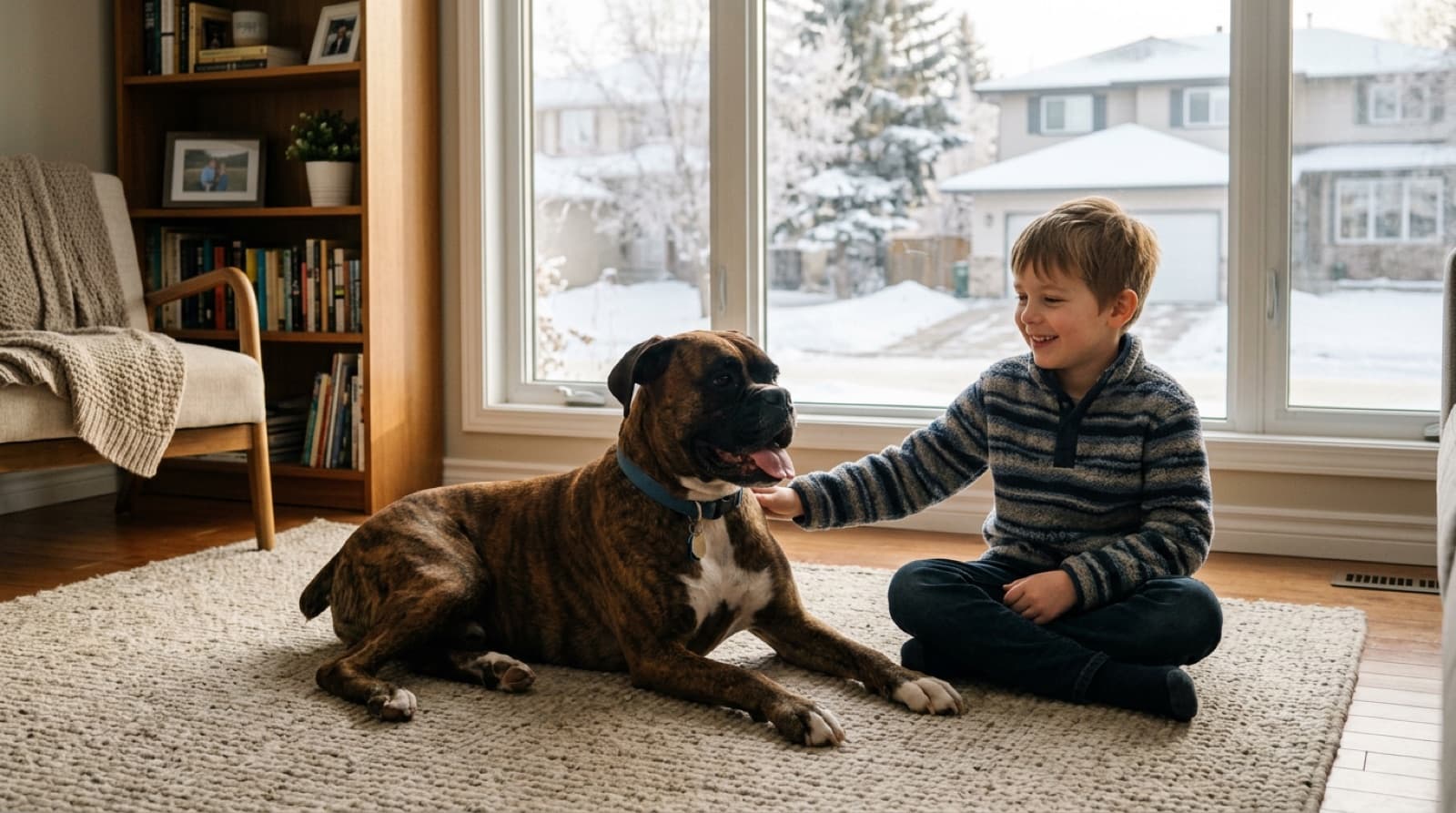
The Boxer + kids risk profile
- Body-slam jumping. Most common injury source. Adolescent Boxer + small child equals knockdowns, broken lips, bruises, sometimes concussions. Edmonton ER and child-care clinic visits happen routinely.
- Butt-wiggle greeting. The Boxer signature greeting involves whole-body wiggle. Small children get knocked sideways even when the dog is not trying to jump.
- Rough play. Boxers play with mouth + body contact. Even gentle play can hurt small kids.
- Zoomies. Adolescent Boxer running through living room can plow through a child standing in the path.
- Resource guarding. Rare but possible. Toddlers approaching dog with food or toys is the most common trigger scenario.
- Face-licking enthusiasm. Sometimes inadvertent face nips during enthusiastic licking.
The temperamental gentleness is real. Boxers are patient with kid behaviour that other breeds would not tolerate (ear-pulling, climbing, loud play). The breed standard from the AKC Boxer breed profile describes “bright, alert, fearless and friendly with family.” The risk is physical, not temperamental, and it is manageable with the right protocols.
The age sweet spot: kids 6 to 12
| Kid age | Boxer-fit reality |
|---|---|
| 0 to 1 year | High-management. Most safe with baby contained (playpen, crib, baby gate). |
| 1 to 4 years | HIGHEST RISK age. Most rescues recommend AGAINST new Boxer adoption without significant training commitment. |
| 5 to 7 years | Workable with management. Kids beginning to handle Boxer greetings. Still need supervision. |
| 8 to 12 years | SWEET SPOT. Most successful Boxer + kids relationships. Kids manage greetings, understand boundaries, appreciate clown energy. |
| 12+ teen | Works well. Teens can be primary Boxer caretakers and walkers. Boxers make great teen companions. |
The Boxer-energy peak (first 3 to 4 years) matches the peak childhood active years. The Boxer lifespan of 10 to 12 years matches school-aged childhood through teen years. The breed and the family arc line up beautifully when the timing is right. The wrong timing is adolescent Boxer + toddler, which most Edmonton rescues will counsel against during the foster phone screen.
Knockdown prevention: the Edmonton playbook
Environmental management:
- Baby gates throughout the home. Separate Boxer access from kids during high-energy times.
- Designated rooms. Kids playroom Boxer-free during play. Living room Boxer-free during kid TV time.
- Crate or “place” command during meal times, kids playtime, bath time.
- Leash in house. Adolescent Boxer on house-leash for the first 6 months in the home. Owner controls greetings.
Training:
- “Place” command on dog bed. Heavy reinforcement (chicken, hot dogs). Boxer goes to bed when kids enter the room until calm.
- “Four on the floor.” Boxer trained that all four paws on ground equals attention and affection. Jumping equals no attention. Every household member consistent.
- “Wait” at doorways. Boxer waits before greeting.
- Kids' behaviour rules taught explicitly: do not run from dog (prey-chase trigger), do not scream around dog (over-arousal), do not take dog's food or toys, do not climb on dog.
- Early excitement redirection. When Boxer ears prick + body tenses + kids approaching, redirect attention to “place” or training cue.
Edmonton-specific resources:
- Edmonton force-free trainers (CCPDT, KPA, IAABC, or Fear Free certified) familiar with Boxer + kids. Private training $80 to $150 per session.
- Edmonton daycare during the after-school witching hour gives Boxer outlet and removes from kid chaos. $30 to $55/day.
- Family-friendly off-leash zones (Hawrelak designated areas, Mill Creek Ravine, Whitemud) for Boxer exercise WITHOUT kids. One parent takes Boxer, other parent has kids.
Physical tools: front-clip harness (reduces jumping leverage), gentle leader head halti, head wraps. NEVER use aversive collars (e-collars, prong) for jumping. They exacerbate excitement and create conflict, and Bylaw 21244 dangerous-dog provisions still apply if a corrected Boxer redirects onto a child.
The long game: most knockdown issues moderate by 24+ months as the Boxer matures. First 1 to 2 years require intensive management. The reward is the calm adult Boxer who becomes the family rock for 8 to 10 years.
Why Edmonton winter compounds the family-Boxer challenge
Indoor confinement during 5 to 6 months of sub-zero weather puts adolescent Boxer + kids in close-quarters exactly when outdoor energy release drops.
Three compounding factors from November through March:
- Indoor confinement compounds knockdown risk. More Boxer-and-kid close-quarters time during exactly the months when outdoor energy release drops. The result: more accidental knockdowns, more couch wrestling, more kitchen chaos with the Boxer underfoot.
- Exercise volume drops below the Boxer's needs. Adolescent Boxers need 90 to 120 minutes of daily structured exercise. Wind chill below -25C makes the full target unsafe, especially because Boxers are mildly brachycephalic and cold air stresses their breathing during exercise.
- Holiday season disruption. December through January brings family visits, table scraps, schedule disruption, and a generally over-aroused household.
The winter management plan:
- Indoor mental enrichment (food puzzles, scent games, training sessions) plus daycare 2 to 3 days a week through January and February ($30 to $55/day in Edmonton).
- One parent takes Boxer to indoor exercise space (off-leash daycare playtime, indoor dog parks) while other parent has kid time.
- Structured indoor decompression (Boxer crate or “place” during high-energy kid moments).
- Stretch the breed's daily exercise across 3 shorter sessions rather than one long one when wind chill drops below -25C. The brachycephalic limit is real: short bursts work better than sustained cold exposure.
The Environment Canada wind chill chart published by Environment and Climate Change Canada is a useful reference for Edmonton families planning Boxer exercise routines through deep winter.
Browse adoptable Boxers in Edmonton
Adult Boxers (3+ years) are the family-friendly sweet spot. Edmonton rescues disclose kid-history honestly during the foster phone screen.
See Available Boxers →The adult-Boxer alternative: skip adolescence
For families with kids under 8, the adult Boxer adoption (3+ years from SCARS, Edmonton Humane Society, Zoe's Animal Rescue, or AHHRB) is the honest recommendation. Why:
- Skips the 8 to 24 month adolescent knockdown phase entirely.
- Foster home has weeks of observation of how the dog behaves with kids if the foster home has kids (ask).
- Training is typically already installed (sit, place, recall, leash manners).
- Energy has moderated to the family-rock baseline most owners hope for.
- Boxers live 10 to 12 years, so an adult adoption still gives 6 to 8 years of family companionship.
- Senior Boxers (8+ years) are even calmer and frequently overlooked at the shelter.
Edmonton rescues sometimes have specific Boxers placed in foster homes with kids that the rescue can vouch for. Ask during the application. The match-quality difference between “Boxer that has lived with kids in foster” and “Boxer of unknown history” is substantial for first-time Boxer families with young kids.
The dollar math also favours adult adoption: $300 to $700 adoption fee vs $3,000 to $5,000+ for a breeder Boxer puppy with health-tested parents. The rescue fee already covers spay or neuter, vaccines, microchip, and basic vet workup worth $400 to $700 on its own.
Frequently Asked Questions
Are Boxers safe with toddlers and babies?
The honest answer: Boxers are gentle by temperament but physically dangerous to toddlers without management. The breed paradox: temperamentally one of the most kid-loving breeds in existence. Patient, tolerant of rough handling, devoted to family children. AND a 60 to 80 lb adolescent Boxer with full body-slam greeting can send a 2-year-old to the ER. Edmonton ER vet and child ER visits happen routinely from family Boxer enthusiasm. The risk profile: body-slam jumping (most common injury source, adolescent Boxer + small child = knockdowns, broken lips, bruises, sometimes concussions); butt-wiggle greeting (whole-body wiggle knocks small children sideways); rough play (Boxers play with mouth + body contact, even gentle play can hurt small kids); zoomies (adolescent Boxer running through living room plows through child); resource guarding (rare but possible, toddlers approaching dog with food); face-licking enthusiasm (inadvertent face nips during enthusiastic licking). Age recommendations: babies (0-1 year) HIGH-MANAGEMENT scenario, most safe with baby contained (playpen, crib, baby gate). Toddlers (1-4) HIGHEST RISK age. Most Edmonton rescues recommend AVOIDING new Boxer adoption with kids under 5 without significant training commitment. Elementary (5-10) Boxer + this age MOST successful, kids can manage greetings and understand boundaries.
How do I stop my Boxer from knocking over my kids?
Edmonton parents with Boxers face this constantly. Knockdown prevention protocol. Environmental management: baby gates throughout home (separate Boxer access from kids during high-energy times), designated rooms (kids playroom Boxer-free during play, living room Boxer-free during kid TV time), crate or "place" command during meal times and kids playtime, leash in house (adolescent Boxer on house-leash for first 6 months, owner controls greetings). Training: "place" command on dog bed (heavy reinforcement, Boxer goes to bed when kids enter room until calm), "four on floor" (Boxer trained that all four paws on ground equals attention/affection; jumping equals no attention; every household member consistent), "wait" at doorways. Kids' behaviours to teach: do not run from dog (prey-chase trigger), do not scream around dog (over-arousal), do not take dog's food or toys, do not climb on dog. Edmonton-specific: Edmonton force-free trainers (CCPDT, KPA, IAABC, Fear Free certified) familiar with Boxer + kids, private training $80 to $150 per session; Edmonton daycare during witching hour (after-school crazy time) gives Boxer outlet ($30 to $55/day); family-friendly off-leash zones (designated areas in Hawrelak, Mill Creek Ravine, Whitemud Ravine) for Boxer exercise WITHOUT kids (one parent takes Boxer, other parent has kids). Physical tools: front-clip harness (reduces jumping leverage), gentle leader head halti. NEVER use aversive collars for jumping (e-collars, prong collars exacerbate excitement and create conflict). The long game: most knockdown issues moderate by 24+ months as Boxer matures. First 1 to 2 years require intensive management.
What age kids do Boxers do best with?
Sweet spot: 6 to 12 years old. Kids old enough to manage Boxer greetings independently, understand boundaries (do not take dog's food, do not pull tails, do not wake sleeping dog), physical size adequate to absorb Boxer enthusiasm without serious injury, appreciate the clown energy of the breed, can participate in training and walks. Boxer + kids develop strong bonds during this developmental window. Under 5: high-management scenario. Knockdown and injury risk significant. Both Boxer and kids require constant supervision. Most rescues recommend waiting. 5-8: workable with management. Kids beginning to handle Boxer greetings. Still need supervision but safer. 8-12: SWEET SPOT. Most successful Boxer + kids relationships. 12+ teen: works well, teens can be primary Boxer caretakers and walkers. Boxers make great teen companions. Key developmental considerations: Boxer ENERGY peak first 3 to 4 years matches PEAK childhood active years (beautiful match), Boxer LIFESPAN 10 to 12 years matches school-aged childhood through teen years, Boxer CALMNESS in senior years (8+) matches family settling, Boxer DEATH at 10 to 12 years often coincides with kids leaving home (emotional family loss). Edmonton family reality: Edmonton suburbs (Sherwood Park, Riverbend, Windermere, Summerside, Heritage Valley, Tamarack, Strathcona, Beaumont) full of Boxer + kids families. Most successful with kids over 5. Some families with toddlers manage but require significant training and management commitment.
How do I train a Boxer not to jump on visitors?
Most-asked Boxer training question. Edmonton owners with kids especially struggle (kids invite friends, Boxer jumps, kids embarrassed). Protocol. Phase 1 prediction: watch for arousal cues (ears prick, body tenses, eyes locked on visitor), intervene BEFORE jumping, leash on dog before guest enters. Phase 2 alternative behaviours: "place" command on dog bed during entries (heavy reinforcement with chicken, hot dogs; Edmonton force-free trainers can shape this in 4 to 6 weeks); "sit for greeting" (greeting only happens with Boxer in sit, visitor approaches Boxer sits visitor pets, Boxer breaks sit visitor turns away); "four on floor" (every paw lift equals no attention, every paw down equals praise and affection). Phase 3 visitor compliance: visitor "training" (instruct visitors to ignore jumping Boxer; most well-meaning friends pet jumping Boxer which defeats training), sign on door ("Please ignore the dog when entering, we are training"), treats by door for compliant visitors, some visitors will not comply (manage with leash + place command). Phase 4 desensitisation and counter-conditioning: practice with friends willing to help (5 to 10 entries per session), reward calm and reduce arousal, generalise to multiple people and environments. Physical tools: front-clip harness, gentle leader head halti, door leash dedicated near entry. Edmonton force-free trainers: CCPDT, KPA, IAABC, or Fear Free certified. Private training $80 to $150 per session worth investment for jumping issues. What NOT to do: knee-to-chest "punishment" (creates fear and escalates excitement long-term), holding paws (creates conflict), shouting (escalates arousal), aversive collars (often worsen). Most jumping moderates by 18 to 24 months with consistent training.
Is a rescue Boxer with unknown history safe around children?
Critical question. Honest framework. Assessment factors: rescue evaluation (reputable Edmonton rescues like SCARS, Edmonton Humane Society, Zoe's Animal Rescue, AHHRB evaluate dogs in foster homes; dogs spending 2 to 4+ weeks in foster reveal much more than shelter behaviour; ASK rescue "Has this dog been around children? How did they react?"); age of dog (adolescent Boxer 8 to 24 months less predictable around kids than mature Boxer 3+ years; senior Boxer 5+ most predictable); body language observation (meet-and-greet rescue dog, watch tail position, lip-licking, avoidance, hyper-focus, panting at rest); bite history (ask directly, rescues required to disclose); medical (pain-related aggression real, hip dysplasia, dental issues, ear infections can trigger reactivity, recent vet exam essential). Red flags (avoid for kids under 12): disclosed bite history, resource guarding food/toys/owner, stiffening and hard stares with kids, avoiding or cowering from kids, unknown history plus nervous body language, reactive on-leash, multiple homes and repeated returns. Green flags (likely fine for kids 5+): foster home reports of kid interactions, relaxed body language with kids, approaches kids with soft eyes and relaxed mouth, tolerates kid-handling without flinching, no bite history and no resource guarding, solid recall and sit and place. Rescue recommendations to ask for: foster home with kids (gold standard), behavioural assessment by rescue, trial period (Edmonton rescues typically allow 2-week trial). Critical: never rush. Match wrong equals potential bite + injured kid + heartbroken family + dog returned.
Edmonton suburbs Boxer + kid families: what works?
Edmonton suburbs (Sherwood Park, Riverbend, Windermere, Summerside, Heritage Valley, Tamarack, Strathcona, Beaumont, Spruce Grove, St Albert) full of Boxer + kid families. What works: adult Boxer adoption (skip adolescence; 3 to 5 year-old Boxer typically already-trained; Edmonton rescues sometimes have adult Boxers); big yards + off-leash access (Edmonton suburbs typically large lots; river-valley pathway access for exercise); daycare 2 to 3x weekly ($30 to $55/day in Edmonton, adolescent Boxer outlet during witching-hour-with-kids); partner shares Boxer walk (one parent takes Boxer to Mill Creek Ravine or Whitemud while other parent has kids); kids age 5+ adopting (most successful Boxer + kid families); force-free trainer investment ($200 to $500 first year training pays dividends); baby gates + designated spaces (kids playroom Boxer-free, Boxer crate or place during kid chaos); family-member commitment (primary Boxer person typically one adult committed to training, exercise, management). Edmonton family-friendly off-leash zones: Hawrelak south slope (designated family areas), Mill Creek Ravine (some sections), Whitemud Ravine (off-peak), Terwillegar Park (huge, distance is manageable). Avoid busy river-valley pathways with toddlers + adolescent Boxer. Park etiquette: kids stay close to parent, Boxer remain on long-line until reliable recall. What fails: Boxer + kids under 3 + first-time owners + busy schedules (constant management impossible); adolescent Boxer + new baby (knockdown + jealousy + management overwhelmed); apartment with kids + Boxer (insufficient exercise space + neighbour noise complaints under Bylaw 21244); two working parents + multiple young kids + adolescent Boxer (insufficient exercise + supervision + training time).
Existing Boxer + new baby integration?
Different scenario than adopting Boxer to kid-home. Edmonton couple-with-Boxer adding baby is common. Pre-arrival preparation (3 to 6 months before): practice baby sounds (recordings of crying baby, increase exposure gradually, reward calm response), baby gear training (strollers, swings, mobiles, carriers; Boxer exposed gradually), baby-free zones (establish "place" command, baby gates installed before arrival), routine changes (pre-implement routine changes so dog does not blame baby), training refresher ("place," "stay," "leave it" reinforced heavily), health check (vet visit, ensure no pain-related concerns). Post-arrival first weeks: gradual introductions (partner brings baby blanket home before baby), calm energy meet (baby in carrier first encounters, calm parents equals calm dog), NEVER leave unsupervised (even gentle Boxers + baby require supervision), Boxer continued exercise (don't neglect Boxer, tired Boxer equals settled Boxer, hire walker if needed), positive associations (baby equals treats, attention, walks, NOT separation or punishment). Crawling + walking toddler: highest risk phase. Baby gates throughout home. Boxer crate or "place" during baby unsupervised time. Teach baby (when old enough) to respect Boxer space. Continued training maintenance. Red flags get HELP IMMEDIATELY: Boxer growling at baby (STOP all interaction, veterinary behaviourist consult); stiff body posture around baby; resource guarding around baby; avoidance of baby; stress signals around baby (excessive panting, lip licking). Professional help: Edmonton force-free trainers familiar with baby integration, veterinary behaviourists.
How does Edmonton winter change Boxer + kids family management?
Three ways. First, indoor confinement compounds knockdown risk. Edmonton winter (5 to 6 months of sub-zero) keeps families inside more, which means more Boxer-and-kid close-quarters time during exactly the months when outdoor energy release drops. The result is more accidental knockdowns, more couch wrestling, more kitchen chaos with the Boxer underfoot. Second, exercise volume drops below the Boxer's adolescent needs (90 to 120 minutes daily structured exercise becomes harder when wind chill drops below -25C and paw protection becomes essential). Under-exercised adolescent Boxer + kids stuck inside is a destructive-behaviour perfect storm. Third, brachycephalic cold-air considerations apply: Boxers are mildly brachycephalic (less severe than Pugs or French Bulldogs but enough to matter), and very cold air can stress their breathing during exercise at -20C and below. Cold-weather exercise should be moderate in duration with breaks in heated breaks of breath. The winter management plan that works: indoor mental enrichment (food puzzles, scent games, training sessions) plus daycare 2 to 3 days a week through January and February ($30 to $55/day in Edmonton), one parent takes Boxer to indoor exercise space (off-leash daycare playtime or indoor dog parks) while other parent has kid time, structured indoor decompression (Boxer crate or place during high-energy kid moments), and stretching the breed's daily exercise across 3 shorter sessions rather than one long one when wind chill drops.
Boxer + kids activities that work vs ones that do not?
Activities that build healthy Boxer + kids relationships vs problem-creating ones. Works well: parallel activity (Boxer in same room as kids playing but not engaged with them; calm coexistence; reward this); structured fetch with older kids (kid throws ball, Boxer retrieves, trained "drop" command; adolescent Boxer + small kids equals potential jumping injury); walking together (kid holds leash with parent's hand on leash too, older kids 8+ eventually walk Boxer alone for short distances); trick training (kid teaches Boxer tricks: sit, shake, roll; bonding); scent work (hide treats, Boxer finds; mental stimulation plus kid involvement); calm cuddle time (older Boxer 3+ years + kid reading or watching TV, mature Boxers settle); grooming (kids brush Boxer; shed-management bonus); feeding with supervision (kid puts food bowl down with parent watching; builds trust). Problem-creating (avoid): wrestling and rough housing (Boxer mouth + kid skin equals dental contact, Boxer learns rough play OK, future visitors at risk); running-from-dog games (prey-chase trigger; adolescent Boxer chasing kid + body-slam equals injury); food-teasing (kid waving food in Boxer's face; resource frustration; sometimes leads to snapping); tail and ear pulling (Boxers usually tolerant but pain limit exists, dog teeth); sleeping dog waking (startled Boxers can snap reflexively); baby birthday parties with adolescent Boxer (over-stimulating; Boxer separated); meal-time table feeding (counter-surfing + begging + jumping). Kids-with-Boxer safety education: teach kids to ask before touching, approach calmly, avoid eye contact when greeting, not run or scream, recognise "no" body language (turning away, lip licking, panting at rest).
Multi-Boxer household with kids?
Two Boxers + kids: layered complexity. Honest assessment. What makes it work: opposite-sex pairing (same-sex tension increases fight risk; mixed-sex pairing reduces but does not eliminate); age gap (younger Boxer + older established Boxer beats two adolescent Boxers simultaneously); established first Boxer (3+ years already in home, mature Boxer can handle puppy + new family chaos); larger home (separate spaces for Boxer needs: food bowls, beds, play areas separate); adult kids (older kids can help manage). Safety concerns: Boxer fights + kids (kids can be injured intervening or in fight zone); over-arousal (two excited Boxers + kids equals compounded chaos, greater knockdown risk); resource guarding between dogs around kids (food, toys, owner attention); management exhaustion (two Boxers + kids equals significant time + energy investment). Recommendations: wait until first Boxer fully mature (3+ years) before adding second; wait until kids 5+ years before two-Boxer household; professional training (Edmonton force-free trainer consultation before adoption); kids age-appropriate (must understand multi-dog household dynamics); honest rescue disclosure (rescues need to know existing dogs and kids ages). What fails: two adolescent Boxers + young kids + new dog adoption all at once equals recipe for crisis; two same-sex Boxers + kids without management training; unknown-history rescue + kids + existing Boxer simultaneously. Edmonton multi-Boxer families: many succeed. Generally families with grown kids OR kids 8+. Carefully matched dogs. Strong training + management commitment.
Edmonton off-leash zones with kids and Boxer?
Edmonton off-leash culture + kids + Boxer requires careful navigation. Safest off-leash options with kids: Hawrelak (south-slope designated areas), Mill Creek Ravine (designated trails with family-traffic awareness), Terwillegar Park (huge, off-leash sections with adequate distance). Highest-risk for kids: busy river-valley pathway sections at peak hours, Whitemud Ravine main pathways with toddlers + adolescent Boxer (steep terrain + coyote risk in some sections). On-leash safer for families: river-valley pathway (allows on-leash exercise with kids without off-leash chaos), Capilano area, suburban pathway systems. Rules kids need to know: stay close to parent + Boxer, do not run from dogs, do not approach unfamiliar dogs without parent + owner permission, stand still if approached by unleashed dog ("be a tree"), do not scream at dogs (over-arousal trigger), do not take dog's ball or toy. Boxer management in zones: until reliable recall (typically 18+ months) use long-line; Edmonton Bylaw 21244 requires dogs under voice or visual control, fine $250 for failing to control; recall practice in low-distraction times (early morning); watch for over-arousal (break up play before chaos); Boxer + Boxer play sometimes mistaken for fighting (read body language); watch for unfriendly dogs. Edmonton-specific risks: coyote sightings on river-valley corridors (adolescent Boxer chasing coyote + kid present equals chaos); wildlife encounters; other dogs unpredictable. When Boxer misbehaves at zone + kids present: calmly leash, walk away from situation, reward returning to leash, end zone visit early if needed.
Bottom line: Edmonton family Boxer with kids reality?
The honest framework. RIGHT IF: kids 5+ years old; adult Boxer adoption (3+ years) preferred over puppy; spouse or partner committed to primary training + exercise role; Edmonton suburb home + yard; force-free training investment $200 to $500 first year; Edmonton daycare access + budget ($200 to $400/month for adolescent phase); pet insurance enrollment immediately; time + energy for Boxer exercise + management + kids; kids understand Boxer safety basics. CHALLENGING IF: kids under 5 + adolescent Boxer + first-time owners (most rescues recommend waiting); multiple kids ages 0 to 5 + new Boxer adoption; single parent + young kids + adolescent Boxer; tight budget for training + daycare investment; apartment living + young kids + Boxer; frequent travel + Boxer family scenario. WRONG IF: disclosed bite history with kids + new Boxer; Boxer with same-sex aggression + multi-Boxer household; reactive Boxer + young kids without behavioural support; family unable to commit to consistent training. The bigger picture: Edmonton family Boxers grow up with kids and many become beautiful long-term partnerships. Wiggle-butt clown energy + kid-loving temperament + protective devotion equals magic in the right home. Boxer death at 10 to 12 years is devastating to families. The 8 to 10 years between adoption and loss often span school years through teen years. Multi-generational family memory. Key message: not all Edmonton families are ready for a new Boxer at all times. Honest self-assessment + matching dog to lifestyle equals success.
Adoptable Boxers in Edmonton
Live listings from SCARS, Edmonton Humane Society, Zoe's, AHHRB, and AARCS Edmonton fosters.
Boxer Adoption Edmonton
Rescue pipelines, costs, breed-mix reality, brindle vs fawn vs reverse-brindle, white-Boxer health considerations.
Boxer Adolescence + Training Edmonton
The 8 to 24 month phase, force-free training playbook, witching-hour management, daycare and walker math.
Boxer Cancer Awareness Edmonton
Breed-elevated cancer risks, early-detection signals, Edmonton specialty oncology referral, pet insurance timing.
New dog? Start with these care guides
Everything a new adopter needs to set up a safe, happy home.