The short answer
French Bulldogs are rare in Edmonton rescue but they appear. The pipeline is urban owner-surrender, not northern transfer. Edmonton Humane Society sees them most. Zoe's, AARCS Edmonton fosters, and AHHRB see lower volume. Fees $600 to $900 purebred, $400 to $700 mixes. The 2020-2022 pandemic-puppy surrender wave is real. Frenchies are one of Canada's most-stolen breeds. Frenchie-Pug crosses breathe worse; Frenchie-Boston crosses breathe better. Plan for serious brachycephalic vet costs.

Why Frenchies are rare in Edmonton rescue
Edmonton rescue intake follows northern Alberta's pipeline. Stray pickups in northern communities, owner-surrender of working breeds that overwhelmed a first home, transfer from rural shelters with no capacity, intake from First Nations community partnerships. That pipeline brings Huskies, Shepherds, Pit Bull-types, and large mixed-breed dogs in steady volume. It does not bring French Bulldogs.
Frenchies enter Edmonton rescue through a different pipeline entirely: urban owner-surrender. A buyer overwhelmed by a $4,000 BOAS surgery bill they were not expecting. A household allergy diagnosis. A divorce where neither party can keep the dog. A move into a building that bans the breed by weight or appearance. A life change that exposes the financial reality of the original purchase. These surrenders happen inside Edmonton city limits, are quieter than northern intake, and usually arrive at EHS rather than at foster-based rescues.
A second layer is the breed's commercial origin. Frenchies are an expensive-breeder breed. Most Frenchies in Edmonton households were purchased rather than adopted, often for $3,500 to $8,000 from breeders or backyard sources during the 2020 to 2022 demand spike. That commercial pipeline is not designed to surrender into rescue, and many owners try to rehome through Kijiji or Facebook Marketplace first. Only when that fails, or when the dog has serious medical needs that no private buyer will absorb, does the dog reach a formal rescue.
The practical effect for adopters is that Frenchie inventory rotates fast. When a Frenchie is listed by EHS or Zoe's, multiple applications stack up within days. Frenchie mixes (Frenchie-Pug, Frenchie-Boston, Frenchie-Bulldog) appear more often than purebreds, and they are usually wonderful dogs with the temperament of the Frenchie and a slightly different physical profile from the second parent. Foster notes are the right place to look for the actual size, breathing, and energy of a specific dog.
Edmonton rescues that occasionally list Frenchies
Six Edmonton-area rescues carry French Bulldogs or Frenchie mixes from time to time. Inventory is genuinely intermittent for this breed, so set up listing alerts where you can and check current Edmonton listings before fixating on a single rescue.
- Edmonton Humane Society (EHS): the city's largest shelter and the most visible source of Frenchie intake in Edmonton. EHS sees Frenchies primarily through urban owner surrenders, often tied to vet-cost overwhelm or life-change. The centralised facility means you can meet the dog in person before applying, and the EHS behaviour team produces detailed temperament assessments that explicitly cover breathing capacity, energy level, and child tolerance. Frenchie turnover at EHS is fast; same-day applications usually win.
- Zoe's Animal Rescue: long-running Edmonton foster-based rescue. Lower-volume small-breed intake than EHS but a real source. Zoe's foster temperament write-ups are among the most thorough in Edmonton, which matters for a breed where breathing, exercise capacity, and household fit all need careful matching. The application emphasises long-term fit over speed.
- AARCS (Alberta Animal Rescue Crew Society): headquartered in Calgary with Edmonton-area foster homes. AARCS tags each dog with its current foster location, so Edmonton-foster Frenchies surface on Edmonton listings. AARCS foster notes explicitly cover kid tolerance, multi-pet compatibility, and known medical conditions, all of which matter for a Frenchie placement.
- Alberta Homeward Hound Rescue Bureau (AHHRB): Edmonton-area foster-based rescue. AHHRB lists every dog as Mixed Breed on paper, so Frenchies and Frenchie-cross dogs there are identified by photo and description rather than a breed tag. Worth checking even if a search for French Bulldog returns nothing.
- GEARS (Greater Edmonton Animal Rescue Society) and Hope Lives Here Animal Rescue: both Edmonton-area rescues with smaller, rotating dog inventory that occasionally includes a Frenchie or Frenchie-cross. Lower frequency than the four rescues above, but worth following if you are willing to wait for the right dog.
- SCARS (Second Chance Animal Rescue Society): sees Frenchies very rarely because northern Alberta intake is overwhelmingly working-breed and large-mix. When a Frenchie does appear at SCARS, it is almost always through an unusual surrender path. Worth a glance at listings but do not expect regular Frenchie inventory.
Adopters sometimes ask whether there is a dedicated French Bulldog rescue in Alberta. As of writing we cannot verify an Alberta-based Frenchie-specific rescue with current adoptable listings and a confirmed charitable registration. Breed-focused fancier clubs operate as breeder-oriented organisations rather than rescue groups. If you see a Frenchie-rescue name on social media, verify it the same way you would verify any pet transaction: a Canada Revenue Agency charitable registry check, a real address or named foster network, public-facing vet references, and a current adoptable-dog list. Most Edmonton Frenchie adopters find their dog through the six rescues above.
What an Edmonton rescue Frenchie actually costs
Edmonton rescue adoption fees for purebred French Bulldogs generally land between $600 and $900, sometimes higher for puppies or young adults under two. Frenchie mixes typically run $400 to $700. The fee is not a sale price; it is a partial recovery on the medical work the rescue has already done. A typical Frenchie adoption fee covers:
- Spay or neuter surgery. Frenchie spay or neuter is more expensive than for most small breeds because of anaesthesia risk in brachycephalic dogs. Standalone at an Edmonton vet clinic, this runs $500 to $900 with a brachycephalic anaesthesia protocol.
- Core vaccinations. DAPP and rabies at minimum. Bordetella often included if the dog has been boarded.
- Microchip implant and registration. Required for licensed dogs by the City of Edmonton Animal Care and Control Bylaw 21244.
- Deworming and flea and tick treatment. Standard intake processing.
- Breed-specific medical assessment. Almost always includes a breathing capacity evaluation, skin-fold inspection, dental check, eye check (Frenchies are prone to cherry eye and corneal ulcers), and often spinal X-rays. This is the cost driver that puts Frenchie adoption fees above other small breeds.
- BOAS-related work, sometimes. Some Frenchies arrive needing nares (nostril) widening, soft-palate trim, or other airway work. If the rescue has completed any of this before listing, the fee reflects part of that cost. A full BOAS soft-palate surgery alone runs $3,500 to $6,500 at retail Edmonton specialty pricing.
Stacked on their own, those services cost $1,500 to $4,000 at retail Edmonton vet pricing, and far more if BOAS work was needed. The rescue fee is a partial recovery, with the rest subsidised by donations. Senior Frenchies (around eight years and up) often have reduced fees of $300 to $500 to prioritise placement.
Beyond the adoption fee, plan on ongoing Frenchie costs of $2,400 to $4,500 per year, which is higher than for most small breeds because of breed-specific medical needs. Routine vet care averages $500 to $900 per year (annual exam, vaccines, parasite prevention, plus the breed-specific monitoring of breathing and skin). Pet insurance for a young Frenchie in Edmonton runs $70 to $130 per month, and is genuinely worth it for this breed given the BOAS, spinal, eye, and skin risk profile. Enrol in the first week before any pre-existing conditions appear in vet records. Food is modest given the dog's size. Skin-fold cleaning supplies and ear cleaners are a real ongoing line item.
For comparison, a Frenchie puppy from an Alberta breeder runs $3,500 to $7,500 for pet-quality, sometimes much higher for show lines, rare colours, or imported pedigrees. The breeder puppy comes with none of the vet work the rescue dog already has, and the brachycephalic medical reality is the same regardless of where the dog came from. The rescue path is significantly cheaper and the dog's breathing and health are usually already assessed.
The pandemic-puppy surrender wave
The Frenchie market in Canada went vertical between 2020 and 2022. Demand spiked during pandemic lockdowns, breeders raised prices to $5,000 and up, backyard breeders flooded Kijiji with $3,000 to $5,000 puppies, and out-of-province transports moved Frenchies into Alberta in volume. Buyers paid the premium because everyone wanted a small companion dog and Frenchies were the breed of the moment.
Those puppies are now two to four year old adults, and the surrender wave is hitting Edmonton rescue directly. The triggers are predictable:
- Vet-cost overwhelm. A BOAS soft-palate surgery, a spinal episode, a hemivertebrae diagnosis, or chronic skin disease can stack to $5,000 to $12,000 in the first three years. Many original buyers did not budget for it.
- Post-pandemic financial pressure. Households that bought a $6,000 puppy in 2021 are now facing higher mortgage payments, return-to-office, and inflation. The Frenchie is one of the first cuts.
- Lifestyle reversal. Buyers who worked from home through the pandemic are back in the office, and the dog who used to have company all day is now alone for nine hours. Frenchies are companion dogs and they suffer in that gap.
- Realisation of the medical reality. Many buyers were not told (or did not understand) that Frenchies snore, overheat, require careful exercise, and may need airway surgery. The puppy phase masks it; the adult dog is the truth.
- Move into a building that bans the breed. Edmonton condo and rental moves often expose breed weight or appearance restrictions that were not a factor in the original house.
If you adopt one of these surrender-wave Frenchies, you are stepping into the medical reality the original owner could not carry. Most of these dogs are sound, friendly, and eager to bond with a new home. Some come with active medical needs already in progress. The rescue will disclose what they know in foster notes; ask directly about breathing, exercise tolerance, skin condition, and any known surgical history. A rescue Frenchie with disclosed BOAS that has already been addressed is usually a better risk than a breeder puppy whose airway is unknown.
The same wave is bringing Frenchie crosses into rescue. Frenchie-Pug, Frenchie-Boston, Frenchie-Bulldog, and unintentional accidents from neighbourhood backyard breeding all show up. These mixes are often easier-breathing than pure Frenchies and adopt out at lower fees. Read the foster temperament write-up as the truth and the breed label as a hint.
Frenchie mixes: reading the foster notes
Edmonton rescue lists more Frenchie mixes than purebreds in most months. The breed label on a cross is a guess; the foster temperament and breathing write-up is the real read. The common Edmonton Frenchie-mix patterns:
- Frenchie-Pug cross: the most brachycephalic of the common Frenchie mixes. Both parent breeds have severe flat-face genetics, and the cross often produces a dog with worse BOAS, more snoring, more heat intolerance, and a higher risk of needing soft-palate surgery than either parent alone. Usually 16 to 24 pounds. Foster notes will flag exercise tolerance honestly; watch a video of the dog at rest before applying and listen for laboured breathing.
- Frenchie-Boston cross: usually the easiest-breathing Frenchie mix. Boston Terriers have a slightly longer muzzle than Frenchies, and the cross typically inherits a more open airway. These dogs handle Edmonton summer walks better than pure Frenchies and rarely need airway surgery. Usually 14 to 22 pounds, often more energetic than a pure Frenchie, and a strong family-fit option for households that want the Frenchie temperament without the heaviest medical risk.
- Frenchie-Bulldog cross: shows up in rescue as larger, heavier dogs (28 to 45 pounds) with more pronounced skin folds and similar brachycephalic challenges. Skin-fold cleaning becomes a daily routine; ear infections are common; BOAS risk is real. The temperament is usually calm and family-friendly, but the medical load is heavier than a pure Frenchie. Often face Edmonton condo weight restrictions.
- Frenchie-Chihuahua cross (Frenchuahua): a smaller cross, usually 10 to 18 pounds. Breathing varies by which parent dominates. Temperament is more variable than the Boston or Pug crosses; the Chihuahua side can introduce reactivity or single-person bond patterns that the foster will flag.
- Frenchie-Pit cross: a less common cross but it appears, especially in northern intake. The Pit side brings a more open airway and stronger build; the Frenchie side brings the flat-face features and family temperament. These dogs may face Edmonton housing restrictions even when the dog itself is fine, because condo boards sometimes screen by appearance.
- Frenchie-Mixed-Breed of unknown: common in northern intake dogs where the parentage is genuinely unknown but the Frenchie head and body are obvious. Foster temperament notes matter much more than the label.
The general rule for Frenchie mixes is that breathing matters more than breed label. Watch the dog at rest. Listen for audible breathing without exercise. Ask the foster home directly about how the dog handles a five-minute walk in moderate weather. A Frenchie mix that the foster describes as quiet at rest and comfortable on a short walk is a much safer adoption than one whose breathing is laboured before exercise even starts.
One of Canada's most-stolen breeds
French Bulldogs are documented across Canadian theft tracking as one of the most-targeted breeds. The reasons are clinical: high resale value, small size, low resistance, and a recognisable look that buyers will pay for without asking questions. Lost-pet networks in Edmonton and across Alberta carry records of Frenchie thefts from outside coffee shops, from front yards, from unlocked cars, and from open garages. The risk is real and it is breed-specific. Practical Edmonton precautions:
- Never tie a Frenchie outside a business. Not at a coffee shop, not at a grocery store, not for “just two minutes.” The opportunity cost for a thief is zero. If you cannot bring the dog inside or leave them at home, do not stop.
- Never leave a Frenchie in a parked car. Beyond the heatstroke risk, parked cars with visible Frenchies are theft targets. Even in winter, even in a locked car, the risk is real.
- Microchip the day you bring the dog home. Register the chip with current contact information including phone, email, and address. Update it any time you move. Required for licensed Edmonton dogs under Bylaw 21244, but the registration is what actually finds a stolen dog.
- Secure the yard. Fences with locked gates, no period of unsupervised yard time, no leaving the Frenchie on the front step. Most Frenchie thefts from yards happen in the first ten seconds of an opportunity.
- Consider a GPS tracker on the collar. Several reputable tracker products are sold in Canada and add real recovery capability. The monthly subscription cost is modest compared to the risk profile of the breed.
- Be careful with social media. Posting walk routes, regular times, home addresses, or yard photos that identify the location are documented theft enablers. Frenchie social media accounts have been used to scout targets.
- If your Frenchie is stolen, act immediately. Contact Edmonton Animal Care and Control, post to local lost-pet networks within the first hour, alert area vet clinics (a stolen dog is often presented at an unfamiliar vet within days), and file a police report. The first 24 hours are decisive.
For a deeper Edmonton-specific protocol covering insurance riders, microchip registry verification, lost-pet network workflow, and theft-response steps, see the Edmonton Frenchie theft prevention guide.
What Edmonton rescues evaluate in a Frenchie application
Frenchie applications are screened differently from working-breed applications. Edmonton rescues are not worried about exercise capacity or yard size; they are worried about household fit, medical-cost capacity, climate-appropriate setup, and breathing-aware management. The screening typically covers:
- Vet-cost capacity. The single most important question for a Frenchie home. The rescue will ask whether you have pet insurance lined up, whether you have a savings buffer for a $4,000 to $8,000 emergency, and whether you understand that BOAS, spine, skin, and eye conditions are realistic possibilities. Vague answers about “we will figure it out” do not match a Frenchie's actual risk profile.
- Climate management. The rescue will ask about your plan for summer above +25 C (early-morning or evening walks, cool times, never push exercise in heat) and winter below -15 C (warm coat, short outings, indoor exercise below -20 C). A clear answer reassures the rescue. A claim that the dog will be fine because Frenchies are tough does not.
- Household structure and kid age. Most Edmonton rescues will place Frenchies into homes with calm older kids; households with toddlers or very young children face more scrutiny because of bite history risk and breathing-disturbance from rough play. Foster notes flag each dog's comfort with children specifically.
- Existing pets. Frenchies generally do well with other small dogs and cats they are introduced to gradually. The rescue will ask about your other dogs' ages, sizes, and temperaments. Households with large or high-energy dogs face more scrutiny because Frenchies can be injured in rough play.
- Schedule and time alone. Frenchies are companion dogs and bond closely. A 50-hour-a-week work-from-office schedule with no midday check is a harder fit than a retiree home, a work-from-home home, a hybrid schedule, or a household with multiple adults present at different times.
- Housing approval. If you live in a condo or rent, the rescue will ask for written confirmation from your board or landlord that the dog is approved. Edmonton condo weight caps and breed-appearance restrictions are real; getting this confirmed in writing before adoption avoids a forced surrender later.
- Water safety awareness. The rescue will ask whether you understand that Frenchies cannot swim and what your plan is around the North Saskatchewan River, area lakes, backyard pools, and bathtubs. This sounds basic; it is the difference between a long life and a tragedy.
- Skin and dental care commitment. Daily skin-fold cleaning and regular dental care are non-optional for most Frenchies. The rescue will ask whether you are realistic about the maintenance.
Specificity wins applications. “We work from home most days and have a savings buffer for vet emergencies plus pet insurance lined up with one of the Canadian providers” is much stronger than “We love Frenchies and will take good care of the dog.” The rescue is trying to determine whether the placement will last through a $5,000 vet bill and a hot Edmonton July. The specific answer signals the realistic plan.
Browse adoptable Edmonton French Bulldogs and Frenchie mixes
Current Edmonton listings from EHS, Zoe's, AARCS Edmonton fosters, AHHRB, GEARS, and Hope Lives Here in one place. Frenchie inventory rotates fast; set up listing alerts to catch them when they appear.
See Edmonton Adoptable Dogs →How to apply for an Edmonton Frenchie adoption
Edmonton Frenchie adoptions move fast because demand is high and inventory is intermittent. The typical application sequence:
- Set up listing alerts. Register for adoption alerts on EHS, Zoe's, AHHRB, AARCS, GEARS, and Hope Lives Here. Frenchies are listed at unpredictable intervals; alerts catch listings the day they appear.
- Find a specific dog you want to apply for. Edmonton rescues apply per-dog, not on a general waitlist. Read the entire foster write-up: breathing pattern, exercise tolerance, kid tolerance, dog tolerance, known medical history, and any flagged conditions. Watch a video of the dog at rest if one is available.
- Submit the application same day. Expect 45 to 60 minutes for a thorough Frenchie application. Have your vet's name ready if you have other pets, your landlord or condo board approval in writing if you rent or live in a condo, pet insurance research done with a specific provider in mind, and two non-family references with current phone numbers. Same-day applications are reviewed first.
- Phone screen with the foster. If the application clears the first review, the dog's foster home will call you. This is the conversation that decides most placements. Be honest about your household rhythm, work schedule, vet-cost capacity, and climate management plan. The foster has lived with this specific dog; they will tell you what they see and they can tell whether your home will fit.
- Meet-and-greet. Either at the foster's home or a neutral location. Bring everyone in the household, including kids and other dogs if relevant. Watch the dog breathe at rest, ask the foster to show you a short walk, and ask any remaining questions about medical history and care routines.
- Reference checks. Most Edmonton rescues call two references, including any prior vet if you have other pets. Give your references a heads-up so they pick up.
- Home visit, sometimes. Smaller foster-based rescues like Zoe's and AHHRB sometimes do a brief home check before approval. EHS less commonly. The visit is not a white-glove inspection; the rescue wants to see that the basic environment is safe, that water and yard hazards are managed, and that the household matches what the application said.
- Adoption contract and fee. Most rescues use a standard adoption contract specifying the dog must be returned to the rescue if you cannot keep them, ever. Frenchie contracts often include specific language about anti-resale and anti-breeding clauses given the breed's commercial profile. Read it before signing.
Realistic timeline from application to dog-in-your-house is one to three weeks for a Frenchie placement, sometimes faster when the foster home is ready to move the dog and the application is exceptionally strong. Multiple applications on the same dog are normal; if you are not selected, ask the rescue to keep your application on file for similar dogs.
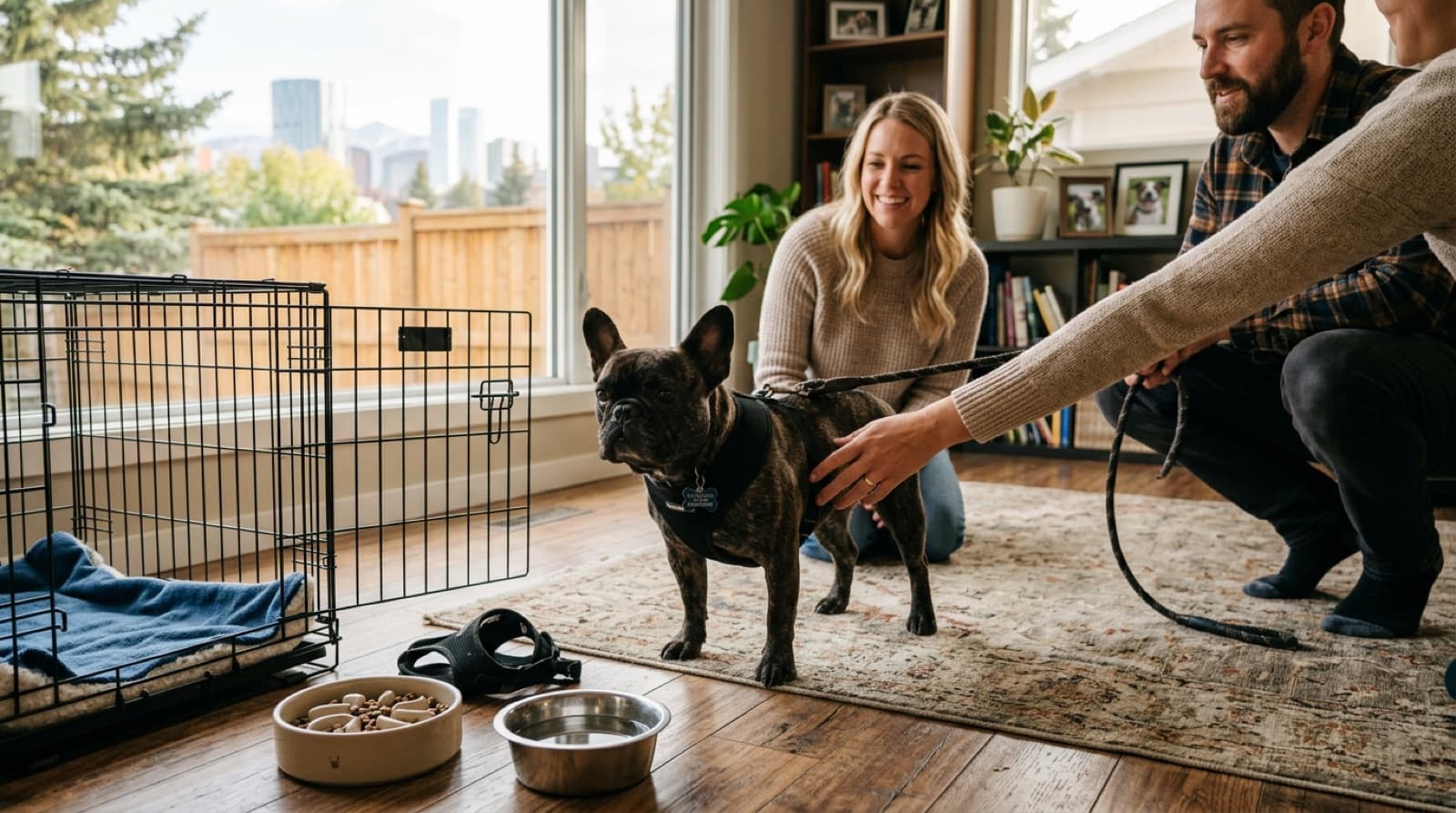
The first 30 days with an Edmonton rescue Frenchie
The 3-3-3 decompression principle (three days to start settling, three weeks to learn the routine, three months to fully bond) applies to Frenchies as it does to other rescue dogs. Frenchies usually move through the early phases quickly because the breed defaults to social and household-oriented. Practical week-one priorities for an Edmonton rescue Frenchie:
- Establish a brachycephalic-aware exercise routine immediately. Short walks at moderate pace, two to three times daily of 15 to 25 minutes each, with pace and duration adjusted for temperature. No high-impact running, no extended fetch sessions, no hard play that triggers laboured breathing. Watch for the recovery time after exercise; a healthy Frenchie should breathe normally within five minutes of stopping.
- Set up climate management. A warm winter coat for outings below -10 C, paw protection on salted sidewalks, and a plan to keep summer exercise to early morning or evening. Indoor exercise (short play sessions, food puzzles, training) fills the gap on extreme-weather days.
- License the dog with the City of Edmonton. Required for any dog over six months under the Animal Care and Control Bylaw 21244. Tags should be visible on the collar from day one. Information is on the City of Edmonton dogs page.
- Microchip registration verification. Confirm the chip is registered to your contact information, not the rescue or a previous owner. This is the single most important theft-recovery step. Most rescues handle the transfer, but verify directly with the chip registry.
- Pet insurance enrolment. Enrol in the first week if possible, before any pre-existing conditions appear in vet records. The Frenchie risk profile makes coverage genuinely worth the monthly cost. Several Canadian providers offer Frenchie-eligible policies; compare BOAS coverage specifically because some policies exclude brachycephalic-related conditions.
- Skin-fold and ear care routine. Daily inspection and cleaning of facial skin folds and ears prevents most chronic skin and ear infections. The foster home can show you the routine they have used; replicate it.
- Watch breathing patterns. Learn your specific dog's normal at-rest breathing pattern and recovery time after exercise. Changes from baseline are the early warning for BOAS or other airway issues. Document a short video of the dog at rest in week one as a reference.
- Water safety setup. Block access to bathtubs unless supervised, never leave the dog unattended near pools, and plan summer outings away from open water. The North Saskatchewan River banks at Hawrelak, Mill Creek, and Terwillegar are popular but contain real drop-offs; Frenchies cannot swim out.
- Theft-prevention habits from day one. Never tie outside a business, never leave in a car, secure the yard, set up the GPS tracker if you have one, and review the social media privacy rule with everyone in the household.
- Vet check in week one. Even with the rescue's assessment, an Edmonton vet visit in the first seven days establishes your relationship with the vet and a baseline for the dog. Ask the vet specifically about the dog's breathing, dental health, and skin condition. This visit is also the moment to set up pet insurance with current records.
By week three the routine is established and you will see the real dog. By month three the bond is solid and the household has adapted to the breed-specific care. Most Edmonton Frenchie adoptions that fail do so in the first 90 days, usually because the new owner underestimated the medical reality or the climate management. If you make it past the first 90 days with consistent care and realistic expectations, the next 10 to 12 years are usually the devoted, funny, household-shadow companion the breed is famous for.
Frequently asked questions
Where can I adopt a French Bulldog near me in Edmonton?
French Bulldogs are rare in Edmonton rescue, but they do appear. The Edmonton Humane Society sees them most often, usually through urban owner surrenders tied to vet-cost overwhelm, a life change, or a household allergy diagnosis. AARCS, headquartered in Calgary, tags Edmonton-foster dogs and surfaces them on Edmonton listings; Frenchies show up there occasionally. Zoe's Animal Rescue carries lower-volume small-breed intake and is worth following. Alberta Homeward Hound Rescue Bureau (AHHRB) lists every dog as Mixed Breed on paper, so Frenchie-cross dogs there are identified by photo, not breed tag. SCARS, GEARS, and Hope Lives Here see Frenchies less often because northern Alberta intake skews to working breeds. Inventory rotates fast; same-day applications usually win for this breed.
Why are French Bulldogs rare in Edmonton rescue?
Northern Alberta rescue intake skews heavily to working breeds and large mixed-breed dogs. The pipeline that brings Huskies, Shepherds, and Pit Bull-types into Edmonton rescue does not bring Frenchies. They enter Edmonton rescue almost entirely through urban owner-surrender: a buyer overwhelmed by vet costs, a household allergy diagnosis, a divorce, a move into a building that bans the breed by weight or appearance. The volume is low and the adopter pool for small companion dogs is steady, so Frenchies rarely linger when they appear.
How much does it cost to adopt a French Bulldog in Edmonton?
Edmonton rescue adoption fees for purebred French Bulldogs typically run $600 to $900, sometimes higher for puppies or young adults under two. Frenchie mixes generally run $400 to $700. The fee covers spay or neuter, core vaccinations (DAPP and rabies), microchip implant and registration, deworming, flea and tick treatment, and a basic vet workup. Frenchie intake almost always includes a breed-specific medical assessment for breathing capacity, skin folds, and spinal X-rays, which raises the rescue cost above other small breeds. The fee is a partial recovery on costs, not a sale price. Senior Frenchies often have reduced fees of $300 to $500 to prioritise placement.
Is the pandemic-puppy Frenchie surrender wave real?
Yes, and Edmonton rescue intake reflects it directly. Frenchies bought at $5,000 to $8,000 between 2020 and 2022, often from backyard breeders or out-of-province sellers, are now resurfacing in rescue as two to four year old dogs. The triggers are vet-cost overwhelm (a BOAS soft-palate surgery can run $4,000 to $7,000), owners realising the brachycephalic medical reality after the puppy phase, financial pressure post-pandemic, and life-change. The dogs themselves are usually sound; the original purchase decision was the mismatch. If you adopt one of these surrender-wave Frenchies, you are stepping into the medical reality the original owner could not carry. Plan accordingly.
Are French Bulldogs really one of Canada's most-stolen breeds?
Yes. French Bulldogs are documented across Canadian theft tracking as one of the most-targeted breeds because of their small size, low resistance, and resale value. Lost-pet networks in Edmonton and across Alberta carry records of Frenchie thefts from outside coffee shops, from yards, and from unlocked cars. Practical Edmonton precautions: never leave a Frenchie tied outside a business, never leave one in a parked car for any reason, fence and gate-lock the yard, microchip the dog the day you bring them home, register the chip with current contact info, and consider a GPS tracker on the collar. Posting walk routes and home addresses to public social media is a documented theft enabler.
What is the difference between a Frenchie-Pug and a Frenchie-Boston?
Both are common Frenchie mixes in Edmonton rescue and they read differently in foster. A Frenchie-Pug typically has more severe brachycephalic features than a pure Frenchie. The combined flat-face genetics often produce worse BOAS, more snoring, more heat intolerance, and a higher risk of soft-palate surgery. A Frenchie-Boston is usually easier to manage. Boston Terriers have a slightly longer muzzle than Frenchies, so the cross often breathes better, handles exercise better, and tolerates Edmonton summers more comfortably than a pure Frenchie. Foster notes will tell you the actual breathing pattern of a specific dog. Watch a five-minute video of the dog at rest before applying; audible snoring or laboured breathing matters.
Can French Bulldogs handle Edmonton winters and summers?
They struggle at both ends, and Edmonton has both. The flat-faced build makes thermoregulation poor. In summer above +25 C, Frenchies overheat fast on walks and during exercise; pace walks for early morning or late evening, carry water, and never push exercise in heat. In winter below -15 C, the short coat and low body fat mean rapid heat loss; a warm winter coat and short outings are the routine, with most exercise indoors below -20 C. Frenchies also cannot swim. Their body shape is wrong for it and they sink. Never leave a Frenchie unattended near open water, including the North Saskatchewan River and area lakes.
Do Frenchies face Edmonton condo and rental restrictions?
Sometimes, and the restrictions are usually about weight or appearance rather than breed. Edmonton condo boards often cap dog weight at 25 or 30 pounds; adult Frenchies typically fit (18 to 28 pounds), but heavier ones or Frenchie-Bulldog crosses may not. Some boards screen by appearance and lump Frenchies in with banned bully breeds, which is wrong but happens. Rental landlords sometimes apply blanket no-dog policies regardless of breed. Get any building approval in writing before the adoption is finalised. Edmonton rescues will ask for landlord or condo board confirmation as part of the application.
What is the free-Frenchie warning for Edmonton?
Free or low-cost Frenchie listings on Kijiji and Facebook Marketplace deserve extra caution. Common patterns are flippers collecting cheap Frenchies to resell at $1,500 to $3,500 with fabricated breeder backstories, backyard breeders using free as a hook before the real price reveals at pickup, owners with a sick or recently injured dog rehoming without disclosure, and outright theft fronts (a stolen Frenchie being rehomed quickly). A legitimate owner rehoming with a modest fee can be fine, but verification matters: see the dog in its current home, get vet records, ask why the dog is being rehomed, and verify ownership history. The Canadian Anti-Fraud Centre tracks pet resale fraud, and Frenchies are one of the most-targeted breeds in Canada.
How long do Frenchies wait in Edmonton rescue?
Not long. Frenchies usually place inside one to four weeks when they appear, and adolescent or adult Frenchies often have multiple applications on day one. Senior Frenchies (eight years and up) move slightly slower but still typically place inside six weeks because retiree adopters specifically look for calm small companions. The dogs that wait longest are Frenchies flagged for serious medical needs that have not yet been resolved, dogs with kid-tolerance concerns from prior bite history, and dogs whose foster notes describe single-person bond patterns that limit household options. Even those usually place within two to three months.
Related Edmonton French Bulldog guides
Edmonton Adoptable Dogs
Current Edmonton-area French Bulldog, Frenchie-mix, and small companion-breed listings from EHS, Zoe's, AARCS Edmonton fosters, AHHRB, GEARS, and Hope Lives Here.
French Bulldog Health Issues: Breathing, Spine
French Bulldog health issues to plan for: short-nose breathing and heat, back disease and vertebral malformations, allergies, skin folds, ears and eyes.
French Bulldog Winter Care Edmonton
Edmonton winter Frenchie care: -10 to -40 thresholds, cold-air breathing impact, coat and paw protection, indoor exercise routine, and the dry-indoor-heat skin-care problem.
French Bulldog Theft Prevention Edmonton
Edmonton-specific Frenchie theft prevention protocol: microchip registry verification, GPS tracker setup, insurance riders, social media privacy, lost-pet network workflow, and the first 24 hours of theft response.
Find your Edmonton rescue Frenchie
Browse current Edmonton-area French Bulldog and Frenchie-mix listings. Inventory is intermittent for this breed; alerts and same-day applications win.
Browse All Edmonton Dogs →New dog? Start with these care guides
Everything a new adopter needs to set up a safe, happy home.