The short answer
Pomeranians are NOT built for Edmonton winter the way Northern breeds are. The double coat is designed for moderate cold, not Alberta cold, and the 4 to 7 lb toy-breed body mass loses heat fast. Plan for bundled outings, short sessions, and a full indoor enrichment routine for the deep-cold months. A coat is mandatory below -5C. Booties or paw wax are mandatory below -15C. Sessions drop to 10 to 20 minutes between -15 and -25C, and to 5 to 10 minute breaks only below -25C. Below -35C, the day is indoor-only. The harness rule (never a collar) matters even more in cold because cold air aggravates tracheal collapse.
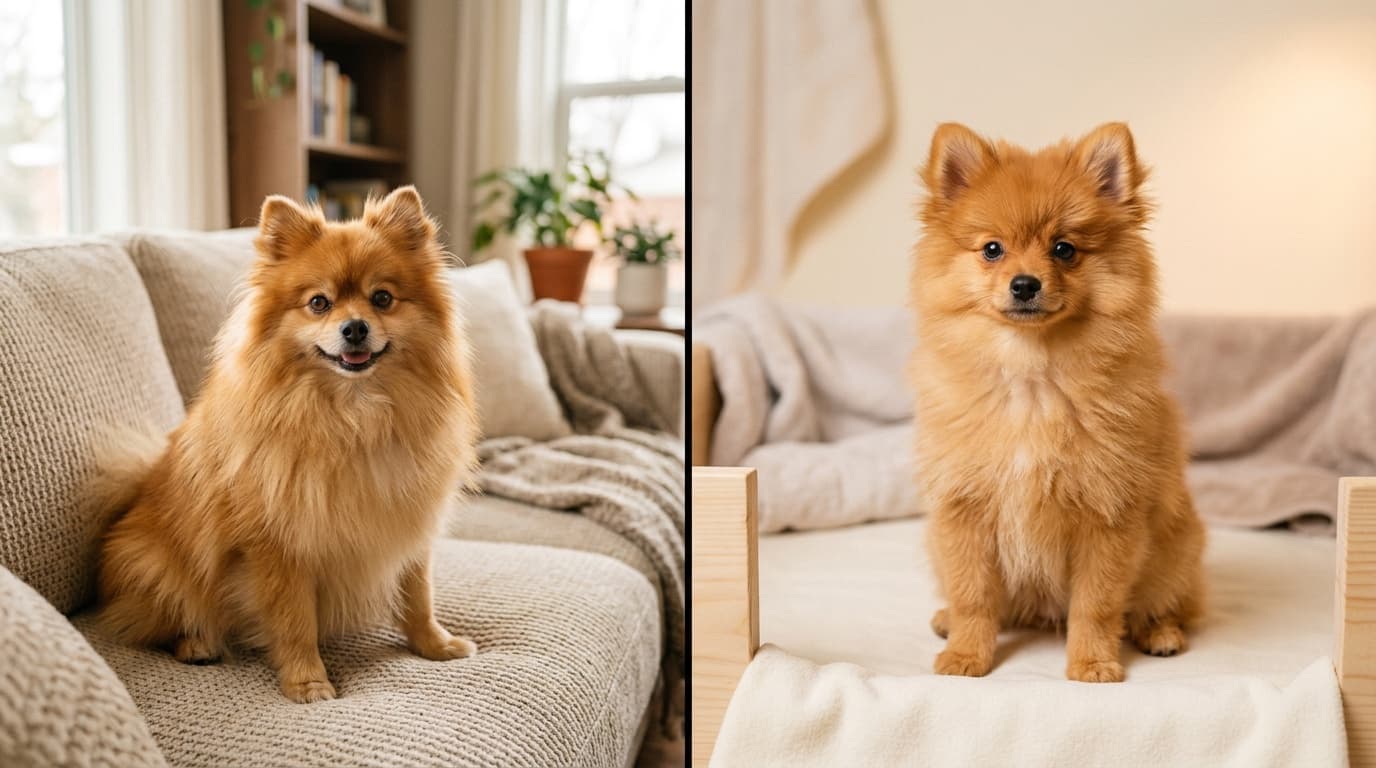
The Edmonton winter Pomeranian reality
Spend ten minutes on Pomeranian social media and you will see fluffy Poms playing in snow, racing through powder, and looking unbothered at -10C. That part is accurate. The double coat is genuinely insulating, the breed has Northern roots (Pomeranians descend from larger spitz-type sled dogs), and most healthy adult Poms handle short outings in mild cold without issue. The problem is when owners stretch that observation into “Poms are fine in any cold,” which is the opposite of what toy-breed body mass actually tells us.
The math is unforgiving. A Husky weighs 45 to 60 lbs. A Pomeranian weighs 4 to 7 lbs. Heat loss in cold weather is driven by the ratio of body surface area to body mass, and a toy breed has a much higher ratio. The same -25C ambient that a Husky can sustain for an hour will cool a Pom in 15 minutes. The double coat insulates the body but does nothing for the nose, ear tips, paw pads, or tail tip; those parts frostbite the same way any dog's would, and on a Pom the timeline is shorter because the whole dog has less thermal reserve to give.
Add tracheal collapse, which is unusually common in Pomeranians, and Edmonton cold dry air becomes a respiratory issue as well as a thermal one. Cold dry air irritates an already-compromised trachea; a Pom that coughs occasionally in summer can cough constantly through a January walk. The BC SPCA cold weather safety guidance is explicit that small breeds are at higher risk in cold than thick-coated Northern breeds, regardless of coat appearance.
The Edmonton owner pattern that actually works is the inverse of the Husky pattern: keep the outdoor exposures brief, keep the indoor day full of mental enrichment, layer the dog in a coat below -5C, and stop trying to meet the winter exercise budget outdoors. A Pom that gets 30 to 45 minutes of distributed mental and physical activity indoors plus two or three short outdoor trips is a content Edmonton dog. A Pom forced into a 45 minute walk at -25C is a cold dog with a sore trachea.
Temperature thresholds Edmonton Pom owners need to know
Wind chill matters more than ambient. Environment and Climate Change Canada wind chill guidance classifies a wind chill of -28 to -39 as “frostbite possible in 10 to 30 minutes” on exposed human skin, and -40 to -47 as “frostbite possible in 5 to 10 minutes.” Those numbers apply roughly to a Pom's exposed nose, ear tips, and paw pads, and they cap the safe outdoor session length faster than the ambient thermometer suggests.
The following ranges are for a healthy adult Pomeranian in good condition with no tracheal collapse, cardiac disease, or thin-coat genetics. Puppies, seniors, and any Pom with respiratory or heart conditions need stricter limits.
+5 to -5C: routine
Walks of 20 to 45 minutes are comfortable for most healthy adult Poms. Coat is optional for the breed average; seniors, thin-coat lines, and Poms recently transferred from warmer climates benefit from a light fleece. No paw protection needed unless the sidewalks are heavily salted. Watch for shivering; if the dog stops sniffing and starts walking stiffly toward home, end the walk.
-5 to -15C: bundle
Coat required. Sessions of 15 to 30 minutes. Paw protection (booties or paw wax) becomes valuable but is not yet strictly mandatory unless the dog is walking on salted streets. Watch the ear tips; a Pom that starts shaking its head or pawing at its ears is signalling cold ear-tip discomfort. Most Edmonton Poms find this range workable on a sheltered route but become reluctant on exposed sidewalks with prairie wind.
-15 to -25C: shorten
Outdoor sessions drop to 10 to 20 minutes of structured walking. Coat mandatory. Paw protection mandatory. Check the ear tips, nose, and paws every five minutes; if you see any pale or waxy patches, head home. Sheltered river-valley routes pull ahead of exposed sidewalk routes by a wide margin. Dry the dog fully before any second outing. Most Poms in this range are fine for a brief sniff walk but should not be doing aerobic work outside.
-25 to -35C: brief breaks only
5 to 10 minute outdoor sessions only. Bathroom break plus a one-block sniff loop, then back inside. Coat and booties mandatory. The walk is not exercise; it is a brief outdoor break to keep the dog mentally connected to the outside world. Move all the day's exercise indoors. Watch for tracheal cough in this range; the cold dry air is a respiratory irritant for any Pom with even mild tracheal weakness.
Below -35C: indoor day
Bathroom breaks only, 2 to 5 minutes each, with the dog returning indoors immediately. Pee pads are a sensible backup for Edmonton Poms on these days; a -40C day is not the time to insist on a long outdoor potty walk. The AVMA cold weather pet safety guidance is explicit that toy and small breeds need shorter cold exposure than medium and large dogs regardless of coat type.
Two practical add-ons. First, the dog tells you. Lifted paws, shivering, refusing to walk, sitting down mid-walk, or turning toward home are all signs the session is over. A Pom that asks to be carried after two blocks is not being stubborn; it is communicating. Second, the wind chill calculation matters every time. A -22C ambient with a 25 km/h wind from an open boulevard is functionally -33C for the exposed parts, and the thresholds above shift down by one band.
Frostbite signs and emergency response on a toy breed
Pomeranian frostbite happens on the same parts as any other dog, but the timeline is shorter because the whole dog has less body mass to draw thermal reserves from. The frostbite zones to check after any walk colder than -20C are the nose, ear tips, paw pads, and tail tip.
Stage 1: monitor
Skin looks pale, waxy, or grayish. The area is cold to touch and the dog often does not react to gentle pressure (lost sensation). Get the dog indoors and rewarm the area gradually with lukewarm (not hot) water or warm cloths. Do not rub; friction damages partially frozen tissue. Most stage-one frostbite recovers fully, but the skin will be tender for several days and the area is more vulnerable to refreezing on the next outing.
Stage 2: emergency vet
As the area rewarms it blisters, swells, or turns dark red, blue, or purple. The dog may show pain on touch and may refuse to put weight on a frostbitten paw. This is a vet visit, same day. Edmonton has 24-hour emergency veterinary services; call ahead and head in. Stage-two frostbite on a Pom usually requires pain management, antibiotics for secondary infection, and follow-up wound care. On a toy breed, even a small area of stage-two frostbite is proportionally significant.
Stage 3: full emergency
Tissue blackens and dies. The line between healthy and dead tissue (the demarcation line) appears over days. This is a full emergency, immediately. Dead tissue can require surgical removal, and ear tip or tail tip amputation is a real possibility. Stage three is rare in pet Poms and almost always involves either prolonged extreme exposure or a wet-coat hypothermia event where the dog could not get back indoors.
What not to do
Do not use hot water. Do not use a hair dryer on hot. Do not rub the area to warm it. Do not put the dog in a hot bath. All of those approaches damage partially frozen tissue further. Gradual rewarming, lukewarm cloths or water, and indoor stillness while the area thaws are the right pattern. The Edmonton Humane Society publishes winter pet-care guidance and the city's emergency vet clinics are open through the worst weather.
The harness rule and tracheal collapse in winter
The single most important thing Edmonton Pomeranian owners can do is walk the dog on a harness, never a collar. The Pomeranian is one of the toy breeds most predisposed to tracheal collapse, a condition where the cartilage rings supporting the windpipe weaken and flatten under pressure. Collar pressure on a pulling Pom is one of the main daily aggravators. A well-fitting front-clip or back-clip harness distributes pressure across the chest instead.
Winter complicates tracheal collapse in two ways. Cold dry air irritates an already-compromised trachea, which can turn an occasional summer cough into a constant winter one. And the harness-coat layering issue means most Edmonton Pom owners end up with a coat that integrates a harness clip (so the leash attaches over the coat without pressure on the neck), or they put the harness on under a coat with a leash slot. Either approach works. The thing to avoid is using a collar under the coat because the harness is awkward to layer; that combination is the worst case for the trachea in cold.
The honking cough signal
The clinical sign of tracheal collapse is a honking goose-like cough, often after exertion, excitement, or sustained cold-air breathing. A Pom that returns from a January walk and coughs for 10 minutes is signalling tracheal stress. Mild and occasional is manageable with environment changes (harness, shorter cold-weather walks, weight management); constant or worsening is a vet appointment. City of Edmonton dogs services does not regulate this directly, but the licensing system means every Edmonton Pom should have a vet on file who can establish a tracheal collapse baseline.
Walking pace in cold
For Poms with diagnosed or suspected tracheal collapse, slow the winter walking pace. Heavy exertion in cold dry air is what triggers most acute episodes. A sniff walk where the dog leads the pace and breathes through the nose works far better than a brisk pace where the dog mouth-breathes cold air. Many Edmonton Pom owners with tracheal-collapse dogs structure winter outings around sniffing and exploration rather than aerobic work, and reserve any sustained activity for indoor sessions in warm air.
Paw protection: wax, boots, and the salt problem on tiny paws
Pomeranian paws are small enough that road salt and salt-brine residue cause disproportionate damage. The protective lipid layer on the pad is thin, and a single salted-sidewalk walk in deep cold can strip it and crack the pad. Most Edmonton Pom owners deal with salt-cracked pads at some point in the first winter; the routine that prevents it is paw wax, booties, and a post-walk rinse.
Paw wax
The default for most Edmonton Poms because it is faster to apply than booties and the dog does not need to tolerate anything new on the feet. A thick beeswax-based barrier applied to the pads before walks blocks salt absorption and reduces drying. Apply 5 minutes before the walk so the wax sets. Reapply for any second outing. The wax wears off through the walk, which is what you want; it is doing its job.
Booties
The challenge with booties on a Pom is fit. Most booties on the Canadian market are designed for medium dogs and slide off Pom paws within minutes of walking. Properly sized toy-breed booties exist but are a smaller product category, and finding a fit that stays on through deep snow can take three or four attempts. The build-up pattern that works is short indoor sessions with food rewards, working up to outdoor wear in mild cold before deploying in deep cold. Many Edmonton Pom owners settle on paw wax as the everyday solution and reserve booties for the deepest cold or longest outings.
Post-walk rinse
Mandatory after any walk on salted sidewalks, with or without wax or booties. Rinse all four paws in lukewarm water in the kitchen sink or a bowl by the door. Salt left on the pads continues to dry and irritate the skin after the walk, and a Pom licking salt off its paws can ingest enough to cause vomiting. The post-walk paw rinse is the single highest-impact winter routine an Edmonton Pom owner can build. It takes two minutes.
Ice and snow between the toes
Pomeranians have long hair between the paw pads, and that hair traps snow during deep-snow walks. The snow packs in and refreezes into hard balls that the dog cannot dislodge. Trim the hair between the pads to floor-level (a groomer or a careful at-home pass with rounded-tip scissors) before the first snow of the season. Check the paws every five minutes on deep-snow outings; if you see the dog lift a paw repeatedly mid-walk, warm the paw between your hands until the ice melts, then continue or head home.
Browse adoptable Pomeranians in Edmonton
Pomeranians are one of the best toy breeds for Edmonton apartment and condo life when the winter routine is structured. Browse Poms and Pom mixes listed with Edmonton-area rescues; foster temperament notes tell you which dogs have settled into winter outings already and which need acclimation time.
See Edmonton Adoptable Dogs →
Indoor exercise on extreme-cold days
The Pomeranian exercise budget is small compared to working breeds. Most healthy adult Poms need 30 to 45 minutes of distributed activity per day, and indoor mental work counts double for a Pom brain. On a -42C Edmonton day, the indoor routine fully replaces the walk and the dog goes to bed satisfied.
Puzzle feeders
The single highest-value indoor enrichment for a Pom. Feed every meal from a puzzle toy rather than a bowl. A 10 minute work session for a meal that would have taken 90 seconds from a bowl is genuine mental exercise. Rotate two or three different puzzle types so the dog does not memorise the solution. Starter puzzles in the $15 to $30 range are widely available at Edmonton pet stores; the more advanced multi-step puzzles run $40 to $70.
Scent games
Hide a few small treats around the apartment and let the dog find them. A Pom that has not done scent work before may need to be shown the pattern the first few times; once they catch on, this becomes 15 to 20 minutes of focused work for a 5 minute setup. Snuffle mats (fabric mats with hidden treats tucked into folds) are a structured version of the same exercise for small spaces.
Trick training
Pomeranians learn tricks quickly and enjoy structured training sessions. Five to ten minute blocks several times a day add up to real mental exercise; teaching a new trick (spin, paw, weave through legs, settle on a mat) is the equivalent of 20 minutes of outdoor work for a Pom brain. Force-free, reward-based training methodology is the standard recommended by the American Veterinary Society of Animal Behavior for all breeds; for a tracheal-collapse-prone toy breed, force-free is also the only training approach that does not aggravate the airway.
Indoor play
Gentle indoor fetch in a long hallway, controlled tug with a small rope toy, supervised stair laps for adults with sound knees. Avoid jumping off furniture; the small Pomeranian skeleton is more vulnerable to luxating patella and shoulder injuries than larger breeds. Most Edmonton Pom owners settle into a pattern of three or four short play sessions per day rather than one long block, which works better for the dog's attention span and the joint-protection requirement.
Daycare and dog-walker as the safety valve
The deep-winter weeks where outdoor exposure is genuinely limited are easier with a midday daycare day or a dog-walker. A Pom that gets sustained social play in a heated indoor space twice a week absorbs the rest of the week's indoor-heavy routine more easily. Edmonton has toy-breed-friendly daycares (ask the rescue you adopted from or a Pom-experienced friend for recommendations); the small-dog separation matters for safety, since Poms playing with medium and large dogs in mixed daycare groups risk traumatic injury.
The winter Pomeranian coat: brushing, drying, and never shaving
The Pomeranian double coat is the breed's signature feature and the highest-maintenance part of owning one. Two coat-blowing seasons per year (spring and fall) drop heavy amounts of undercoat; the rest of the year, daily brushing prevents mats from forming in the long topcoat. Edmonton winter complicates this because indoor heating dries the coat and outdoor moisture (snow that melts in the coat) can mat the undercoat behind the ears, on the chest, and in the “skirts” on the rear legs.
Daily brushing
A pin brush or a soft slicker brush for the topcoat, plus an undercoat rake or comb for the dense layer beneath. Five to ten minutes a day is enough during routine months; coat-blow seasons need 15 to 20 minutes a day for two or three weeks until the dead undercoat is out. The most-mat-prone areas are behind the ears, the chest, the front legs (where the harness sits), and the rear “skirts.” Check those areas daily.
Drying after wet snow
Snow accumulates in the coat during walks on warmer winter days and melts indoors. A Pom that comes home with snow-loaded fur needs the chest, belly, paws, and rear thoroughly toweled and either air-dried in a warm space or blow-dried on low heat. Wet undercoat mats fast and tangles into the topcoat, creating mats that have to be cut out (and on a Pom, cutting out mats damages the visible coat). Drying time after a wet-snow walk can be 30 to 60 minutes; build the time into the routine.
Never shave
The double coat insulates against cold AND heat by trapping a thin air layer near the skin. Shaving a Pom for summer makes the dog more vulnerable to sunburn and heat stroke as well as winter cold. The bigger problem is post-clipping alopecia (sometimes called “coat funk”), where the coat fails to regrow properly after a shave, leaving the dog with patchy or wool-textured fur for life. Some Poms develop it; some do not; you cannot predict which. The safe rule is never to shave a Pom.
What is safe to trim
A sanitary trim around the rear and a careful trim of the paw-pad hair (to prevent ice balls) are both safe and useful. Many owners also have a groomer trim a small amount off the topcoat ends to keep the silhouette tidy; that is fine as long as the cut stays in the topcoat layer and does not expose the undercoat. The distinction is “a careful trim of the surface” vs “shaving down to the skin.”
Senior Pomeranians in Edmonton winter
Older Pomeranians (roughly 9 years and up) need a tighter winter routine than the breed average. Joint stiffness is more pronounced in cold; a senior Pom that is fine on summer walks may resist leaving the apartment in deep cold not because of fear but because the cold makes the joints hurt. Cardiac disease is common in the breed's senior years and reduces cold tolerance further. Most Edmonton Pom owners with senior dogs shift the temperature thresholds in this guide down by one band and accept that the dog's winter exercise is mostly indoor.
Practical add-ons. A coat is mandatory below freezing for most seniors, not below -5C. Warm-up walks (five minutes of indoor movement before going outside in cold) help loosen stiff joints. Joint supplements (glucosamine, chondroitin, omega-3) prescribed by a vet help some senior Poms tolerate cold better. Pee pads as a backup for the worst-weather days take pressure off both the dog and the routine; a senior Pom does not need to prove anything by walking outside in -35C.
Cardiac signs to watch for in winter: increased cough that does not resolve, exercise intolerance (the dog gives up faster than usual), and any episode of fainting. Senior Pom hearts can decompensate in cold weather, and the right move is a vet check before assuming the dog is just slowing down. Most Edmonton Pom seniors do well with a structured winter routine; the cardiac issues are manageable when caught early.
Adopting a Pomeranian from a warmer climate
The Pom coat thickens in response to local climate but the body mass does not change, so a transferred Pom never becomes a cold-weather breed; it just gradually tolerates short cold exposures better. A Pom that has lived its life in coastal Vancouver, a southern province, or any milder climate will need genuine acclimation time before it tolerates Edmonton winter the way a locally raised Pom does.
Late autumn adoption (October to early December). The dog acclimates gradually as Edmonton temperatures drop through the season. The coat thickens. The first deep cold snap arrives after the dog has had four to six weeks of progressively colder outdoor time. Most foster-network transfer Poms do well on this timeline. Pair with the 3-3-3 decompression rule for the first 30 days and keep winter outings conservative regardless of the dog's background.
Deep winter adoption (January to February). A Pom arriving from a milder climate hits -30C in the first week. The coat has not had time to thicken to local conditions. Shift the temperature thresholds above down by one band for the first six to eight weeks. Be more conservative with session length. Some Poms tolerate the shock fine; others refuse to leave the apartment for several days and need careful acclimation through repeated brief outdoor trips. Both responses are normal.
Spring adoption (March to May). The easiest decompression season for any Edmonton rescue dog. The Pom adjusts to Edmonton as it warms, has the full summer and autumn to settle into the household, and meets the first Edmonton winter as an established family member rather than a brand-new adopter. Most Edmonton rescue staff recommend spring adoption for first-time Pomeranian owners specifically because the first winter is then a known-dog situation.
Edmonton rescues placing Poms (SCARS, Edmonton Humane Society, Zoe's Animal Rescue) generally know the foster home's climate and the dog's observed cold tolerance. Ask. The honest foster read on a specific dog is more useful than the breed-average answer.
Frequently asked questions
How cold is too cold for a Pomeranian in Edmonton?
For a healthy adult Pomeranian, sustained outdoor walks become uncomfortable around -10 to -15C and start carrying real frostbite risk at -25C. Coat and booties become mandatory at -15C, sessions drop to 10 to 20 minutes between -15 and -25C, brief 5 to 10 minute breaks only between -25 and -35C, and indoor-only with quick potty breaks below -35C. A Pom is a 4 to 7 lb toy breed; the double coat helps but does not change the body-mass math. Puppies, seniors, and any Pom with tracheal collapse, heart disease, or thin coat density need stricter limits than the breed average.
Can a Pomeranian live in Edmonton winter at all?
Yes, comfortably, with the right routine. Pomeranians are one of the most popular Edmonton apartment and condo dogs because their exercise needs are met with indoor play plus short bundled outings. The winter routine works because the cold exposure is short and structured: bathroom break, brief sniff walk in mild cold, indoor enrichment for the rest of the day. A Pom in a heated Edmonton apartment with a thoughtful winter plan does better than a high-drive working breed left under-exercised in the same conditions. The key is not avoiding cold exposure entirely; it is keeping each exposure brief and the indoor day full.
Does a Pomeranian need a winter coat in Edmonton?
Yes, below about -5C for most Poms and below freezing for seniors or thin-coat varieties. The Pomeranian double coat is genuinely insulating in mild cold, but the toy-breed body mass loses heat faster than the coat can compensate for once Edmonton temperatures drop. A well-fitting fleece or insulated coat that covers the chest, belly, and shoulders without restricting the legs is the standard Edmonton Pomeranian setup from late October through March. The coat does not replace the dog coat; it supplements it. Never use a coat in place of shortening the walk in deep cold.
What does Pomeranian frostbite look like?
Early frostbite on a Pomeranian shows on the ear tips, nose, paw pads, and tail tip. The skin looks pale, waxy, or grayish and feels cold to touch. The dog often stops reacting to gentle pressure on the area (lost sensation). Because Poms are small, frostbite progresses faster than on larger dogs; what would be 30 minutes of exposure for a Husky can be 10 to 15 minutes for a Pom in the same conditions. At stage two, the area blisters or turns dark and swollen as it rewarms. Any visible blistering or persistent discolouration is an emergency vet visit, same day. Rewarm gradually with lukewarm cloths, never with hot water or rubbing.
Do Pomeranians need boots in Edmonton winter?
Most Pomeranians benefit from boots more than larger breeds do, partly because the paw surface area is so small that salt-cracked pads cause disproportionate pain. The challenge is fit; many boots are designed for medium dogs and slide off Pom paws within minutes. Properly sized toy-breed boots paired with patient indoor training (food rewards, short sessions, building tolerance over weeks rather than days) is the routine that works. Many Edmonton Pom owners use a paw wax barrier as the everyday solution and reserve boots for the deepest cold or heavily salted streets. Either approach beats no protection.
Can I shave my Pomeranian for summer if I plan ahead for winter?
Never shave a Pomeranian. The Pom double coat insulates against cold AND heat by trapping a thin layer of air close to the skin, and a shaved Pom is more vulnerable to summer sunburn and heat stroke as well as winter cold. The more serious issue is regrowth; some Poms develop post-clipping alopecia where the coat never grows back properly, leaving the dog with patchy or wool-textured fur for life. Regular brushing to prevent matting plus a sanitary trim around the rear are the only Pom grooming tools that are safe year-round. Full body shave is not.
Why does my Pomeranian cough or honk in winter cold?
Most likely tracheal collapse or tracheal irritation triggered by cold dry air. The Pomeranian is one of the breeds most predisposed to tracheal collapse, where the cartilage rings in the windpipe weaken and flatten under pressure. Cold dry air, harness or collar pressure, excitement, and pulling on a leash all aggravate it. The clinical sign is a honking goose-like cough, often after exertion or in cold weather. Switch to a harness if you have not already (never a collar for a Pom), shorten cold-weather walks, warm the air through the dog by encouraging mouth-closed nose breathing during exertion, and book a vet check for any sustained cough. Tracheal collapse is manageable in most cases but the diagnosis matters.
How do I exercise a Pomeranian indoors on a -40C Edmonton day?
Indoor exercise for a Pom is mostly mental, not aerobic. The combinations that work: puzzle feeders for meals, scent games hiding treats around the apartment, structured trick training sessions (5 to 10 minute blocks several times a day), short controlled tug, gentle indoor fetch in a long hallway, and supervised stair laps for healthy adults with sound knees. A 4 hour indoor day with three or four mental enrichment blocks tires a Pom out more than an unstructured day with one rushed walk. The 60 to 90 minute exercise budget high-drive breeds need does not apply to Poms; 30 to 45 minutes of distributed activity is enough for most.
Is the Edmonton river valley warmer for a Pom walk?
Yes, measurably. The river valley sits 35 to 50 metres below the city plateau, sheltered from prairie wind, and runs 3 to 5C warmer than the surrounding rim. For a Pom on a -20C day, the difference between an exposed sidewalk walk and a sheltered river-valley path is meaningful; the rim feels closer to -25C with wind, and the valley feels closer to -15C. The catch is the walk to the valley access points; if you have to cross open prairie or exposed bridges to get there, the trip out can be colder than the destination. Hawrelak Park, Mill Creek Ravine, and Whitemud Ravine all have wind-sheltered trails appropriate for short Pom outings on milder winter days.
I am adopting a Pomeranian from a warmer climate. How long does winter acclimation take?
Plan for six to eight weeks of conservative routine for the first Edmonton winter, and longer if the dog comes from coastal BC or a southern province. The Pom coat thickens in response to local climate, but the underlying body mass does not change, so a transferred Pom never becomes a cold-weather breed; it just gradually tolerates short cold exposures better. Shorten the temperature thresholds in this guide by one band for the first month. Watch the body language harder; a Pom that refuses to step outside or freezes mid-walk is communicating. Most Edmonton rescues placing Poms will share the foster home location so you know what climate the dog has been acclimated to.
Related Edmonton Pomeranian guides
Adoptable Pomeranians in Edmonton
Browse current Pomeranians and Pom mixes listed with Edmonton-area rescues. Updated regularly.
Pomeranian Adoption Edmonton
Edmonton Pom rescue sources, adoption costs, foster acclimation, and breed-vs-buy honesty.
Pomeranian Health Issues: Trachea, Knees, Coat
Pomeranian health issues to plan for: collapsing trachea, knees and hips, alopecia X coat loss, dental disease, puppy low blood sugar and heart valve disease.
How to Groom a Pomeranian
A Pomeranian grooming guide: why shaving the double coat risks it never growing back, the coat blow and puppy uglies, line brushing, safe trims, and cost.
Find your Edmonton Pomeranian
Browse adoptable Pomeranians from Edmonton-area rescues. Filter by age and energy to find a Pom whose pace fits your apartment routine.
Browse All Edmonton Dogs →New dog? Start with these care guides
Everything a new adopter needs to set up a safe, happy home.