The short answer
Poodle health depends heavily on size. Standard Poodles carry large-breed risks: bloat (GDV), hip dysplasia, Addisons disease, and sebaceous adenitis (a skin condition). Toy and Miniature Poodles more often see luxating patella, dental disease, and Legg-Calvé-Perthes, and tend to live longer. Across sizes: epilepsy, progressive retinal atrophy, and cataracts. Doodles can inherit from both parent breeds, and are not reliably hypoallergenic. Keep your Poodle lean, know the size-specific risks, and enrol pet insurance early (roughly $40 to $90 per month in BC). Grooming, the breed's other big commitment, is covered in our adoption guide. This is general information, not veterinary advice.
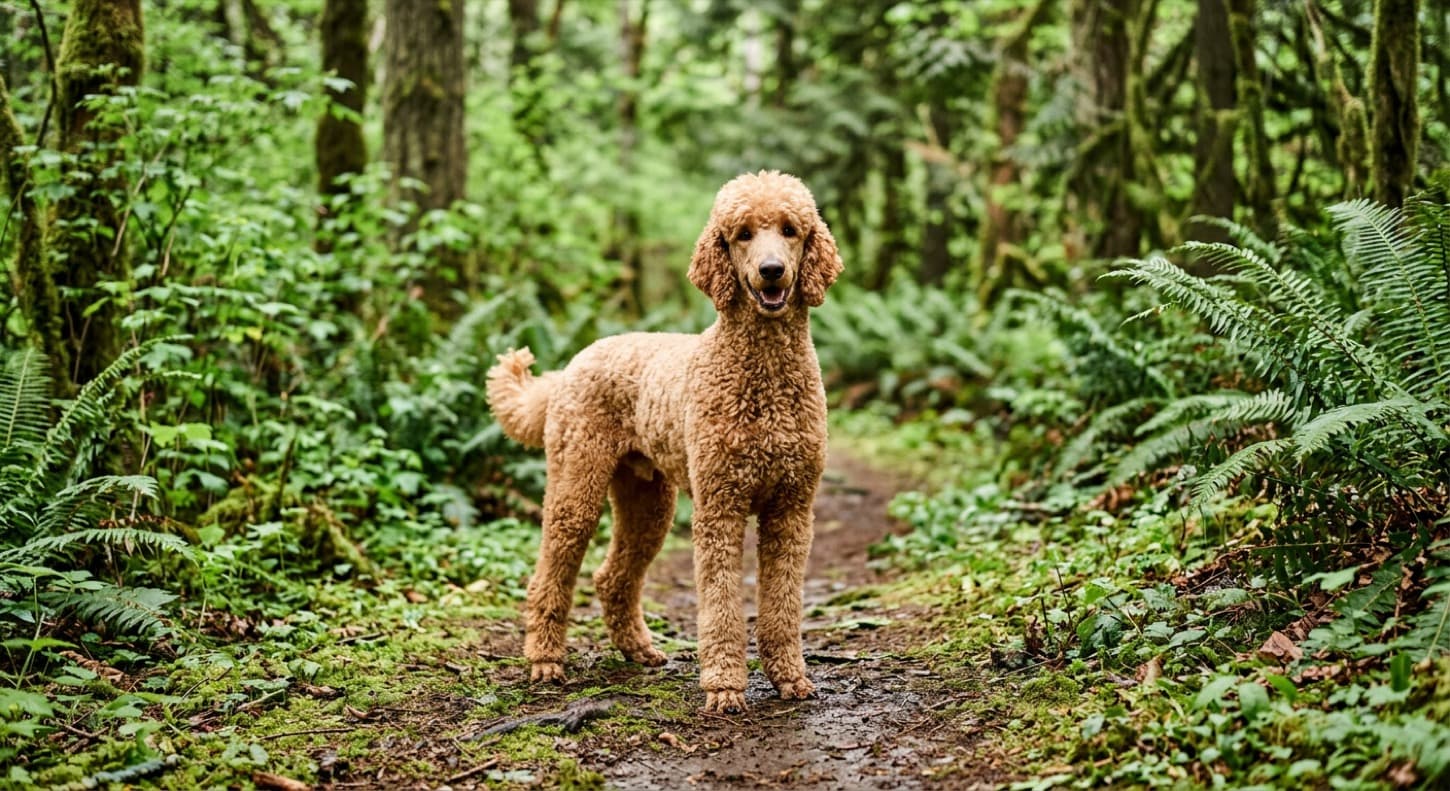
Size is the most useful lens
The single most useful thing to know about Poodle health is that the Toy, Miniature, and Standard are really three different dogs. A large deep-chested Standard and a tiny Toy face quite different risks, so whenever you read about “Poodle health,” ask which size it applies to.
Standard Poodles carry the risks that go with being a large, deep-chested dog: bloat, hip dysplasia, Addisons disease, sebaceous adenitis, and a somewhat shorter lifespan. Toy and Miniature Poodles more often see the small-breed conditions: luxating patella, dental disease (small mouths crowd teeth), Legg-Calvé-Perthes disease, and collapsing trachea, and they tend to live longer, often into their mid-teens. Some conditions, epilepsy, progressive retinal atrophy, and Addisons, appear across all sizes. Keep this lens in mind as you read on.
Addisons disease
Addisons disease (hypoadrenocorticism) is a hormonal condition where the adrenal glands do not produce enough essential hormones, and Standard Poodles are one of the breeds notably predisposed. It is sometimes called the “great pretender” because its signs, lethargy, poor appetite, vomiting, weakness, are vague and come and go, so it can be missed or mistaken for other problems.
The reassuring part: once diagnosed, Addisons is very manageable with lifelong medication, and affected dogs typically go on to live full, normal lives. The risk is mainly in the diagnosis, because an untreated Addisonian dog can occasionally have a sudden, serious crisis. The practical takeaway is awareness: if your Standard Poodle has recurring vague illness that comes and goes, mention Addisons to your vet as something worth checking, since a simple test can look for it. Catching it early makes it a manageable lifelong condition rather than an emergency.
Bloat (Standard Poodles)
Bloat, or gastric dilatation-volvulus (GDV), is a life-threatening emergency where the stomach fills with gas and can twist, and the Standard Poodle, as a large deep-chested breed, is at higher risk (Toy and Miniature Poodles much less so). Signs: a swollen abdomen, unproductive retching, restlessness, and drooling. It comes on fast and needs an emergency vet immediately.
Every Standard Poodle owner should know the signs, because minutes matter with GDV. Some owners discuss a preventive gastropexy (a surgery that tacks the stomach to prevent twisting, sometimes done at the same time as spay or neuter) with their vet, and feeding smaller meals with no hard exercise right after eating is a common precaution. Ask your vet what is right for your Standard Poodle. The AKC Standard Poodle breed profile lists the recommended health screenings for the breed.
Joints, eyes, skin, and epilepsy
Joints. Standard Poodles see hip dysplasia (breeders clear the parents through the OFA); Toy and Miniature Poodles more often see luxating patella and Legg-Calvé-Perthes. Keeping your Poodle lean is the best joint protection across all sizes.
Eyes. Progressive retinal atrophy (a gradual inherited vision loss, with a DNA test for the common form) and cataracts occur across the breed. Include an eye check in routine care and mention cloudiness or vision changes to your vet.
Skin (sebaceous adenitis). This inherited skin condition, seen mainly in Standard Poodles, destroys the skin's oil glands through inflammation, causing dry, flaky skin, hair loss, and sometimes secondary infections. It is managed rather than cured, often with medicated baths, oils, and ongoing skin care, and a veterinary dermatologist can help.
Epilepsy. Idiopathic epilepsy appears in the breed. A seizure is frightening but many epileptic dogs live full lives well managed on medication. If your Poodle has a seizure, keep it safe during the episode and see your vet to investigate and, if needed, manage it.
A note on Doodles
Be clear-eyed about “hybrid vigour.” The idea that crossing two breeds automatically produces a healthier dog is often overstated: a Doodle (a Poodle crossed with another breed) can inherit health conditions from either or both parent breeds. A Goldendoodle can carry Poodle risks and Golden Retriever risks.
Doodles are also not reliably hypoallergenic or low-shedding, because coat type varies litter to litter, and a Doodle coat often needs as much grooming as a Poodle's. A well-bred Doodle from health-tested parents may benefit from a wider gene pool, but a Doodle from untested parents has no such guarantee. For a rescue Doodle, treat it as potentially carrying the risks of both breeds in its mix, ask the rescue what is known about its health and background, and consider a DNA test to understand the mix. For the grooming reality of both Poodles and Doodles, see our adoption guide.
The Poodle health profile at a glance
| Concern | Mainly which size | What helps |
|---|---|---|
| Addisons disease | Standard (all sizes possible) | Awareness, simple test, lifelong medication |
| Bloat (GDV) | Standard | Know the signs, emergency vet, discuss gastropexy |
| Hip dysplasia | Standard | Keep lean, OFA-cleared parents, vet management |
| Luxating patella / LCP | Toy, Miniature | Keep lean, vet grading, surgery if needed |
| Sebaceous adenitis | Standard | Medicated baths, oils, dermatology |
| PRA / cataracts / epilepsy | All sizes | DNA test, eye checks, vet management |
Should I get pet insurance for a Poodle or Doodle?
It is well worth considering, and enrolling early is the key. Poodles are generally healthy, but Addisons disease means lifelong medication, bloat surgery is a large emergency bill for Standards, and joint, eye, and skin conditions can need ongoing or specialist care. BC pet insurance runs roughly $40 to $90 per month depending on the size and age of the dog, less for a Toy, more for a Standard.
The rule that catches everyone: anything already present becomes a pre-existing condition and is excluded, so enrol while your dog is young and healthy. Read policies for how they handle hereditary and congenital conditions, which matters for this breed and doubly for a Doodle carrying two breeds' worth of risk. Budget roughly $2,000 to $3,500 per year in total care, with grooming a significant ongoing line item.
To keep routine costs down, see our guides to low-cost vet options in Vancouver and affordable spay and neuter.
Ready to meet a Poodle or Doodle?
Browse adoptable Poodles and Doodles from Lower Mainland rescues. A rescue can tell you a specific dog's size, coat, and any known health history, which is exactly what a size-driven breed rewards. Refreshed regularly.
See Available Poodles →Frequently Asked Questions
What health problems are Poodles prone to?
Poodles are generally a healthy, long-lived breed, but the risks shift with size, since the Toy, Miniature, and Standard are really three different dogs health-wise. Across the breed, the conditions worth knowing are Addisons disease (which Standard Poodles are notably predisposed to), bloat (a risk in the deep-chested Standard), hip dysplasia, epilepsy, eye conditions like progressive retinal atrophy and cataracts, and a skin condition called sebaceous adenitis seen mainly in Standards. Toy and Miniature Poodles more often see luxating patella, dental disease, and Legg-Calvé-Perthes. Doodles (Poodle crosses) can inherit conditions from both parent breeds. Most Poodles live long lives; the keys are knowing the size-specific risks, insuring early, and staying current on vet care. Always confirm specifics with your vet.
Does a Poodle's size change its health risks?
Yes, meaningfully, and it is the most useful lens for Poodle health. Standard Poodles, as large deep-chested dogs, carry the risks that go with size: bloat (GDV), hip dysplasia, Addisons disease, sebaceous adenitis, and a somewhat shorter lifespan than the smaller varieties. Toy and Miniature Poodles, as small dogs, more often see luxating patella (slipping kneecap), dental disease (small mouths crowd teeth), Legg-Calvé-Perthes disease (a hip condition of small breeds), and collapsing trachea, and they tend to live longer, often into their mid-teens. Some conditions, like progressive retinal atrophy, epilepsy, and Addisons, appear across sizes. When you read about Poodle health, always ask which size it applies to, because a Standard and a Toy are quite different health propositions.
What is Addisons disease, and are Poodles at risk?
Addisons disease (hypoadrenocorticism) is a hormonal condition where the adrenal glands do not produce enough of certain essential hormones, and Standard Poodles are one of the breeds notably predisposed to it. It is sometimes called the great pretender because its signs, lethargy, poor appetite, vomiting, weakness, are vague and come and go, so it can be missed or mistaken for other problems, and it can occasionally cause a sudden, serious crisis. The good news: once diagnosed, it is very manageable with lifelong medication, and dogs typically go on to live full, normal lives. The practical takeaway is awareness: if your Standard Poodle has recurring vague illness, mention Addisons to your vet as something to consider, since a simple test can check for it.
Are Standard Poodles at risk of bloat?
Yes. Bloat, or gastric dilatation-volvulus (GDV), is a life-threatening emergency where the stomach fills with gas and can twist, and the Standard Poodle, as a large deep-chested breed, is at higher risk (Toy and Miniature Poodles much less so). Signs include a swollen or distended abdomen, unproductive retching (trying to vomit with nothing coming up), restlessness, drooling, and distress, and it comes on fast and needs an emergency vet immediately, not in the morning. Some owners of at-risk breeds discuss a preventive gastropexy (a surgery that tacks the stomach to prevent twisting, sometimes done at spay or neuter) with their vet, and feeding smaller meals with no hard exercise right after eating is a common precaution. Ask your vet what is right for your Standard Poodle.
What joint and bone problems do Poodles get?
It depends on size. Standard Poodles see hip dysplasia (a developmental joint condition that can lead to arthritis), and reputable breeders clear the parents through the OFA. Toy and Miniature Poodles more often see luxating patella (a kneecap that slips out of place, causing an intermittent skip in the step) and Legg-Calvé-Perthes disease (a hip condition of small breeds where the femoral head degenerates). Across sizes, keeping your Poodle lean is the best lifelong protection for the joints, since excess weight loads developing and arthritic joints. Watch for limping, a skipping gait, stiffness, or reluctance to jump, and raise anything with your vet, who can grade a patella, image a hip, and recommend management from weight control and supplements up to surgery for serious cases.
What is sebaceous adenitis, and other skin and eye issues?
Sebaceous adenitis is an inherited skin condition seen mainly in Standard Poodles, in which the skin's oil glands are destroyed by inflammation, leading to dry, flaky skin, hair loss, and sometimes secondary infections. It is managed rather than cured, often with medicated baths, oils, and ongoing skin care, and a dermatologist can help. On the eye side, Poodles across sizes can develop progressive retinal atrophy (a gradual inherited loss of vision, with a DNA test for the common form) and cataracts. For a rescue Poodle you usually will not have genetic results, so include skin and eye checks in routine care and mention any persistent flaky skin, coat thinning, cloudiness, or vision changes to your vet.
Are Doodles healthier than purebred Poodles?
Not necessarily, and it is worth being clear-eyed about this. The idea of hybrid vigour, that crossing two breeds automatically produces a healthier dog, is often overstated: a Doodle (a Poodle crossed with another breed like a Labrador, Golden Retriever, or Bernese Mountain Dog) can inherit health conditions from either or both parent breeds, so a Goldendoodle can carry Poodle risks and Golden Retriever risks. Doodles are also not reliably hypoallergenic or low-shedding, since coat type varies litter to litter. A well-bred Doodle from health-tested parents may benefit from a wider gene pool, but a Doodle from untested parents has no such guarantee. For a rescue Doodle, treat it as potentially carrying the risks of both breeds in its mix, and ask the rescue what is known about the dog's health and background.
How long do Poodles live, and how do I give mine the best odds?
It depends on size: Toy and Miniature Poodles are long-lived and commonly reach their mid-teens (around 14 to 16 years), while Standard Poodles, as a larger breed, typically live around 12 to 14 years. You influence lifespan a great deal: keep your Poodle lean, provide regular exercise (this is an active, intelligent breed), keep up dental care (especially important for the small varieties), stay current on vet check-ups, and act promptly on any vague recurring illness, bloat signs, or vision or mobility change. Knowing your Poodle's size-specific risks lets you and your vet watch for the right things. A lean, well-cared-for Poodle with an attentive owner often reaches the top of its size's range in good health.
Is pet insurance worth it for a Poodle or Doodle?
It is well worth considering, and enrolling early is the key, before anything becomes a pre-existing condition. Poodles are generally healthy, but Addisons disease means lifelong medication, bloat surgery is a large emergency bill for Standards, and joint, eye, and skin conditions can need ongoing or specialist care, so vet bills do happen over a long lifespan. BC pet insurance runs roughly $40 to $90 per month depending on the size and age of the dog, less for a Toy, more for a Standard. Read policies for how they handle hereditary and congenital conditions, which matters for this breed and for Doodles carrying two breeds worth of risk, and enrol while your dog is young and healthy. Budget roughly $2,000 to $3,500 per year in total care, with grooming a significant ongoing line item (covered in our adoption guide).
More Poodle and breed guides
Poodle & Doodle Adoption in Vancouver
Where to adopt, real costs, the grooming commitment, the hypoallergenic myth, and the three sizes.
Adoptable Poodles in Vancouver
All currently available Poodles and Doodles. Updates regularly.
Low-Cost Vet Options in Vancouver
Keep routine care affordable so your budget is free for the conditions that matter.
Golden Retriever Health Issues
A common Doodle parent breed's health profile, useful if you are adopting a Goldendoodle.
New dog? Start with these care guides
Everything a new adopter needs to set up a safe, happy home.