The short answer
German Shepherds reach Victoria rescue at a steady rate, and the work is exercise, training, and health budgeting. BC SPCA Victoria lists Shepherds and Shepherd mixes through surrender and stray intake at $250 to $500, and the Island foster-based rescues (Victoria Humane Society, VPAS, Bless Rescue Partners, Promises Rescue Society) run $500 to $700 because they cover transport from northern BC. The breed is among the most surrendered large dogs, almost always because owners underestimated the drive. A Shepherd needs 90 minutes to two hours of daily activity plus mental work, and the health picture (hip and elbow dysplasia, degenerative myelopathy) needs a real budget and early insurance. Get the exercise and training right and you have one of the most loyal, capable dogs there is. Plan one to three months from application to dog-in-home.
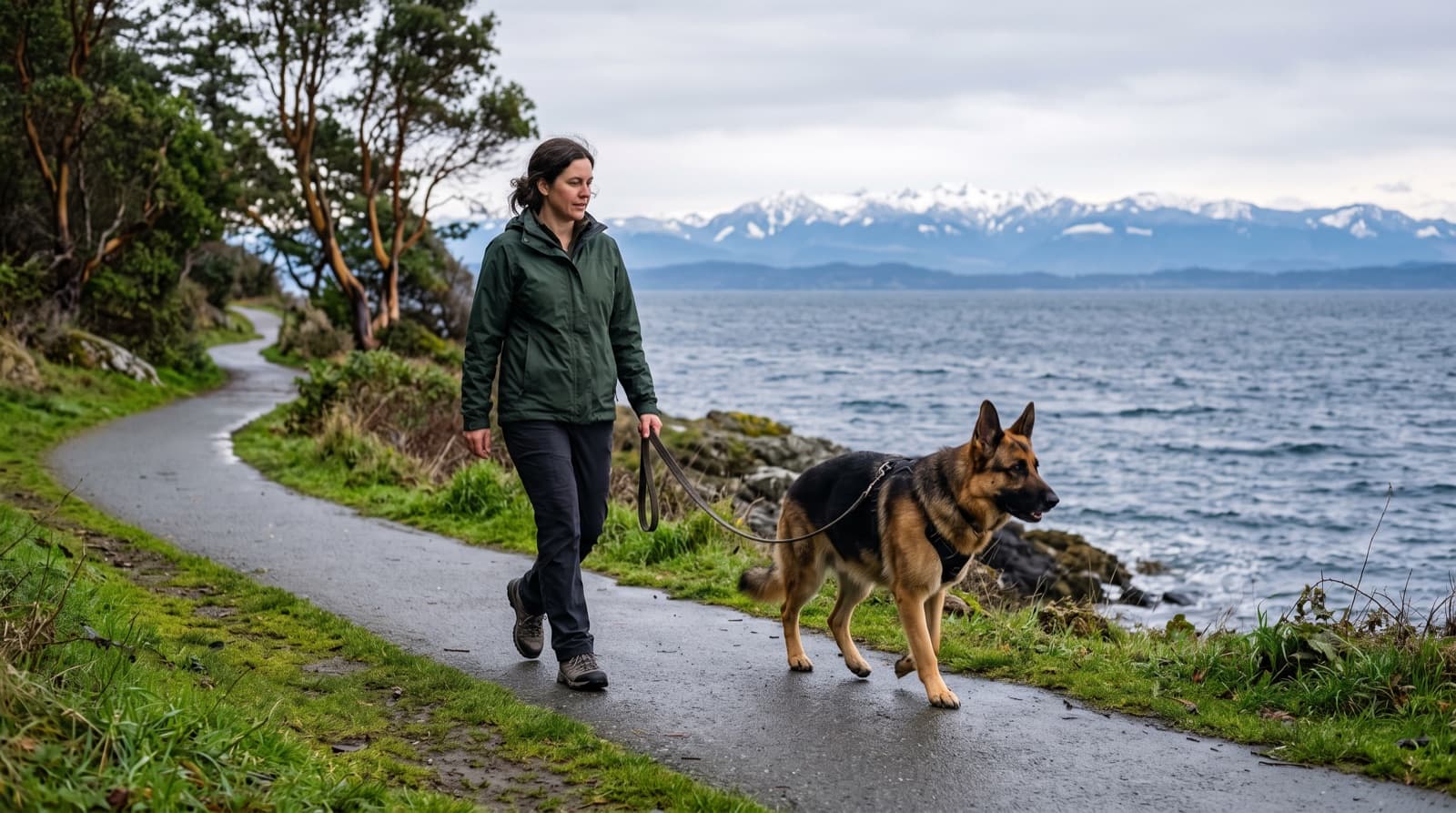
Why German Shepherds surrender in Victoria
The German Shepherd is one of the most surrendered large breeds in North American rescue, and the reasons are strikingly consistent. Almost none of them are about a bad dog. They are about a household that adopted the image (loyal, brilliant, protective) and got the reality of a working-bred animal with intense needs. Reading these patterns before you apply helps you understand foster write-ups and budget for what a Shepherd actually requires.
- Underestimated drive and energy. This is the number-one reason. A German Shepherd bred from working stock needs 90 minutes to two hours of physical and mental work a day. Owners who expected a couch companion get a dog that becomes destructive, vocal, and reactive when its needs are not met. The dog is not misbehaving. It is under-stimulated, and the household eventually gives up.
- Reactivity and guarding. The same protective instinct that makes the breed valued can tip into leash reactivity, barrier frustration, or guarding of people, food, or territory when the dog is under-exercised, under-socialised, or handled with harsh tools. A large Shepherd lunging on leash frightens the household, and untreated it escalates until the family surrenders. Nearly all of it is manageable with the right training approach started early.
- Size and strength of an untrained adolescent. A Shepherd hits 50 to 90 lb of muscle by the time it is a year old. An adolescent that was never taught leash manners or impulse control can pull an adult off their feet and is genuinely hard to manage. Many surrenders happen in that six-month to two-year window when the cute puppy becomes a powerful teenager the owner cannot physically handle.
- Health costs. Hip and elbow dysplasia, degenerative myelopathy, and bloat surgery are real and expensive. A household that did not budget for a large-breed medical picture, and did not buy insurance, can face a bill it cannot pay and surrender the dog rather than treat it. Adopting a rescue that has already had a vet workup, and insuring early, avoids this trap.
- Life changes and housing. A move to a rental with a no-large-dogs or breed-restriction clause, a new baby, a relationship breakdown, or a financial shock lands large working dogs in rescue disproportionately, because they are the hardest to rehome privately and the least welcome in rental housing.
The through-line is that a German Shepherd is a demanding dog that rewards a prepared owner enormously and overwhelms an unprepared one. A listing that describes a dog as “too much” or needing “an experienced home” is nearly always pointing at one of these patterns rather than a broken dog. Put the questions to the rescue plainly: how much daily exercise does this dog need, how is it on leash, has it shown any reactivity or guarding, and what is its health history. The Island rescues that handle large breeds will give you honest answers.
Victoria and Island rescues that list German Shepherds
Several organisations across southern Vancouver Island list German Shepherds and Shepherd mixes, and because Victoria is a mid-size market, a wider net across the Island helps. Set up listing alerts on every rescue you would consider. A multi-rescue alert net catches the right dog within a few weeks. For a fuller directory, see our guide to the best dog rescues in Victoria.
- BC SPCA Victoria: the region's main shelter branch, and the most reliable steady source of Shepherds and Shepherd mixes, which arrive mainly as owner surrenders and strays. You can meet a dog in person before you apply, and staff write up what they see: how the dog carries itself, its energy level, and any medical or behavioural flags. Fees here run $250 to $500 depending on the dog and its age.
- Victoria Humane Society: a foster-based rescue covering a wide southern Vancouver Island footprint through a volunteer foster network. Many of its dogs, including Shepherds and Shepherd mixes, arrive via transport from northern BC and out of region, which is why its fees run higher, roughly $500 to $700, to help recover transport and foster medical costs. Because the dogs live in real homes, the temperament notes on drive, leash behaviour, and how a dog handles being alone tend to be more accurate than a shelter-only setting.
- Victoria Pet Adoption Society (VPAS), Bless Rescue Partners, and Promises Rescue Society: all foster-based Island rescues that take in large breeds and Shepherd types. Bless Rescue Partners is known for detailed foster write-ups, which is exactly what you want for a breed where the individual dog matters more than the label. Promises Rescue Society is a Vancouver Island rescue worth adding to your alert net. For a senior Shepherd, SAINTS Senior Animal Sanctuary focuses on older dogs and is a good call.
For veterinary and welfare context, the College of Veterinarians of BC is the professional body regulating BC vets and a useful reference when choosing a clinic. If you hit a veterinary bill you cannot cover, our Victoria low-cost vet guide covers the BC programs and payment routes that apply here. Before you send any money, confirm the rescue is real: a verifiable address, charitable-registry status, and a live adoptable-dog list. Cheap purebred Shepherd puppies advertised online, and sellers pushing a deposit before you have met the dog, are the classic GSD scam, and a legitimate Island rescue always starts with an application and a conversation, never a wire transfer.
Working lines, show lines, and rescue reality
People new to the breed often ask whether they should look for a working-line or a show-line German Shepherd. It is a fair question, because the two selection paths produce noticeably different dogs, but for a rescue adopter it matters less than you would think.
Working-line Shepherds are bred for job performance in police, military, protection sport, and herding. They are typically leaner, more athletic, higher in drive, and more intense, and they genuinely need serious daily work to be content. Show-line Shepherds, including the sloped-back conformation type seen in the ring, are bred for appearance and are often a little calmer and lower in drive, though still an active, demanding dog by any normal standard. There is also a large population of pet-line and mixed-heritage Shepherds that sit somewhere in between.
Here is the rescue reality: most Shepherds in Island rescue are not a documented working or show dog. They are pet-line or mixed-background dogs whose actual temperament is what you are adopting, and that temperament is visible in the foster home right now. A working-line dog with a lazy owner is a nightmare; a working-line dog with a job is a joy. A show-line dog can still be reactive if it was never socialised. The label predicts far less than the foster assessment does. When you read a listing, look past any breeding claim and focus on the concrete notes: how much exercise the dog needs, how it walks on leash, how it handles other dogs, cats, and strangers, and whether it can settle alone. The Canadian Kennel Club breed standard describes the ideal Shepherd, but the dog in the foster home is the one coming to live with you.
The practical takeaway for a Victoria adopter is to be honest about your own energy and experience, then match to the individual dog rather than to a line. If you want a hiking and training partner and you will put in the daily hours, a higher-drive Shepherd is a fantastic fit. If you want a steadier family companion, tell the rescue that and let the foster point you to a lower-drive dog. Either way, the mild coastal climate here means the exercise is easy to deliver almost every day of the year.
German Shepherd health, in brief
German Shepherds typically live 9 to 13 years, and the breed carries several well-documented health risks that you should budget for and insure against early. This is general information, not veterinary advice; work with your own vet on any specific dog.
- Hip and elbow dysplasia. The most common breed concern, and a major reason the Orthopedic Foundation for Animals maintains public hip and elbow screening databases. It ranges from mild to severe and can require lifelong management or surgery. Keeping the dog lean and fit reduces the impact considerably.
- Degenerative myelopathy (DM). A progressive spinal-cord disease that causes gradual hind-end weakness and loss of coordination in older dogs. It is over-represented in the breed and has a known genetic marker. There is no cure, but physiotherapy and supportive care help maintain quality of life.
- Bloat (gastric dilatation-volvulus). A life-threatening emergency in deep-chested breeds where the stomach twists. Know the signs (a swollen abdomen, unproductive retching, distress) and your nearest emergency clinic, because minutes matter.
- Exocrine pancreatic insufficiency (EPI). The breed is predisposed to this digestive-enzyme deficiency, which causes weight loss despite a good appetite and is managed with enzyme supplements and diet.
- Allergies and skin issues. Common in the breed and often lifelong, needing diet and dermatology management.
- Degenerative joint disease and arthritis. Large working dogs develop joint wear with age; weight control and joint support slow it.
For breed-level health-testing standards, the Orthopedic Foundation for Animals maintains public screening databases at ofa.org. A rescue Shepherd will not usually have OFA records, but the resource is useful context for what the breed is screened for. Plan a baseline vet visit in your first month to establish records, score body condition, and check gait and joints. Know where the nearest emergency and referral veterinary clinic is before you need it, since bloat and severe injuries do not wait for business hours in a large breed. The single best financial move is to enrol in pet insurance in week one, before any condition is on record, because the breed is expensive to insure retroactively once hip, joint, or spinal issues appear.
What a Victoria rescue German Shepherd actually costs
Most Victoria-area rescue dogs run $250 to $700. BC SPCA Victoria and the CRD Animal Shelter sit at the lower end, roughly $250 to $500. Foster-based rescues that cover transport intake from northern BC, such as Victoria Humane Society and Bless Rescue Partners, run higher, around $500 to $700, because the fee helps recover ferry, transport, and foster medical costs. Senior Shepherds seven years and up are often reduced to $150 to $300. None of that is a purchase price. The fee reimburses part of what the rescue already spent getting the dog ready: the spay or neuter surgery, core vaccinations, a microchip and registration, deworming and parasite treatment, and a basic vet workup. Line those services up at BC clinic rates and the total sits well above the adoption fee, which makes the fee a genuine bargain against the real cost of the care already provided.
Compare that to a working or show-line German Shepherd puppy from a breeder at $2,000 to $3,500 with no medical work yet done, and the rescue path is dramatically cheaper, and the dog often arrives with a known temperament you can actually assess. Plan an additional $150 to $350 in the first month for your own vet baseline. The other real early costs for a large working breed are training and gear: budget for a well-fitted harness, a long-line, a crate sized for a big dog, and ideally a few sessions with a qualified force-free trainer, which for a Shepherd is money well spent rather than an optional extra.
Ongoing costs for a German Shepherd run higher than for a small breed, realistically $2,000 to $4,000 a year once you account for large-breed food, routine vet care, pet insurance (genuinely essential for a breed with documented hip, joint, and spinal risk), and a municipal dog licence, which the CRD administers regionally for member municipalities and the City of Victoria administers within its own boundaries. Our Victoria pet licensing guide covers how that works. If your Shepherd is not already spayed or neutered, our Victoria spay and neuter guide and our low-cost vet options guide cover local options, though most rescue Shepherds arrive already altered.
Browse adoptable Victoria German Shepherds and Shepherd mixes
Current Vancouver Island listings from BC SPCA Victoria, Victoria Humane Society, VPAS, and other local rescues in one place. Well-behaved adult Shepherds place fast, so alerts and same-day applications win.
See Victoria Adoptable Dogs →The first 30 days with a Victoria German Shepherd
A rescue Shepherd runs on the same 3-3-3 arc as any adopted dog: the first three days are raw decompression, the routine clicks into place over about three weeks, and the real bond takes closer to three months. With a large, powerful, sometimes wary breed, the early weeks are also about not overwhelming the dog and not putting it in situations it is not ready for. Our first week with a rescue dog guide covers the general decompression plan; here is the Shepherd-specific version.
- Keep the world small at first. A Shepherd needs to learn your home and routine before it meets the neighbourhood. Skip the busy off-leash park, the dog daycare, and the friend meet-ups for the first couple of weeks. Give it a quiet space and a predictable schedule.
- Leash and long-line only until you know the dog. Do not test off-leash recall with a newly adopted Shepherd, however good it seems. Use a well-fitted harness and a long-line in fenced or quiet spaces while you build recall and read how the dog behaves around others.
- Meet the exercise need from day one, calmly. Structured walks and low-key sniffing and scent games, not high-arousal chaos. A Shepherd that gets its physical and mental needs met settles far faster. Victoria is mild enough that daily outdoor activity is realistic year round.
- Book a baseline vet visit in the first two weeks. Establish records, score body condition, check hips, gait, and joints, and confirm the microchip is registered to you.
- Enrol in pet insurance in week one. Before any hip, joint, or spinal issue is on record. For this breed it is the single most valuable first-month decision.
- Line up a qualified trainer early. If the dog shows any reactivity or you are new to the breed, book a force-free trainer or an IAABC-accredited behaviour consultant now rather than after a problem entrenches.
- Crate train from night one. A crate sized for a large dog gives the Shepherd a safe den during decompression and helps with house manners and settling.
- Manage tick and flea prevention year round. Victoria is mild and wet, so parasites are active almost all year, unlike colder parts of Canada. Talk to your vet about a year-round prevention plan from the start.
- Dry the dog properly after wet walks. The coastal rain and mud are constant here, and a double-coated Shepherd holds a lot of water. Keep towels by the door and dry the coat well to prevent hot spots and skin irritation.
- Introduce resident pets and children slowly and supervised. Spread introductions over weeks, not hours, and watch for guarding around food and toys. Let the foster notes guide what the dog can handle.
- Licence the dog. Register with the CRD or your municipality, depending on where you live, early in the settling period.
- Same routes, same routine for the first two weeks. Predictability speeds settling for a big dog adjusting to a new home. Save new adventures and new dog friends for after week three.
By about week three, a Shepherd that arrived wary and watchful starts to lower its guard, and the confident, steady temperament underneath begins to surface. By the three-month mark the bond feels solid and the exercise, training, and health routine is simply how your week runs. Give it the full 90 days before you draw any conclusions. Early leash reactivity, over-alertness at the door, and unsettled pacing usually ease as the dog learns it is safe, gets consistent training, and burns its energy. A German Shepherd that trusts its household and gets its needs met becomes one of the most devoted and capable companions you will ever have.
Frequently asked questions
Where can I adopt a German Shepherd near me in Victoria?
Start with BC SPCA Victoria, which lists German Shepherds and Shepherd mixes regularly through owner surrender and stray intake, with adoption fees from $250 to $500. Then widen the net across the southern Vancouver Island foster-based rescues: Victoria Humane Society, Victoria Pet Adoption Society (VPAS), Bless Rescue Partners, and Promises Rescue Society all take in large breeds and Shepherd types, often through transport from northern BC and out of region. For a senior Shepherd, SAINTS Senior Animal Sanctuary is worth a call. German Shepherds and GSD mixes are common enough in Island rescue that a set of listing alerts across every one of these organisations will surface a good match within a few weeks. Victoria is a mid-size market, so apply the same day a Shepherd that suits your household appears, with references and landlord approval already in hand.
Why do German Shepherds end up in rescue so often?
The German Shepherd is consistently among the most surrendered large breeds in North American rescue, and the reasons are almost always about the household underestimating the dog, not the dog being bad. People adopt the loyal, smart, protective image and get a working-bred dog with intense drive, real exercise needs, and a tendency toward reactivity if under-exercised and under-trained. Five patterns dominate: drive and energy the owner cannot meet, leash reactivity or guarding behaviour that scares the household, the sheer size and strength of an untrained adolescent, the cost of hip, elbow, and other health issues, and life changes like a move to a no-large-dogs rental. None of these are unfixable. They are simply what a powerful working breed needs, and a prepared adopter gets one of the most rewarding dogs there is.
How much does it cost to adopt a German Shepherd in Victoria?
Most Victoria-area rescue dogs run $250 to $700. BC SPCA Victoria and the CRD Animal Shelter sit at the lower end, roughly $250 to $500. Foster-based rescues that cover transport intake from northern BC, such as Victoria Humane Society and Bless Rescue Partners, run higher, around $500 to $700, because the fee helps recover ferry, transport, and foster medical costs. Senior Shepherds seven years and up are often reduced to $150 to $300. Whatever the fee, you are not buying the dog so much as reimbursing part of the care behind it. The big-ticket spay or neuter surgery is already done, along with core vaccinations, a microchip, deworming, parasite treatment, and a basic vet workup, and paying for that list yourself at BC clinic rates would land well above the fee. Compared with a working or show-line breeder puppy at $2,000 to $3,500 with no medical work yet done, adoption is the cheaper path by a wide margin. Budget an extra $150 to $350 in the first month for your own vet baseline.
What is the difference between working-line and show-line German Shepherds?
Working-line German Shepherds are bred for job performance in police, military, protection sport, and herding roles. They tend to be leaner, higher in drive, more intense, and need serious daily physical and mental work. Show-line Shepherds, including the sloped-back conformation type, are bred for the ring and are often calmer and slightly lower in drive, though still an active, demanding breed. Most rescue Shepherds are neither a pure working nor a pure show dog. They are pet-line or mixed-background Shepherds whose actual temperament matters far more than the label. A good Victoria foster home will tell you what the dog in front of you is like: how it handles being alone, how it walks on leash, how it reacts to other dogs and strangers. Trust that assessment over any assumption about lines, because the individual dog is what you are adopting.
Are German Shepherds good with kids and other dogs?
Many are excellent family dogs, and the breed has a long history as a devoted, protective companion for children. The cautions are size and drive rather than temperament. A large, boisterous adolescent Shepherd can knock over a toddler without any bad intent, and herding instinct can show up as nipping at running children. With other dogs, it varies by the individual: some Shepherds are social, others are selective or reactive on leash, and guarding tendencies can extend to the household. This is exactly why a foster-based Victoria rescue matters. The foster has watched the dog with kids, cats, and other dogs in a real home and will flag any concern in the write-up. For a home with young children or a resident dog, look for a Shepherd whose foster notes confirm it has lived successfully with them, and plan supervised introductions over the first several weeks.
What health problems do German Shepherds have?
German Shepherds carry a few well-documented breed risks, so plan for them and buy insurance early. Hip and elbow dysplasia are the most common, and the breed is one of the reasons the Orthopedic Foundation for Animals maintains public hip and elbow screening databases. Degenerative myelopathy (DM), a progressive spinal-cord disease that causes gradual hind-end weakness in older dogs, is over-represented in the breed and has a genetic marker. Bloat, or gastric dilatation-volvulus, is a life-threatening emergency that deep-chested breeds face, so know the signs and your nearest emergency clinic. Other risks include exocrine pancreatic insufficiency, allergies and skin issues, and degenerative joint disease as the dog ages. A rescue Shepherd will not usually have breeder health-test records, but a good rescue does a vet workup and flags anything found. None of this is a reason to avoid the breed. It is a reason to budget for care and enrol in pet insurance in week one, before any condition is on record.
How much exercise does a German Shepherd need?
A lot, and mental work counts as much as physical. Plan 90 minutes to two hours of activity a day for a healthy adult, split between walking, off-leash running in a safe fenced or appropriate space, and brain work like training, scent games, and puzzle feeders. Victoria makes this easier than most Canadian cities because the mild Pacific climate lets a dog be active outdoors nearly year round. A Shepherd that is exercised and mentally engaged is calm and steady at home. An under-exercised one becomes the reactive, destructive, vocal dog that ends up surrendered. This is the single biggest predictor of whether a Shepherd adoption succeeds. If your schedule cannot support that level of daily activity for the many years a Shepherd lives, this is not the breed for your household right now.
Can a rescue German Shepherd be trusted off leash in Victoria?
It depends entirely on the individual dog, its recall training, and its behaviour around other dogs and people. Many well-trained Shepherds are reliable off leash. A newly adopted rescue Shepherd is not, at least not until you have built recall and read its behaviour over weeks. Start on a long-line in fenced or quiet spaces. Victoria has good options: Beacon Hill Park has an off-leash area, and Dallas Road and Clover Point along the waterfront, Mount Douglas Park (PKOLS), Cadboro-Gyro Park, and the trails at Thetis Lake Regional Park and Elk/Beaver Lake Regional Park all draw dogs. Because a Shepherd can be reactive or protective, choose quieter times and quieter spots while you learn the dog, and keep it leashed anywhere near unfamiliar dogs until you know how it responds. Our Victoria off-leash parks guide covers the local rules and best spots.
How do I manage reactivity or guarding in a German Shepherd?
Reactivity, whether toward other dogs, strangers, or noise, is common in under-exercised or under-socialised Shepherds and is manageable with the right approach. The foundation is meeting the exercise and mental needs, because a tired, fulfilled dog has far less to react about. Beyond that, work with a qualified force-free trainer or a certified behaviour consultant early rather than waiting for the problem to entrench. Look for a professional accredited through the International Association of Animal Behavior Consultants (IAABC). Reward-based counter-conditioning, distance management, and consistent leash handling change behaviour. Aversive tools like prong and shock collars often make a fearful or reactive Shepherd worse and can trigger a defensive bite. If a rescue Shepherd is flagged as reactive, ask the foster exactly what triggers it and what has helped, and be honest about whether your household and neighbourhood can support the management plan.
Should I adopt a German Shepherd puppy or an adult?
For most Victoria households, an adult Shepherd is the far safer choice. Shepherd puppies are demanding, and adolescence, roughly six months to two years, stacks intense energy, testing behaviour, and a rapidly growing large body all at once. That is the exact window when many Shepherds get surrendered by owners who were not ready. An adult rescue Shepherd has a settled temperament, established house manners, a known health picture, and a foster who can tell you precisely what the dog is like. Senior Shepherds are calmer still and place beautifully into quieter homes, often at a reduced fee. If you have specific experience with the breed, the time for two years of intensive training and socialisation, and the budget for it, a puppy can work. For everyone else, adopt the adult whose temperament you can already see.
How long is the wait to adopt a German Shepherd in Victoria?
One to three months is a realistic average from application approval to dog-in-home, though it varies a lot by the specific dog. German Shepherds and Shepherd mixes come through Island rescue at a steady rate, both from local surrender and from northern BC transport, so the breed is more available here than a Golden Retriever, which is rare and places within days. Well-behaved adult Shepherds with no red flags place fast, sometimes within a week or two of listing. Reactive dogs, dogs with managed medical needs, and dogs that need a specific home, no cats or no young children, wait longer. Setting alerts across BC SPCA Victoria, Victoria Humane Society, VPAS, Bless Rescue Partners, and Promises Rescue Society, and staying open to a Shepherd mix, shortens the wait considerably. Have your references, landlord approval, and vet contact ready so you can apply the day the right dog appears.
Related Victoria adoption guides
Victoria Adoptable Dogs
Current Vancouver Island German Shepherd and Shepherd-mix listings from BC SPCA Victoria, Victoria Humane Society, and other local rescues.
Best Dog Rescues in Victoria
A directory of the Vancouver Island shelters and foster-based rescues worth setting listing alerts on, with what each is known for.
Victoria Off-Leash Parks Guide
Beacon Hill Park, Dallas Road, Mount Douglas, Thetis Lake, and the best spots and rules for exercising a big dog on the Island.
First Week With a Rescue Dog
The 3-3-3 decompression plan, settling routines, and what to expect in the first days with a newly adopted Victoria rescue dog.
Find your Victoria rescue German Shepherd
Browse current Vancouver Island German Shepherd and Shepherd-mix listings. Well-behaved adult Shepherds place fast, so alerts and same-day applications win.
Browse All Victoria Dogs →New dog? Start with these care guides
Everything a new adopter needs to set up a safe, happy home.