The short answer
Huskies are one of the most-surrendered breeds, so they appear in Victoria rescue often. The work is containment, exercise, and coat. Start with BC SPCA Victoria and the Island foster rescues like Victoria Humane Society. Fees run $250 to $700 across Victoria-area rescues, plus a secure, dig-proof, six-foot fence. A Husky is an escape artist with a high prey drive and a recall that collapses on a scent or a squirrel, so off leash in an unfenced space is not safe for most of them. They need one to two hours of hard daily exercise or they get destructive, and they shed heavily year-round with two coat blows a year. Victoria's mild wet climate is easier than a prairie summer, but a thick northern coat still needs shade and water on warm days. A Husky is rarely a good first dog. Plan a few weeks to a couple of months from application to dog-in-home.
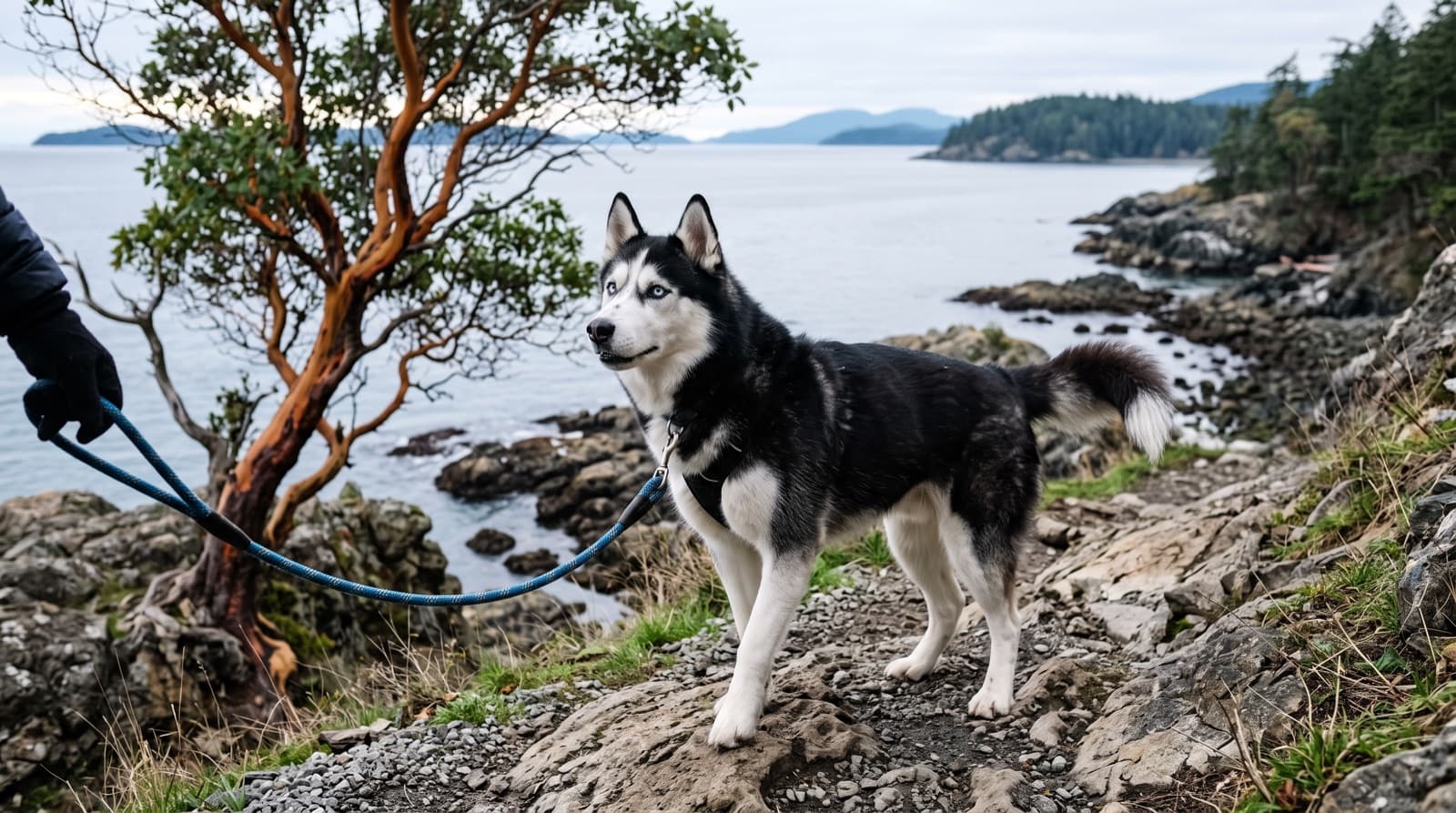
Why Huskies surrender in Victoria
The Siberian Husky is one of the most-surrendered breeds in Canada, and the pattern is remarkably consistent. Almost every Husky surrender is a mismatch between what the owner expected and what the breed actually is, not a difficult dog. Understanding the patterns helps Victoria adopters read foster write-ups honestly and budget for what a Husky really needs.
- Bought for the looks, unprepared for the reality. The Husky's striking appearance and wolfish charisma sell the dog before the owner understands the escape drive, the exercise demand, or the shedding. When the reality lands, the honeymoon ends, and a lot of Huskies are surrendered within their first two years by owners who were sold on the photos.
- Escape and recall failure. A Husky digs under fences, climbs over them, slips collars, and bolts through open doors, and once it is loose it keeps going. Households that lose the dog twice, or that cannot secure the yard, often surrender in frustration. This is the single most common practical reason Huskies come into Island rescue.
- Destruction from too little exercise. An under-exercised Husky turns a house into a project: shredded furniture, dug-up yards, chewed drywall, and howling. Owners who underestimated the one to two hours of daily hard exercise the breed needs give up when the damage mounts.
- Shedding and mess. The double coat sheds year-round and blows out in drifts twice a year. Owners who did not expect a home permanently coated in fur, or who tried to shave the dog and made it worse, sometimes surrender over the mess.
- Life changes and transport intake. A move to a no-pets rental, a new baby, or a schedule that leaves the dog alone too long ends many Husky placements. On top of that, Vancouver Island rescues take in Huskies and Husky crosses through transport from northern BC communities where free-roaming dogs and unplanned litters are common, which is why so many Island Huskies arrive via foster-based rescues.
Reading these patterns ahead of time matters. A dog described as “too much dog for us” is, in nearly every case, one of the reasons above showing through. Get specific with the rescue before you commit: is this dog a known escaper, how does it cope alone, what is its energy level, and how is it with cats and kids. The Victoria-area rescues that handle northern breeds will have honest answers, because they have seen the returns.
Victoria and Island rescues that list Huskies
Several southern Vancouver Island organisations list Huskies or Husky mixes, and because Victoria is a mid-size market, a wide Island net catches the right dog faster. Set up listing alerts on every rescue you would consider. For a fuller directory, see our guide to the best dog rescues in Victoria.
- BC SPCA Victoria: the region's main shelter branch and a dependable source of Huskies and Husky mixes, most arriving as owner surrenders or strays. You can meet a dog before applying, and staff document what they observe: temperament, energy level, and any medical or behavioural flags they have spotted. Fees here typically run $250 to $500 by age.
- Victoria Humane Society: a foster-based rescue covering a wide southern Island footprint through a volunteer foster network. Because the dogs live in real homes, the notes on escape history, energy, and how the dog handles being alone tend to be accurate, which matters enormously for this breed. VHS regularly takes in Huskies through northern BC transport.
- Victoria Pet Adoption Society (VPAS), Bless Rescue Partners, and Promises Rescue Society: foster-based Island rescues that pull dogs from out of region and place them through detailed foster write-ups. Bless Rescue Partners in particular is known for thorough foster notes. Foster-based rescues that cover transport intake tend to charge $500 to $700 to help recover the cost of moving the dog to the Island.
- CRD Animal Shelter and SAINTS: the Capital Regional District shelter handles some strays and surrenders and publishes fees ranging from $25 for small animals up to $700 for puppies, and it also administers dog licensing for member municipalities. For an older Husky, SAINTS Senior Animal Sanctuary is worth knowing about, as senior dogs place at reduced fees into quieter homes.
Before you send money, make sure the rescue is real: a verifiable address, charitable status, and a current adoptable-dog list. Huskies churn through constant free-to-good-home and cheap-rehoming posts, because so many owners give up on the breed, and a lot of those listings hide sick dogs or an upfront-deposit scam. A legitimate Island rescue will always want an application and a conversation first. For professional oversight of BC veterinarians, the College of Veterinarians of British Columbia is the regulatory body and a useful reference when you choose a clinic.
The escape-artist reality: fence and leash first
Everything about safely owning a Husky in Victoria comes back to one fact: this is a breed built to run, and to run away from you. The Siberian Husky was developed to pull sleds over long distances, and it carries a high prey drive, a strong wanderlust, and an independent streak. When something more interesting than you appears, a squirrel on the Dallas Road bluffs, a deer crossing a Saanich trail, an open gate, the Husky is gone, and the recall you practised for months evaporates.
The practical consequence is firm and simple: most Huskies should never be off leash in an unfenced space. A securely fenced yard gives the dog freedom to run at home. Everywhere else, including Beacon Hill Park, Thetis Lake Regional Park, Mount Douglas (PKOLS), Cadboro-Gyro Park, and the coastal paths near the city, the Husky stays on a leash or a long-line. Even in a fully fenced off-leash area, many Husky owners keep a long-line clipped on, because a Husky that decides to leave is fast and does not look back. If your dream is off-leash hiking companionship, the Husky is the wrong breed, and it is far kinder to know that going in than to spend years fighting the dog's nature.
Containment is the other half. A standard four-foot fence does not hold a determined Husky. The realistic setup is a minimum six-foot fence with the bottom secured against digging, using buried wire, a concrete footer, or an L-footer of mesh laid flat along the ground inside the fence line. Gates need to self-latch and self-close, and every household member needs the habit of securing the dog before opening a front door or a car door. Use a well-fitted martingale collar or a harness the dog cannot back out of, microchip the dog, and keep the registration current, because a Husky that gets out will travel. Victoria rescues ask about your fence during the application for exactly this reason. If the yard is not secure, fix it before the dog comes home.
The reward for all this structure is a dog that is genuinely a joy to be active with. Victoria's mild coastal climate lets you get a Husky out year-round without deep snow or extreme cold, and a well-exercised, well-contained Husky is affectionate, comic, social, and endlessly game for adventure. The containment is not a burden you carry forever with resentment. It is the price of admission for one of the most charismatic breeds there is.
Coat, shedding, and Victoria's mild climate
The Husky's double coat is beautiful and it is a lot of work. A coarse outer layer sheds over a dense wool undercoat, and the dog sheds steadily every day plus blows the undercoat in dramatic clumps twice a year, usually spring and fall, for two to three weeks at a stretch. During a coat blow your floors, furniture, and clothes fill with fur no matter how often you clean. Management is regular brushing, a few times a week normally and daily during a blow, with an undercoat rake and a strong vacuum. Do not shave a Husky. The double coat insulates against both cold and heat and shields the skin from sun, and shaving damages the regrowth and strips that protection. Bathe only occasionally, because the coat is largely self-cleaning and over-bathing dries it out. If a fur-free home is a hard requirement for you, this is not your breed.
Victoria's mild, wet Pacific climate is genuinely easier on a Husky than a Calgary or prairie summer, but a thick-coated northern breed still needs heat management. The upside is real: Victoria rarely gets extreme heat and rarely drops far below freezing, so a Husky is comfortable and active outdoors most of the year and loves the cool, damp winters. The catch is that even a mild summer afternoon can overheat a dog carrying an arctic coat faster than you expect. During a summer warm spell, walk in the cooler morning and evening hours, always bring water, provide real shade in the yard, and never leave a Husky in a parked car. Watch for heavy panting, thick drooling, or sudden lethargy as signs of heat stress and cool the dog down promptly.
The bigger day-to-day Victoria reality is not heat, though; it is rain and mud. Southern Vancouver Island winters are wet rather than snowy, so you will be managing a soggy, muddy, heavy-coated dog through much of the year. A towel routine at the door, paw wiping after muddy trail walks at Thetis Lake or Elk and Beaver Lake, and a drying-off spot for the dog all become part of the household rhythm. The good news is a Husky adores cool, wet, brisk weather, so the same rain that means towels also means a happy, comfortable dog on your walks.
Husky health, in brief
Siberian Huskies are generally a hardy, athletic breed with a long working history and fewer of the structural extremes that trouble some breeds, but a few conditions are worth planning around so adopters apply with realistic expectations. None of this is a substitute for an in-person Victoria vet, and nothing here is a diagnosis.
- Eye conditions. The most breed-associated group. Juvenile cataracts, progressive retinal atrophy (PRA), and corneal dystrophy all appear in the breed, which is why responsible breeders eye-test their dogs. A vet eye check in the first month is sensible.
- Hip dysplasia. Occurs in the breed, though at lower rates than in many large breeds. Keeping the dog lean and fit lowers the day-to-day impact.
- Hypothyroidism. Shows up in middle age, is diagnosed with bloodwork, and is managed with a daily pill.
- Skin and autoimmune conditions. Certain zinc-responsive skin issues and autoimmune conditions are seen in the breed. Report any persistent skin, coat, or crusting changes to your vet.
- Weight and fitness. Huskies are natural athletes and do best lean. An under-exercised, overfed Husky is prone to weight gain that worsens joints, so measured meals and real daily exercise are the baseline.
For breed-level health-testing standards, the Orthopedic Foundation for Animals maintains public screening databases at ofa.org, and the Canadian Kennel Club publishes the breed standard and health guidance. A rescue Husky will not usually come with OFA records, but they are useful context for what the breed is screened for. Plan a baseline vet visit in your first month to establish records, check the eyes, and score body condition. If veterinary costs are a barrier, our Victoria low-cost vet guide sets out the BC programs that actually apply here.
What a Victoria rescue Husky actually costs
Adoption fees across Victoria-area rescues run $250 to $700 for most adult dogs. BC SPCA Victoria and the CRD Animal Shelter sit at the lower end, roughly $250 to $500, while foster-based Island rescues that cover out-of-region transport intake run $500 to $700 because the fee helps recover the transport cost. Senior Huskies, seven years and up, are often reduced to $150 to $300. Whatever the number, the fee is not a sale price; it recovers part of the care already done. Each piece of it, a microchip and registration, deworming and parasite treatment, core vaccinations, spay or neuter, and a basic vet workup, is a cost you would otherwise carry yourself, and totalled at retail Victoria vet pricing it lands well past the adoption fee, so the fee is a genuine bargain against the real cost of the care already provided.
Compare that with a Husky puppy from a breeder at $1,200 to $2,500 with no medical work done yet, and the rescue path is significantly cheaper, and an adult rescue dog often arrives with a known temperament, which matters a great deal for this breed. Plan another $150 to $350 in the first month for your own vet baseline. The other real first-month cost for a Husky is containment: a taller or dig-proofed fence, gate hardware, and a good long-line and harness. This is the one line item you cannot skip, and it is what keeps the dog alive and out of rescue a second time.
Ongoing Husky costs run roughly $2,000 to $3,500 a year: quality food for a 35 to 60 lb athletic dog, routine vet care, grooming supplies and the occasional professional de-shed, pet insurance (worth it for a breed with documented eye and joint risks), and an annual dog licence, which the CRD administers for member municipalities alongside the City of Victoria bylaw services. Our Victoria pet licensing guide walks through how and where to licence your dog. If your Husky is not already spayed or neutered, our Victoria spay and neuter guide covers the local options, though most rescue Huskies arrive already altered.
Browse adoptable Victoria Huskies and Husky mixes
Current southern Vancouver Island listings from BC SPCA Victoria, Victoria Humane Society, and other Island rescues in one place. Huskies are surrendered often, so the right-fit dog still moves quickly; alerts and same-day applications win.
See Victoria Adoptable Dogs →The first 30 days with a Victoria Husky
Huskies run on the same 3-3-3 arc as any rescue dog: the first three days are raw decompression, the routine clicks into place over about three weeks, and the real bond takes closer to three months. What you cannot ease off on, even in week one, is containment, because a Husky can dig out or bolt through a door the first afternoon. Our first week with a rescue dog guide covers the general decompression plan; here is the Husky-specific version.
- Escape-proof the yard before the dog arrives. Walk the fence line for gaps at the bottom, low sections, and gates that do not self-latch. Assume the dog will dig, climb, and test every weak point on day one. If you do not have a secure yard, have a long-line and a plan ready before pickup.
- Leash or long-line for every outing, no exceptions. Until you know this individual dog, treat off-leash freedom outside a fenced area as off the table. A martingale or a properly fitted harness reduces the risk of a Husky backing out mid-bolt.
- Door and gate protocol from night one. A household rule that the dog is secured or behind a barrier before anyone opens a front or car door. Most first-week escapes are door dashes, not fence jumps.
- Book a baseline vet visit in the first two weeks. Establish records, check the eyes, confirm the microchip is registered to you, and discuss any breed-specific monitoring.
- Set the exercise routine immediately. Even during decompression, a Husky needs real physical and mental outlet. Start with on-leash walks and secure-yard play, build up as the dog settles, and add puzzle feeders and chews to drain mental energy.
- Start the coat routine. Brush a few times a week with an undercoat rake, and set up a towel-and-drying spot at the door for Victoria's rain and mud.
- Enrol in pet insurance in week one. Before any pre-existing conditions appear in your records. Eye and joint issues are cheaper to insure against when enrolled early.
- Licence the dog. Arrange the annual licence through the CRD or your municipality's bylaw services early in the settling period.
- Crate train from night one. Even a house-trained Husky benefits from a crate routine for the first month; it gives the dog a safe den and reduces destruction during decompression.
- Same routes, same routine for the first two weeks. Predictability speeds settling. Save fenced dog parks and new dog friends for after week three, once you know the dog's recall and social style.
- Heat awareness even early on. If you adopt during a summer warm spell, walk in the cool hours and keep water and shade available. A thick coat plus a new, stressed dog is a heat-stress combination to respect.
By about week three, the frantic escape-testing of the first days, the fence-line patrolling and the door-dashing, starts to ease as the Husky accepts the yard and the routine as its own. By the three-month mark the bond feels solid and the fence-checking, brushing, and daily-exercise routine is simply how your week runs. Do not write the dog off in the early weeks. The howling, the digging, and the restless energy that alarm new Husky owners nearly always settle once containment is solid, the exercise is real, and the dog has had time to trust the place.
Frequently asked questions
Where can I adopt a Husky near me in Victoria?
Start with the BC SPCA Victoria branch and the Island foster-based rescues that take in northern-breed dogs. BC SPCA Victoria lists Huskies and Husky mixes through owner surrender and stray intake, with adoption fees typically $250 to $500. Victoria Humane Society, Victoria Pet Adoption Society (VPAS), Bless Rescue Partners, and Promises Rescue Society all run volunteer foster networks across southern Vancouver Island and regularly pull Huskies and Husky crosses from northern BC transport intake, which is where a lot of Island Huskies actually come from. Because Huskies are surrendered often, they show up more frequently than rarer breeds, but the ones that fit a specific household still move quickly. Set alerts across every rescue at once, get your references and, if you rent, your landlord approval ready in advance, and apply the same day a suitable dog appears. Victoria is a mid-size market, so casting a wide Island net beats waiting on any single rescue.
Why do Huskies end up in rescue so often in Victoria?
Huskies are consistently one of the most-surrendered breeds in Canada, and the reasons are almost always a mismatch between the breed and the owner rather than a bad dog. People buy or adopt a Husky for the striking looks and the wolfish appeal without understanding the escape drive, the exercise needs, or the shedding. Then reality lands: the dog digs under or leaps over the fence and goes on an adventure, it destroys the couch or the drywall when left bored, it howls, it pulls hard on leash, and it blows its coat twice a year in drifts of fur. Add a move to a no-pets rental, a new baby, or a work schedule that leaves the dog alone too long, and the Husky ends up back in rescue. Vancouver Island rescues also take in Huskies through transport from northern BC communities where free-roaming and unplanned litters are common. The dogs themselves are usually friendly, social, and affectionate. The surrender is about the household, not the temperament.
How much does it cost to adopt a Husky in Victoria?
Most Victoria-area rescue adoption fees run $250 to $700 for an adult dog. BC SPCA Victoria and the CRD Animal Shelter sit at the lower end, roughly $250 to $500. Foster-based Island rescues that cover out-of-region transport intake tend to run $500 to $700 because the fee helps recover the cost of moving the dog to the Island. Senior Huskies, seven years and up, are often reduced to $150 to $300. Whatever the number, the fee is not a sale price. Every line item behind it, the microchip, deworming and parasite treatment, core vaccinations, spay or neuter, and a basic vet workup, is something you would otherwise pay for yourself, and at retail Victoria vet pricing the total would run well past the adoption fee. Compared with a Husky puppy from a breeder at $1,200 to $2,500 with no medical work done yet, rescue is the cheaper and often more sensible path. Budget another $150 to $350 in the first month for your own vet baseline, plus the real containment cost for this breed: a secure, dig-proof, tall-enough fence, which is the one investment you cannot skip.
Can a Husky ever be trusted off leash?
For the large majority of Huskies, no, not in an unfenced space. The Siberian Husky was bred to run, and to run away from the handler as much as toward a destination. The breed has a high prey drive, a strong wanderlust, and a recall that collapses the moment something more interesting appears. This is hardwired, not a training gap you can close with enough practice. The realistic plan for Victoria is a securely fenced yard for off-leash freedom at home and a leash or long-line everywhere else, including Beacon Hill Park, the Dallas Road waterfront, Thetis Lake, and Mount Douglas (PKOLS). Even in a designated off-leash area, many Husky owners keep a long-line on because a Husky that decides to leave a fenced beach or bolts after a deer is gone. If you want a dog you can hike with off leash, the Husky is the wrong breed. If you can commit to leashed adventures and a secure yard, a Husky is a wonderful, high-energy companion.
Are Huskies really escape artists?
Yes, and this is the single most important thing to plan for. Huskies dig under fences, climb or jump over them, slip collars, open unlatched gates, and bolt through open doors. A standard four-foot fence is not enough for a determined Husky. The realistic setup is a minimum six-foot fence with the bottom secured against digging, either buried wire, a concrete footer, or an L-footer of mesh laid flat along the ground inside the fence line, plus gates that self-latch and self-close. Front doors and car doors need a household rule that the dog is secured or behind a barrier before anyone opens them. Microchip the dog and keep the registration current, and use a well-fitted martingale collar or a harness the dog cannot back out of. Victoria-area rescues will often ask about your fence during the application specifically because they see so many Huskies returned after an escape. If your yard is not secure, the honest answer is to fix the fence before the dog arrives, not after the first getaway.
Are Huskies a good first dog?
For most first-time owners, no. The Husky combines high exercise needs, a powerful escape drive, stubborn independence, heavy shedding, and a tendency to be destructive when bored, and that is a demanding package for someone learning dog ownership for the first time. None of it is impossible, and plenty of committed first-time owners have raised great Huskies, but it takes research, structure, a secure yard, and a realistic amount of daily exercise. If you are set on the breed as a first dog, adopt an adult with a known temperament rather than a puppy, work with a certified trainer early, and be honest about your schedule and your fence. A better first-dog fit for many households is a lower-drive breed or an easygoing adult mix. If the Husky look and personality are what you truly want and you can meet the needs, an adult rescue Husky can absolutely work. Just go in with clear eyes rather than falling for the photos.
How much do Huskies shed, and how do I manage the coat?
A lot, all the time, with two dramatic coat blows a year. The Siberian Husky has a thick double coat: a coarse outer layer and a dense wool undercoat. Day to day it sheds steadily, and twice a year, usually spring and fall, it blows the undercoat in clumps for two to three weeks, coating your floors, furniture, and clothing in fur. Management is regular brushing, ideally a few times a week and daily during a coat blow, with an undercoat rake and a good vacuum. Do not shave a Husky. The double coat insulates against both cold and heat and protects the skin from sun, and shaving damages how it regrows and removes that protection. Bathe only occasionally, because the coat is fairly self-cleaning and over-bathing strips it. Expect fur to be a permanent feature of your home. If a spotless, hair-free house matters to you, the Husky is not your breed.
How does Victoria's mild climate affect a Husky?
Victoria's mild, wet Pacific coastal weather is far easier on a Husky than a prairie summer, but a thick-coated northern breed still needs heat management on warm days. The good news is Victoria rarely gets extreme heat and rarely drops far below freezing, so a Husky is comfortable being active outdoors most of the year and thrives in the cool, damp winters. The catch is that a Husky carries a heavy double coat built for arctic cold, so on the warmer summer afternoons the dog can overheat faster than you expect. Walk in the cooler morning and evening hours during a summer warm spell, always carry water, provide shade in the yard, and never leave a Husky in a parked car. Watch for heavy panting, drooling, or lethargy as heat-stress signs. The other Victoria reality is rain and mud rather than snow. A Husky loves the cool wet weather, but you will be managing a wet, muddy, heavy-coated dog through much of the year, so a towel routine at the door and paw care after muddy walks become part of the week.
Are Huskies destructive, and how much exercise do they need?
A bored, under-exercised Husky is one of the most destructive dogs you can own. Left alone with too little physical and mental outlet, Huskies chew furniture, shred bedding, dig up yards, and can go through drywall. This is not spite; it is a working sled dog with unmet energy turning that energy loose on the house. Plan for a genuine minimum of one to two hours of hard exercise a day for an adult, running, hiking on leash, a secure fenced romp, or dog sports, plus mental work like puzzle feeders, training games, and chews. Victoria's mild climate helps, because you can get the dog out year-round without fighting deep snow or extreme cold. Elk and Beaver Lake Regional Park has long trails for leashed distance, and the Dallas Road and Clover Point waterfront gives a good brisk workout with sea air. Crate training and a settled routine also reduce destruction during the settling weeks. If your schedule cannot support that level of daily exercise, a Husky will be miserable and your home will pay for it.
What health problems do Huskies have?
Siberian Huskies are generally a hardy, athletic breed with a long working history, and they tend to have fewer of the structural extremes that plague some breeds, but a few conditions are worth planning around. Eye conditions are the most breed-associated: juvenile cataracts, progressive retinal atrophy (PRA), and corneal dystrophy all appear in the breed, which is why responsible breeders eye-test their dogs. Hip dysplasia occurs, though at lower rates than in many large breeds. Hypothyroidism and some skin and autoimmune conditions show up as well. For breed-level health-screening standards, the Orthopedic Foundation for Animals maintains public databases at ofa.org, and the Canadian Kennel Club publishes the breed standard and health-testing guidance. A rescue Husky will not usually come with health records, so plan a baseline vet visit in the first month to establish records, check the eyes, and score body condition. Never rely on this article for a diagnosis or treatment; an in-person Victoria vet is the right call for any health question.
Should I adopt a Husky puppy or an adult, and how long is the wait?
For most Victoria households, an adult Husky is the far easier choice. A puppy means twelve to eighteen months of intensive training, teething destruction, and escape-proofing on a dog whose adult temperament you cannot yet read, and Husky adolescence is genuinely testing. An adult has a settled personality, established house manners, a known energy level, and usually a lower fee, and the rescue can tell you how the dog does with cats, kids, other dogs, and being alone. Senior Huskies are often calm, affectionate companions at reduced fees and place beautifully into quieter homes. As for timing, because Huskies are surrendered often, they appear in Island rescue more regularly than rarer breeds, so the wait can be shorter than for a Golden Retriever, sometimes a few weeks. But the specific dog that fits your household, good with your kids, your cat, your fence, may take longer. Set alerts across BC SPCA Victoria and the Island foster rescues, stay open to a Husky mix, and have your application materials ready so you can move the day the right dog is listed.
Related Victoria adoption guides
Victoria Adoptable Dogs
Current Vancouver Island Husky and Husky-mix listings from BC SPCA Victoria, Victoria Humane Society, and other Island rescues.
Best Dog Rescues in Victoria
A directory of the southern Island shelters and foster-based rescues worth setting listing alerts on, with what each is known for.
Victoria Off-Leash Parks Guide
Where to run a dog safely on southern Vancouver Island, and why fenced areas and long-lines matter for high-flight-risk breeds like the Husky.
First Week With a Rescue Dog
The 3-3-3 decompression plan, settling routines, and what to expect in the first days with a newly adopted Victoria rescue dog.
Find your Victoria rescue Husky
Browse current Vancouver Island Husky and Husky-mix listings. Huskies are surrendered often, so they turn up regularly, but the right-fit dog still moves quickly; alerts and same-day applications win.
Browse All Victoria Dogs →New dog? Start with these care guides
Everything a new adopter needs to set up a safe, happy home.