
The short answer
Feed an Alaskan Malamute a complete large-breed food, well below the bag's recommendation, and judge weight by feel. Bred to work on modest rations, Malamutes are efficient eaters that gain weight easily, so feed to body condition under that thick coat, not to a chart. Puppies need a controlled-calcium large-breed puppy formula until about 12 to 18 months. Feed two meals a day from the floor, never raised, because elevated bowls increase bloat risk. And know the breed's one true diet link: zinc-responsive dermatosis, which is vet-managed, never self-dosed.
How much should I feed an Alaskan Malamute?
Less than you would guess, and well under the bag. The Malamute was bred to pull heavy freight across the Arctic on rations that would leave other dogs gaunt, and that efficiency carried into the modern pet. The near-universal advice from Malamute breeders and rescues is the same: if you feed to the bag's chart, you will overfeed and waste money. Most adults do fine on roughly two cups twice a day for a big male, a touch less for a female, tuned to the individual dog.
The right tool is not a number on a bag but the WSAVA body condition score. And with a Malamute you have to use your hands, because the dense double coat hides the waist and ribs completely. Feel for the ribs under a light layer of fat. If you cannot find them, the dog is overweight, no matter how good the coat looks. Do not free-feed; scheduled meals let you see what the dog actually eats.
Growing a Malamute puppy: calcium is the key
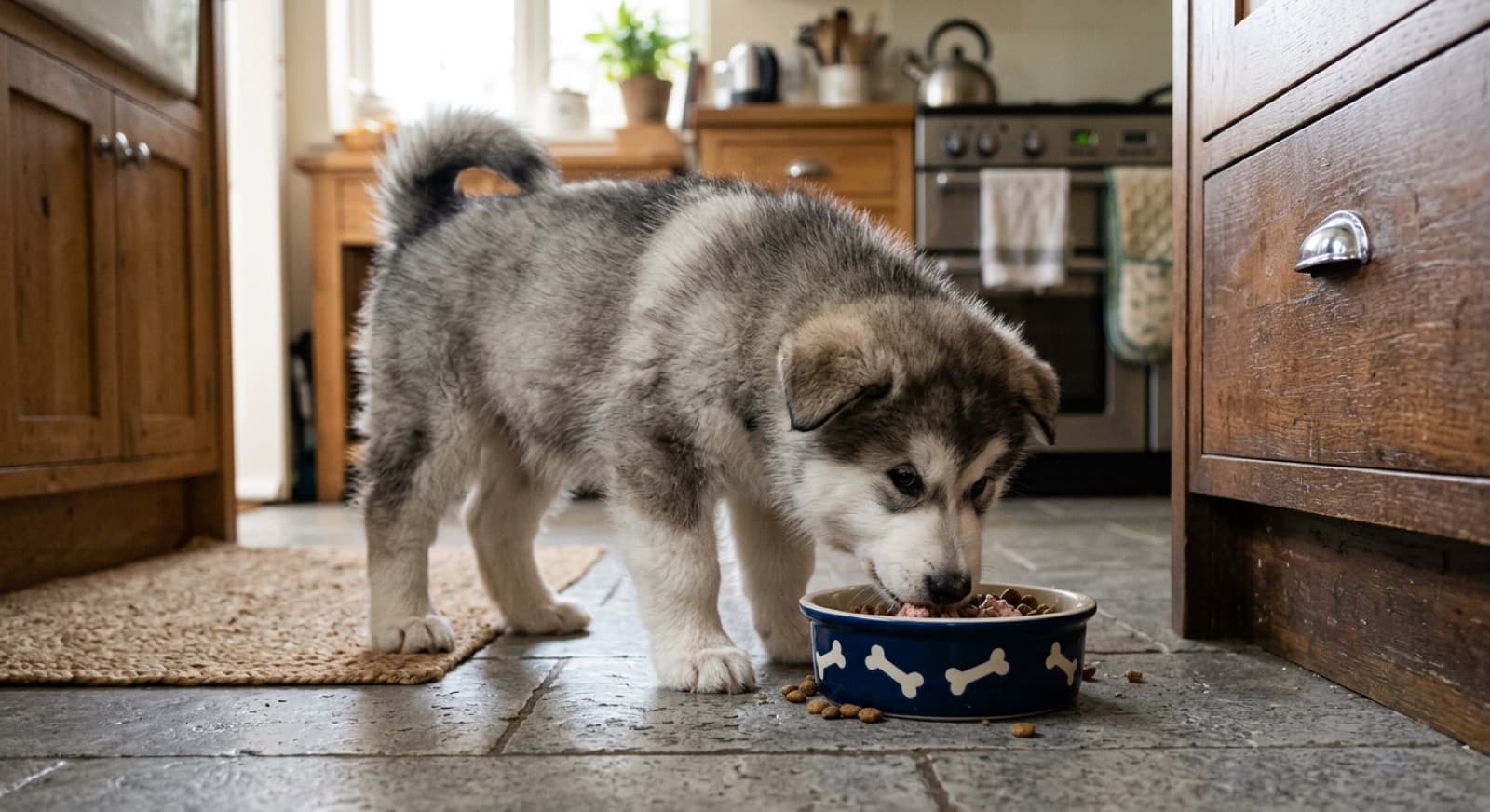
A Malamute is a large breed, so the puppy needs a large-breed puppy formula, and the reason is calcium. A large-breed puppy under about six months absorbs most of the calcium it eats and cannot down-regulate the excess. The Merck Veterinary Manual is blunt that excess calcium causes more severe osteochondrosis and disrupted bone development in young, rapidly growing large-breed dogs.
Two rules follow. First, look for the AAFCO statement on the bag that says the food is formulated for the growth of large-size dogs (70 pounds or more as an adult); the version that says “except for” large-size growth is the one to avoid. Second, do not add a calcium supplement or a multivitamin to a complete puppy food. For a Malamute puppy it is not helpful, it is harmful. Keep the puppy on its large-breed formula to roughly 12 to 18 months and confirm the adult switch with your vet.
Bloat, and the raised-bowl myth
Raised or elevated bowls do not prevent bloat in a Malamute. The large Purdue study found they were associated with an increased risk. Feed from the floor.
Bloat, or gastric dilatation-volvulus, is when the stomach fills with gas and twists, and it is rapidly fatal without emergency surgery. Malamutes are deep-chested, so the risk is real, but it is fair to call it moderate rather than top-tier: Malamutes do not appear on the highest-risk breed lists alongside the Great Dane and Weimaraner, and there is no published lifetime-risk figure for the breed.
That said, the prevention is the same and worth doing. The AKC notes that dogs fed once a day are twice as likely to bloat as those fed twice, and fast eaters are at much higher risk, so feed two or more smaller meals and slow a gulper with a slow-feeder bowl on the floor. The Merck Veterinary Manual even lists avoiding elevated bowls as a prevention step. A preventive gastropexy, which tacks the stomach so it cannot twist, is the most reliable protection and worth raising with your vet. A swollen belly and unproductive retching is an emergency.
Zinc-responsive dermatosis: the breed-specific diet link
Never self-dose zinc. It is toxic in overdose and blocks copper absorption. Zinc-responsive dermatosis is diagnosed and dosed by a vet, ideally a veterinary dermatologist.
This is the one health issue where diet and the Malamute genuinely intersect, and it is specific enough that many general guides miss it. In the hereditary form, a Malamute eating a complete, balanced diet with plenty of zinc still cannot absorb enough, because of an inherited defect in zinc uptake. VCA Hospitals notes this type occurs most often in the Alaskan breeds, the Malamute and the Siberian Husky, and the Merck Veterinary Manual describes the same familial pattern.
The signs are crusting, scaling, redness, and hair loss, usually around the eyes, muzzle, ears, and the paw pads. It is treated with vet-supervised oral zinc, often for the dog's life, plus diet adjustment if needed. The reason this is a strictly vet-managed condition, and why no responsible guide prints a dose, is that zinc is toxic in excess and interferes with copper. If your Malamute develops the pattern above, that is a veterinary dermatology visit, not a supplement-aisle experiment.
Which Malamute health issues are about diet?
Owners tend to file every worry under feeding, so it helps to separate what diet controls from what it does not.
- Zinc-responsive dermatosis (diet-managed): the genuine diet link, covered above. Vet-managed, never self-dosed.
- Obesity and joint strain (diet): the everyday issue, and the reason the feed-lean rule matters so much for an efficient eater.
- Hip dysplasia (diet modifies it): the genes set the risk, but keeping the puppy lean during growth and the adult at a healthy weight reduces how badly it shows.
- Hypothyroidism (not caused by diet): an autoimmune condition that causes weight gain, so owners blame food. It is treated with daily medication. A Malamute gaining weight on a normal portion deserves a thyroid test, not just a food cut.
- Chondrodysplasia and polyneuropathy (genetic, not diet): inherited conditions with DNA tests. Nothing you feed prevents or treats them.
Foods to avoid
Keep these away from a Malamute completely:
- Chocolate (darker is worse)
- Grapes and raisins (can cause kidney failure, even a few)
- Xylitol (in sugar-free gum, some peanut butters, and baking), which is rapidly fatal to dogs
- Onions, garlic, leeks, and chives
- Macadamia nuts
- Alcohol and caffeine
- Cooked bones (they splinter)
A Malamute is a determined, food-driven dog that can open bins and clear counters, so keep food secured. If your dog eats something on this list, call your vet, the nearest emergency clinic, or a pet poison helpline right away.
Should I feed my Malamute a raw diet?
Only with a vet or veterinary nutritionist involved, and be careful with a growing puppy. Northern-breed owners are drawn to raw, and some Malamutes do well on a properly built diet, but the FDA warns that raw meat carries a pathogen risk for the dog and the household. Home-built raw diets are also commonly unbalanced, and getting calcium wrong is exactly what harms a large-breed puppy.
For most Malamutes, a complete cooked or kibble diet from a nutritionist-backed brand matches raw on outcomes. If you go raw, work with a veterinary nutritionist on a complete, calcium-correct recipe rather than guessing.
Looking to adopt an Alaskan Malamute?
Plan the lean-feeding and calcium plan before day one. Browse Alaskan Malamutes and Malamute mixes available now from the rescues we track across Canada.
See Available Malamutes →Where to buy Malamute food
Every brand worth feeding a Malamute is easy to find in store and online:
- Pet specialty chains (Pet Planet, Tail Blazers, Tisol, and similar). Carry Pro Plan, Royal Canin, and large-breed lines.
- Pet Valu and PetSmart. Stock the major large-breed puppy and adult formulas.
- Your vet clinic. The best source for large-breed puppy guidance and the prescription support if zinc-responsive dermatosis is diagnosed.
- Costco. Kirkland Signature large-breed is a cheaper everyday adult option.
Because a Malamute eats modestly for its size, a large bag lasts a while, so buy one it finishes before the food goes stale and store it sealed. The major large-breed formulas are easy to set on a recurring delivery.
Frequently Asked Questions
How much should I feed an Alaskan Malamute?
Less than the size suggests, and well below what the bag says. Malamutes were bred to haul loads over distance on modest rations, so they are efficient eaters, and most do well on roughly two cups twice a day for a big male, a little less for a female, adjusted to the dog. Feed by body condition, not the feeding chart, which tends to over-recommend. Because that thick double coat hides the body, judge condition with your hands: you should be able to feel the ribs under a light layer without pressing hard.
What is the best food for an Alaskan Malamute?
For a puppy, a large-breed puppy formula with controlled calcium is the priority. For an adult, a complete large-breed food from a brand that employs a board-certified veterinary nutritionist and runs feeding trials, such as Purina Pro Plan, Royal Canin, Hill's Science Diet, or Eukanuba. The nutrient profile matters more than the marketing, and the calcium level matters most for the puppy. Start with whatever the breeder or rescue was feeding and change over seven to ten days to avoid stomach upset.
Do raised or elevated bowls prevent bloat in a Malamute?
No, and the belief that they help is backwards. The large Purdue study found elevated feeders were associated with an increased risk of bloat in large breeds, not a reduced one. Feed a Malamute from the floor. Malamutes are deep-chested, so bloat is a real concern, though their risk is moderate rather than top-tier like a Great Dane. The habits that genuinely help: feed two or more smaller meals a day, slow a fast eater with a slow-feeder bowl, and avoid hard exercise around meals. A preventive gastropexy is worth discussing with your vet.
What is zinc-responsive dermatosis in Malamutes?
It is a breed-linked skin condition where a Malamute on a complete, balanced diet still cannot absorb enough zinc because of an inherited defect in zinc uptake. It shows up as crusting, scaling, redness, and hair loss, often around the eyes, muzzle, ears, and paw pads. It is treated with vet-supervised oral zinc supplementation, frequently for life, alongside any needed diet correction. This is strictly a vet-managed condition: zinc is toxic in overdose and interferes with copper absorption, so never guess a dose at home. See your vet, ideally a veterinary dermatologist.
How long does an Alaskan Malamute stay on puppy food?
A Malamute is a large breed, so plan to keep it on a large-breed puppy formula until somewhere around 12 to 18 months, then move to an adult large-breed food. The point of the large-breed puppy formula is controlled calcium and calories to slow growth and protect the joints. Do not add a calcium supplement on top of a complete puppy food, because excess calcium is linked to developmental bone disease in large-breed puppies. Confirm the switch timing with your vet.
Are Alaskan Malamutes picky eaters?
Usually the opposite. Most Malamutes are greedy rather than picky and will eat well past what they need, which is exactly why portion control matters so much for the breed. What sometimes looks like pickiness is often an overfed dog being selective because it is not actually hungry. If a normally enthusiastic Malamute suddenly goes off its food, that is worth a vet call rather than a topper, because a real appetite change can signal a problem.
Should I feed my Malamute grain-free?
Not unless your vet diagnoses a grain allergy, and grain is rarely the culprit anyway: most food allergies are to animal proteins like chicken or beef, not grains. The FDA has also been investigating a possible link between grain-free diets built on peas, lentils, and potatoes and a heart condition called dilated cardiomyopathy. Most vets steer owners toward established, nutritionist-backed brands over boutique grain-free. If your Malamute is itchy, environmental allergies are far more likely than food, so work it up with your vet rather than guessing with the bag.
What to Feed a Husky
The other efficient northern breed, with the same zinc and lean-feeding angles.
What to Feed a Great Dane
Controlled-calcium growth and the bloat rules for a higher-risk giant breed.
What to Feed a German Shepherd
Large-breed growth, sensitive stomachs, and bloat for another working breed.
Alaskan Malamutes for Adoption
Live listings of Malamutes and Malamute mixes from the rescues we track.