The short answer
A Goldendoodle needs either near-daily line brushing or a professional groom every six to eight weeks, and realistically both. There is no low-effort lane. The low-shed coat mats because the loose hair stays trapped instead of falling out. Brush to the skin and confirm with a metal comb, and never bathe a matted dog. Expect a matting crisis during the coat change between eight and fourteen months. And know that curlier coats, including most F1b doodles, mat faster and need more work.
Low-shed is not low-maintenance
Most people bring home a Goldendoodle believing they are getting an easy-care, hypoallergenic, low-maintenance dog. Then the grooming reality lands, and it is a shock. The doodle coat is among the most maintenance-heavy coats of any breed, and the reason is the exact trait it was bred for. A low-shedding coat does not drop its loose hair on your floor. It holds onto it, and that trapped, shedding hair is what tangles into mats against the skin.
So the marketing that sells doodles as wash-and-go is simply wrong, and a lot of owners end up feeling misled. The honest reframe is that low-shed and low-maintenance are opposites here: the very thing that keeps your house clean is the thing that makes the coat demanding. Once you accept that, the rest of this guide is about choosing how you will do the work, not whether you have to.
The coat lottery: F1, F1b, and the curl factor
A Goldendoodle is a Golden Retriever crossed with a Poodle, and the Poodle side gives the wavy-to-curly, continuously growing, low-shed coat that behaves much like a Poodle's coat at grooming time. The catch is that the coat type is a genuine lottery, and even littermates land anywhere from straight to wavy to curly. The generation labels correlate loosely, and the practical rule is simple: the curlier the coat, the more Poodle-like it is, and the faster it mats.
An F1, a first cross of Golden and Poodle, is often loose and wavy, sheds a bit more, and is somewhat easier to brush. An F1b, an F1 bred back to a Poodle, is curlier and lower-shedding, which makes it more allergy-friendly but faster to mat and more like grooming a Poodle. Multigen doodles vary but often trend curly. None of this is a reason to prefer one over another, but it does mean your grooming load depends on the individual coat in front of you, not the label on the adoption paperwork. If your doodle's coat is tight and curly, plan for the heavier end of the routine.
Line brushing: the only method that works
The number one mistake is surface brushing. You run a brush over the top of that soft coat, it looks brushed, and a mat is forming at the skin where the brush never reached. You find out at the groomer, or when you finally push a comb down and it stops dead.
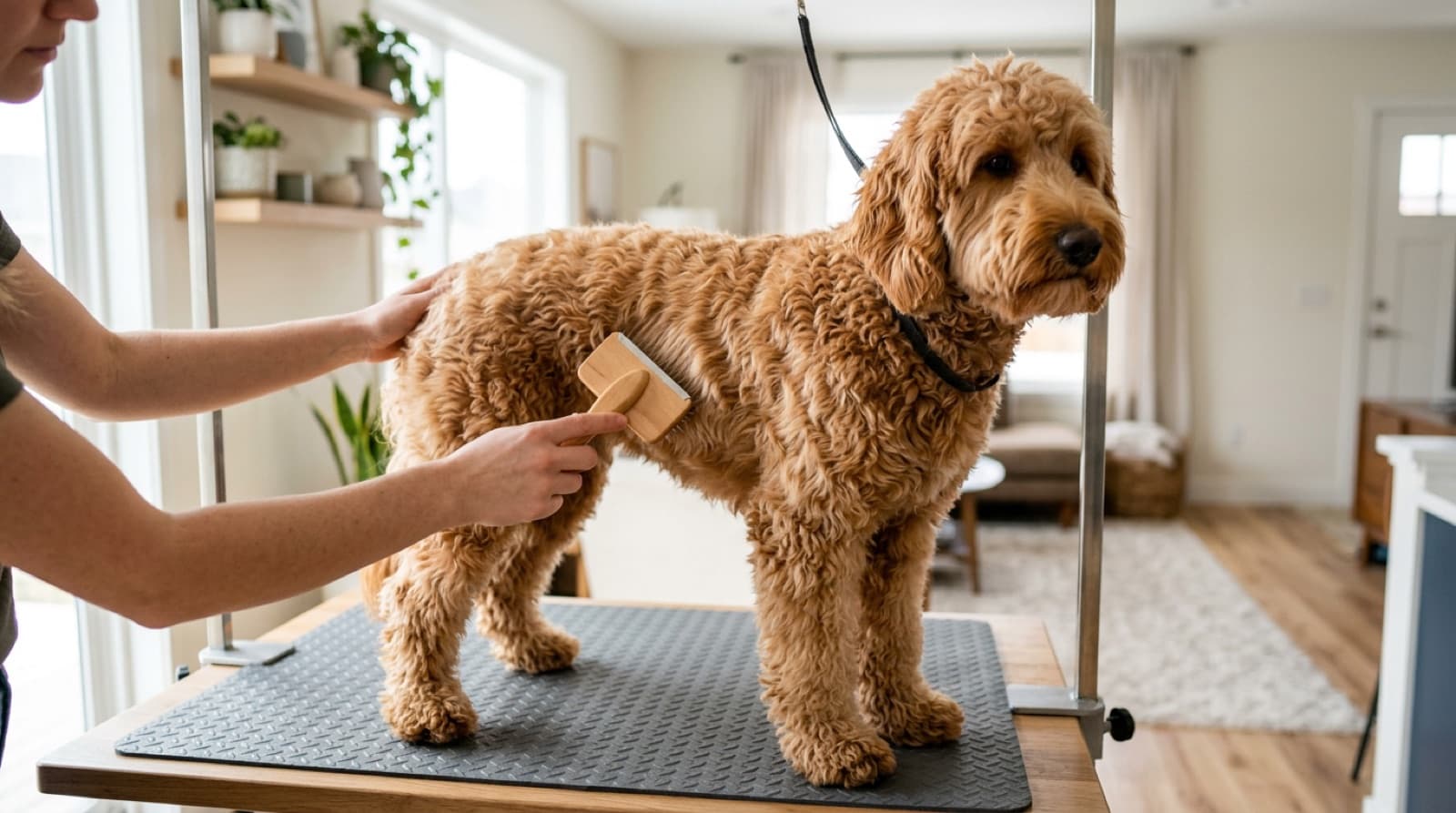
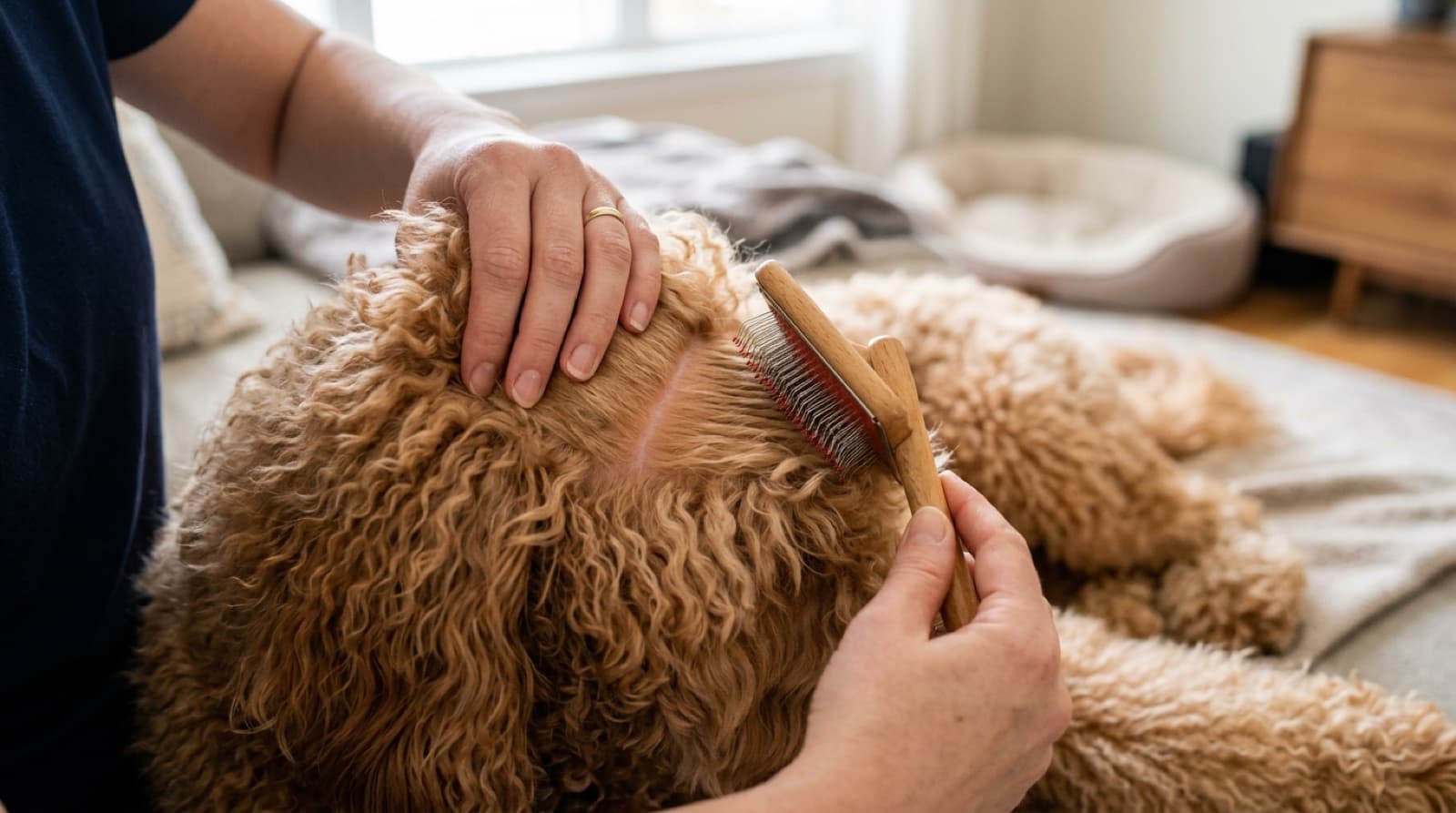
The fix is line brushing. Part the coat in a section down to the skin, hold the hair above the part out of the way, and brush the exposed layer from the skin outward with a firm slicker brush, then move the part along and repeat over the whole dog. The verification step is non-negotiable: run a metal comb through each section, and if it will not glide from the skin out, there is still a mat. A detangling spray adds slip so the brush and comb move with less pulling. Keep a dematting tool for breaking apart small mats before they pelt, but use it sparingly, since it thins the coat, and never take scissors to a mat at home.
Some of the product links in this section are Amazon affiliate links — we may earn a small commission at no extra cost to you. It never changes which products we recommend.
The coat change: a scheduled emergency
Between roughly 8 and 14 months, a doodle's adult coat comes in under the puppy coat and the two tangle into relentless matting. This is normal, it is predictable, and it is when most shave-downs happen. Brush more, not less, through it.
The coat change is the single most-searched Goldendoodle grooming problem, and it catches almost everyone. Somewhere between about eight and fourteen months, the soft silky puppy coat sheds out underneath the denser, curlier adult coat growing in, and during the overlap the dead puppy coat wraps around the incoming adult coat and mats no matter how careful you have been. Owners who felt on top of grooming suddenly feel like they are drowning.
The move is to treat it as scheduled, not as bad luck. Increase brushing before it hits and keep it up daily through the window, and if the coat is winning, book a shorter groom to get through it rather than fighting a losing battle. After the change, the coat settles into its adult texture, usually coarser and curlier than the puppy coat, and the routine becomes predictable again. Knowing this is coming is what keeps a doodle out of a forced shave-down at ten months.
The teddy-bear cut, bathing, and drying
The standard pet look is the teddy-bear cut, a rounded face with an even one-to-two-inch body, and it needs a full hand-scissor finish every visit, which is part of why doodles cost what they do to groom. A shorter contour cut is the lower-maintenance option and the sensible choice if you know you will not brush daily, since less length means less to mat. Be honest with yourself and the groomer about how much brushing you will actually do, and pick the length to match.
Two rules protect the coat around bath time. Brush and comb the dog out completely before the bath, because water tightens any remaining tangle into a pelt, and dry to the skin afterward with a high-velocity dryer while brushing, since a doodle left to air-dry dries curled around its tangles and mats as it goes. A human hairdryer runs too hot for the dense coat. Keep nails short with a nail grinder, since most doodles tolerate a grinder better than clippers.
The honest cost: groomer versus doing it yourself
Doodles are among the priciest breeds to groom, and it is worth pricing in before you adopt. In Canada, a full groom for a standard Goldendoodle commonly runs around $80 to $150 or more per visit, with mini and medium doodles somewhat less, every six to eight weeks. Canadian grooming cost surveys such as Dogster's give a sense of the ranges, and a de-matting surcharge is common when the coat arrives pelted.
The cost is high for concrete reasons: a standard doodle is a large dog with a lot of surface area, the dense continuously growing coat takes a long time to brush out, de-matting adds skilled time, and the teddy-bear look is a full hand-scissor finish every single visit rather than a quick clipper pass. At six to eight week intervals that lands most standard-doodle owners somewhere around $700 to $1,000 or more a year before de-matting fees. Grooming at home cuts that, and the core kit, a real slicker, a metal comb, and a detangler, is inexpensive, with a high-velocity dryer and quality clippers the bigger add-ons. The honest caveat is that doing a doodle well takes real time and technique, and most owners still book the occasional professional scissor cut.
Thinking about adopting a Goldendoodle?
Go in knowing the coat is real work, pick your grooming lane, and you will be a great doodle owner. Browse Goldendoodles and doodle mixes available now from the rescues we track across Canada.
See Available Goldendoodles →Frequently Asked Questions
Are Goldendoodles low-maintenance?
No. The low-shedding coat is one of the highest-maintenance coats of any breed, which surprises owners who were told doodles are easy-care. Low-shedding means the loose hair stays trapped in the coat and mats instead of falling to the floor, so it needs constant brushing or frequent professional grooming. The honest framing is that low-shed does not mean low-maintenance, and every doodle owner has to plan for real grooming.
How often should I brush a Goldendoodle?
Daily for curly and fleece coats, and every two to three days for wavy coats, always brushing all the way down to the skin rather than just the surface. Curly coats can mat to the skin in as little as a couple of days without brushing, so consistency matters more than the occasional long session. Section the coat, brush from the skin outward, and check each section with a metal comb.
Why does my doodle mat even though I brush him?
Almost always because the brushing is only reaching the top layer while mats form against the skin underneath. The coat looks fine on top, then the groomer runs a comb through and finds felt at the roots. The fix is line brushing, parting the coat and brushing each layer from the skin out, followed by a metal comb: if the comb will not glide from root to tip, there is still a mat that the brush missed.
When does the Goldendoodle coat change and why does it mat so much?
Roughly between eight and fourteen months, the soft puppy coat sheds out underneath the denser, curlier adult coat coming in, and the two textures tangle together into a predictable matting crisis. Owners who kept a once-a-week routine often get overwhelmed here, and many shave-downs happen in this window. The move is to pre-empt it by increasing brushing before it hits, because the coat also permanently shifts to a coarser, curlier texture afterward.
Does an F1 or F1b Goldendoodle mat more?
An F1b is curlier and lower-shedding, but it mats faster and grooms more like a Poodle, while an F1 is often wavier and slightly more forgiving to brush. The rule of thumb across all doodle generations is that curlier means more Poodle-like, which means it mats faster and needs more brushing. Even within a single litter, coats range from straight to wavy to curly, so your grooming load depends on the individual coat as much as the label.
Why did the groomer shave my doodle instead of trimming?
Once a coat mats tight to the skin, brushing it out is painful and can damage the skin, so a humane shave-down becomes the only safe option. That is not a groomer failing, it is the consequence of a coat that pelted, and it grows back over about three to four months. The way to avoid it is consistent line brushing and not stretching the time between professional grooms, especially through the coat change.
How much does it cost to groom a Goldendoodle?
In Canada, a full groom for a standard Goldendoodle commonly runs around $80 to $150 or more per visit, every six to eight weeks, with mini and medium doodles somewhat less. Coat condition swings the price, and a matted coat adds a de-matting surcharge or forces a shave-down. Doodles are among the priciest breeds to groom because of their size, the dense continuously growing coat, and the full hand-scissor finish every visit.
Can I groom my Goldendoodle at home?
Yes, with the right tools, a real slicker brush, a metal comb, a detangling spray, and a high-velocity dryer, but two safety rules matter. Never bathe a matted dog, since water tightens the tangles into felt, and never try to cut mats out with scissors, because mats sit tight to the skin and it is easy to cut the dog. Most owners still book periodic professional cuts for the scissor finish even when they brush at home.
How to Groom a Poodle
The Poodle parent coat. The line-brushing rules carry straight over to a doodle.
How to Groom a Bichon Frise
Another curly, mat-prone coat with the same brush-first, never-bathe-a-mat rules.
What to Feed a Goldendoodle
The other half of doodle care: portions, growth, and the sensitive-tummy question.
Goldendoodles for Adoption
Live listings of Goldendoodles and doodle mixes from the rescues we track.