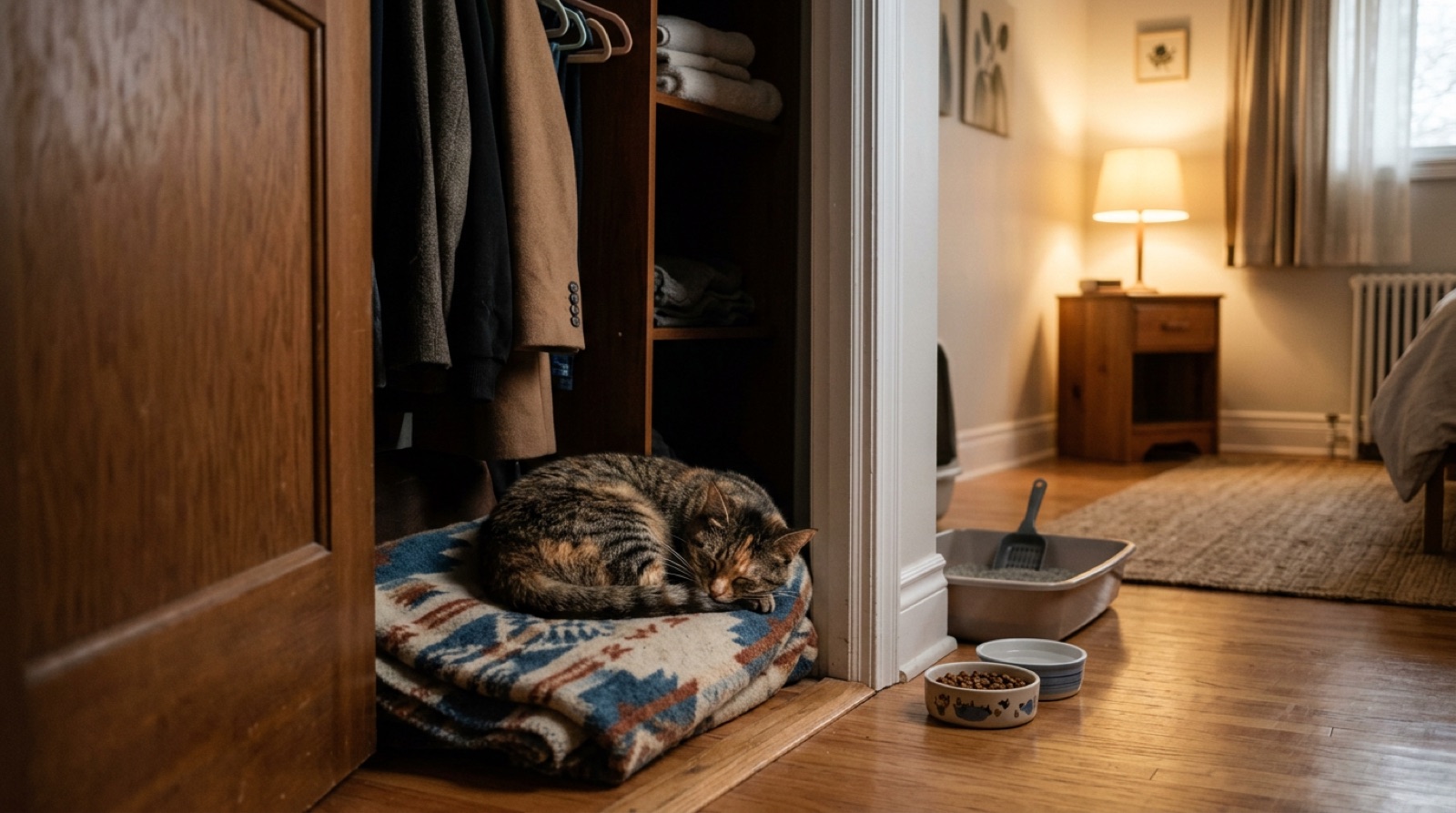
The short answer
Set up one quiet room with a litter box, food and water apart from each other, two hiding spots and the carrier left open. Use the same food and the same litter the rescue used and change neither this week. Let the cat hide and come out on its own, usually at night at first. Book a vet within a week or two. Go to a vet immediately if a male cat strains in the box without producing urine, which is a hours-not-days emergency.
The first week is the part nobody warns adopters about properly. You have spent weeks choosing a cat, you get it home, and it disappears behind the dryer for three days. It is easy to read that as rejection or as evidence that something is wrong.
It is neither. A cat that has just moved has lost every familiar smell and sound at once. Hiding is what a sensible animal does in that situation, and the cats that hide hardest often turn into the most affectionate ones once they decide the place is safe.
What you control is the environment and the pace. Here is how to set both up.
What to Have Ready Before Pickup
| Item | Why it matters |
|---|---|
| Litter box and the same litter the rescue used | Changing brand and box in the same week causes accidents |
| The same food the rescue was feeding | Diet changes plus stress equals diarrhoea, every time |
| Two hiding spots in the safe room | A cat that can hide comes out sooner than one that cannot |
| Water bowl away from the food | Most cats dislike drinking beside their food |
| Scratching post, vertical if possible | Decide where scratching happens before the cat decides |
| A wand toy | Play is how a frightened cat starts trusting a room |
| Carrier left open in the room | Turns the carrier into furniture instead of a vet-visit trigger |
Full first-year budget for all of this is in our Kingston cat cost guide.
Three Days, Three Weeks, Three Months
| Period | What you will see | What you should be doing |
|---|---|---|
| Days 1 to 3 | Hiding, minimal eating, litter use at night only | Leave the cat alone. Sit in the room reading, say nothing, expect nothing. |
| Week 1 to 3 | Coming out when you are still, testing the room, first play | Introduce the rest of the house one room at a time. Keep the safe room open. |
| Month 1 to 3 | Real personality appears, routines form, lap use may begin | Full house access, normal life, first vet check completed. |
Setting up the safe room
Pick the quietest room you have. A spare bedroom is ideal, a bathroom works, a busy hallway does not. Put the litter box in one corner and the food and water somewhere else in the room, because most cats will not eat beside a toilet any more than you would.
Give the cat two ways to hide, not zero. Counterintuitively, a cat with a covered bed and a cardboard box comes out sooner than a cat with nowhere to retreat, because retreating is what makes exploring feel survivable. Leave the carrier open in a corner. It becomes furniture rather than a vet trigger.
Open the carrier, walk away, and let the cat exit in its own time. Do not lift the cat out. Then spend time in the room doing something quiet and ignoring the cat completely. Reading aloud works well, because your voice becomes ordinary background rather than an event.
Food, litter and the one-change rule
Ask the rescue what the cat has been eating and what litter the foster used, then buy both before pickup. This costs nothing and prevents the most common first-week problem, which is diarrhoea from a diet change stacked on top of the stress of a move.
Change one thing at a time and not this week. If you want a different food, transition over seven to ten days once the cat is settled, mixing a little of the new into the old and shifting the ratio gradually. Same with litter. A cat that dislikes an unfamiliar substrate will find your carpet instead, and undoing that takes far longer than waiting a fortnight would have.
One box per cat plus one spare, scooped daily. Most litter box problems are either a medical issue or a box the cat objects to, and it is worth ruling out the medical side first with a vet rather than assuming behaviour.
Registering with a Kingston vet
Book a first appointment within a week or two even when the rescue has done everything. The point is the relationship rather than the exam. When something goes wrong at 8 p.m. on a Sunday, being an existing client of a Kingston clinic changes what is available to you.
Bring the rescue's paperwork so the vet can see what vaccines, deworming and testing are already recorded and when the next boosters fall. Ask new-client wait times when you phone around, since some Kingston practices book well ahead.
Sort the city cat licence at the same time if you live in the urban area. A microchip registered to your current phone number, paired with the licence, is how an escaped cat gets home. Both are covered in our Kingston cost guide.
Symptoms that mean a vet tonight
A male cat straining in the litter box and producing little or no urine is a urinary blockage until a veterinarian proves otherwise. This is measured in hours, not days, and cats die from it overnight. Crying in the box, repeated trips with nothing to show, vomiting or hiding alongside it point the same direction. Go now, before anything behavioural is considered.
Also urgent: open-mouth or laboured breathing, repeated vomiting, no food at all for 24 hours, seizures, obvious trauma or a swollen painful belly. After hours, Kingston Regional Pet Hospital at 1381 Midland Avenue takes emergencies, 613-634-5370. Confirm current hours when you call. Never give a cat human pain medication.
Still choosing a cat?
Kingston foster homes can tell you which cats settle fast and which need a patient household. Browse who is available right now. Listings refreshed regularly.
See Available Kingston Cats →Frequently Asked Questions
How long does it take a rescue cat to settle in?
Longer than most people expect, and the rough shape is three days, three weeks, three months. The first three days are usually hiding and very little eating. By three weeks the cat has learned the routine and started testing the space. By three months you are seeing the actual personality, which is often noticeably different from the cat you met at the shelter. Nervous cats and cats that came out of colony situations can take longer still. Nothing about a slow start predicts a bad outcome.
My new cat is hiding and will not come out. Is that normal?
Completely normal, and it is the single most common worry in the first week. A cat that has just been moved has lost every familiar smell, sound and surface at once, so hiding is a sensible response rather than a problem. Leave food, water and a litter box in the room and let the cat come out on its own schedule, usually at night at first. Do not pull a cat out from under a bed. That teaches the cat that hiding does not work and that you are the reason, which sets you back a week.
What is a safe room and why does it matter?
One closed room, ideally a spare bedroom or a quiet bathroom, holding everything the cat needs for the first few days. Litter box in one corner, food and water away from it, two hiding options, a scratching post and the carrier left open. The point is that a whole house is overwhelming to a cat that does not yet know where anything is or where it can escape to. Restricting the space actually speeds settling up. Open the rest of the house one room at a time once the cat is eating and using the box reliably.
How do I switch my cat to a new food?
Slowly, over seven to ten days, and not in the first week if you can help it. Ask the rescue what the cat has been eating and buy that brand before pickup. Once the cat is settled, mix a small amount of the new food into the old and increase the proportion gradually. Changing diet abruptly on top of the stress of a move is the standard way to end up with diarrhoea and a cat that then avoids the litter box, which turns one problem into two.
Should I change the litter type too?
Not at the same time, and preferably not for a few weeks. Use whatever litter the rescue or foster used and change it later if you want to, one gradual step at a time. A cat that dislikes a new substrate under its feet in an unfamiliar house will find somewhere else to go, and once a cat has picked a corner of the carpet it is much harder to undo. One box per cat plus one spare is the standard, scooped daily.
When should I take my new cat to a vet in Kingston?
Within the first week or two, even when the rescue has completed everything. The visit is not really about medicine, it is about registering with a clinic and having a relationship before you need one at 9 p.m. on a Sunday. Bring the paperwork the rescue gave you so the vet can see what vaccines and treatments are already done and when boosters are due. Kingston has plenty of family clinics, and it is worth asking new-client wait times when you call, since some practices book weeks out.
What symptoms mean I should go to a vet immediately?
Go tonight if a male cat is straining in the litter box and producing little or nothing, because urinary blockage is a life-threatening emergency measured in hours rather than days. Also urgent: open-mouth or laboured breathing, repeated vomiting, complete refusal to eat for 24 hours or more, obvious trauma, seizures, or a swollen painful abdomen. After hours, Kingston Regional Pet Hospital on Midland Avenue handles emergencies at 613-634-5370. When you are unsure, phoning a clinic costs nothing and waiting can cost everything.
My cat is not eating. How worried should I be?
A little reduced appetite in the first day or two is expected. A cat that eats nothing at all for more than about 24 hours needs veterinary attention rather than patience, because cats develop liver problems from not eating far faster than dogs do. Try warming wet food slightly to raise the smell, offering it in a quiet spot rather than a busy kitchen, and leaving the room while the cat eats. If none of that produces food going in by the end of day one, phone your vet.
How do I introduce a rescue cat to my resident cat?
Through a closed door, and slower than feels necessary. Keep the new cat in the safe room for at least the first week and feed both cats on either side of that door so they associate each other with something good. Swap bedding between them so each learns the other's scent before ever seeing them. Then try short supervised visual contact, then brief supervised time together. Hissing and posturing are normal early. Sustained fighting means back up a stage rather than pushing on.
How do I stop my new cat escaping out the front door?
Assume it will try, because a cat that recently arrived has no reason yet to think of your house as home. Keep the safe room door closed while people come and go, and get everyone in the household into the habit of checking behind them. A microchip registered to your current phone number is the single most useful precaution, and Kingston requires a cat licence in the urban area anyway. If the cat does get out, search close to the house at dawn and dusk and look low and under porches rather than up.
When will my cat start being affectionate?
Whenever it decides to, and pushing accelerates nothing. Some cats climb into a lap on day two. Others take three months and then never leave. The reliable way to speed it up is to be boring and predictable, feed on a schedule, play with a wand toy daily, and let the cat approach you rather than reaching for it. Sitting in the room doing something else entirely is remarkably effective. Attention offered rather than demanded is the whole trick with a nervous cat.
Should I adopt two cats at once?
It works better than people assume, particularly with a bonded pair or two cats that already know each other. They settle faster because they have each other as a familiar element in an unfamiliar house, and they entertain each other during a long Eastern Ontario winter when nobody is going outside much. Two strangers introduced at the same time is a harder project. If you want two cats, ask Kingston rescues about pairs they are placing together rather than picking two unrelated cats yourself.
Related Kingston Guides
One search, every Kingston rescue
Shelter cats and foster cats from across Kingston, in a single list.
Browse Available Kingston Cats →New cat? Start with these care guides
Everything a new adopter needs to set up a safe, happy home.