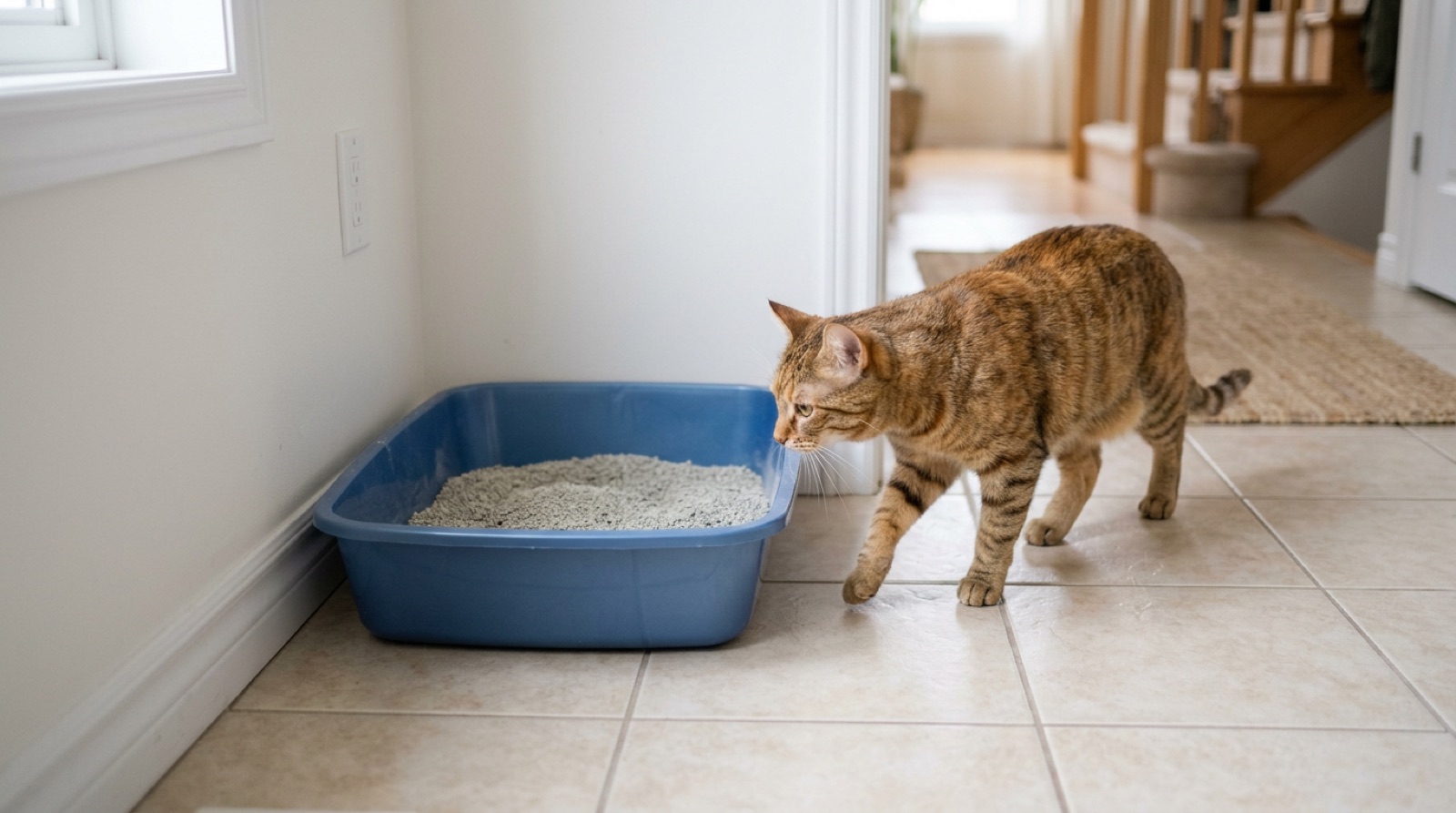
The short answer
Rule out medical causes first. A male cat straining to urinate with little or nothing coming out is an emergency, and an Ottawa 24-hour hospital needs to see him today. If the exam and urinalysis are clean, work the setup: one box per cat plus one, large and uncovered, fine-grained unscented clumping litter, a box on every floor, scooped daily, and washed weekly. Clean past accidents with enzymatic cleaner only. Cats never do this out of spite.
Emergency first: a blocked cat has hours, not days
If your cat, and especially your male cat, is going in and out of the box producing little or no urine, crying while trying, licking obsessively at his genitals, vomiting, or hiding and refusing food, stop reading and get to an emergency hospital. This is a urethral obstruction until proven otherwise. The Cornell Feline Health Center is unambiguous: urethral obstruction is a true medical emergency, and the time from complete obstruction to death may be less than twenty-four to forty-eight hours.
Ottawa has 24-hour emergency care in three quadrants of the city: Alta Vista Specialty and Emergency on Walkley Road, Ottawa Animal Emergency and Specialty Hospital on Lola Street, and Capital City Specialty and Emergency in Kanata. Save the closest number now. Nothing else in this article matters if the cat is blocked.
Litter box problems are the single most common reason cats get surrendered, and it is the most fixable one. That combination is what makes it worth being methodical about. Most people jump straight to changing the litter, then the box, then buying a product, and by the time they get to the vet the cat has been uncomfortable for weeks and has learned to prefer the bathmat.
Work in the opposite order. Medical first, because the body decides everything else. Then resources and setup. Then stress and social pressure, which in a multi-cat home is really just resources by another name.
One thing to let go of immediately: your cat is not angry with you. Cats do not retaliate, and reading the behaviour as spite leads to punishment, which adds stress, which makes the underlying problem worse. What you are looking at is a cat telling you something hurts or something about the box does not work.
Step One: The Medical Causes
A vet visit for a sudden litter box change usually means a physical exam, a urinalysis, and often bloodwork. That combination catches most of what matters. Common culprits:
Urethral obstruction. Life-threatening, mostly male cats, needs care within hours. Covered above.
Feline idiopathic cystitis. Painful bladder inflammation with no infectious cause. Cornell identifies stress as an important factor in its development, and notes multi-cat households and routine changes as risks.
Urinary tract infection and bladder stones. Both make urinating hurt, and a cat that hurts in the box starts avoiding the box.
Kidney disease, diabetes, and hyperthyroidism. All three increase urine volume. A cat that suddenly cannot make it to the box may simply be producing far more than before.
Arthritis. Badly underdiagnosed in cats. A stiff older cat cannot climb into a high-sided box comfortably, and the accidents happen right beside it.
Cognitive decline. In genuinely old cats, forgetting the box location is real. More boxes, closer to where the cat sleeps, helps.
Take a note of what you have actually seen before the appointment: how often, where, how much, whether there was straining or vocalising, and whether the stool is involved as well as urine. That history shortens the diagnostic path considerably. Our Ottawa senior cat guide covers the age-related conditions in more depth.
Step Two: The Setup Variables
Once a vet has cleared the cat, go through this list honestly. Most homes fail at least two lines, and fixing two is often enough.
| Variable | Target | Why it matters |
|---|---|---|
| Number of boxes | One per cat, plus one | Two cats need three boxes. Crowding drives cats to find their own spot. |
| Box size | Large and uncovered | Big enough to stand on all fours and turn around. Most commercial boxes are too small. |
| Litter type | Fine-grained, unscented, clumping | Research consistently shows cats prefer it. Scented litter is for humans. |
| Litter depth | About 3 to 5 cm | Deep enough to dig, shallow enough not to feel unstable underfoot. |
| Location | Quiet, low-traffic, escape routes on two sides | Beside a noisy furnace or washing machine is a box a cat will abandon. |
| Levels of the home | One box per floor minimum | A cat will not climb two flights of stairs in a Glebe row house at 3 a.m. |
| Scooping | At least once daily | Cats avoid dirty boxes in favour of a cleaner surface, like your bathmat. |
| Full wash | Weekly, mild dish soap | Skip strong or citrus cleaners. Ammonia smells like urine to a cat. |
Box count, size, litter texture, and cleaning intervals follow the guidance published by the Ohio State University Indoor Pet Initiative.
The Multi-Cat Maths Nobody Wants to Hear
One box per cat plus one. Two cats, three boxes. Three cats, four boxes. In a downtown Ottawa one-bedroom or a Centretown condo this feels absurd, and it is the recommendation people ignore most often. It is also the one that resolves the most cases.
Spacing matters as much as the count. Three boxes side by side in one bathroom is one location as far as a cat is concerned. A confident cat can guard a single doorway and quietly deny a shyer housemate access without a single hiss, and you will never see it happen. Separate rooms, separate floors.
The same logic applies to every other resource. Multiple feeding stations, multiple water bowls, multiple elevated perches. Cats in a shared space need enough places to be that they are never forced into a standoff. When a household adds a second cat and the resident starts having accidents, the resource count is the first thing to check and the introduction pace is the second. Our Ottawa cat introduction guide covers doing it slowly enough to stick.
Cleaning Up So the Cat Does Not Come Back
Use an enzymatic cleaner made for pet urine. Standard household cleaners remove what you can see and leave the scent markers your cat can still smell, which turns the spot into an established toilet in the cat's mental map of the house.
Never use anything ammonia-based. Ammonia is a component of urine, so to a cat you have just relabelled the spot as a bathroom. Strong citrus and pine cleaners tend to repel cats generally, which is not the outcome you want in the room where the box lives.
Soak rather than wipe. Urine travels into carpet backing and underlay, and a surface wipe leaves the reservoir intact. Saturate the area, let the enzyme work for as long as the label says, and let it dry fully. If the same square metre of a Sandy Hill apartment carpet has been hit repeatedly, replacement is sometimes the only real answer.
Block access while you fix the root cause. A closed door, furniture, or a temporary plastic runner buys time. Cleaning alone never solves it if the medical issue or the box setup is still unaddressed.
Stress Triggers Specific to Ottawa Households
Stress is not a soft factor here. It is a documented contributor to feline idiopathic cystitis, which is a genuinely painful condition. Patterns we see locally:
Term-end moves. Student housing turnover around uOttawa and Carleton means a lot of cats change address in April and August. A move resets a cat's entire map of safe places, and the box is part of that map.
Outdoor cats at ground-floor windows. A cat watching a stray patrol the yard cannot do anything about it, and that frustration frequently comes out as spraying near the window. Blocking the sightline often ends it.
Winter confinement. During a deep freeze everyone is indoors more, routines compress, and the household gets noisier. Cats notice. More vertical space and more hiding spots absorb a surprising amount of that pressure.
Renovation and construction noise. Common in older neighbourhoods like the Glebe and Hintonburg. Set the cat up in a quiet room away from the work with its own box, food, and water for the duration.
New baby, new partner, new dog. Any household composition change is a resource change. Add boxes and perches before the new arrival, not after the accidents start.
If you want a broader read on feline behaviour and environmental needs, the American Association of Feline Practitioners publishes free client brochures that pair well with a vet conversation.
What Not to Do
Do not punish. Rubbing a cat's nose in it, yelling, or spraying water adds stress to a stress-driven problem and damages the relationship you need to fix it.
Do not confine the cat to the box room indefinitely. Short-term retraining in a small space can help under guidance, but weeks of confinement usually makes an anxious cat more anxious.
Do not switch litter abruptly during an active problem. You lose the only variable you had controlled. Add a second box with the new litter instead and let the cat choose.
Do not give a supplement or medication without your vet. Urinary diets and behavioural medications both have real roles, and both need a diagnosis first. We do not recommend doses, and neither should any website.
Do not wait it out. The longer a cat practises going elsewhere, the more established the habit becomes and the harder the retraining gets.
Browse adoptable Ottawa cats
Foster-based Ottawa rescues can tell you exactly how a cat uses its box in a real home before you adopt. Listings refreshed regularly.
See Available Ottawa Cats →Frequently Asked Questions
Why has my cat suddenly stopped using the litter box?
Assume it is medical until a vet says otherwise. A sudden change in litter box habits in an otherwise settled cat is one of the most common ways urinary disease, kidney disease, arthritis, and diabetes announce themselves. Cats do not protest, and they do not do things out of spite. What they do is associate the box with pain and start looking for somewhere that hurts less. Book the exam first. If the bloodwork and urinalysis come back clean, then you have a genuine behaviour or setup problem, and that is far easier to fix.
Is a cat straining to pee an emergency?
For a male cat, yes, and it is measured in hours. A urethral obstruction blocks urine from leaving the body, toxins build up fast, and the Cornell Feline Health Center states plainly that the time from complete obstruction to death may be less than twenty-four to forty-eight hours. If your male cat is squatting repeatedly with nothing coming out, crying in the box, licking his genitals obsessively, vomiting, or hiding and refusing food, go to an emergency hospital now. Do not wait for morning, do not try a diet change, do not read further.
What are the warning signs of a urinary blockage in a cat?
Repeated trips to the box producing little or no urine, straining and vocalising while trying, blood in the urine, obsessive licking at the genital area, a tense or painful belly, vomiting, lethargy, and refusing food. Male cats block far more often than females because their urethra is narrower. Female cats can still develop painful urinary disease that needs same-day care. If you are unsure whether what you are seeing counts, phone a 24-hour hospital and describe it. Triage staff would much rather field the call than see the cat too late.
Where can I take a cat with a urinary emergency in Ottawa?
Ottawa has round-the-clock options across the city, so distance is rarely the barrier. Alta Vista Specialty and Emergency Veterinary Centre on Walkley Road, Ottawa Animal Emergency and Specialty Hospital on Lola Street, and Capital City Specialty and Emergency Animal Hospital on Silver Seven Road in Kanata all run 24-hour emergency services. Pick the one closest to you and program the number into your phone tonight, before you need it. Deciding where to drive while a cat is screaming in a carrier is not a decision anyone makes well.
How many litter boxes should I have?
One per cat, plus one. Two cats means three boxes. This is the single most common gap we see in Ottawa apartments, where floor space is tight and a second box feels like a lot to give up in a downtown one-bedroom. Boxes also need to be spread out. Three boxes lined up along one wall read as a single location to a cat, which defeats the purpose. In a multi-level home, put at least one box on every floor.
What kind of litter do cats actually prefer?
Fine-grained, unscented, clumping litter wins in study after study. The texture is closest to the sand and soft soil cats naturally choose, and clumping litter stays cleaner between scoops. Scented litter is marketed to the human nose and often repels the cat. If you want to switch litter types, do it gradually by mixing the new into the old over a week or two, and put out a second box with the new litter so the cat gets a vote instead of an ultimatum.
Does box location matter that much?
It matters more than almost anything except cleanliness. Cats want a quiet spot with sightlines and more than one way out, because using the box makes them briefly vulnerable. A box wedged beside the furnace, next to a noisy washing machine, or in a basement corner a cat has to cross open floor to reach is a box that gets abandoned. In smaller Ottawa condos the usual compromise is the bathroom, which works well: quiet, easy to clean, and rarely a high-traffic corridor.
Is my cat peeing outside the box out of spite?
No. Cats do not do revenge, and framing it that way sends people down the wrong road. What actually happens is simpler and sadder. Something has made the box unpleasant or unsafe, or something in the cat's body has made urinating painful, and the cat is solving the problem the only way it can. Punishment makes it worse by adding stress, and stress is itself a documented trigger for feline idiopathic cystitis. Treat it as information, not defiance.
What is spraying and how is it different from peeing outside the box?
Spraying is a small amount of urine deposited on a vertical surface by a standing cat with a quivering tail. Regular inappropriate urination is a full bladder emptied on a horizontal surface. The distinction matters because spraying is usually communication, driven by territory, an unneutered cat, a new animal in the home, or a cat visible through a window. Neutering resolves a large share of it. If your cat is spraying at a window, blocking the view of the neighbourhood cat outside often does more than any product you can buy.
Why did my cat start having accidents after I adopted a second cat?
Because the resource maths changed and probably the introduction moved too fast. Two cats need three boxes, more feeding stations, and more vertical space, and a resident cat that feels crowded may start marking or avoiding a shared box. Cornell also notes that living in a multi-cat household is itself a risk factor for feline idiopathic cystitis, which means social stress can produce genuinely painful medical disease. Slow the introduction down, add resources, and get the cat checked. Our Ottawa introduction guide covers the timeline properly.
How do I get the smell out so my cat stops returning to the spot?
Enzymatic cleaner, and only enzymatic cleaner. Regular household products break down the visible mess but leave the scent markers a cat can still detect, so the cat keeps returning to what it reads as an established toilet. Avoid anything ammonia-based, because ammonia smells like urine and effectively advertises the spot. Soak the area properly rather than wiping it, let it dry fully, and block access while you work on the underlying cause. Cleaning alone never fixes it if the box setup or a medical issue is still in play.
My senior cat started missing the box. Is that normal ageing?
It is common, but it is not something to accept without a look. Arthritic cats struggle to climb into high-sided boxes and may stop making it in time, which a low-entry box solves in an afternoon. Cognitive decline can make an older cat forget where the box is, so more boxes closer to where the cat sleeps helps. But kidney disease, diabetes, and hyperthyroidism all increase urination and all show up in older cats, so bloodwork comes first. Ageing explains a lot of things and hides a few important ones.
Can stress alone cause litter box problems?
Yes, and it can cause real physical illness rather than just avoidance. Feline idiopathic cystitis is a painful bladder condition strongly linked to stress, and Cornell lists changes in routine and multi-cat living among the risk factors. In Ottawa the triggers we hear about most are moves at the end of a university term, renovation noise, a new baby, and a cat suddenly seeing strays through a ground-floor window. Environmental enrichment, more vertical space, predictable routines, and hiding spots genuinely help, but a straining cat still needs a vet first.
Related Ottawa Guides
Fixable, Almost Always
Litter box trouble sends far too many Ottawa cats back to a shelter. Vet first, then resources. Most cases resolve.
Browse Available Ottawa Cats →New cat? Start with these care guides
Everything a new adopter needs to set up a safe, happy home.