The short answer
No face-to-face meeting on day one. Put the new cat in a closed safe room for several days, then swap bedding and scent between the two before they ever see each other. Feed them on either side of a closed door, moving the bowls closer daily. Only then allow brief visual contact through a barrier, then short supervised sessions. Budget two to six weeks, double every resource, and go back a stage the moment either cat stops eating.
Almost every cat introduction that goes badly went badly in week one. Someone opened the carrier in the living room, the resident cat came around the corner, and both animals got a first impression that took months to overwrite. It is completely understandable. You are excited, the cats are right there, and waiting feels unnecessary.
Cats do not work that way. They identify who belongs to their group by scent, not by appearance, and a cat that smells wrong is an intruder no matter how friendly it looks. The entire method below is built around that one fact. You are constructing a shared household scent before either cat has to deal with the sight of the other.
Done properly this takes two to six weeks and is mostly waiting. Done badly it takes months of management and sometimes never fully resolves. The staged version is below, along with the dog variant and what to do when it stalls. If you have not adopted yet, the Ottawa cat listings include bonded pairs, which skip this process entirely.
The Six Stages
| Stage | Typical length | What you do | Move on when |
|---|---|---|---|
| 1. Separate | 3 to 7 days | New cat in a closed safe room. No visual contact at all. | New cat eats, drinks, and uses the box normally. |
| 2. Scent swap | 3 to 7 days | Trade bedding and socks rubbed on cheeks. Swap room access. | Both cats sniff the other scent without hissing or fleeing. |
| 3. Feed at the door | 5 to 10 days | Meals on either side of a closed door, moving bowls closer daily. | Both eat calmly within a foot of the door. |
| 4. Visual, barrier on | 1 to 2 weeks | Door cracked and wedged, or a baby gate. Short sessions only. | Looking at each other without staring, puffing, or growling. |
| 5. Supervised together | 1 to 3 weeks | Short shared time with a wand toy and two exits per room. | Neutral coexistence. They ignore each other. |
| 6. Full access | Ongoing | Unsupervised, with resources permanently doubled. | No guarding of boxes, food, or doorways. |
Durations are typical, not prescriptive. The cats set the pace, and moving to the next stage before both are relaxed is what causes setbacks.
Stage 1: The Safe Room
One closed room with a litter box, food, water, a bed, a scratching surface, and at least one place to hide. A spare bedroom is ideal. A bathroom works fine, which matters in smaller downtown and Centretown apartments where a spare room is not on the table.
No visual contact during this stage. The cats will absolutely know about each other through the gap under the door, and that is exactly the point. They are exchanging information in the way cats prefer, without either one being cornered.
You are watching three things in the new cat: eating, drinking, and litter box use. All three normal means the cat is settling and you can begin scent work. The quarantine also protects your resident cat until the new arrival has been examined by a vet, since upper respiratory infections move easily between cats. Our first week guide covers safe room setup in more detail.
Stage 2: Scent Swapping, the Step That Does the Work
If you only do one thing from this article properly, do this one. Swap bedding between the safe room and the rest of the house. Rub a clean sock gently on one cat's cheeks, where the facial scent glands are, and leave it near the other cat's food bowl. Repeat daily with fresh items.
After several days, swap the spaces themselves. Put the resident cat in a closed room for an hour and let the new cat explore the house, then reverse it. Each cat gets to investigate the other's scent map thoroughly without any possibility of a confrontation. This is often the moment the tension drops noticeably.
Watch the reaction rather than the calendar. A cat that sniffs the swapped bedding and walks away calmly is ready to move on. A cat that hisses at it, backs off, or refuses to approach needs more days at this stage. Nothing is lost by staying here longer.
Stages 3 to 5: Food, Then Sight, Then Space
Feed at the door. Meals on either side of the closed door, starting far enough back that both cats eat comfortably. Move the bowls a few centimetres closer each day. The other cat becomes the thing that predicts dinner. If either cat stops eating or backs away, return to yesterday's distance and hold for a couple of days.
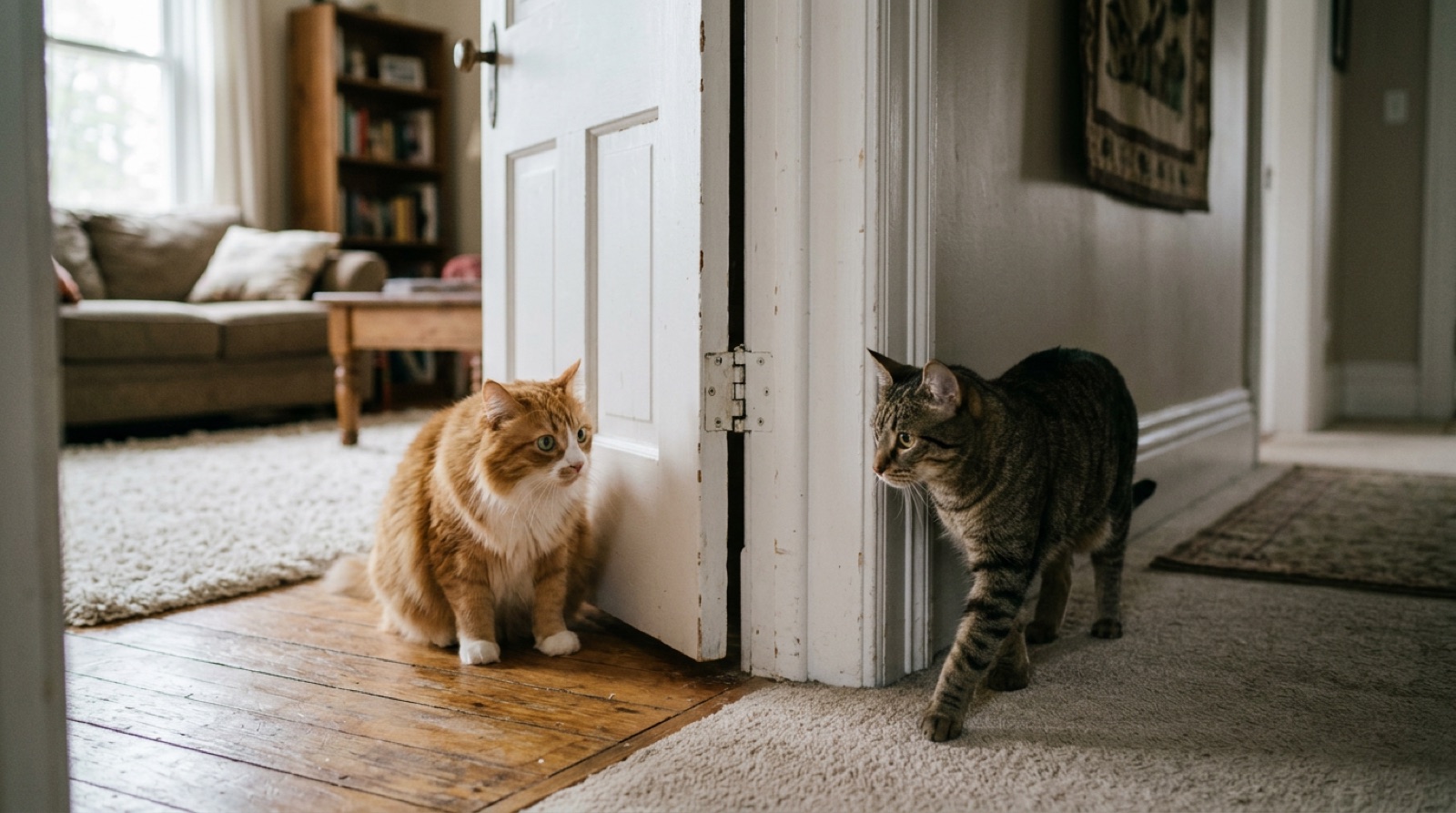
First visual contact, barrier on. Crack the door and wedge it, or use a baby gate. Keep the first sessions to a few minutes and end them while both cats are still relaxed. Ending on a good note matters far more than lasting a long time. Toss treats to both cats so looking at each other pays off.
Supervised time together. Short sessions in a room with two exits and vertical escape routes. Use a wand toy so both cats are focused on something other than each other. Do not force proximity, do not hold either cat, and end early. Build the length gradually over days.
Full access. Only when they can share space without tension, and only with resources permanently doubled. Three litter boxes for two cats, spread across the home, plus separate feeding stations and several elevated spots.
Introducing a Cat to a Resident Dog
Same staged structure, with two additions: the dog is on a leash for every early session, and the cat has a guaranteed escape route the dog cannot follow.
Practise the dog's settle and leave-it away from the cat first, so those cues are reliable before they are needed. A dog that cannot settle on cue is not ready for stage four regardless of how many days have passed.
Vertical escape is the non-negotiable piece. Shelves, a tall cat tree, or a baby gate the cat can clear and the dog cannot. A cat that knows it can leave is a cat that stays calm, and calm cats do not trigger chase behaviour.
End every session while it is still going well, and never leave them alone together until you have weeks of boring, uneventful shared time behind you. Prey drive is not a training failure, it is a hardware feature in some dogs, and management matters more than optimism.
For an independent read on introductions and feline social behaviour, the ASPCA cat care library is a solid non-commercial reference, and the International Association of Animal Behaviour Consultants lists qualified consultants if you need hands-on help.
When It Stalls
Go back one stage, not to the beginning. A setback usually means you moved half a step too fast. Several days at the previous stage generally resolves it.
Add resources before you add training. Most conflict framed as personality is actually competition. Three boxes for two cats, separate feeding stations, more perches. In Ottawa apartments this is the fix that gets skipped and the one that works.
Rule out pain. Sudden aggression between previously settled cats often has a medical cause. Dental pain and arthritis both shorten a cat's fuse considerably. A vet visit is a reasonable early step, not a last resort.
Never use your hands to break up a fight. A blanket, a cushion between them, or a noise from across the room. Cat bites become infected quickly and often need medical treatment.
Accept polite avoidance as success. Plenty of multi-cat homes run on time-shared space and separate resource stations for years. Two cats that ignore each other have a working relationship. Grooming and cuddling are a bonus, not the benchmark.
Browse adoptable Ottawa cats
Bonded pairs skip the introduction entirely, and foster-based rescues can tell you how a cat has lived with other animals. Listings refreshed regularly.
See Available Ottawa Cats →Frequently Asked Questions
How long does it take to introduce two cats?
Two to six weeks for most pairs, and it is entirely normal for it to take longer. Kittens often integrate in days because adults tolerate them more easily. Two adult cats who each had a home to themselves can take a couple of months to reach genuine ease. The variable that matters most is how fast you moved in the first week. Almost every introduction that fails badly was rushed at the start, and going backwards after a bad fight is much harder than going slowly the first time.
Should I let my cats meet on the first day?
No. This is the single most common mistake and the one that costs the most time to undo. A face-to-face meeting on day one gives both cats a frightening first impression that then has to be overwritten. Cats build their sense of who belongs through scent long before sight, so the first several days should have no visual contact at all. Set the new cat up in a closed room and let the two of them learn about each other through the gap under the door.
What is scent swapping and why does it matter?
It is deliberately exchanging each cat's smell before they ever see one another, and it does more work than any other step. Swap bedding between the rooms, or rub a clean sock on one cat's cheeks and leave it near the other's food. Later, swap which cat has run of the house for an hour so each explores the other's scent map without a confrontation. Cats identify group members by a shared colony scent. You are building that shared scent before the first meeting rather than after it.
Why feed cats on either side of a closed door?
Because it builds a positive association at exactly the moment the other cat is present. The other cat becomes the thing that predicts dinner instead of the thing that threatens territory. Start with the bowls far enough back that both cats eat comfortably, then move them a few centimetres closer each day. If either cat stops eating or backs away, you moved too fast. Go back to yesterday's distance and hold there for a couple of days before trying again.
What if my cats hiss at each other?
Hissing is communication, not failure. It means one cat wants more space, and that is a reasonable thing for a cat to say. What matters is what follows. Hissing that ends with both cats settling is fine and you can continue at the current pace. Hissing that escalates to yowling, chasing, or a fight means separate them and go back one stage for several days. Never break up a fight with your hands. Use a blanket, a cushion, or a noise from a distance.
How many litter boxes do I need with two cats?
Three. The rule is one per cat plus one, and it is the resource most people skip when they add a second cat to an Ottawa apartment. Spread them out, because three boxes in one bathroom counts as a single location to a cat. A confident cat can silently guard one doorway and deny access to a shyer housemate without anything you would notice as aggression. The same applies to food bowls, water, and elevated resting spots. Multiply everything.
How do I introduce a cat to a resident dog?
Same staged pattern, plus a leash and a guaranteed escape route. Keep them separated at first and swap scent exactly as you would with two cats. Practise the dog's settle and leave-it commands away from the cat before they ever meet. First visual sessions happen with the dog on a leash and calm, ending while it is still going well. The non-negotiable is vertical escape: shelves, a cat tree, or a baby gate the cat can clear and the dog cannot. Never leave them alone together until you are certain.
Can I introduce a new cat in a small apartment?
Yes, and plenty of Ottawa adopters do it in one-bedrooms downtown and in the Glebe. A bathroom works as the safe room, since it is quiet and easy to clean. What small spaces demand is more vertical territory rather than more floor space. Cat trees, wall shelves, and window perches let two cats occupy the same room at different heights, which is how they avoid conflict naturally. Do not skip the extra litter box because the flat feels tight, since that is the shortcut that produces accidents.
Should I adopt a bonded pair instead?
If you want two cats, a bonded pair skips this entire process. They already live together, already share a scent, and already have a working relationship, so you get two cats with no introduction at all. Ottawa rescues list bonded pairs specifically because splitting them causes real distress. It is genuinely the easiest route into a two-cat household, and pairs often wait longer for a home because adopters assume two cats is twice the difficulty. It usually is not.
What are the signs the introduction is going well?
Boring is the goal. Cats sleeping in the same room facing away from each other, eating within sight without tension, and walking past one another without changing pace are all excellent signs. Mutual grooming and sleeping in contact are the gold standard, but plenty of cats never get there and live together perfectly well for years. Neutral coexistence is a complete success. What you do not want is one cat blocking doorways, one cat hiding constantly, or either one stopping eating.
What if the cats never get along?
Some pairings settle at polite avoidance and that is a real outcome. Cats are not obligate social animals, and a household where two cats time-share space with separate resource stations can be stable and calm for years. If there is ongoing fighting, injury, or one cat hiding constantly and losing weight, get veterinary input first, since pain and illness drive a lot of inter-cat aggression. After that, a qualified behaviour consultant is worth the money. Going backwards to full separation and restarting slowly resolves more cases than people expect.
Does the new cat need its own vet visit before meeting my cat?
Yes, and this is a step people rush past. Ottawa rescues test for FIV and FeLV and vaccinate before adoption, which covers the big items, but a new cat should still be examined and cleared before sharing space, food bowls, or a litter box with your resident cat. Upper respiratory infections and parasites travel easily between cats and shelters are a common source of both. The safe room quarantine period does double duty here: it is a behavioural tool and a health one.
Related Ottawa Guides
Slow Is Fast
A patient first week saves months of management. Ottawa rescues also list bonded pairs that need no introduction at all.
Browse Available Ottawa Cats →New cat? Start with these care guides
Everything a new adopter needs to set up a safe, happy home.