The short answer
Train recall hard, but never trust it off-leash in an unfenced space. A Basset has one of the strongest noses in dogdom plus legendary stubbornness, so a scent overrides training. Exercise on a long line (clipped to a harness), in fully fenced dog parks, or a secure yard. Escaping to follow a scent is a top reason Bassets go missing, so secure the fence and doors, and microchip plus keep the Ottawa licence tag on. The baying is instinctive, manageable but not eliminable, a real consideration in apartments. Bassets are stubborn but food-motivated, so keep training short, upbeat, and treat-rich, and make the dog want to comply. Never use harsh methods, they shut a Basset down.
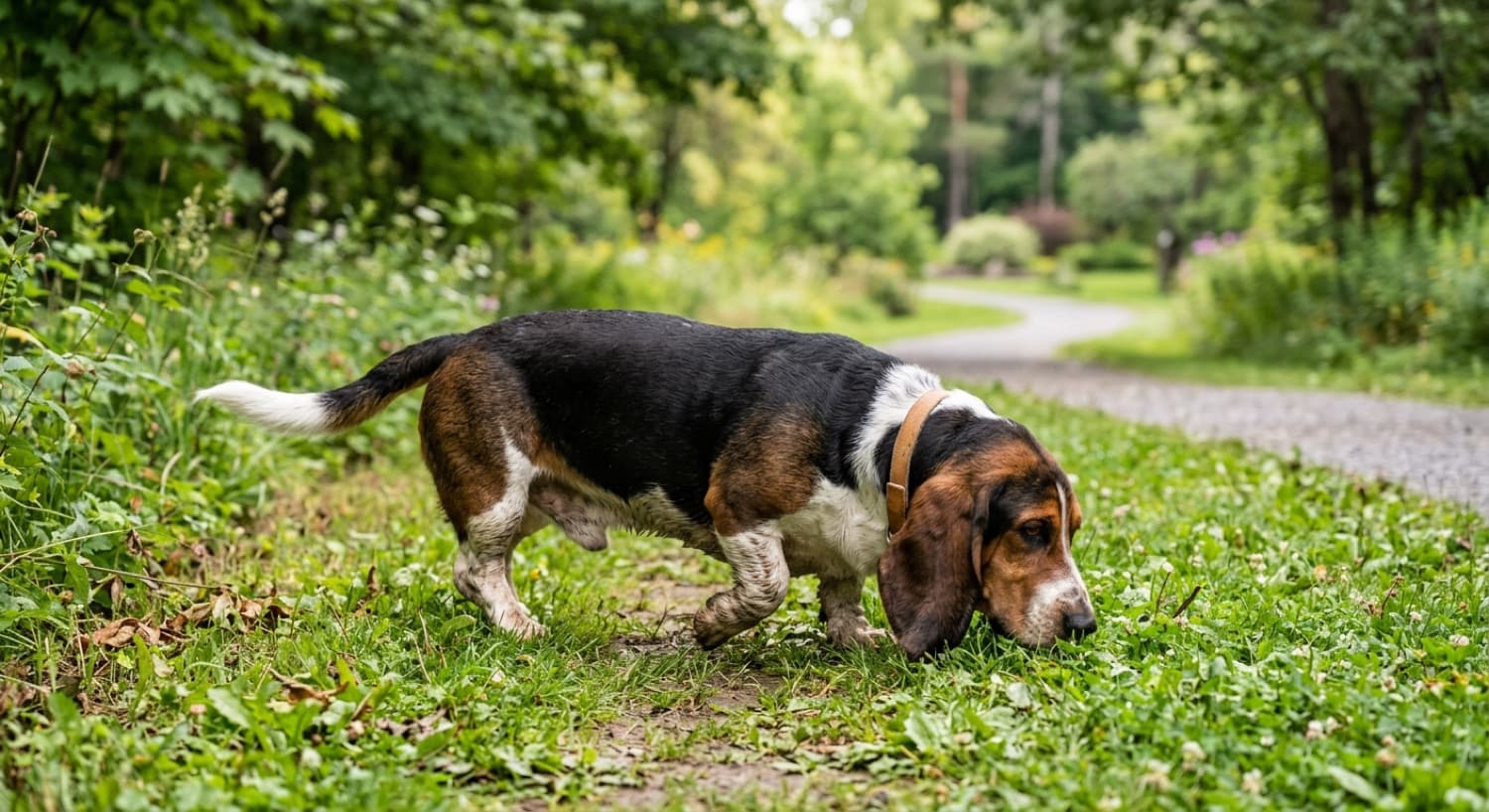
The nose beats the recall, and that is the whole game
Every honest Basset guide starts here, because it shapes everything else. Bassets were bred over centuries to put that famous nose to the ground and follow a scent trail for hours with total focus, ignoring distractions, including a handler calling them back, and the Canadian Kennel Club classes the Basset as a scent hound built for exactly that work. Combine that drive with the breed’s legendary stubbornness and you get a dog whose recall evaporates the moment a real scent takes over.
So the rule is simple and non-negotiable: a Basset does not run loose in unfenced spaces. Not on a quiet Ottawa trail, not in an empty field, not “just this once.” Use a long line for freedom with control, and reserve off-leash running for fully fenced dog parks. This is not you failing to train the dog well enough. It is the most experienced Basset owners and rescues agreeing on the same point: the nose is stronger than the training, and planning around it is what keeps the dog safe.
Secure the environment, and work with the stubbornness
Escaping to follow a scent is why Bassets go missing. A Basset on a trail will squeeze under or through a fence, slip out an open door, and wander far, so prevention is environmental: a secure fence with the bottom blocked (Bassets are low and wriggle through surprising gaps), closed gaps, nose-proof gate latches, strict door discipline with the whole household on board, and never loose in an unfenced yard. Microchip the dog and keep the City of Ottawa licence tag on, covered in our Ottawa pet licensing guide.
On obedience, work with the stubbornness rather than against it. Bassets are independent and not naturally biddable, but they are food-motivated, so use tasty rewards, keep sessions short and upbeat, and make the dog want to comply. Never use harsh methods, they make a Basset shut down or dig in. Manage the baying with exercise, a “quiet” cue, and gradual alone-time training. Settling a newly adopted Basset is covered in our first-week rescue dog guide.
Find your Basset Hound in Ottawa
Adult rescue Bassets come with foster notes on temperament, vocal level, and how they do with kids and dogs, so you can match the individual to your home. Browse live NCR inventory.
See Available Basset Hounds →Exercise the nose, protect the back
A Basset needs moderate daily exercise, less than a working breed but real, and scent-based activity satisfies it best. Sniff walks on a long line, scent games, and food puzzles engage the nose and tire the dog mentally. Because the breed is prone to obesity and back trouble, keeping a Basset active and lean matters, but avoid high-impact activity that stresses the long back (no repeated jumping), and keep it moderate.
For off-leash running, use only fully fenced dog parks. In an Ottawa winter, keep the coldest-day walks shorter, the low belly and long ears get cold and deep snow is hard going for a heavy, short-legged dog, and lean on indoor scent games. The weight-and-back connection is covered in our Basset health guide. A well-exercised Basset is calmer, quieter, and less likely to invent its own trail-following adventures.
Frequently Asked Questions
Can Basset Hounds be trained to have reliable recall?
You can build a decent recall, but you should never trust it completely off-leash in an unfenced space, and that distinction matters. A Basset is a scent hound bred to follow a trail with single-minded focus, ignoring everything else, and when a strong scent takes over, the nose overrides training in a way it does not for most breeds, made worse by the breed’s legendary stubbornness. Even a well-trained Basset may put its nose down and simply leave, deaf to your calls. So train recall, reward it richly, and use it every day, but treat off-leash freedom in unfenced areas as off the table. Exercise your Basset on a long line, in fully fenced dog parks, or a secure yard. This is not a training failure, it is the honest reality of the breed, and accepting it keeps your dog safe, because a Basset on a scent will not come back until the trail runs out.
Are Basset Hounds stubborn and hard to train?
Yes, deservedly, Bassets are among the most stubborn breeds, and it is one of the defining things to understand before adopting one. Bred to work independently, following a scent trail for hours without direction, they were never selected to look to a handler for guidance, so they are far less naturally biddable than a Lab or a Shepherd. A Basset will happily decide your request is not worth its time, and no amount of repetition or force changes that, in fact, harsh methods make a Basset shut down or dig in further. The good news is that Bassets are food-motivated, which is the key that unlocks training: with tasty rewards, short upbeat sessions, and patience, a Basset can learn manners and basic obedience, just slower and on its own terms. The trick is making the dog want to comply rather than trying to compel it. Manage your expectations: a trained Basset is a well-mannered companion, not an off-leash obedience star.
Why do Basset Hounds escape and follow their nose?
Because the nose leads and the body follows, this is the essence of a scent hound. A Basset has one of the most powerful noses in the dog world (second only to the Bloodhound), and when it catches an interesting scent it will follow the trail with total focus, squeezing under or through fences, slipping out open doors, and wandering far from home, oblivious to danger or your calls. This determined, nose-driven wandering is a common reason Bassets go missing. Prevention is about securing the environment, not just training: a secure fence with the bottom blocked against digging or squeezing under (Bassets are low and can wriggle through surprising gaps), closed gaps, gate latches the dog cannot nose open, and strict door discipline with the whole household on board. Never leave a Basset loose in an unfenced yard. Microchip the dog and keep the City of Ottawa licence tag on, because a nose-following Basset is more likely than most breeds to end up lost.
How do I manage a Basset Hound’s baying and howling?
You manage it more than eliminate it, because the deep bay is deeply instinctive, a Basset’s loud, carrying hound voice is what it was bred to use on a trail and to signal the hunter. That said, you can reduce it. Make sure the dog is well exercised and not bored, because an under-stimulated Basset vocalises more. Avoid accidentally rewarding the baying with attention. Teach a "quiet" cue by rewarding calm silence. Address any separation-related howling with gradual alone-time training rather than punishment. And be realistic before you adopt: if you live in an Ottawa apartment or attached townhouse with sound-sensitive neighbours, a Basset’s voice is a genuine consideration, that bay carries. Some baying is simply part of owning the breed, and a Basset will never be a silent dog, but a well-exercised, well-managed one is far quieter than a bored, lonely one.
What is the best way to exercise a Basset Hound in Ottawa?
Lead with the nose, but keep it controlled. A Basset needs moderate daily exercise, less than a working breed, but real, and scent-based activity satisfies the breed in a way plain walking does not. Sniff walks on a long line, where the dog is allowed to track and explore at its own pace, are ideal, and scent games and food-puzzle work at home add enrichment. Because Bassets are prone to obesity and back trouble, keeping them active and lean matters, but avoid high-impact activity that stresses the long back, no repeated jumping, and keep it moderate. For any off-leash running, use only fully fenced dog parks, never an open field or trail, because the nose will take the dog away. In an Ottawa winter, keep the coldest-day outings shorter (the low belly and long ears get cold and deep snow is hard going for a heavy, short-legged dog) and swap in indoor scent games. A well-exercised Basset is calmer, quieter, and less likely to invent its own entertainment.
Should I use a long line and a harness with my Basset Hound?
Yes to both. A long line is the single most useful piece of equipment for a Basset owner: a 15 to 30-foot long line clipped to a well-fitted harness lets your Basset range, sniff, and explore with real freedom while you keep the physical control that recall alone can never guarantee for a scent hound. It is the safe middle ground between a short leash and true off-leash, which is not appropriate for the breed in unfenced spaces. Use a harness rather than a neck collar, both to avoid pressure on the neck of a heavy dog that pulls toward scents, and for better control. Practise recall on the long line constantly, rewarding every check-in, so you build the best recall the dog is capable of while never risking a scent-driven bolt. On Ottawa trails and in open parks, the long line lets a Basset do what it loves, follow its nose, without the risk of it vanishing over the horizon after a trail.
Are Basset Hounds good with kids and other dogs?
Generally very good, which is a big part of their family appeal. Bassets are pack hounds bred to work in groups, so they are typically sociable, tolerant, patient, and friendly with other dogs, and their easygoing, gentle nature suits households with children well. As always, supervise young kids and dogs together, teach children to respect the dog around food (given the Basset’s strong food drive, a resource-guarding flashpoint to manage), and be mindful of the breed’s back, so kids should not climb on or roughly handle a long-backed dog. Read the individual dog: a rescue’s foster notes will tell you how a particular Basset does with kids, dogs, and cats. The bigger challenges with a Basset are almost never sociability, they are the stubbornness, the nose, the voice, and the back, not aggression, which makes the breed a mellow, affectionate family companion for the right, prepared household.
Related Guides
New dog? Start with these care guides
Everything a new adopter needs to set up a safe, happy home.