The short answer
Prevent disc injury with a few lifelong habits: keep the dog lean (weight is the biggest controllable risk), use ramps and pet steps instead of letting the dog jump on and off furniture or the car, carry the dog on stairs or gate them off, lift with support under chest and rear so the back stays level, and walk on a harness, not a collar. Learn the warning signs, a hunched back, yelping, trembling, wobbly or dragging hind legs, and treat sudden pain or weakness as an emergency: the window for the best surgical outcome is measured in hours. Many dogs recover well; some thrive in wheelchairs. Don’t wait and see.
If you see sudden back pain or weakness, go now
Sudden yelping, a hunched or trembling back, reluctance to move, wobbly or dragging hind legs, or inability to walk is a spinal emergency. The chance of a full recovery drops with every hour, so do not wait. Ottawa has 24-hour emergency care, including the Alta Vista Animal Hospital. Program the number into your phone before you ever need it.
Why the back is so vulnerable
The Dachshund’s long body and short legs come from chondrodystrophy, a form of dwarfism that also causes the cushioning spinal discs to harden and degenerate early in life. Degenerated discs are prone to bulging or rupturing under load or a sudden movement, pressing on the spinal cord, this is intervertebral disc disease (IVDD). It is why the breed is affected far more than any other, with roughly a quarter of Dachshunds having an episode in their lifetime.
You cannot change the genetics, but you can change the odds. A single bad jump can trigger an episode, so the whole strategy is to remove those triggers and reduce the load on the spine every day. The prevention below is not optional pampering; it is the core of responsible Dachshund ownership.
The prevention checklist
- Keep the dog lean. Weight is the biggest controllable risk factor. Measure meals, count treats, feel the ribs.
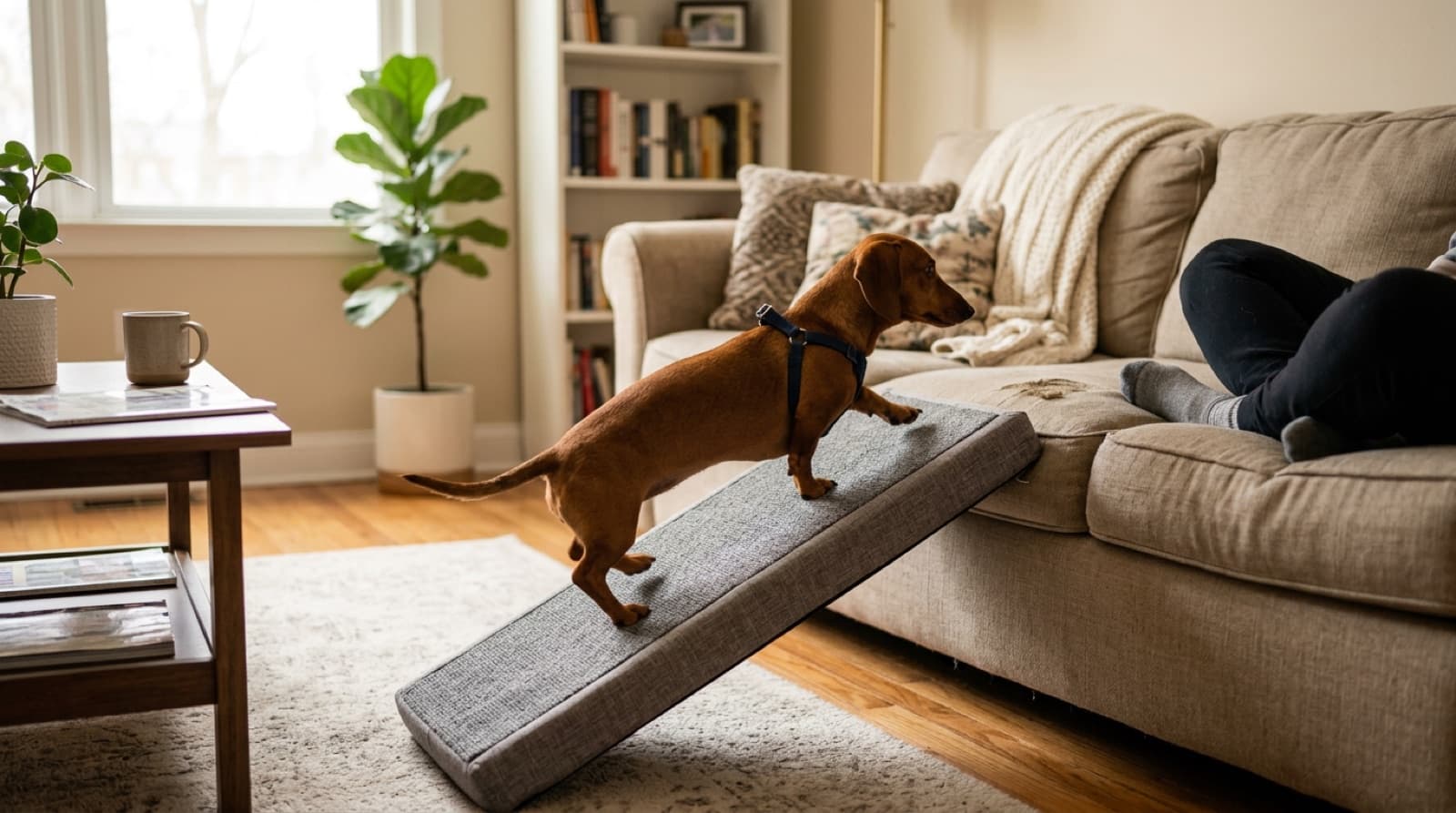
- Ramps and steps everywhere. Couch, bed, car, any height the dog would otherwise jump. Train the dog to use them.
- Manage stairs. Carry the dog, especially going down, or gate off stairs entirely.
- Lift correctly. Support chest and rear together so the back stays level. Never dangle by the front end.
- Harness, not collar. A neck collar that jerks can stress the spine and neck; walk on a well-fitted harness.
- Limit rough play. Discourage twisting, rearing up on hind legs, and jarring landings.
Weight control ties directly into the broader health picture in our Dachshund health guide, and settling a new rescue safely (including ramp training from day one) is covered in our first-week guide.
Find your Dachshund in Ottawa
Adult rescue Dachshunds come with foster notes on temperament and any back history, and some rescues have IVDD-experienced dogs looking for understanding homes. Browse live NCR inventory.
See Available Dachshunds →Frequently Asked Questions
How do I prevent back problems in my Dachshund?
Prevention comes down to a handful of habits practised consistently for the dog’s whole life. Keep the dog lean, weight is the biggest controllable risk factor for a disc injury. Ban jumping on and off furniture and getting in and out of the car by using ramps or pet steps everywhere the dog would otherwise leap. Block or carry the dog on stairs, especially going down, which is hardest on the spine. Lift correctly, always supporting both the chest and the rear so the back stays level, never dangling the dog by the front end or scooping under the belly alone. Use a harness rather than a neck collar for walks. Discourage rough play that involves twisting or rearing up. None of this is complicated, but it has to be constant, because a single bad jump can trigger an episode.
What are the warning signs of IVDD in a Dachshund?
Learn these, because fast action changes outcomes. Early or mild signs include a reluctance to jump, climb stairs, or move normally; a hunched or arched back; trembling or shivering; yelping or crying when picked up or touched along the spine; and a tense, tucked posture. More serious signs are a wobbly, uncoordinated, or "drunken" hind end; dragging one or both back legs; and complete loss of the ability to stand or walk. Any of these, especially the sudden onset of pain or hind-leg weakness, is a medical emergency. The window for the best surgical outcome is short, often measured in hours, so do not wait to "see if it improves." Get to an emergency vet immediately and describe exactly what you saw and when it started.
Should Dachshunds use stairs and jump on furniture?
Ideally no, and this is one of the most important management points for the breed. Jumping down from a couch, bed, or car seat sends a jarring compressive force through the spine on landing, and descending stairs repeatedly loads the back awkwardly, both are classic triggers for a disc injury. The practical fixes are ramps and pet steps at every height the dog frequents (couch, bed, car), training the dog to use them, and carrying the dog up and down stairs or blocking stair access with a gate. Many Ottawa Dachshund owners rearrange furniture and add ramps throughout the home, and it becomes second nature. It feels like a lot at first, but preventing one surgery-level disc rupture pays for a houseful of ramps many times over.
How do I safely pick up a Dachshund?
Support the whole length of the back so it stays level and horizontal, never let the spine curve or the body dangle. Place one hand or forearm under the chest between the front legs, and the other hand or forearm under the hindquarters and rear legs, then lift both ends together so the back stays straight, like lifting a plank rather than a sack. Hold the dog against your body for stability. Never pick a Dachshund up by the front legs, under the armpits alone, or by scooping only under the belly, all of which let the spine sag or twist. Teach everyone in the household, and any dog-sitter, the correct method, and teach children to ask an adult to lift the dog rather than doing it themselves. Consistent correct lifting protects the back through thousands of daily pickups.
What does IVDD treatment cost in Ottawa, and does surgery work?
Treatment depends on severity. A mild episode caught early may be managed conservatively with strict crate rest for several weeks, anti-inflammatory and pain medication, and careful rehabilitation, costing hundreds to low thousands. A severe herniation with significant weakness or paralysis often needs spinal surgery (a decompression procedure) plus hospitalization and rehab, which in Ottawa can run roughly $5,000 to $10,000 or more. Surgery has a good success rate when done promptly, especially if the dog still has deep pain sensation in the legs, which is why speed matters so much. Many dogs recover well and return to a good quality of life, some with lasting management needs. This is precisely why pet insurance taken out early, and confirmed to cover the back, is such a strong idea for the breed, as covered in our health guide.
Can a paralysed Dachshund recover or live a good life?
Often yes, on both counts. With prompt surgery, many Dachshunds that have lost the ability to walk regain function, particularly when they still have deep pain sensation and treatment happens quickly, which is the single biggest reason to treat sudden paralysis as an emergency rather than waiting. Even dogs that do not fully regain walking can live happy, active lives with support: doggie wheelchairs (carts) let them run and play, bladder-expression routines manage continence, and many adapt with remarkable resilience. Rescues sometimes have IVDD-affected or "wheelie" Dachshunds looking for understanding homes, and they can be wonderful, low-drama companions for the right adopter. The key messages are act fast on a sudden episode, and know that a back injury, while serious, is not necessarily the end of a good life for the dog.
Do all Dachshunds get IVDD?
No, but the risk is high enough to plan around as if it could happen to yours. Studies suggest roughly a quarter of Dachshunds experience an IVDD episode in their lifetime, which means most do not, but a one-in-four lifetime risk is far higher than any other breed and unpredictable in timing. Genetics play a large role, some lines are more prone, and the standard (longer) Dachshund carries more risk than some, but management strongly influences outcomes: a lean, carefully-managed Dachshund with ramps and no jumping has meaningfully better odds than an overweight one allowed to leap off furniture. You cannot eliminate the genetic risk, but you can substantially reduce the chance of triggering an episode through the prevention habits in this guide. Treat every Dachshund as back-vulnerable and manage accordingly.
Related Guides
New dog? Start with these care guides
Everything a new adopter needs to set up a safe, happy home.