The short answer
Low-shedding means high grooming, not low maintenance. Brush every day or two, right down to the skin, and book professional grooming every 6 to 8 weeks ($80 to $150 a session, $700 to $1,300 a year in Ottawa). The curly coat traps loose hair and mats fast, especially behind the ears, in the armpits, and under a harness. In an Ottawa winter, snow, ice balls, and road salt mat the coat faster, so rinse and dry the legs and belly after walks and consider a shorter winter trim. A coat matted to the skin has to be shaved, so consistent brushing is the whole game.
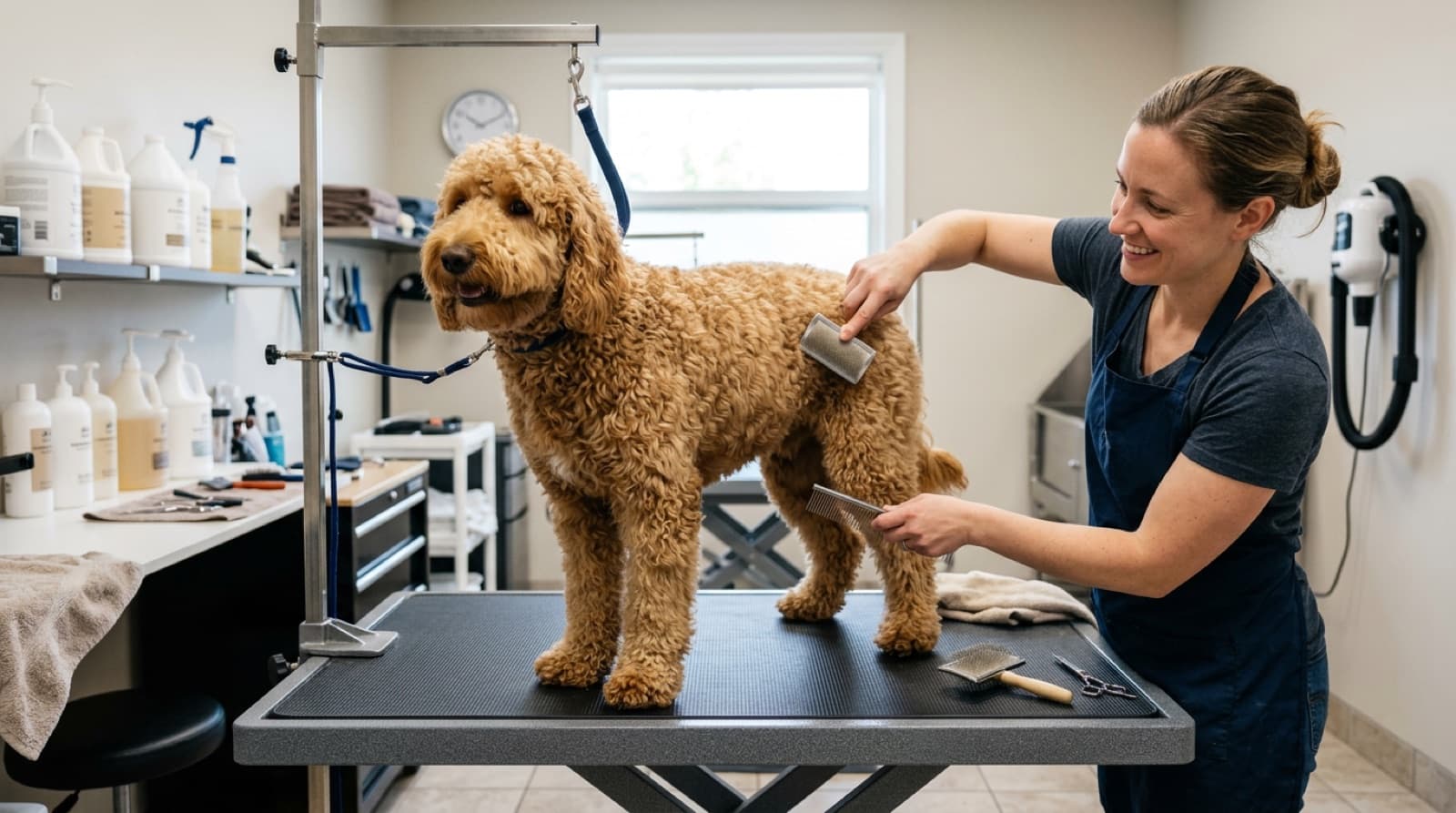
If you take one thing from every Poodle and Doodle guide on this site, it is this: the coat is the commitment. These are wonderful dogs, but the curly, low-shedding coat that draws people in, described in the Canadian Kennel Club standard as dense and curly, is a lifelong, hands-on, and genuinely expensive responsibility. Underestimating it is the single most common reason doodles are surrendered to Ontario rescues. Here is how to stay on top of it.
Brushing beats matting, and it has to reach the skin
A low-shedding coat holds every loose hair instead of dropping it, and those trapped hairs tangle into mats that tighten over time. The fix is frequent, thorough brushing, but the detail that trips people up is depth: a quick surface brush glides over the top of the coat and completely misses the mats forming against the skin. Line-brush in sections, lifting the coat and working from the skin outward, then run a metal comb through. If the comb snags, there is a mat the brush missed.
Three tools cover home maintenance: a slicker brush, a metal greyhound comb to check your work, and a detangling spray. Pay special attention to the friction zones that mat first, behind the ears, the armpits and groin, and anywhere a collar or harness rubs. For a newly adopted rescue who may not be used to handling, introduce the routine gently with treats, so grooming becomes tolerable rather than a battle. The details of settling a new rescue are in our first-week guide.
Winter is the hard season for these coats
Ottawa winters are tough on a curly coat. Snow forms ice balls in the leg and belly feathering, and road salt dries the skin and mats the coat, while a damp coat both mats fastest and insulates poorly. So after every winter walk, rinse or wipe the legs, belly, and paws, and dry the coat thoroughly. Keep brushing frequent through the cold months, because a longer winter coat tangles quicker.
Many Ottawa owners switch to a shorter, practical “puppy cut” for winter, which is far easier to keep clean and mat-free, then grow the coat back in warmer months. That is a smart maintenance choice, and different from a shave-to-the-skin, which is the emergency outcome when a coat was neglected and matted. Booties protect the paws from salt and ice between the toes, and a coat helps a small Poodle on deep-cold days, as long as the dog is dry underneath it.
Ready for the coat commitment?
If the grooming reality sounds manageable, a rescue Poodle or Doodle is a wonderful dog. Browse available Poodles and doodle crosses from Ottawa and NCR rescues, with foster notes on coat type.
See Available Poodles & Doodles →Frequently Asked Questions
How often do Poodles and Doodles need grooming?
Professional grooming every six to eight weeks is the standard for a Poodle or Doodle, and stretching much beyond that invites matting. Between appointments, the coat needs brushing every day or every second day, because the curly, low-shedding coat that makes these breeds appealing is exactly the coat that tangles against itself instead of shedding loose hair out. Doodles with a fleece or wool coat mat especially fast. In Ottawa, plan on roughly $80 to $150 per grooming session depending on size, coat condition, and the trim, which adds up to $700 to $1,300 a year, a real ongoing cost that owners who skipped the math often underestimate. The grooming never stops for the life of the dog, so budget it honestly before adopting.
Why does my Doodle’s coat mat so badly?
Because a low-shedding coat holds onto every loose hair instead of dropping it, and those trapped hairs tangle with the growing coat and each other, forming mats that tighten over time. Doodles are worse than purebred Poodles for this, because a fleece or wavy doodle coat combines curl with length in a way that grabs and holds. Friction zones mat first: behind the ears, in the armpits and groin, under a collar or harness, and anywhere the legs rub. Moisture accelerates it, so a wet Ottawa winter coat mats faster. The only real prevention is frequent, thorough brushing right down to the skin (a quick surface brush misses the mats forming underneath) plus regular professional grooming. Once a coat is matted to the skin, it usually has to be shaved.
What tools do I need to groom a Poodle or Doodle at home?
Three basics keep a coat between professional appointments: a slicker brush to work through the coat, a metal greyhound comb to check you have actually reached the skin (if the comb snags, there is a mat the brush missed), and a detangling spray to ease brushing. Line-brush in sections, lifting the coat and brushing from the skin outward, rather than skimming the surface. Introduce the routine gently and pair it with treats, especially for a rescue dog who may not have been handled much, so grooming becomes tolerable rather than a fight. You do not need to learn to clip the dog yourself; leave the trim to a professional. Your job at home is preventing mats, which is entirely about consistent brushing to the skin.
Should I shave my Doodle for summer or winter?
A full shave is a last resort, usually forced by matting rather than chosen. The curly coat provides insulation against both heat and cold, so shaving it does not necessarily make the dog cooler in summer and removes protection in an Ottawa winter. That said, a shorter, practical trim is very reasonable, especially in winter, when a long coat collects snow, ice balls, and road salt around the legs and belly and mats faster. Many Ottawa owners keep their Poodle or Doodle in a shorter "puppy cut" through winter for easier maintenance, then let it grow in warmer months. The key is that a shorter trim is a maintenance choice; a shave-to-the-skin is what happens when brushing was neglected and the coat matted. Aim for the former.
How do I manage a Poodle or Doodle coat in an Ottawa winter?
Winter is the hardest season for these coats, so tighten the routine. Snow and ice form balls in the leg and belly feathering, and road salt dries and irritates the skin and mats the coat, so rinse or wipe the legs, belly, and paws after every walk and dry the coat thoroughly, because a damp coat mats fastest and insulates poorly. Keep brushing frequent through the cold months, since a longer winter coat tangles quicker. Consider a shorter practical trim for the season. For small Poodles, a coat on deep-cold days helps, but make sure the dog is dry underneath it. Booties protect the paws from salt and ice balls between the toes. The goal is a clean, dry, tangle-free coat that can actually do its insulating job.
How much does Doodle grooming cost in Ottawa?
Expect roughly $80 to $150 per professional session in Ottawa, varying with the dog’s size, the coat’s condition, and the trim you want, with larger doodles and neglected, matted coats at the top of the range or beyond, because de-matting is labour-intensive and some groomers charge extra for it or will simply shave a badly matted dog for welfare reasons. At every six to eight weeks, that works out to roughly $700 to $1,300 a year, plus Ontario’s 13 per cent HST, an ongoing cost for the life of the dog. Keeping up with home brushing lowers the bill, because a well-maintained coat grooms faster than a matted one. This grooming cost is on top of normal food, vet, and licence costs, and it is the number most surprised doodle owners wish they had known before adopting.
Do Poodles and Doodles smell or need frequent baths?
They are relatively low-odour dogs when the coat is clean and dry, and over-bathing can actually cause problems by drying the skin and, if the coat is not dried and brushed out fully afterward, by causing mats. Bathe as needed, every four to six weeks is typical, often timed with professional grooming, using a dog shampoo, and always brush the coat out fully before bathing (bathing a matted coat tightens the mats) and dry it thoroughly afterward. The most common source of odour in these breeds is actually the ears: the coat can trap moisture in the ear canal, leading to infections that smell, so keep the ears clean and dry, especially after baths and any summer swims. A clean, well-groomed Poodle or Doodle is a pleasant, low-smell housemate.
Is a Poodle or Doodle coat really less work than a shedding breed?
It is different work, not less. A shedding breed like a Lab covers your house in hair but needs minimal coat maintenance, a weekly brush and the occasional bath. A Poodle or Doodle keeps your house hair-free but demands near-daily brushing and professional grooming every six to eight weeks for its entire life, at real cost. Neither is objectively easier; they trade vacuuming for brushing and grooming bills. The mistake doodle marketing encourages is selling the low-shedding coat as low-maintenance, when it is the opposite in terms of hands-on time and money. If you want a dog that sheds little AND is low-effort on the coat, neither exists, and being clear about that trade-off before adopting prevents the surprise that lands so many doodles in rescue.
Related Guides
New dog? Start with these care guides
Everything a new adopter needs to set up a safe, happy home.