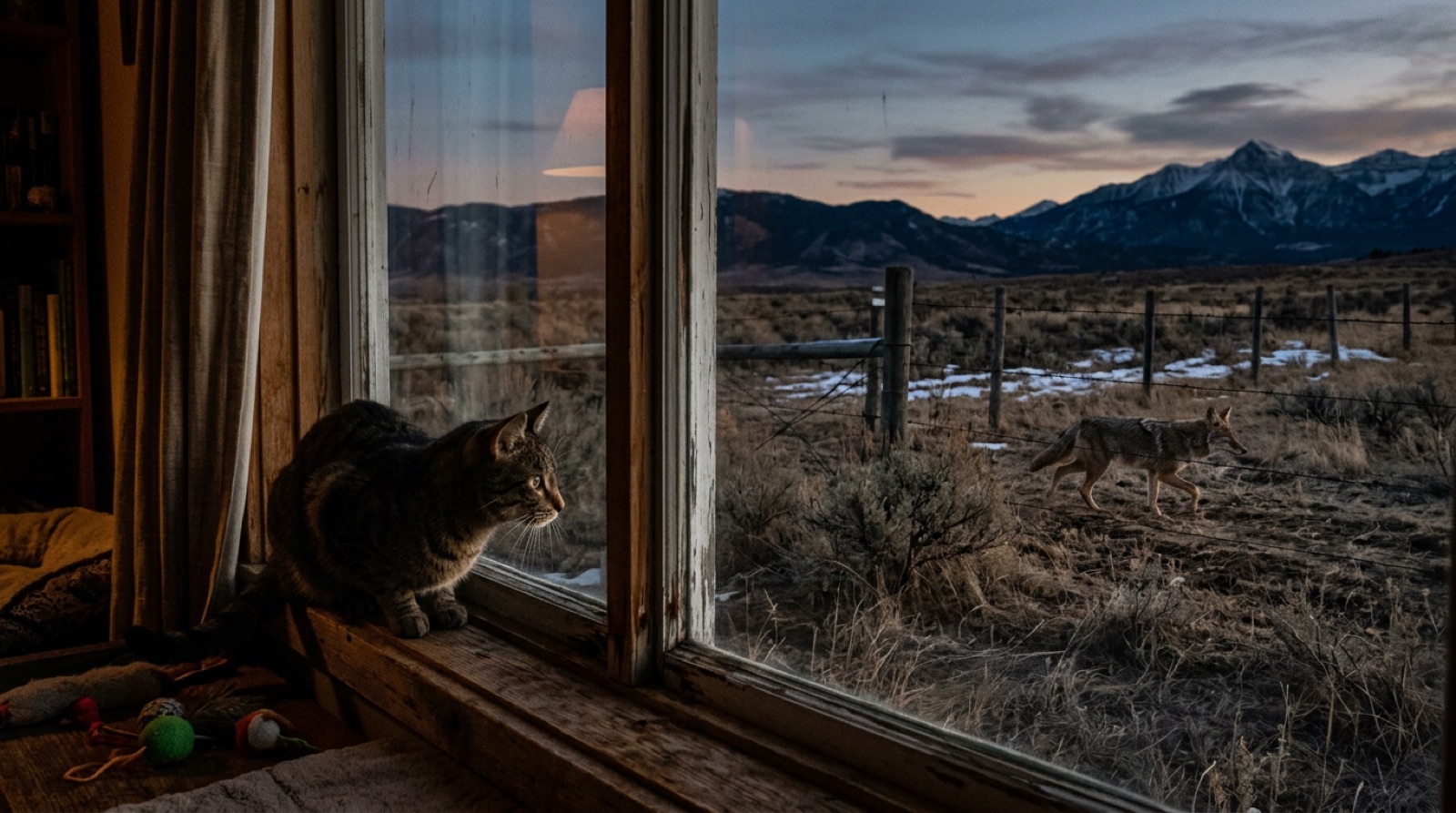
The short answer
Indoor, with real enrichment. The Bow River corridor brings coyotes through town nightly, great horned owls hunt the area, and cougars are present in the surrounding foothills. Winter adds frostbite, chinook refreezes and engine blocks. The Town of Cochrane requires cats to stay on the owner property, so outdoor time means an enclosed run or a harness. Build vertical space, a window perch and twice-daily play, and the trade is a fair one.
The outdoor cat question gets argued in general terms almost everywhere. In Cochrane it can be argued in specific ones, which makes it a shorter conversation.
This is a town of 33,000 with a river running through it and foothills starting at the edge of the last subdivision. Glenbow Ranch is downstream, Big Hill Springs is north, and Kananaskis is a short drive west. That geography is why people move here. It is also why the wildlife is not somewhere else.
A cat let out at nine at night in Cochrane is sharing the neighbourhood with animals that hunt for a living. That is the whole argument.
What Is Actually Out There
| Risk | Why it matters here |
|---|---|
| Coyotes | Well established along the Bow River corridor and through town green space. Active at dawn, dusk and overnight, which is exactly when cats roam. |
| Great horned owls and other raptors | Foothills country supports a healthy owl population. Small cats and kittens are within range. |
| Cougars, occasionally | Rare in town but genuinely present in the surrounding foothills and along the river valleys west of Cochrane. |
| Deep cold snaps | Frostbite on ear tips, paw pads and tails happens faster than owners expect. A cat that got shut out on the wrong night does not always come back. |
| Chinook swings | A 20 degree swing in a few hours turns melt into ice. Cats get soaked in a warm afternoon and then face a hard freeze after dark. |
| Engine blocks | Cold cats climb into warm wheel wells and engine bays. This is a serious winter risk in any acreage or driveway-heavy area. |
| Traffic | Highway 1A and Highway 22 carry fast rural traffic, and neither has anything a cat would recognise as a boundary. |
| Rural hazards | Antifreeze, rodenticide used around barns and outbuildings, farm machinery, and territorial dogs on neighbouring acreages. |
The coyote point deserves emphasis because it is the one that actually takes cats. Coyotes use river corridors and green space as travel routes, and the Bow runs straight through the middle of Cochrane. They hunt at dawn, dusk and overnight, which happens to be exactly when cats do their roaming. The Government of Alberta's own guidance on human-coyote conflict does not hedge on this. Its advice to pet owners is to keep your cats indoors.
Winter Is Its Own Category
Cochrane winters are not just cold, they are inconsistent, and the inconsistency is what catches people out.
A chinook can move the temperature 20 degrees in a few hours. Snow melts, everything gets wet, and then the wind drops and it freezes hard overnight. A cat that was comfortable at three in the afternoon can be in real trouble by ten at night, in a damp coat, on ice, with nowhere warm to get to. Frostbite takes ear tips, paw pads and tail ends.
The engine block warning is not folklore. Cold cats climb into wheel wells and engine bays for the residual heat and stay there as the metal cools. In driveway-heavy neighbourhoods and on acreages, banging the hood or sounding the horn before you start a cold vehicle is a small habit that prevents a horrible outcome.
What the Bylaw Says
The Town of Cochrane has already answered the roaming question. Cats are required to stay on their owner property rather than wander freely, in the town own words they are not allowed to roam freely. That leaves an enclosed run or harness time as the practical way to give outdoor access. Under Animal Bylaw 04/2016 every cat over three months needs a current licence and must wear it when off your property.
You can read the requirements on the Town of Cochrane responsible pet ownership page. Licence tiers and costs are covered in our Cochrane cat cost guide.
Barn Cats and Acreage Life
Working barn cats are a normal part of life on the acreages and horse properties around Cochrane, and pretending otherwise would be silly. They do a genuine job with rodents and they have done for as long as there have been barns here.
They also live shorter lives than indoor cats, for every reason listed above. If you keep barn cats, the three things that materially help are having them altered so the colony does not grow, providing properly insulated shelter rather than assuming the barn is enough, and feeding them so they are not relying entirely on what they catch. A fed barn cat still hunts. That is a myth worth retiring.
What to Do Instead
Indoor-only is only fair to the cat if you replace what the outdoors was providing. That is stimulation, height, and something to hunt. None of it is expensive.
| What | Why it works |
|---|---|
| Window perch with a real view | Bird and squirrel traffic is the single best free entertainment. A perch facing a feeder is better than most toys. |
| Vertical space | Cats want height more than floor area. Shelves and a tall tree change a small house into a big one. |
| A catio or enclosed run | The one way to give a cat outdoor time that still satisfies the town requirement to stay on your property. |
| Harness and leash training | Works better than people think, especially with a cat started young. Keeps the cat under your control. |
| Daily wand play, twice | Ten minutes morning and evening covers the hunt-catch-kill sequence that indoor cats otherwise never complete. |
| Food puzzles | Makes the cat work for food instead of eating a bowl in ninety seconds and being bored for the rest of the day. |
| Rotate the toys | Put half away for a fortnight and bring them back. A returned toy is a new toy. |
A catio is the single best investment on that list, and it is the one option that gives outdoor time while keeping the cat on your property as the bylaw requires. Even a screened corner of a deck gives the cat weather, smells and bird traffic while keeping the coyotes on the other side of the mesh. Give it a sheltered corner so it stays usable in February.
Looking for an indoor cat?
Cochrane-area rescues place cats indoor-only and can tell you which ones have never been outside at all. Listings refreshed regularly.
See Available Cochrane Cats →Frequently Asked Questions
Is it safe to let a cat outside in Cochrane?
Not really, and the reasons here are more concrete than the usual general advice. Cochrane sits in foothills country with the Bow River running straight through it, and that river corridor works as a wildlife highway. Coyotes use it routinely, great horned owls hunt the area, and cougars turn up in the surrounding foothills. Add fast rural traffic on Highway 1A and Highway 22 and winter cold that causes frostbite within hours, and an outdoor cat here faces more ways to die than one in a large city.
Does the Town of Cochrane allow cats to roam?
No. The Town of Cochrane is clear that cats must stay on their owner property rather than roaming freely, with the town own wording being that cats are not allowed to roam freely. If you want your cat to have outdoor time, that means an enclosed run or a harness rather than an open door. Under Animal Bylaw 04/2016 every cat over three months old also needs a current licence, worn whenever the cat is off your property. So the roaming question is already settled at the municipal level, whatever your view of it.
How real is the coyote risk here?
Real enough that local rescues place cats as indoor-only on the strength of it. Coyotes are established along the Bow River corridor and move through town green space, and they are most active at dawn, dusk and overnight, which is precisely when cats do their roaming. A coyote treats a domestic cat as prey, not as a competitor. The pattern owners describe is almost always the same: the cat went out at night as it always did, and then simply did not come back.
What about chinooks? Do they make winter easier for cats?
They make it less predictable, which is worse. A chinook can lift the temperature 20 degrees in a matter of hours, melt everything, and then let it refreeze hard after dark. A cat that got wet during a mild afternoon is a cat facing a hard freeze in a wet coat. The swing also fools owners into thinking a mild day means a mild night. Cochrane weather in February is not something to make plans around eight hours in advance.
Why do people warn about engine blocks in winter?
Because a cold cat looks for the warmest thing it can find, and in a driveway that is a recently parked car. Cats climb into wheel wells and up into engine bays, then stay there as the metal cools. The results when the engine starts are as bad as you would imagine. In acreage areas and any household with vehicles parked outside overnight, banging on the hood or sounding the horn before starting up in cold weather is a habit worth having.
What about barn cats on acreages? Is that different?
It is different in purpose but not in risk, and it is worth being honest about that. Working barn cats are a normal part of Alberta acreage life and they do a real job with rodents. They also live considerably shorter lives than indoor cats for exactly the reasons above. If you keep barn cats, the things that actually help are ensuring they are altered so the population does not grow, providing genuine insulated shelter rather than just a barn, and feeding them so they are not entirely dependent on hunting.
My cat was an outdoor cat before. Can it adjust to indoor life?
Yes, though give it more time than you think and expect some protest. Cats that have roamed will yowl at doors and try to dash out for a few weeks. The transition works when you replace what the cat was getting outside rather than simply removing it. That means real hunting play twice a day, height to climb, a window with something happening outside it, and food that takes effort to get at. Most cats settle within a month or two, and many settle faster.
What is a catio and is it worth building?
It is an enclosed outdoor run, and it is the best answer to this whole question. It is also the way to give your cat outdoor access while still keeping it on your property, which is what the town requires. It can be as simple as a screened section of deck or as elaborate as a walk-in structure with shelves and a tunnel from a window. The cat gets fresh air, sunshine, smells and bird watching. The coyotes and owls get nothing. Plan for winter and give it a sheltered corner.
Can I leash train an adult cat?
Often yes, and it is worth trying if you want to give your cat outdoor time without breaking the on-property rule. Use a proper cat harness rather than a collar, because cats reverse out of collars with alarming skill. Start indoors, let the cat wear the harness with no lead for short periods over several days, and only then attach a lead. Expect the first outdoor sessions to involve a lot of sitting still and sniffing rather than walking. Some cats take to it quickly, some never do, and pushing a cat that hates it does not help.
How do I stop my cat door-dashing?
Make the door boring and the inside interesting. Feed at times that do not coincide with people leaving, keep a wand toy near the entrance to redirect a cat that is loitering, and get everyone in the house checking behind them as a reflex. For a determined dasher, a baby gate or a closed inner door creates a two-stage airlock that buys you a second. And microchip the cat with your current phone number registered, because the escape you did not prevent is the one where identification does the work.
What should I do if my indoor cat gets out?
Search close, low and at quiet times of day. An indoor cat that gets out usually does not go far, and it typically hides within a few properties rather than running for the horizon. Check under decks, in sheds, beneath parked vehicles and in dense shrubs. Go out at dawn and after dark when it is quiet and call in a normal voice rather than a panicked one. Tell your neighbours immediately, since a cat under someone porch is only found if that person knows to look.
Do indoor cats live longer?
Considerably, and the gap is not subtle. A healthy indoor cat routinely reaches its late teens, while cats that roam in an area with predators, rural traffic and hard winters live substantially shorter lives on average. That is the entire reason Cochrane and Calgary-area rescues place cats as indoor-only rather than leaving it to adopter preference. The trade you are making is a smaller world for a longer one, and the enrichment side of that trade is what makes it fair to the cat.
Related Cochrane Guides
One search, every Cochrane-area rescue
Shelter cats and foster cats serving Cochrane and the foothills, in a single list.
Browse Available Cochrane Cats →New cat? Start with these care guides
Everything a new adopter needs to set up a safe, happy home.