The short answer
Adult Russian Blues settle at 7 to 12 lbs and reach full size around 18 to 24 months, with a 15 to 20 year lifespan, one of the longest in any breed. An Edmonton rescue Russian Blue mix or blue DSH is $300 to $500 fully vetted. An ethical TICA or CFA breeder kitten with HCM-screened parents is $1,500 to $3,500 with a 4 to 12 month waitlist. Anything under $1,000 from a self-described breeder is the scam zone. True purebred Russian Blues are uncommon in Edmonton rescue but blue DSH cats with the right look show up regularly at Edmonton Humane Society, Zoe's Animal Rescue, SCARS, and AARCS Edmonton fosters. The breed is calm, quiet, low-maintenance, and a strong fit for working Edmonton households.
The buy-vs-adopt question without the shaming
Most people who land on this page have already done the homework on Russian Blues. They want the shimmery silver-blue coat, the vivid green eyes, the quiet reserved personality, the long lifespan, and the low-maintenance grooming. The question they actually arrive with is harder: pay a Canadian TICA or CFA breeder $2,000 and wait six months for a verified pedigreed kitten, or take a blue DSH from an Edmonton rescue this month for $400. Both are reasonable. We are a rescue aggregator, so our framing leans toward adoption, but the math deserves an honest look.
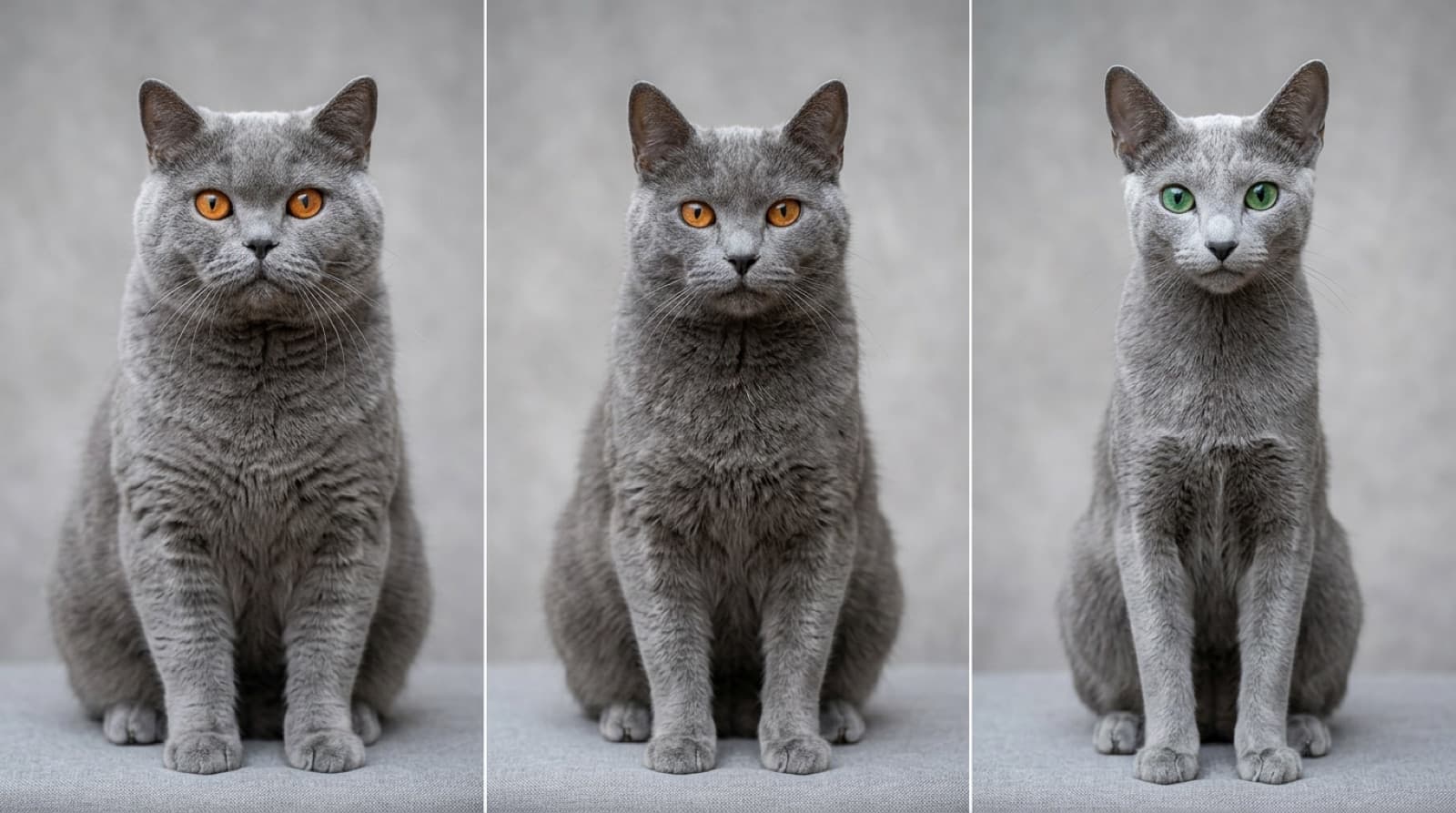
The breeder path gives you the verified breed standard: triangular head, long slender body, green eyes (kittens with yellow eyes that transition to green over months), silver-tipped double coat, lavender-pink paw pads, and the documented Russian Blue temperament. A registered kitten from a TICA or CFA breeder comes with parents echocardiogram-screened for HCM, documented pedigree, and a kitten released at 12 to 16 weeks. You pay $1,500 to $3,500 plus deposit, plus the wait.
The rescue path gives you a real cat now at a fraction of the price. Most Edmonton rescue cats labelled as Russian Blue are actually blue Domestic Shorthair (DSH) cats with the right colour and the wrong everything else. For a pet home, this often delivers what owners actually want: short blue-grey coat that does not mat, calm personality, low-maintenance care. The cat is already spayed or neutered, vaccinated, microchipped, vet-checked, and assessed in foster. You save $1,100 to $3,100 against a breeder kitten.
Neither path is wrong. The reframe most Russian Blue adopters miss is that the question is not breeder vs rescue Russian Blue, it is breeder Russian Blue vs rescue blue DSH that looks similar. For a pet home (rather than show or breeding), the blue DSH often delivers what people actually want. That framing holds up over a 15 to 20 year lifespan.
Where to find a Russian Blue in Edmonton
The purebred Russian Blue at an Edmonton rescue is rare. Blue DSH cats with the right look are not. Here is where they show up:
| Rescue | Good to know |
|---|---|
| Edmonton Humane Society | 13620 163 Street NW, operating since 1907, 3,905 placements in 2024. Largest single Edmonton cat intake. Steady stream of blue DSH cats labelled as Russian Blue mix. See edmontonhumanesociety.com. |
| Zoe's Animal Rescue | Volunteer-run shelterless rescue, every cat in a foster home until adoption. Strong written compatibility notes per cat. See zoesanimalrescue.org. |
| SCARS (Second Chance Animal Rescue Society) | Northern Alberta intake. Foster-based with detailed compatibility profiles. See adopt.scarscare.ca. |
| AARCS Edmonton fosters | Alberta-wide rescue with foster homes across Edmonton. Strong written profiles per cat. |
| National breed-specific rescues | Specialty Purebred Cat Rescue (purebredcatrescue.org) handles pedigreed Russian Blue placements occasionally. Long waits, real pedigrees, cross-border transport for Canadian adopters. |
The honest read on this list: Edmonton Humane Society is your best single bet for a blue cat with the right look. Zoe's Animal Rescue and AARCS Edmonton fosters see blue DSH cats regularly enough that monthly checks are worth it. SCARS works for adopters open to a rural-intake cat. Specialty Purebred Cat Rescue is the right path for adopters specifically wanting verified pedigree.
Set up alerts so you do not have to check every site by hand. LocalPetFinder pulls live cat listings from these Edmonton rescues regularly into one searchable place. Blue cats with the right look move quickly because so many adopters watch for the colour.
The real Edmonton cost breakdown
A rescue adoption fee is not the cat's price. It is a partial reimbursement for vetting the rescue already paid for. That is why a $400 blue DSH from Edmonton Humane Society is cheaper than a “free” Kijiji kitten. And any Russian Blue listed under $1,000 by a self-described breeder is almost always a scam, a backyard breeder, or a blue DSH misrepresented as a Russian Blue.
2026 Edmonton Russian Blue and blue DSH pricing across the realistic options:
| Path | Typical price | What is included |
|---|---|---|
| Edmonton rescue (blue DSH or Russian Blue mix) | $300 to $500 | Spay or neuter, vaccines, microchip, deworming, vet workup, foster assessment. |
| National breed-specific rescue (pedigreed) | $400 to $800 plus transport | Surrendered or retired pedigreed Russian Blue, full vetting, sometimes registration papers. |
| Ethical Canadian TICA or CFA breeder (pet quality) | $1,500 to $3,500 | Registered, HCM-screened parents, kitten released at 12 to 16 weeks, contract with spay or neuter clause. |
| Show or breeding rights kitten | $3,500 plus | Same screening, breeding contract, often co-ownership terms. |
| Under $1,000 unverified seller | Scam zone | Red flag. No paperwork, no health screening, often a fake listing or a blue DSH sold as a Russian Blue. |
The adoption fee covers spay or neuter, core vaccines, a microchip, deworming, parasite treatment, and a vet exam. Paying for that vetting yourself on a free Kijiji kitten in Edmonton runs about $480 to $900. So even at the top of the rescue range, a $500 adopted Russian Blue mix is cheaper than catching up a free kitten on the same vetting.
Annual care for a Russian Blue runs on the lower end for purebreds because the breed is generally healthy and grooming is minimal:
- Food: $35 to $60 per month. Russian Blues are slender and eat less than larger breeds. Quality wet food plus dry sits in the $40 to $55 range.
- Litter: $20 to $35 per month. A standard litter box works fine.
- Grooming: $0 to $50 per year. The short double coat is minimal maintenance. Weekly slicker brush at home. Optional twice-yearly professional groom.
- Annual vet care: $400 to $700. Routine wellness, vaccines, dental check. Higher with pet insurance.
- Enrichment: $150 to $300 first year, $30 to $80 ongoing. Russian Blues are moderate-energy and content with a quality cat tree, window perches, and interactive play.
First-year setup costs another $200 to $500 above ongoing care: a moderate-size litter box, scratching post, cat tree, carrier, slicker brush, food and water bowls. Honest first-year total: $1,000 to $1,600 for a rescue Russian Blue, $2,500 to $4,500 for a breeder kitten. Ongoing years run $700 to $1,200, on the lower end for purebreds.
Our full Edmonton cat cost breakdown has the standard-cat line items for comparison.
What sends a Russian Blue into Edmonton rescue?
Pedigreed Russian Blue surrenders are uncommon, but blue DSH cats are regular Edmonton rescue intake. The patterns:
Owner allergy diagnosis. The number-one Russian Blue specific surrender pattern. People adopt a Russian Blue believing the breed is fully hypoallergenic, develop reactions anyway (the breed produces some Fel d 1, just less than average), and surrender. There are no truly hypoallergenic cats. The dedicated hypoallergenic myth guide in this cluster covers the research.
Owner life change. Move to a no-pet rental, divorce, new baby, financial hardship, owner illness or death. The cat is healthy and sociable, an excellent adoption candidate. Most blue DSH cats at Edmonton Humane Society and Zoe's Animal Rescue arrive this way.
Retired breeder cats. Ethical breeders retire breeding females around age 5 to 8 and place them in pet homes. National breed-specific networks handle most pedigreed placements, but some land at Edmonton rescues directly.
Underestimated reserve. Russian Blues are sensitive and slow to bond. Some owners who expected an immediately affectionate cat surrender when the bond does not form quickly. The bond does form with patience; the cat is not being aloof, it is settling in. Foster teams often place these cats with experienced adopters who understand the breed.
Inappropriate household match. A Russian Blue in a household with toddlers or boisterous high-energy children sometimes spends most of its time hiding. Owners who realised the mismatch surrender to give the cat a better-fit home.
Edmonton climate and indoor-only commitment
Despite the Russian Blue name and the breed's northern Russian origin, modern Russian Blues are strictly indoor cats. The case for indoor-only is the same as for every breed in Edmonton, plus a few breed-specific notes.
Edmonton river-valley coyotes. Coyotes are well established in Edmonton river-valley corridors including Mill Creek Ravine, Whitemud Creek, Capilano Park, and Hawrelak Park. Indoor-only is non-negotiable regardless of breed.
The breed's reserve makes outdoor escape worse. A Russian Blue that escapes outside hides rather than coming home. The reserved personality that makes the breed wonderful indoors becomes a real recovery problem outside. Many lost Russian Blues are not recovered.
The double coat handles indoor air well. Unlike Persians or Sphynx cats, Russian Blues handle Edmonton dry winter indoor air at 15 to 25 percent humidity without issue. A humidifier helps the human household members more than the cat.
Indoor enrichment matters but Russian Blues are moderate-energy cats. A tall cat tree, window perches positioned for bird and squirrel watching, interactive play 10 to 15 minutes daily, and a quiet routine cover most enrichment needs. A secure catio gives the cat safe outdoor air without risk; an Edmonton catio works most of the year except in deep winter cold and peak summer heat. Our indoor vs outdoor cats Edmonton guide covers the full case.
Breed background worth knowing
The Russian Blue is one of the oldest naturally-occurring cat breeds. Origin stories trace the breed to Archangel (Arkhangelsk), a northern Russian port city, with documented exports to Britain in the 1860s. The breed gained recognition in the late 19th century European cat-fancy circuit and was registered by the Cat Fanciers' Association and other major registries in the early 20th century. The breed survived population bottlenecks during World War II and remains relatively close to the original phenotype today.
TICA and CFA recognise the breed under strict standards requiring the slate-blue colour with silver tipping, vivid green eyes in adults, the slender muscular body, and the calm dignified temperament. Both registries enforce single-colour breeding (no point cats, no multi-colour patterns).
Three traits surprise most first-time Russian Blue adopters:
The yellow-to-green eye transition. Russian Blue kittens are born with yellow eyes that gradually transition to green over the first 6 to 12 months. A 4-month-old kitten with yellow eyes is still going to develop into a vivid green-eyed adult. This is a normal part of the breed development and not a sign of mixed parentage.
The dog-like loyalty. Russian Blues bond hard with primary caretakers and often follow them around the house like a quiet shadow. The breed is sometimes called “the introvert's cat” because of this devoted-but-quiet pattern.
The long lifespan. Russian Blues frequently live 15 to 20 years, on the long end for any cat. Over that span, regular vet visits and consistent care pay off. The Cornell Feline Health Center documents the breed's generally healthy profile, with the main concerns being urinary issues and some dental disease in seniors.
Browse adoptable Russian Blue-type cats in Edmonton
Browse Russian Blue-type cats currently in Edmonton rescue: purebred mix, blue Domestic Shorthair, and retired breeder placements from Edmonton Humane Society, Zoe's Animal Rescue, SCARS, and AARCS Edmonton fosters. Refreshed regularly. Filter by age, size, and personality.
See Available Cats in Edmonton →Frequently Asked Questions
Where can I adopt a Russian Blue in Edmonton?
A purebred Russian Blue at an Edmonton rescue is rare, but blue Domestic Shorthair (DSH) cats with the right look show up regularly enough that patient adopters find one. The rescues to watch are Edmonton Humane Society (13620 163 Street NW, since 1907, 3,905 placements in 2024 making it the largest Edmonton cat intake), Zoe's Animal Rescue (foster-based, Caretaker Cat Program and Warm Whiskers Program), SCARS (Second Chance Animal Rescue Society, northern Alberta intake), and AARCS Edmonton fosters. For verified pedigreed Russian Blues, the realistic path is a TICA or CFA breeder waitlist of 4 to 12 months. Watch live listings on LocalPetFinder and set an alert. Many shelter cats labelled as Russian Blue are actually blue DSH cats with similar colouring; the visual difference matters less than people think for a pet home.
How much does a Russian Blue cost in Edmonton?
A Russian Blue mix or blue DSH from an Edmonton rescue runs $300 to $500. That fee covers spay or neuter, core vaccines, microchip, deworming, and a vet workup. An ethical Canadian TICA or CFA Russian Blue breeder charges $1,500 to $3,500 for a pet-quality kitten with HCM-screened parents. Anything under $1,000 from a self-described breeder is the scam zone. Annual care runs $1,000 to $1,600 once the cat is home, which is on the lower end for purebred breeds because the breed is generally healthy and grooming is minimal.
Is $700 fair for a Russian Blue kitten in Edmonton?
Not from a breeder. The honest Canadian breeder floor for a pet-quality Russian Blue kitten with TICA or CFA registration and HCM-screened parents is about $1,500. A kitten advertised at $700 by a self-described breeder is in the scam zone. The most common pattern is a non-existent kitten, a blue Domestic Shorthair sold as a Russian Blue, or a backyard breeder with no health screening. A $400 to $600 price is reasonable for a blue DSH from an Edmonton rescue with full vetting, but it is not fair for a breeder kitten with paperwork. Pay $1,500 plus from a verified TICA or CFA breeder, or $300 to $500 from rescue.
Can I find a purebred Russian Blue at an Edmonton shelter?
Occasionally, but rarely. Most shelter cats labelled as Russian Blue are blue Domestic Shorthair (DSH) cats with the right colouring (slate-grey with silver tipping) and the wrong everything else (round face, single coat, gold or copper eyes). True purebred Russian Blues at rescues come mainly from owner allergy surrenders (people who bought a Russian Blue thinking it was hypoallergenic and developed reactions), divorce, financial hardship, and retired breeder placements. The realistic path to a verified purebred is through a TICA or CFA breeder waitlist or a national breed-specific rescue. For most adopters, a blue DSH from an Edmonton rescue delivers most of what people actually want from the breed: short coat, quiet personality, low-maintenance care.
What is the difference between a Russian Blue and a blue Domestic Shorthair?
Five traits separate a real Russian Blue from a blue DSH. First, the eyes: Russian Blues have vivid green eyes as adults (kittens are born with yellow eyes that transition to green over months); blue DSH cats usually have gold or copper eyes. Second, the body type: Russian Blues are long-legged and slender with a triangular head; blue DSH cats are often stockier with rounder faces. Third, the coat: Russian Blues have a double coat with silver-tipped guard hairs creating a shimmery appearance; blue DSH cats have a normal single short coat. Fourth, the temperament: Russian Blues are reserved with strangers but devoted to family; blue DSH cats vary widely. Fifth, the paw pads: Russian Blues have lavender-pink paw pads; blue DSH cats usually have grey or black paw pads. The dedicated comparison guide in this cluster covers the full distinction.
Are Russian Blues hypoallergenic?
No, but they may produce less Fel d 1 protein (the major cat allergen) than many breeds. The full answer matters. Cat allergies are triggered by Fel d 1 produced in saliva and skin glands; the protein deposits on the coat during grooming and becomes airborne. Some research suggests Russian Blues produce somewhat lower levels of Fel d 1 than the average cat, but levels vary significantly between individual cats. Allergic individuals should always test-spend significant time with the specific cat (not just the breed) before adopting. There are no truly hypoallergenic cat breeds. The dedicated hypoallergenic myth guide in this cluster covers the research in detail.
How long do Russian Blues live?
Fifteen to twenty years, on the long end for cats. Russian Blues are one of the longest-lived recognised breeds, partly because the breed has been protected from the inbreeding bottlenecks that affect many other purebred lines. Healthy individuals routinely reach 18 to 20 years with consistent care. Indoor-only lifestyle, weight management, dental care, and annual vet visits all matter. An Edmonton Russian Blue adopted at age 3 will likely be in your home until you are 17 to 19 years older.
Are Russian Blues good for first-time cat owners in Edmonton?
Yes, with one caveat. The breed is calm, quiet, intelligent, undemanding, and bonds devotedly with primary caretakers. They tolerate alone time better than many breeds (an Edmonton working household angle), and they do well in apartments and condos because they are not vocal or destructive. The caveat: Russian Blues are reserved with strangers and can be slow to bond. A first-time owner who expects an immediately affectionate cat may worry the cat dislikes them when really the cat is just settling in. Patience over weeks rather than days is essential. Once the bond forms, it holds.
How long does an adult Russian Blue take to adjust to an Edmonton home?
Three to six weeks for most adults, longer for retired breeder cats coming from cattery environments. Russian Blues are sensitive to change and signal stress through hiding rather than vocalisation. The 3-3-3 rule applies cleanly: three days of mostly hiding, three weeks of testing the environment, three months to fully bond. Signs of progress include eating in the open, using the litter box reliably without you watching, choosing to sleep where you can see them, and eventually seeking physical contact. Russian Blues bond hard once they decide to, but the decision takes time.
Are Russian Blues good with kids and other pets?
With gentle older kids yes, with toddlers usually not, with calm pets generally yes. Russian Blues prefer quiet predictable environments and dislike rough handling, loud noises, and unpredictable movement. A family with calm school-age children and a low-energy household is a great fit. Toddlers and high-energy boisterous kids are usually a poor match because the cat will hide rather than engage. With other cats, Russian Blues do well with calm companions and may struggle with high-energy breeds like Bengals. With dogs, calm older dogs work; high-energy dogs do not.
Do Russian Blues need a lot of grooming?
No, the short double coat is minimal maintenance. A 5-minute weekly brushing with a slicker brush plus seasonal twice-weekly during the spring and fall shed is enough for most cats. The coat does not mat and does not need professional grooming. Nails monthly. Teeth weekly if the cat tolerates it (cat-safe toothpaste only). Ear cleaning as needed. This is one of the easier purebred cats to live with from a grooming standpoint, which makes the breed a strong match for working Edmonton households.
What are the main Russian Blue health concerns Edmonton owners should know?
Russian Blues are generally one of the healthier purebred cat breeds. The primary concerns are bladder and urinary issues (FLUTD, bladder stones), occasional luxating patellas in some lines, and dental disease in older cats. HCM rates are lower than in Ragdolls, Maine Coons, or British Shorthairs but the breed is not immune. The dedicated Russian Blue health article in this cluster covers the screening details. For a 15 to 20 year-lived breed, annual vet exams from age 7 onward catch the conditions that affect senior Russian Blues most often.
Russian Blue Health: Bladder, Diabetes
Russian Blue health: 15-20 year lifespan, no breed-specific DNA test, with bladder stones and obesity-driven diabetes the main risks.
The Russian Blue Hypoallergenic Myth
No cat is hypoallergenic. Satorina 2014 PMC 4072467: modest Fel d 1 reduction; AAAAI/Cornell consensus on individual variation. Pre-adoption test.
Russian Blue vs Blue DSH: ID Guide
A real Russian Blue is rare at rescue: vivid green eyes + silver shimmer + wedge head are the tells. Most "mixes" are blue Domestic Shorthairs.
Best Cat Rescues Edmonton
Three Edmonton cat rescues compared on adoption fee, wait time, and adopter fit.
New cat? Start with these care guides
Everything a new adopter needs to set up a safe, happy home.