The short answer
A real purebred Russian Blue at rescue is vanishingly rare. CFA registers only a few hundred Russian Blue kittens in a typical year, against millions of Domestic Shorthair cats. Almost every listing tagged “Russian Blue mix” is really a blue or grey Domestic Shorthair (DSH) carrying the dilute coat gene. The three quickest tells for a real Russian Blue: vivid green eyes (not copper, gold, yellow, or hazel), a silver-tipped shimmer coat (not flat blue), and a wedge-shaped head plus slim long-legged body (not round or stocky). Blue DSH cats are wonderful pets with the full DSH temperament range and no breed-specific health risks. Without paperwork, every rescue blue cat should be priced and cared for as a DSH.
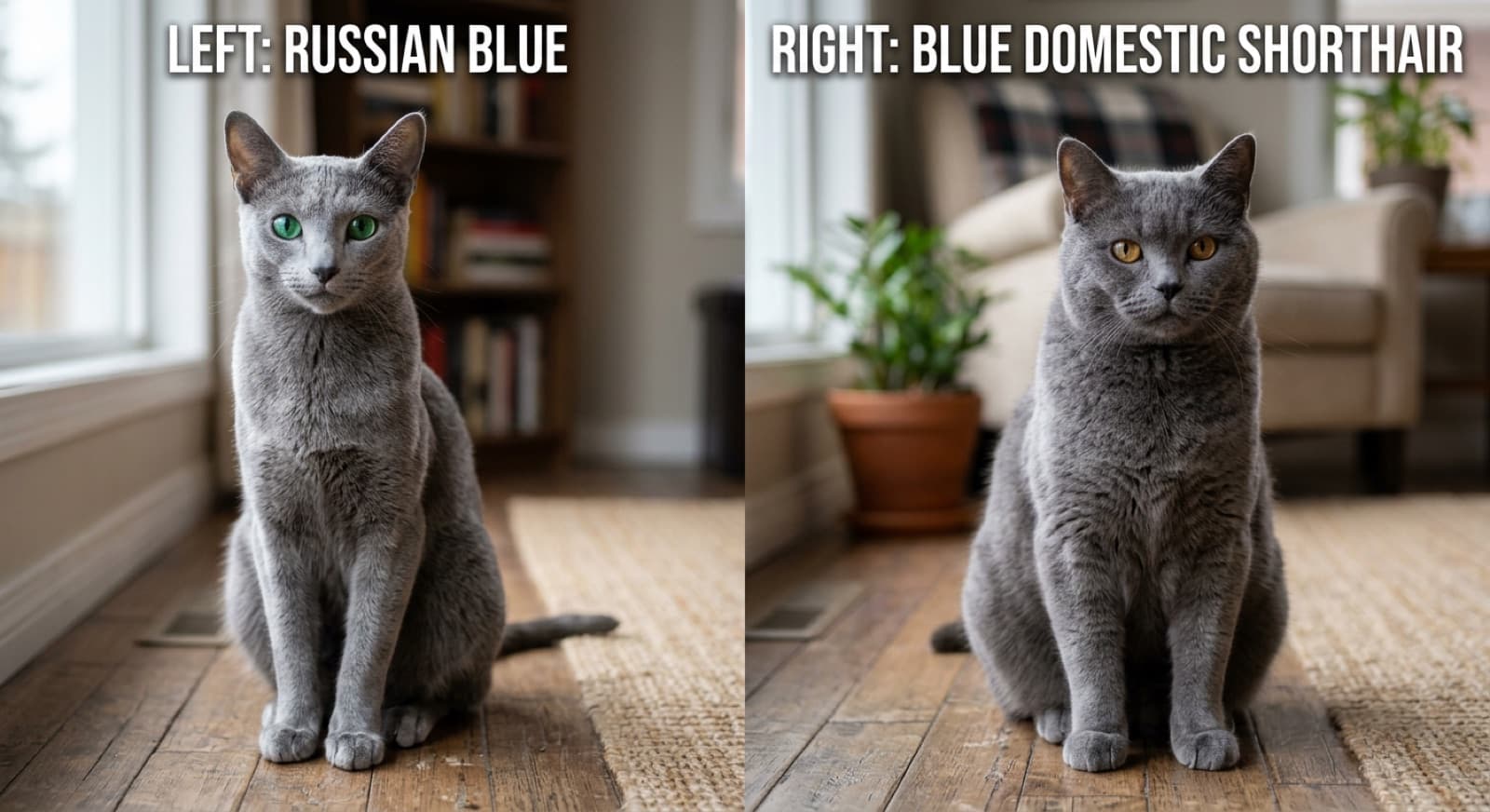
The honest reality: a real Russian Blue at rescue is near-zero
The Russian Blue is a low-population breed in North America. CFA registers only a few hundred Russian Blue kittens in a typical year, and numbers have stayed in that general range for decades. Compare that to the millions of Domestic Shorthair cats living in North American households and the asymmetry becomes obvious: any random blue or grey cat at a rescue is statistically a DSH with the dilute coat gene, not a Russian Blue.
The dilute black gene that produces a blue or grey coat is common across all cat genetic backgrounds. A blue kitten can come from two black DSH parents who both carry the dilute gene as a recessive trait. The resulting kitten looks “Russian Blue-like” without any Russian Blue ancestry at all. This is the underlying reason rescues are full of blue or grey cats while real Russian Blue surrenders are uncommon.
Rescues label blue or grey cats as “Russian Blue mix” because the look is recognisable and adopters search for it. Foster volunteers see a blue cat, recognise the visual association, and tag the listing in a way that helps adopters find what they want. The label is foster shorthand for the visual look, not verified breed ancestry. This is pattern recognition rather than malice, and it is not unique to Russian Blue. The same dynamic plays out across British Shorthair and Chartreux mix listings as well.
From an adoption standpoint, this rarely matters. The cat in front of you is a wonderful blue DSH with whatever temperament the foster reports, whatever health status the workup confirms, and no breed-specific elevated health risks. The breed label is the marketing wrapper; the cat is the cat.
For adopters who specifically need verified breed ancestry (show registration, breeding programs, allergy concerns where lower Fel d 1 actually matters), the rescue path will not deliver that. The realistic options for a verified Russian Blue are CCA-registered Canadian breeders ($1,500 to $3,000) or cross-border placements through Specialty Purebred Cat Rescue, which occasionally facilitates placements of retired breeder cats into Canadian homes.
The three quickest visual tells for a real Russian Blue
When you are looking at a blue cat at a rescue or in a breeder photo, three traits together settle most identification questions in under thirty seconds.
1. Vivid green eyes (mandatory)
The single most decisive test. Vivid green eyes are mandatory in the Russian Blue breed standard across CFA, TICA, FIFe, and the Canadian Cat Association. Copper, gold, yellow, hazel, or mixed adult eye colour means the cat is not breed-pure regardless of seller claims. Russian Blue kittens are born with blue eyes that transition through amber to vivid green by 12 to 16 months. An adult Russian Blue with anything other than vivid green eyes is misidentified.
2. Silver-tipped shimmer coat
The hardest trait to fake. Russian Blues have a short silky double coat with silver tipping at the ends of the guard hairs. The tipping catches light and creates a shimmer or glitter effect under direct light that flat-coloured blue DSH coats do not produce. The coat stands slightly away from the body rather than lying flat, giving the cat a faintly plush outline despite the short length. Run a hand against the grain in good light: a real Russian Blue coat appears to glow at the surface, while a blue DSH coat looks uniformly grey with no light-catching shimmer.
3. Wedge head plus slim long-legged body
Russian Blues have a refined wedge-shaped head (not round like a BSH or Chartreux), a slim athletic body (not stocky), and long legs proportionate to the body length. The silhouette reads as elegant rather than compact and chunky. Adult weight runs 7 to 12 lbs, notably smaller than a BSH (9 to 17 lbs) or Chartreux (7 to 16 lbs). A blue cat with a round head, stocky body, or short legs is closer to BSH ancestry or DSH than Russian Blue. Even a Russian Blue mix shows some wedge influence in the head shape if real ancestry is present.
Comparison: Russian Blue vs Blue DSH vs other blue cats
Five different blue-coated cat types get confused at rescue or in breeder photos. The table below summarises the distinguishing traits. Russian Blue and Nebelung are the only two that consistently show vivid green eyes per their breed standards. Everything else allows other eye colours.
| Trait | Russian Blue | Blue DSH | BSH (blue) | Chartreux | Korat |
|---|---|---|---|---|---|
| Eye colour | Vivid green only | Any (green, yellow, copper, gold) | Copper or deep gold | Copper to gold | Green (matures late) |
| Coat structure | Short double coat, silver-tipped shimmer | Flat blue or grey, no tipping | Dense plush single coat | Woolly water-resistant double coat | Silver-tipped single coat (less shimmer) |
| Head shape | Wedge-shaped, refined | Variable | Round with broad muzzle | Round with narrow muzzle | Heart-shaped |
| Body type | Slim elegant, long legs | Any build | Compact stocky, broad chest | Muscular, shorter legs | Semi-cobby muscular |
| Paw pads (blue cat) | Mauve or lavender | Grey, pink, or mixed | Blue | Blue | Lavender to blue |
| Temperament | Reserved, devoted, quiet | Wide individual variation | Calm, easygoing | Quiet, observant | Active, attached |
| Adult weight | 7 to 12 lbs | 8 to 15 lbs | 9 to 17 lbs | 7 to 16 lbs | 6 to 11 lbs |
| Average lifespan | 15 to 20 years | 12 to 18 years | 12 to 17 years | 11 to 15 years | 10 to 15 years |
| Rescue rate | Occasional pure; common as look-mixes | Very common | Rare pure; common as mixes | Essentially nil | Essentially nil |
The Russian Blue row and the Blue DSH row are the two most relevant for adopters because they cover the realistic rescue population. The BSH and Chartreux comparison is covered in detail in the BSH vs Chartreux vs Russian Blue identification guide. Korat is included for completeness but is genuinely rare at any Canadian rescue.
What “Russian Blue mix” at a rescue actually is
This is the most adoption-relevant part of the article. Rescue cats tagged “Russian Blue mix” are almost always blue Domestic Shorthair with partial breed ancestry at best. They are wonderful cats; they just are not breed-pure in any verifiable sense.
Browse the cat listings at almost any cat-only rescue or municipal humane society on a given week and you will see blue or grey cats tagged “Russian Blue mix.” The real rate of verifiable Russian Blue ancestry in these cats is low. Most fall into one of the following categories:
- Blue Domestic Shorthair (most common): blue or grey DSH with the dilute coat gene, non-green eyes (often yellow or copper), variable head shape, and any body type. No verifiable Russian Blue ancestry. The look is the dilute gene; the rest is generic DSH genetics. This is the realistic baseline for almost every rescue blue cat.
- Russian Blue cross with DSH: a slim grey cat with green-tinted (but not vivid green) eyes, a slightly refined head, and partial ancestry from somewhere in the family tree. Less common than pure DSH but the most credible “mix” signal. This cat may carry some Russian Blue DNA without being breed-pure.
- Verified surrendered Russian Blue (rare): an occasional pure Russian Blue surrender with paperwork, usually for owner allergy, financial hardship, or breeder retirement. A handful per year across all cat rescues combined. If a listing genuinely has pedigree paperwork, the rescue will note it explicitly.
The honest framing we tell adopters: the breed label on a rescue listing is foster shorthand for the visual look, not verified ancestry. Foster notes that describe the actual cat (body type, temperament, coat texture, paw pad colour, eye colour) are more useful than the breed tag. If a foster note reads “slim 9 lb body, vivid green eyes, silver shimmer to the coat, lavender paw pads, wedge head, calm and shy with strangers,” you have actionable information pointing to genuine Russian Blue ancestry. If it just reads “Russian Blue mix,” you have a label.
The common adopter mistake is assuming purebred because the cat looks the part. The look is the easy part; the breed verification is the hard part. Without pedigree paperwork or DNA testing, the “Russian Blue mix” label translates to “blue DSH with the look” from a cost and care planning perspective. This is not a bad thing. Most adopters who want a Russian Blue for the colour and temperament find the rescue route satisfies the want at a fraction of breeder cost.
The Nebelung variant
Nebelung is the long-haired variant of the Russian Blue. The name comes from the German word for “creature of the mist,” a reference to the silvery shimmer of the long blue coat. The breed was developed in the 1980s by Cora Cobb of Nebelheim Cattery in the United States from Russian Blue crossed with black domestic longhair lineage. The goal was a breed with the temperament, head shape, and silver-tipped coat structure of a Russian Blue but with the long coat of a domestic longhair.
Registry recognition splits across organisations:
- TICA: championship status since 1997. The first major registry to fully recognise Nebelung as a distinct breed.
- CFA: preliminary status only. CFA recognises the breed but has not advanced it to championship.
- GCCF (UK): preliminary recognition. The UK registry maintains the breed at preliminary status.
- FIFe: not recognised. The European registry does not recognise Nebelung as a separate breed.
The cat itself has the same wedge head, silver-tipped coat structure, vivid green eyes, and slim elegant body as a Russian Blue, with longer hair. Adult Nebelung weight runs slightly higher due to the heavier coat, but the underlying body type is identical. Temperament matches the Russian Blue: shy with strangers, bonded to one or two humans, quiet, observant.
Nebelung is genuinely rare. Worldwide registration numbers are very low even compared to Russian Blue, and at Canadian rescue the breed is essentially nonexistent. Long-haired blue or grey cats at rescues are almost always Domestic Longhair (DLH) with the dilute coat gene, not Nebelung. A DLH with green eyes and a silver-tipped-looking coat is still a DLH unless pedigree paperwork accompanies the cat. Adopters who specifically want a Nebelung are realistically looking at US-based breeders with import logistics or at Specialty Purebred Cat Rescue cross-border placements.
The Korat differentiator
Korat is the other blue-coated breed that gets confused with Russian Blue at first glance. The breed has documented Thai origins dating back over 200 years, with references in the Thai “Cat Book Poems” (Tamra Maew) from the Ayutthaya kingdom era. The breed reached Western registries in the 1950s and 60s; CFA and TICA both recognise Korat at championship status today.
Korat shares the silver-blue coat colour and green eye colour with Russian Blue but differs on every other major trait:
- Coat structure: Korat has a single coat that lies close to the body. Per the CFA Korat breed standard, Korat does carry silver tipping, but the single coat produces a less pronounced shimmer than the Russian Blue's standing-out double coat.
- Head shape: Korat has a distinctive heart-shaped face when viewed from the front, not a wedge. The cheeks are full, the muzzle is short, and the top of the head forms a heart-shape outline.
- Eye colour development: Korat eyes mature later than other breeds; kittens often show gold or amber eyes that gradually transition to green over the first two to four years. Adult Korat green is luminous but less vivid than Russian Blue.
- Body type: Korat is semi-cobby and muscular, with a body closer to a slightly slimmer Burmese than to a Russian Blue. The legs are proportionate to the body, not the long legs of a Russian Blue.
Canadian rescue availability is essentially nil. Worldwide Korat numbers are low and Canadian breeding stock is minimal. Most listings labelled Korat are misidentified Russian Blue-look DSH or partial Burmese-DSH crosses. Adopters who specifically want a Korat are realistically looking at US or Thai breeder routes with import logistics. The breed is genuinely rare from breeders too.
The “I think my cat is a Russian Blue” question
Adopters who already own a blue or grey rescue cat often ask whether the cat is “really” a Russian Blue. The honest answer has three parts.
First, without paperwork you cannot confirm purebred status. Cat breed registration is built on documented pedigree records: both parents registered, breeding tracked, kitten registered at birth, registry verifies the lineage. A rescue cat with no paperwork has no breeding records, no parental registration, and no registry verification. The cat may be 100% Russian Blue by ancestry and still cannot be registered as a Russian Blue.
Second, DNA testing can give breed percentages but is not a registration substitute. Wisdom Panel offers a cat DNA test at around $129.99 USD (Canadian pricing varies with import and shipping), and broad ancestry panels like UC Davis Veterinary Genetics Laboratory can identify breed components. For Russian Blue-leaning cats the breed report often comes back as “mostly domestic” with a low-confidence Russian Blue signal, because cat breeds are less genetically distinct than dog breeds and the test database is smaller. The result is useful for curiosity but does not change registration status.
Third, for adoption purposes the breed question rarely matters. The cat in front of you is the cat in front of you regardless of what a DNA test reports about ancestry percentages. Daily care, lifespan, temperament, and health risks are driven by the individual cat and its environment, not by registered breed status. A rescue cat with strong Russian Blue traits gets the same care as a registered Russian Blue. The difference is the paperwork.
For show or breeding (not adoption), CFA, TICA, or CCA paperwork is the only verification that registers as legitimate. DNA testing alone does not qualify a cat for show registration. For everyone else, which is the overwhelming majority of adopters, the rescue blue cat is exactly what it is and the breed label is decorative. Treat the cat as a wonderful blue cat with DSH genetics and you will be making accurate care and cost decisions.
How to verify a real Russian Blue breeder
If you are buying a kitten from a breeder rather than adopting from a rescue, breed verification matters because the price gap between a Russian Blue ($1,500 to $3,000) and a DSH ($300 to $500) is large. The step-by-step verification is consistent across registries.
- Ask for CCA, CFA, or TICA registration paperwork by name. A vague “registered” claim is not enough. The breeder should provide a specific registration number and cattery name. Cross-reference the cattery on the registry online directory (cca-afc.com for CCA, cfa.org for CFA, tica.org for TICA). If the cattery does not appear in the directory, the paperwork is fake.
- Verify the cattery directly. The Canadian Cat Association directory at cca-afc.com lists Canadian catteries specifically. CFA and TICA both maintain searchable breeder directories for North American catteries. The Russian Blue Fanciers Association also maintains a breeder list specific to the breed.
- Confirm both parents are registered with photos, registration numbers, and verified vivid green eyes. The pedigree should document at least three generations back. Ask for parent photos at adult age (not just kitten photos) to verify the eye colour developed correctly.
- Confirm HCM screening via annual echocardiogram by a veterinary cardiologist on both parents. Hypertrophic cardiomyopathy is the most common feline heart condition overall. Russian Blues do not carry a documented breed-specific elevated HCM risk (they sit at the general feline population baseline; see our Russian Blue health issues guide for the full picture), but ethical breeders still screen breeding cats annually as general best practice.
- Confirm kitten release age of 12 to 14 weeks minimum. Kittens released earlier are usually being moved before health issues become apparent.
- Visit the cattery in person. Meet both parents. Observe living conditions. Ethical breeders welcome cattery visits; sellers who refuse visits or insist on parking-lot meets are running fraud.
- Pay via a verifiable method. Never cash in a parking lot. An e-transfer, certified cheque, or credit card through a documented invoice creates a paper trail.
- Read the contract. Look for a spay or neuter agreement, a return-to-breeder clause, and a health guarantee covering HCM diagnosis within the warranty window.
- Red flag: “hypoallergenic kitten” marketing. Russian Blue is not scientifically hypoallergenic. The breed produces lower levels of Fel d 1 (the primary cat allergen) than most breeds, which some allergy sufferers tolerate better, but lower Fel d 1 is not zero Fel d 1. Sellers marketing “hypoallergenic Russian Blue kittens” at premium pricing are misrepresenting the breed. The full picture is covered in our Russian Blue hypoallergenic myth article.
Ethical Canadian Russian Blue breeders charge $1,500 to $3,000 for a registered kitten with paperwork, HCM screening on both parents, and verified conformation including the mandatory vivid green eye colour. Anyone advertising a purebred Russian Blue under $1,000 with no waitlist and no health testing documentation is running a scam or selling mix kittens as purebred. The kitten may be healthy and adoptable; the label and price together are fraud.
Scam patterns specific to Russian Blue
Russian Blue scams cluster around eye-colour misrepresentation, hypoallergenic marketing, and breed-mix repricing. Knowing the breed standard tells you which listings are fraud.
“Russian Blue” with copper, yellow, or hazel eyes
The single fastest scam tell. Vivid green eyes are mandatory in the Russian Blue breed standard across every major registry. A blue cat with copper, yellow, hazel, amber, or mixed adult eyes marketed as Russian Blue is misidentified. The seller is either uninformed or running fraud. Either way, the cat is not a Russian Blue. If breeder-tier pricing ($1,500+) accompanies a copper-eyed cat, walk away. The same cat from a rescue at $300 to $500 is the honest answer.
“Hypoallergenic Russian Blue kittens” premium pricing
A pattern of social-media listings claiming hypoallergenic Russian Blue kittens at $3,000+ markups over standard registered pricing. No cat is truly hypoallergenic. Russian Blue produces lower Fel d 1 than average but lower is not zero, and allergy response varies by individual. Marketing the breed as guaranteed allergy-safe is dishonest. Real ethical breeders explain the lower-allergen reality without overpromising; sellers who lead with “hypoallergenic guaranteed” are red-flagged.
“Russian Blue” at $200 to $500 from a backyard seller
The reverse pattern. A real registered Russian Blue from a verified Canadian breeder runs $1,500 to $3,000. A “Russian Blue kitten” at $200 to $500 from a classifieds or social-media listing is almost certainly a blue or grey DSH being sold as a Russian Blue. The price is the tell. The kitten may be a wonderful cat at $400 if labelled honestly as a DSH; at the same price labelled Russian Blue, the seller is misrepresenting ancestry. The rescue rate for the same cat is $300 to $500 with full vetting included, which is the honest answer.
Photo theft and stock image fraud
Sellers post stock photos or stolen breeder photos of high-quality registered Russian Blues while delivering different cats at meet-up. Verification: reverse image search the photos before paying anything. Insist on cattery visits with the specific kitten in real time. Sellers who refuse visits or pressure deposits before viewing are running this pattern. Real breeders share unique photos with the kitten in the cattery environment and welcome visits.
“Imported Russian bloodline” markup
A pattern of listings claiming imported Russian bloodlines at premium pricing. Real imported breeding stock comes with documented transit history, microchip records, and registry transfers. Vague “imported from Russia” claims with no paperwork are a fraud signal. The bloodline of a registered Russian Blue is what the pedigree documents; geographic origin claims with no paperwork are decorative.
“Nebelung” misidentifying DLH
Long-haired blue or grey cats marketed as Nebelung at premium pricing when the cat is realistically a Domestic Longhair with the dilute coat gene. Verification: ask for TICA or CFA registration paperwork (Nebelung is recognised by both at different status levels). Real Nebelung breeders are extremely rare; a Nebelung listing in Canada at $2,000+ should be verified against the registry directory before any deposit. The same long-haired blue rescue cat is realistically $400 to $600 from a rescue.
Skip the breed-paperwork drama. Browse adoptable blue-coated cats.
Rescue blue and grey cats deliver the Russian Blue look at $300 to $500 in adoption fees. Most are DSH with the dilute coat gene rather than breed-pure Russian Blue, and foster notes describe the actual cat.
See Adoptable Cats →The rescue path bypasses all this
Rescue blue cats (Russian Blue-look, BSH-look, or generic blue DSH) are domestic cats with whatever genetic profile they happen to have. Adoption fees typically run $300 to $500 and cover spay or neuter, vaccinations, microchip, deworming, and a vet workup. Zero paperwork verification. Zero breed-claim verification. Zero scam risk. The cat in front of you is the cat in front of you.
For most adopters who want a Russian Blue for the coat colour and the temperament rather than show registration, the rescue path is the clean answer. If the priorities are a blue-grey coat, a calm or shy temperament, an indoor lifestyle, and a long-lived companion, almost any rescue blue cat delivers exactly that. Daily care and care costs follow the cat, not the breed label. The difference is verifiable ancestry and breed-specific health screening, both of which matter for breeding programs and show registration but rarely change daily ownership.
Cat-only rescues and municipal humane societies consistently list blue-coated cats, and their foster homes do detailed temperament and grooming-tolerance assessments. Watch the foster notes for the specific traits described above rather than relying on the breed label alone. For adopters who specifically want documented Russian Blue ancestry, Specialty Purebred Cat Rescue operates across North America and occasionally facilitates cross-border placements of retired breeder cats into Canadian homes.
The full medical picture for Russian Blue specifically is covered in our Russian Blue health issues guide, and the rescue-versus-breeder cost breakdown is in our Russian Blue adoption guide.
Sources and further reading
Sources informing this article include the Cat Fanciers' Association Russian Blue breed standard, TICA breed reference materials, and the Canadian Cat Association. For broad genetic ancestry testing, UC Davis Veterinary Genetics Laboratory offers panels that can identify breed components. Health and temperament guidance for your specific cat belongs with your veterinarian.
Frequently Asked Questions
How can I tell if my cat is a real Russian Blue?
Three traits together settle most identification questions. First, the eyes: a purebred Russian Blue has vivid green eyes as an adult (kittens are born with blue eyes that transition through amber to green by 12 to 16 months). Copper, gold, yellow, hazel, or mixed adult eyes point to a blue Domestic Shorthair (DSH), not a Russian Blue. Second, the coat: a short double coat with silver-tipped guard hairs that catches light and shimmers, distinct from the flat single coat of a blue DSH. Third, the body: long-legged, slender, and muscular with a wedge-shaped head, rather than stocky with a round face. A cat showing all three signals a genuine Russian Blue or strong Russian Blue ancestry. Without pedigree paperwork you cannot confirm purebred status, but these tells are decisive enough for most adopters.
Are most rescue cats labelled Russian Blue actually purebred?
Usually no. Most blue cats at rescues are blue Domestic Shorthair cats with the right colour and the wrong everything else: gold or copper eyes (not green), a single short coat (not the double coat with silver tipping), rounder faces, and grey or black paw pads. Foster staff label them "Russian Blue mix" based on coat colour rather than a full breed assessment, because adopters search for the look. The label is foster shorthand for the visual impression, not verified breed ancestry. For a pet home, this distinction matters far less than people think.
Are all Russian Blues supposed to have green eyes?
Yes. Vivid green eyes are mandatory in the Russian Blue breed standard across CFA, TICA, FIFe, and the Canadian Cat Association. A blue or grey cat with copper, gold, yellow, hazel, or mixed adult eyes marketed as Russian Blue is misidentified, regardless of seller claims. The green colour develops over the first year: kittens are born with blue eyes that transition through amber to vivid green by 12 to 16 months. An adult Russian Blue with anything other than vivid green eyes is not breed-pure. This is the single fastest verification test in breed identification.
What is the double coat with silver tipping?
The Russian Blue has a double coat: a thick dense undercoat plus longer guard hairs on top. The guard hairs are silver-tipped, meaning the very tip of each hair shaft is white or silver while the lower portion is slate-blue. Light catching the silver tips creates a shimmering halo effect as the cat moves. The coat feels plush, dense, and slightly stiff, and it stands away from the body rather than lying flat. A blue DSH typically has a single short coat with no dense undercoat, no silver tipping, and no shimmer; it feels flatter and lies close to the body. The double coat is the second-best diagnostic after eye colour.
What is the difference between Russian Blue and Korat?
Both have silver-tipped blue coats but the breeds differ on coat structure, head shape, and body. Russian Blue has a short double coat that stands out from the body for a pronounced shimmer, plus vivid green eyes, a wedge-shaped head, and a slim elegant body. Korat has a single coat that lies close to the body (per the CFA Korat standard the silver tipping is present but the single coat produces a less pronounced shimmer than the double coat), green eyes that mature later (often gold in kittens), a heart-shaped face rather than a wedge, and a semi-cobby muscular body. Korat originates in Thailand with 200+ years of documented history; Russian Blue originates in the Russian Archangel Isles. Both are CFA and TICA recognised. Korat is extremely rare in Canadian rescue networks and uncommon even from breeders.
Are Nebelung cats real?
Yes. The Nebelung is the long-haired variant of the Russian Blue, developed in the 1980s by Cora Cobb of Nebelheim Cattery in the United States from Russian Blue crossed with black domestic longhair lines. TICA recognises Nebelung at championship status (since 1997), CFA holds preliminary status, GCCF maintains preliminary recognition, and FIFe does not recognise the breed. The cat has the same vivid green eyes, silver-tipped coat structure, and wedge head as a Russian Blue, just with longer hair. Population numbers are very low globally and the breed is essentially nonexistent in Canadian rescue. Long-haired blue or grey cats at rescues are almost always Domestic Longhair with the dilute coat gene, not Nebelung.
Can a "Russian Blue mix" at a rescue actually be part Russian Blue?
Possible but rarely verifiable. The most credible mix signal is a slim grey cat with greenish (but not vivid green) eyes and a slightly refined head shape, which suggests partial Russian Blue ancestry somewhere in the family tree. A chunky blue cat with copper eyes labelled "Russian Blue mix" is almost certainly just a blue DSH with no Russian Blue ancestry. Without DNA testing or pedigree paperwork, the breed label is foster shorthand for the look. For adoption purposes the ancestry question rarely matters: the cat is whatever cat is in front of you, the temperament is whatever the foster reports, and care costs follow the cat, not the breed label.
Should I get DNA testing on my "Russian Blue mix" rescue cat?
For breed curiosity, optional; for health screening, mostly unnecessary for a Russian Blue-leaning cat. Wisdom Panel offers a cat DNA test at around $130 USD (Canadian pricing varies with import and shipping), and broad panels like UC Davis VGL can identify breed-ancestry components. The breed report often comes back as mostly domestic with low-confidence percentages because cat breeds are less genetically distinct than dog breeds and the databases are smaller. Russian Blue does not have a breed-specific DNA panel that meaningfully changes care planning, and the result is not a registration substitute. The test is worth running for curiosity but should not change adoption decisions or daily care.
How do I verify a real Russian Blue breeder?
Ask for CCA, CFA, or TICA registration paperwork by name with a specific cattery number, then verify the cattery directly on the registry online directory (cca-afc.com, cfa.org, or tica.org). Confirm both parents are registered with photos, registration numbers, and verified vivid green eyes. Confirm HCM screening via annual echocardiogram on both parents by a veterinary cardiologist. Kitten release age 12 to 14 weeks minimum. Visit the cattery in person and meet both parents. Pay via a verifiable method, never cash in a parking lot. The contract should specify spay or neuter, return-to-breeder, and a health guarantee. Ethical Canadian breeders charge $1,500 to $3,000 for a registered kitten with paperwork and parent health testing.
Is a "Russian Blue" with copper or yellow eyes a scam?
Either fraud or seller ignorance, but either way the cat is not a Russian Blue. Vivid green eyes are mandatory in the Russian Blue breed standard across every major registry. An adult cat with copper, gold, yellow, hazel, or mixed eyes is not breed-pure regardless of seller claims. The cat may still be a wonderful blue DSH or BSH-leaning mix and a great pet; the breed label is the problem, not the cat. If a seller is asking breeder-tier pricing ($1,500+) for a copper-eyed blue cat marketed as Russian Blue, walk away. The same cat from a rescue at $300 to $500 fully vetted is the honest answer.
What about lifespan differences?
Russian Blues commonly live 15 to 20 years, on the long end for any cat. Blue DSH cats track the broader cat-population average of roughly 12 to 18 years, but individual variation is wide. The breed-protective effect from limited inbreeding bottlenecks contributes to the Russian Blue's longer average. A specific blue DSH may live just as long, but the breed average favours the purebred. Either way, indoor lifestyle, dental care, weight management, and routine vet visits influence lifespan far more than the breed label does.
How do Russian Blue and blue DSH personalities differ?
Russian Blues are more reliably reserved with strangers, more devoted to their primary caretakers, and slower to bond than blue DSH cats. The breed temperament is consistent across individuals because TICA and CFA select for it. Many owners describe Russian Blues as dog-like in their attachment, following a chosen person around the house. Blue DSH personalities vary widely, from outgoing and social to extremely shy, because there is no selection pressure for a specific profile. That variation is why foster assessments are so valuable: the foster knows the individual cat even when the breed background is unknown.
What are blue paw pads vs mauve paw pads?
Russian Blues have mauve or lavender paw pads on the blue-coated cat per the CFA and TICA breed standards. The soft pinkish-purple tone distinguishes a Russian Blue from a British Shorthair (blue paw pads matching the coat) and from a blue DSH (any colour, often grey, pink, or mixed). Paw pad colour is a subtle verification step ethical breeders welcome you to check on a kitten, and it is most visible on light backgrounds in good light. Grey, pink, or black paw pads on a blue cat marketed as Russian Blue should prompt questions about ancestry, though paw pad colour alone is not as decisive as eye colour or coat structure.
Are blue DSH cats just as good as pets as purebred Russian Blues?
For most adopters, yes. A blue DSH with the right look delivers what most people actually want: a short-coated blue-grey cat that needs minimal grooming, fits apartments and condos, gets along with a quiet household, and lives indoors. The trade-offs are less predictable temperament and a somewhat shorter average lifespan. For show or breeding ambitions, a purebred Russian Blue with paperwork is required. For pet companionship, a blue DSH from rescue at $300 to $500 fully vetted is the easier and far cheaper path, and the cat that would otherwise stay in care finds a home.
Browse Adoptable Cats
Browse adoptable blue-coated cats and Russian Blue-look mixes from rescues across Canada.
Russian Blue Adoption Guide
Rescue sources, real costs, surrender patterns, and how to find a real Russian Blue or mix.
Russian Blue Health Issues
HCM, bladder stones, kidney monitoring, and the 15 to 20 year lifespan care plan.
Russian Blue Hypoallergenic Myth
Lower Fel d 1 is not zero Fel d 1. What the science says and how to test tolerance before adopting.
New cat? Start with these care guides
Everything a new adopter needs to set up a safe, happy home.