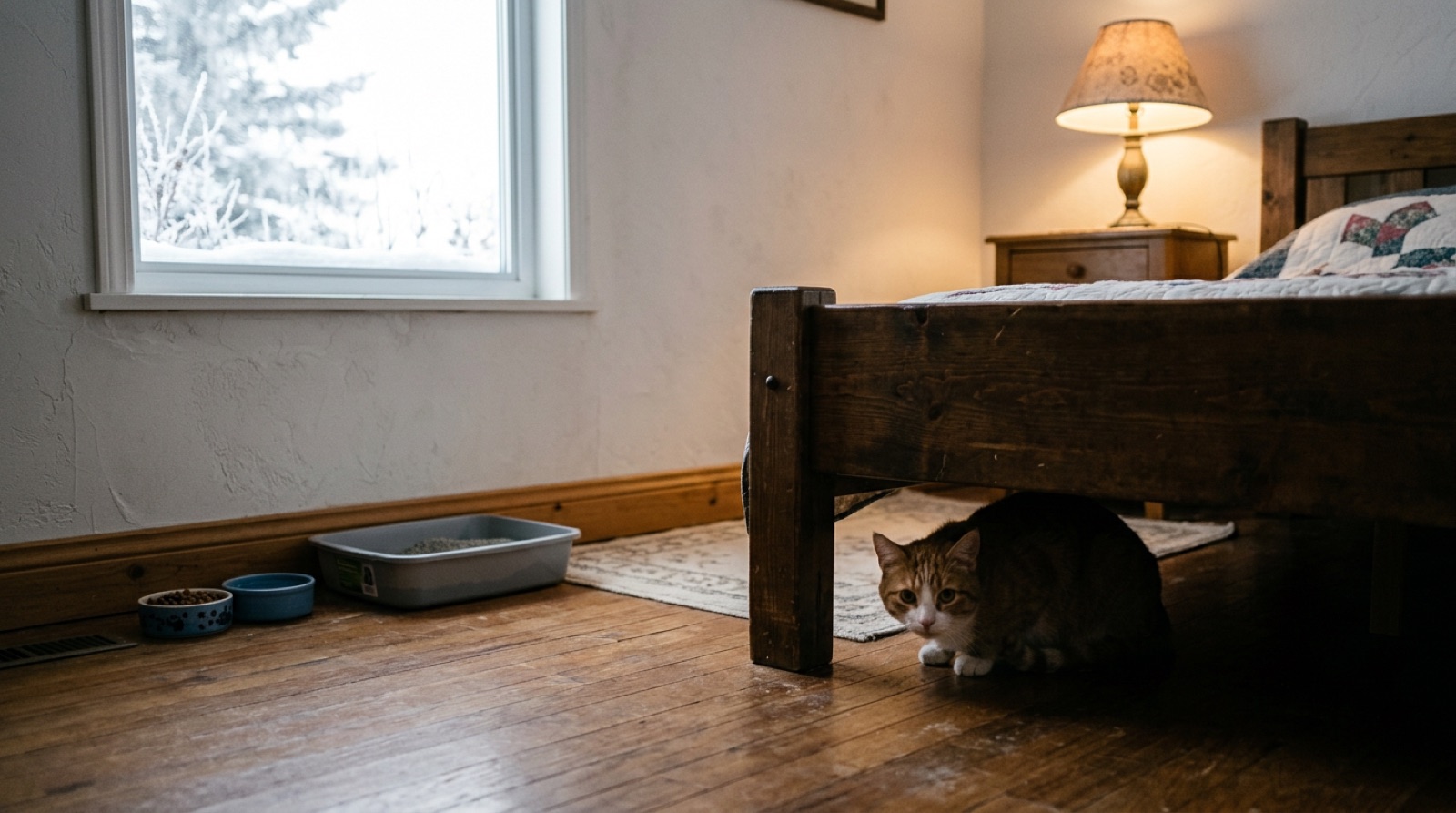
The short answer
One room, door closed, litter box in one corner and food in the other. Open the carrier and walk away. Expect hiding for three to seven days, and eating overnight before you see it happen. Keep the shelter food for the first fortnight. Register with a Red Deer vet inside two weeks. Straining in the litter box with no urine is a same-night emergency, especially in males.
The most common mistake in the first week is kindness applied at the wrong moment.
People bring a cat home, want it to feel welcome, and so they carry it around the house, introduce it to everyone, and keep checking under the bed. From the cat point of view, it has just been removed from everything it knew and dropped into a building full of unfamiliar smells and a stranger who will not leave it alone.
The version that works is almost the opposite. Give the cat one small room, everything it needs, and then largely ignore it. Cats decide a place is safe by observing it undisturbed. Doing less genuinely gets you there faster.
Set Up the Safe Room First
Do this before you leave to collect the cat, so the room is finished and quiet when the carrier arrives. A spare bedroom or a quiet office is ideal. A bathroom works if that is what you have.
- ✓A litter box in a corner away from the food, using the litter the shelter used
- ✓Food and water bowls at the other end of the room
- ✓Two hiding places, a covered bed and a cardboard box on its side
- ✓Something vertical to climb, even a sturdy chair beside a window
- ✓A scratching post or a flat cardboard scratcher
- ✓A worn t-shirt of yours, so your scent becomes normal before you do
While you are in there, check the window screens. A loose screen is how a frightened new cat gets outside in the first week, and a cat with no map of your neighbourhood has very little chance of finding its way back. Red Deer does not license cats, so a collar tag and a registered microchip are the only things connecting a found cat to your address.
How the First Weeks Actually Go
Every cat runs its own schedule. This is the shape most of them follow, and the ones that take twice as long usually turn out fine.
Open the carrier in the safe room and walk away. Do not lift the cat out. Most cats go straight under the bed and stay there, and that is a healthy response rather than a bad sign.
Eating and using the litter box, usually overnight while you are asleep. Sit in the room reading aloud without approaching. Check that food is going down and the box is being used.
Coming out while you are present, taking treats, maybe accepting a chin scratch. Some cats reach this by day two, others take three weeks. Neither is a problem.
Opening the door to the rest of the house, one room at a time, while keeping the safe room set up as a retreat. Do not remove the safe room the moment the cat leaves it.
The real personality arrives. Cats that seemed shy turn chatty, cats that seemed bold get clingier. This is the cat you actually adopted.
The useful measure in the first days is not whether the cat comes out to see you. It is whether food is disappearing and the litter box is being used. Both usually happen overnight, in the dark, while you are asleep. Check in the morning rather than watching in the evening.
Emergency Symptoms: Know These Before You Need Them
Most first weeks are uneventful. The point of this section is that the one genuine emergency in cats moves faster than most owners expect, and waiting until morning is how cats die of it.
Straining in the litter box with no urine coming out
This is a urinary blockage, and it is most common in male cats. It is life-threatening within hours rather than days, because the bladder cannot empty and the resulting changes affect the kidneys and the heart rhythm. It does not resolve on its own and there is nothing you can do at home. Phone a vet immediately, describe exactly what you are seeing, and drive in. A cat crying in the box, licking at itself constantly, or making repeated trips with nothing produced needs to be seen tonight, not tomorrow.
Other symptoms that warrant a phone call to a vet the same day rather than waiting:
- →Difficulty breathing, open-mouth breathing, or fast shallow breaths at rest
- →Repeated vomiting, or vomiting together with lethargy
- →Nothing eaten at all in 24 hours, which is more serious in cats than in dogs
- →Collapse, unsteadiness, or a swollen and painful belly
- →Any suspicion the cat ate a household chemical, a plant, or antifreeze
Never give a cat human medication of any kind while you wait. Several common household painkillers are toxic to cats, and some are fatal in very small amounts. Phone the clinic and take instruction from them.
Find Your Vet on Adoption Day
Register with a Red Deer clinic in the first fortnight, before anything is wrong. Being an existing client makes the difficult phone call considerably easier, and it gets you a routine wellness exam where a vet meets a healthy version of your cat for comparison later.
For after hours, two Red Deer practices publish emergency capability. Cedarwood Veterinary and Animal Emergency Hospital at 7644 50 Ave, 403-347-2676, has staff available during and after normal hours and asks owners to phone before leaving home. Alberta Veterinary Center at 202 Burnt Ridge Rd, 403-347-1711, states on its own site that it offers 24-hour emergency care through the regular office number.
Put both numbers in your phone on the day you bring the cat home. Being midway between Calgary and Edmonton on the QEII means Red Deer has options its smaller neighbours do not, but two in the morning is not the time to be researching them.
Food, Litter and the Slow Switch
Ask the shelter or foster what the cat is eating and what litter it is using, then buy both, even if you intend to change later. A house move and a diet change at the same time is how you end up with diarrhoea in a cat that has not yet decided it likes you.
Once the cat is settled and eating reliably, usually after a week or two, switch over across seven to ten days by mixing a little more of the new food in each day. Same principle with litter. If you want a different type, add it gradually to the existing litter rather than swapping the box contents overnight.
Browse adoptable cats in Red Deer
Shelter and foster cats from Red Deer and central Alberta, all already altered and vaccinated. Listings refreshed regularly.
See Available Red Deer Cats →Frequently Asked Questions
How long does a rescue cat take to settle in?
Plan for weeks rather than days. A common rule of thumb is three days to stop panicking, three weeks to learn the routine, and three months to genuinely feel at home, and it holds up reasonably well in practice. Some cats compress that into a fortnight and some take longer. The mistake almost everyone makes is deciding after four days that the cat is unfriendly. A cat hiding on day four is a cat behaving exactly as expected.
Why is my new cat hiding all the time?
Because hiding is what a cat does when it is not yet sure of a place, and it is a sign the animal is coping rather than failing. Give it a room with hiding spots and let it use them. Do not drag a cat out from under the bed to reassure it, because that teaches the cat that hiding places are not safe either. Sit quietly in the room instead, talk normally, and let curiosity do the work at its own pace.
What should I set up before the cat arrives?
One room, closed door, everything the cat needs inside it. A litter box in one corner, food and water at the opposite end, two hiding places, something to climb, and a scratching post. A spare bedroom or a quiet office is ideal, and a bathroom works at a pinch. Set the room up before you leave to collect the cat, so the whole thing is finished and quiet by the time the carrier comes through the door.
Should I change my cat food right away?
No. Ask what the shelter or foster was feeding and buy that first, even if you plan to switch. A sudden diet change on top of a house move often causes diarrhoea, which is miserable for the cat and worrying for you. Once the cat is eating reliably and settled, usually after a week or two, switch over across seven to ten days by mixing a little more of the new food into the old each day.
When should I book the first vet visit?
Within the first two weeks for a wellness check, unless something is obviously wrong sooner. Adopted cats arrive vaccinated and altered, so this visit is about establishing a relationship with a clinic rather than fixing anything. Phone a Red Deer practice, register as a client, and ask what an annual exam costs while you are on the phone. The point is having somewhere that already knows your cat before the day something goes wrong.
What symptoms mean I need a vet tonight?
Straining in the litter box without producing urine is the one to memorise, particularly in a male cat. That is a urinary blockage and it is a life-threatening emergency measured in hours, not days. It kills through kidney failure and heart rhythm changes, and it does not resolve on its own. Also treat as urgent: difficulty breathing, repeated vomiting, collapse, a swollen painful belly, or a cat that has eaten nothing in 24 hours. Phone a vet first and describe the symptoms.
Where do I go for an after-hours emergency in Red Deer?
Sort this out on adoption day, not at midnight. Two Red Deer practices publish after-hours capability. Cedarwood Veterinary and Animal Emergency Hospital at 7644 50 Ave, 403-347-2676, states that staff are available during and after normal hours and asks owners to phone before leaving home. Alberta Veterinary Center at 202 Burnt Ridge Rd, 403-347-1711, states that it provides 24-hour emergency care on its regular number. Phone ahead either way so they can prepare.
My cat is not using the litter box. What now?
Rule out medical causes before you treat it as behaviour, because that order matters. Straining without urinating is an emergency, and a urinary tract problem can present as house soiling. Once a vet has cleared that, look at the setup. Try the litter the shelter used, put the box somewhere quiet and away from the food, avoid covered boxes at first, and provide one box per cat plus one spare. Most first-week accidents come from stress and resolve on their own.
How do I introduce a new cat to my existing cat?
Slowly, and through a closed door for longer than you want to. Keep them entirely separate for the first week, then swap bedding between the rooms so each learns the other smell before they meet. Next feed them on opposite sides of the closed door so good things happen near that scent. Only then try short supervised meetings. Rushing this creates a grudge that can last months, and going slowly usually costs you two or three weeks.
Should I let my new cat outside?
No, and in Red Deer the bylaw agrees. Cat Bylaw 3174/96 makes it an offence to allow a cat to run at large, with fines starting at $30 and impound through Alberta Animal Services. Beyond that, a newly adopted cat has no map of your neighbourhood and no reason to come back to a house it barely knows. Cats that get out in the first fortnight are the ones that genuinely disappear. Keep the cat in, and escape-proof the doors.
How do I escape-proof the house?
Check window screens for gaps and make sure they are properly seated, because a determined cat will push a loose screen out of its track. Watch the door as you come in and out, especially in the first weeks. Put the cat in the safe room before movers, trades or a delivery arrive. Red Deer does not license cats, so a collar tag and a registered microchip are the only things linking a found cat back to you. Get both sorted early.
When should I introduce the cat to the whole house?
After it is comfortable in the safe room, which usually takes one to three weeks. Open the door and let the cat explore on its own terms rather than carrying it around the house. Do this while you are home and the house is quiet. Keep the safe room set up with its litter box and hiding places for at least another few weeks. Cats retreat to the familiar room when the house gets busy, and taking that option away too early undoes progress.
Related Red Deer Guides
One search, every Red Deer rescue
Shelter cats and foster cats serving Red Deer and central Alberta, in a single list.
Browse Available Red Deer Cats →New cat? Start with these care guides
Everything a new adopter needs to set up a safe, happy home.