The short answer
Malamutes and Huskies are not the same breed. The Alaskan Malamute is a 75 to 100 lb freight hauler bred by the Mahlemiut Inupiat for sustained low-speed power. The Siberian Husky is a 35 to 60 lb distance racer bred by the Chukchi people for speed with lighter loads. Both share Arctic spitz heritage. Both shed dramatically, both struggle in Calgary summers, both are poor guard dogs, both are escape artists, and both rarely earn off-leash freedom. The breeds need different households.
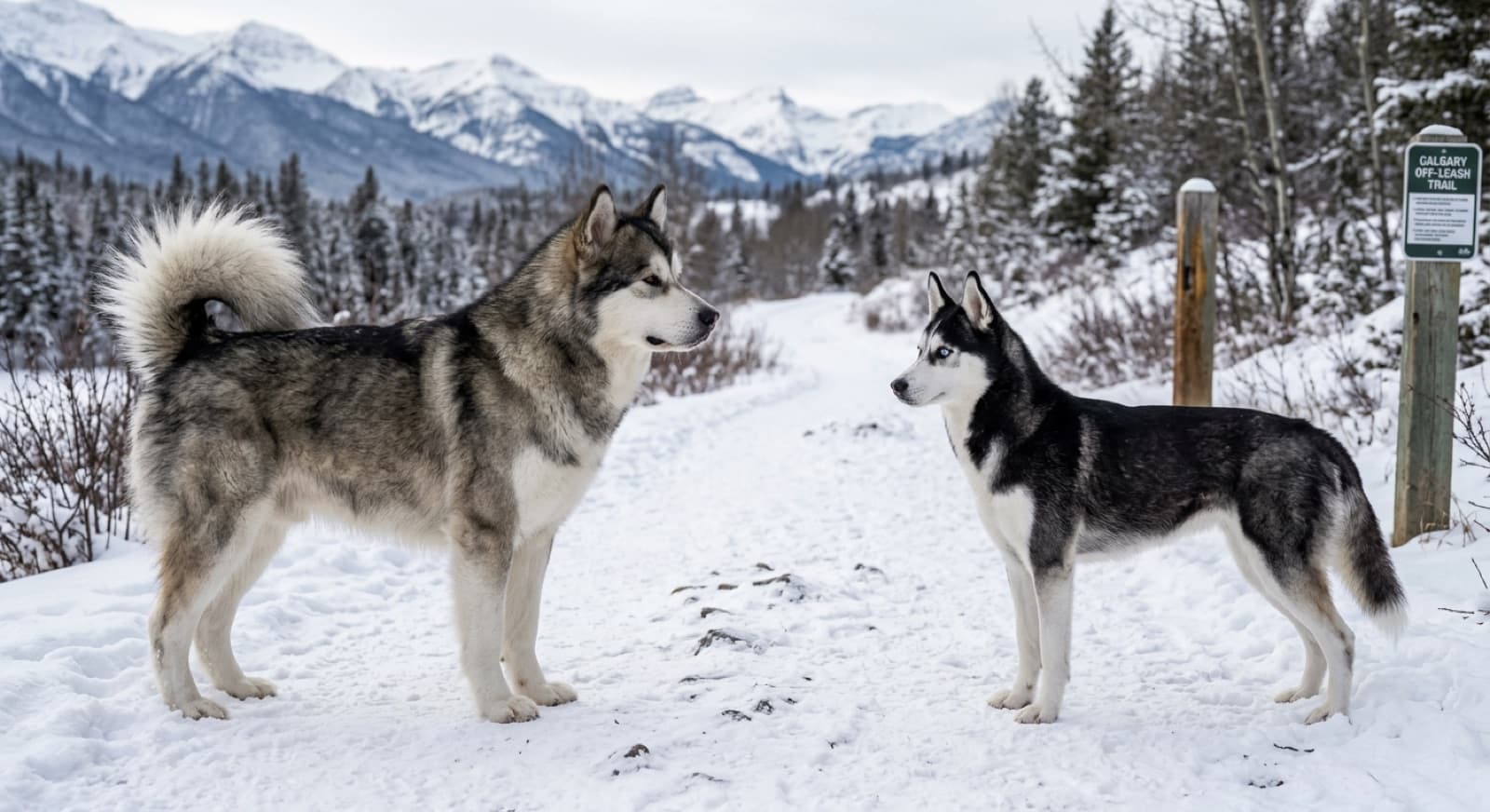
The Arctic spitz lineage: one heritage, two peoples, two jobs
Both breeds descend from the Northern dog landrace populations that spread across the polar north over thousands of years with Indigenous peoples moving between Siberia, Alaska, and northern Canada. Genetic studies place both the Malamute and the Husky in the basal spitz cluster, closely related to other Arctic working dogs like the Greenland Dog, the Canadian Inuit Dog, and the Samoyed.
The breeds diverged because they were developed by different Indigenous peoples for different working roles.
The Alaskan Malamute was bred by the Mahlemiut Inupiat, a people of the Norton Sound region of northwest Alaska. The breed's name comes from the Mahlemiut people. The job was heavy freight: hauling sleds loaded with seal carcasses, supplies, and gear across long Arctic distances at a sustained, manageable pace. The breed needed strength, endurance, weight-bearing structure, and the calm temperament to work in large teams without conflict. Speed was secondary; sustainable power was primary.
The Siberian Husky was bred by the Chukchi people of the Chukotka peninsula in northeastern Siberia. The job was lighter freight and long-distance running: smaller sleds at faster speeds across vast tundra distances. The breed needed efficient gait, lean build, lower body weight, and the metabolic efficiency to cover ground without overheating. The Husky's famous toughness on minimal food rations comes from this selection pressure.
The Husky was brought to Alaska in the early 1900s for the All-Alaska Sweepstakes sled-dog races, where the breed's speed quickly outclassed local sled dogs. The American Kennel Club recognized the Siberian Husky in 1930. The Alaskan Malamute followed in 1935 with a separate breed standard emphasizing the heavier-boned freight build. The two breeds have been recognized as distinct ever since.
For adopters, the relevant takeaway is that the breeds are not interchangeable. Treating a Malamute as a big Husky misreads the temperament and the exercise need. Treating a Husky as a smaller Malamute misreads the racing drive and the vocalization.
Visual and physical comparison
Size is the single most reliable signal between the two breeds. An adult Malamute next to an adult Husky looks substantially larger, heavier-boned, and more powerfully built.
| Trait | Alaskan Malamute | Siberian Husky |
|---|---|---|
| Weight (adult) | 75 to 100 lbs | 35 to 60 lbs |
| Height at shoulder | 23 to 25 in | 20 to 24 in |
| Build | Heavy-boned, broad chest | Lean, narrow chest |
| Coat | Dense double, woolier undercoat | Dense double, more variable density |
| Coat colour | Grey, black, sable, red with white | Very variable: black, grey, red, agouti, white, parti |
| Eye colour | Brown only (standard) | Brown, blue, parti, heterochromia |
| Tail | Curled over the back (plume) | Carried lower, sickle shape |
| Country of origin | Alaska (Mahlemiut people) | Siberia (Chukchi people) |
| AKC recognition | 1935 | 1930 |
| Lifespan | 10 to 14 years | 12 to 15 years |
The tail and eye colour are the two cleanest non-size signals. A double-coated northern dog with a tightly curled plume tail over the back and brown eyes is almost certainly Malamute or Malamute-leaning. A double-coated northern dog with a sickle-shape tail carried lower and any combination of brown, blue, or parti-coloured eyes is more likely Husky or Husky-leaning. Eye colour alone is not definitive in mixes, but blue eyes in a northern dog are a strong Husky-ancestry signal because blue is a disqualifying fault in the Malamute breed standard.
For Calgary rescue dogs labelled vaguely as “Northern breed mix” or “Husky cross,” the size and tail are the most reliable starting clues. A 90 lb plume-tailed dog is Malamute-heavy. A 50 lb sickle-tailed dog is Husky-heavy. A DNA test from Embark or Wisdom Panel confirms the breakdown if it matters for breed-specific health screening.
Working purpose: freight versus racing
The breeds were selected for different jobs over many generations, and the behavioural differences in the modern pet dog still trace back to those selection pressures.
Malamute (freight haulers). The Mahlemiut bred for power at sustained low speed. A Malamute sled team could move heavy loads over long distances at roughly 6 to 10 km/h. The breed needed strength to start a loaded sled, endurance to keep moving for hours, and a calm pack temperament to work in large teams without conflict. Modern Malamutes inherit the strong pulling instinct, the steady working pace, and the calmer baseline temperament. They are not naturally racing-fast. They are naturally good at sustained pulling work like carting, weight pulling, and freight hauling.
Husky (distance racers). The Chukchi bred for speed and efficiency. A Husky sled team could move light loads over very long distances at roughly 16 to 24 km/h sustained, and faster in racing settings. The breed needed an efficient gait, lean build, and metabolic toughness on minimal rations. Modern Huskies inherit the running drive, the racing-distance endurance, and the higher arousal baseline. They are not built for heavy pulling. They are built for distance running, skijoring, canicross, and bikejoring.
For Calgary households, the working-purpose difference matters for two practical decisions. First, the type of exercise the dog enjoys most: Malamutes love steady walks, hikes, and pulling work; Huskies love running, sprinting, and distance work. Second, the daily exercise volume: Huskies generally need more total active minutes per day (90 to 120) than Malamutes (60 to 90), even though the Malamute is the bigger dog. The Husky's racing-bred metabolism creates more daily energy to burn.
Temperament: shared traits, real differences
Both breeds share strong baseline traits from their Arctic spitz heritage: friendly with people, poor guard dogs, high prey drive, pack-oriented, independent decision-makers, often same-sex selective with other dogs, vocal in their own ways, and famously escape-driven. Inside that shared baseline, there are real differences worth understanding.
Malamute temperament. More independent, more stubborn, calmer baseline arousal, less vocally expressive (Malamutes “woo” more than howl), more inclined to wander than to run. The Malamute is bigger and slower-moving but proportionally stronger, which makes the dog harder to physically manage if it decides to pull toward something. Same-sex aggression (particularly female-female) is well-documented in the breed and is a real consideration for multi-dog households.
Husky temperament. More biddable than the Malamute for active training, higher arousal baseline, more vocal (howling, whining, talking), more racing-driven (when the Husky takes off, the dog moves fast and covers ground), more food-motivated, and more variable temperament between lines (working racing lines tend higher-energy than show lines). Same-sex selectivity exists but is less consistently breed-typical than in the Malamute.
Both breeds, common to remember. Neither is a guard dog. Both will happily greet a stranger at the door. Both have strong prey drive and chase small fast-moving animals (cats, squirrels, rabbits, sometimes small dogs). Both treat recall as optional advice rather than a command, particularly off-leash with a moving stimulus. Both escape through fences, under fences, over fences, and out of unsecured doors. Both need force-free training with high-value rewards because aversive methods damage the bond with these independent-minded breeds. Calgary force-free trainers like Raising Canine and Pup City Pup Academy work well for both breeds.
For more on the Husky-specific behavioural pattern, see our Husky training Calgary guide and Husky escape prevention guide. Most of the same principles apply to Malamutes with the size and force differences adjusted upward.
Exercise needs: both demanding, different in shape
Neither breed is a low-exercise dog. The Malamute needs 60 to 90 minutes of focused daily activity; the Husky needs 90 to 120 minutes. Both need that activity at the upper end of the range during adolescence (8 to 24 months) and through the prime adult years (2 to 8 years).
Malamute exercise that works. Long structured walks at a steady pace, weighted backpack hikes (start 5% of body weight, build to 15% with vet sign-off), winter sled or skijor work, carting, weight pulling, hiking in the Kananaskis foothills, swimming where available. Repeated fetch and high-arousal ball drills are less satisfying for the breed; structured pulling work scratches the working itch better.
Husky exercise that works. Running with a runner (the Husky is a great canicross partner), bikejoring on quiet pathways, skijoring in Calgary winters, long-line work in safely contained spaces, distance hiking, and structured high-arousal play. Repeated short walks in a city block do not satisfy a Husky; the breed needs sustained ground-covering activity.
For both breeds, Calgary off-leash parks are useful for socialization but rarely safe for full off-leash freedom because of the breeds' recall failure rate. Long lines (10 to 15 metres) in big spaces like Nose Hill and Tom Campbell's Hill let the dog cover ground without the escape risk of full off-leash. See our Husky exercise and lifestyle guide for the daily Calgary routine that adapts well to Malamutes at a slower pace.
Calgary climate fit: winters great, summers genuinely dangerous
Both breeds overheat at temperatures most other dogs handle fine. From May through September in Calgary, midday exercise above 22 degrees Celsius is dangerous for both breeds. Heat stroke can develop in 15 to 30 minutes of exertion in 25-degree heat.
Calgary is one of the better Canadian climates for both breeds. The long cold winters (December through March routinely sees daytime highs below freezing) match the breeds' thermoregulatory range exactly. Both breeds thrive in temperatures down to roughly minus 25 degrees Celsius with normal paw protection and acclimatization. Snow is a comfort, not a hardship. Cold-weather sport (skijoring, canicross, sledding) is the best part of the year for both breeds.
The summer challenge is real and is the single biggest climate risk for both breeds in Calgary. The double-coated Arctic build does not handle heat the way a Lab or a short-coated breed does. Practical summer management:
- Air conditioning is mandatory. A non-AC apartment in Calgary July at 28 degrees Celsius is dangerous for a Malamute or Husky. Confirm AC is in the unit before adopting if you rent.
- Exercise timing shifts. Early morning (before 7 AM) and late evening (after 8 PM) walks only on hot days. Midday walks are off the table from late May through mid-September.
- Watch the signs. Heavy panting, drooling, slow movement, refusal to walk, glazed expression. Stop immediately, cool the dog with water (not ice), and call a vet if the dog doesn't recover in 10 minutes.
- Never shave the coat. The double coat insulates against heat as well as cold; shaving destroys the thermal regulation and exposes skin to sunburn. Brush instead.
- Yard shade and water. Outdoor time on hot days needs shade and constant cold water access.
The honest summer reality is that both breeds spend more time indoors with AC during Calgary summers than most other breeds. Households without AC, or households planning long summer days outdoors, should think carefully before adopting either breed.
Shedding: both heavy, daily commitment
Both breeds shed dramatically year-round and blow their double coats twice a year in heavy seasonal events lasting 3 to 6 weeks. There is no low-shed northern breed, and no grooming technique that prevents the daily and seasonal coat loss.
Of the two, the Malamute sheds slightly more in total volume because the dog is bigger and the undercoat is denser and woolier. The Husky undercoat is more variable in density depending on the line, with some Huskies shedding noticeably less than others.
The daily and seasonal routine that works for both:
- Weekly brushing year-round with a slicker brush and a metal comb to manage normal shed.
- Daily brushing during coat blow (spring and fall) with an undercoat rake (Furminator or similar). Expect to fill a grocery bag with fur per session.
- A bath every 6 to 12 weeks. Over-bathing strips the protective coat oils.
- A vacuum cleaner that handles pet hair. Dyson, Shark, and equivalent upright vacuums with pet attachments are worth the investment. Carpet households should expect to vacuum twice a week.
- Acceptance. Both breeds shed onto every soft surface in the home. Sofas, beds, car upholstery, and clothing all carry the dog. Households unwilling to accept this should pick a different breed.
For the full coat-care detail that applies to both breeds, see our Husky shedding and grooming Calgary guide. The same routine works for Malamutes at slightly higher daily volume.
Trainability: stubborn versus stubborn-with-drive
Neither breed is in the eager-to-please obedience category. Both were bred to make their own decisions in dangerous Arctic terrain, and the modern pet dog still inherits that independent judgment.
Of the two, the Malamute is more stubborn-independent. The breed considers commands as suggestions and weighs whether compliance makes sense before responding. Recall is poor. Loose-leash walking is hard work because the dog naturally pulls. Multi-step obedience sequences take longer to install than they do with most other large breeds.
The Husky is slightly more biddable for active training because the breed's higher food motivation and stronger handler attachment make positive-reinforcement training land faster. But the Husky's racing drive makes off-leash work and recall even riskier than the Malamute's wandering drive: a Husky in pursuit of a squirrel or rabbit moves very fast and covers ground before the handler can react.
For both breeds, the training approach that works:
- Force-free methods with high-value rewards. Aversive tools (prong, e-collar, leash corrections) damage the bond with these independent breeds and create reactivity over time. The American Veterinary Society of Animal Behavior position statement on punishment-based training is worth reading.
- Group classes early. Raising Canine and Pup City Pup Academy run continuous Calgary group classes that work well for both breeds during puppy and adolescent phases.
- Long lines instead of off-leash. 10 to 15 metre long lines in safely contained spaces give the dog freedom without the escape risk.
- Job-appropriate exercise. A working breed without a job becomes a problem-solver. Skijoring, canicross, weight pulling, hiking, and structured walks all channel the drive productively.
- Patience. Both breeds take longer to fully install behaviours than retrievers or working obedience breeds. The training is doable; the timeline is longer.
Cost comparison: breeder, rescue, and lifetime
Breeder cost differs significantly between the two breeds.
Alaskan Malamute breeders in Canada are rarer. Well-bred Canadian Kennel Club registered puppies from health-tested parents run $2,500 to $5,000 with waitlists of 12 to 24 months because litters are infrequent and the breed has fewer active breeders. Most reputable Canadian Malamute breeders are members of the Canadian Kennel Club breed registry and the Alaskan Malamute Club of America.
Siberian Husky breeders are more common in Canada. CKC-registered puppies from health-tested parents run $1,500 to $3,500 with waitlists of 6 to 12 months. The breed has a larger active breeder population, and reputable breeders are listed through the Siberian Husky Club of Canada.
Rescue costs are similar for both breeds: $400 to $900 typical adoption fee in Calgary. Both breeds are very common in Calgary rescue because both are heavily surrendered for under-research reasons (exercise demand, shedding, escape behaviour, vocalization). The surrender pool is large enough that adopters can usually find the right age, sex, and energy match within a reasonable timeline. AARCS, Halo Husky Haven, and the Calgary Humane Society all see Malamutes, Huskies, and crosses regularly.
Lifetime cost runs higher for the Malamute because the dog is bigger: more food per day, larger crates and beds, higher vet bills (anesthesia, surgery, medication dosing all scale with body weight), and pet insurance premiums that scale with breed and weight. Estimate $2,500 to $3,500 per year for an adult Malamute and $1,800 to $2,800 for an adult Husky in Calgary, excluding emergencies.
Browse adoptable Malamutes in Calgary
Once you know the Malamute and the Husky are separate breeds with separate household demands, the rescue conversation gets clearer. Calgary rescues see both breeds regularly, and the foster network gives honest temperament feedback before adoption.
See Available Malamutes →Mal-Husky mixes in Calgary rescue
Mal-Husky crosses are common in Calgary rescue because both breeds escape regularly, both get surrendered for similar lifestyle-mismatch reasons, and unplanned litters happen. A dog labelled vaguely as “Northern breed mix” or “Husky cross” in a Calgary rescue listing has a real chance of being a Mal-Husky combination.
The temperament of a Mal-Husky mix is unpredictable. The dog can inherit:
- The harder combination: Malamute size (85 lbs+) combined with Husky racing drive, Husky vocalization, and Husky escape behaviour. This is the most demanding household-fit profile in the cross.
- The easier combination: smaller Husky-leaning size with the calmer Malamute baseline. This is a more manageable pet profile.
- Any combination in between, because both breeds share enough core traits that the variability runs across many dimensions.
There is no reliable way to predict before adopting. The honest planning approach for a Mal-Husky mix:
- Assume the larger Malamute size for housing, crate, and budget planning.
- Assume the higher Husky exercise need for daily activity planning.
- Assume the Husky escape drive for fencing and containment planning.
- Treat anything easier than that as a bonus.
Foster-based rescues like AARCS evaluate temperament during the foster period and give honest feedback about the individual dog's drive, recall, vocalization, and household manners before the adoption. That foster evaluation is more useful than the vague breed label for predicting the lifestyle demand.
Which one is right for a Calgary household
The decision depends on four practical factors: housing, daily exercise capacity, summer cooling, and household composition.
The Siberian Husky fits best in:
- Apartments and rentals where the smaller size (35 to 60 lbs) makes housing easier (with the vocalization caveat for neighbour relations).
- Active running households where the breed's distance-running heritage matches the human lifestyle.
- Households committed to 90 to 120 minutes of daily exercise.
- Cold-weather sport households (canicross, skijoring, bikejoring).
- Families with kids of any age (the smaller size carries less force in bumps).
- Households without small prey-animal pets (cats, rabbits, small dogs).
The Alaskan Malamute fits best in:
- Houses with fenced yards where the size (75 to 100 lbs) is comfortable.
- Households drawn to the historic freight-hauling working role (carting, weight pulling, sustained hiking).
- Households committed to 60 to 90 minutes of daily exercise with steady-pace structure.
- Calmer indoor environments where the slightly lower arousal baseline matches the household.
- Owners with experience handling large, physically powerful, stubborn-independent breeds.
- Households without same-sex resident dogs (female-female aggression is well-documented in the breed).
Both breeds require:
- Air conditioning in Calgary summer.
- Securely fenced yard with the bottom buried or anchored against digging.
- Acceptance of heavy shedding and twice-yearly coat blow.
- Force-free training commitment.
- Long-line work instead of off-leash freedom in most settings.
- Calgary winter as the dog's favourite season.
For most Calgary first-time Arctic-breed owners, the Husky is the more workable starting point: smaller, more rental-friendly, more available in rescue, and the breed's wider exposure means more Calgary-specific resources, trainers, and breed-specific rescues. The Malamute is a wonderful breed for the right household but the size, scarcity, and physical demand make the first-time Arctic-breed entry harder.
The honest first question for any Calgary adopter considering either breed is whether the lifestyle demand matches the household honestly, not whether the dog is cute. Both breeds are gorgeous; both are also the most-surrendered northern breeds in Calgary rescue because owners underestimated the daily reality.
Frequently Asked Questions
Are the Alaskan Malamute and Siberian Husky the same breed?
No. They are two separate breeds with different countries of origin, different sizes, different working roles, and separate breed standards. The Siberian Husky was bred by the Chukchi people of Siberia as a distance sled racer and light freight dog, recognized by the American Kennel Club in 1930 and the Canadian Kennel Club shortly after. The Alaskan Malamute was bred by the Mahlemiut Inupiat in Alaska as a heavy-freight hauler for sustained low-speed work, recognized by the AKC in 1935. They share Arctic spitz ancestry from the Northern dog landrace populations that spread across the polar north thousands of years ago, but the breeds have been on separate paths for over a century. An adult Malamute next to an adult Husky looks like a noticeably larger, heavier, slower-moving dog.
Which is bigger, a Malamute or a Husky?
The Alaskan Malamute is significantly bigger. Adult Malamutes weigh 75 to 100 lbs and stand 23 to 25 inches at the shoulder. Adult Siberian Huskies weigh 35 to 60 lbs and stand 20 to 24 inches. A male Malamute can weigh nearly double what a female Husky weighs. The Malamute is also heavier-boned and broader through the chest because the breed was developed for hauling heavy loads at low speed; the Husky is leaner with a narrower chest because the breed was developed for distance running. Side by side, the size difference is the single most reliable visual signal between the two breeds.
Which breed sheds more?
Both shed dramatically year-round and blow their double coats twice a year (spring and fall) in heavy seasonal shedding events lasting 3 to 6 weeks. Of the two, the Malamute sheds slightly more in total volume because the dog is bigger and the undercoat is denser and woolier. The Husky undercoat is more variable in density depending on the line. For practical Calgary household planning, treat both breeds as equally demanding: weekly brushing year-round, daily brushing during coat blow, a high-quality undercoat rake (Furminator or similar), and a vacuum cleaner that handles pet hair. Neither breed is appropriate for any household with serious dog-hair allergies. See our Husky shedding and grooming guide for the daily coat care routine that applies to both breeds.
Which is more stubborn to train?
The Malamute is generally more stubborn and more independent. Both breeds were bred to work in sled teams where the dog needed to use its own judgment in dangerous terrain, so neither is the eager-to-please obedience type. The Husky is slightly more biddable for active training (recall is still poor, but obedience training tends to land faster). The Malamute is more likely to weigh whether the command makes sense to the dog before complying. For both breeds, force-free training with high-value rewards is the only approach that works long-term. Calgary force-free trainers like Raising Canine and Pup City Pup Academy run group classes that suit both breeds, with patience and consistency mattering more than technique.
Which breed is louder?
The Husky is louder. Huskies are famous howlers and vocalizers; they talk, sing, argue, and protest with a wide vocal range that can carry blocks away in a quiet Calgary neighbourhood. Malamutes are also vocal (the breed has its own woo-woo conversational sound) but the volume and frequency are usually lower than a Husky. Neither breed is a quiet dog. For apartment, condo, and rental households in Calgary, the Husky's vocalizing is the more common neighbour complaint trigger. If quiet is non-negotiable in your housing, neither breed is the right fit.
Which is better with children?
Both breeds are typically friendly with children when properly socialized, but size is the practical safety factor. The smaller Husky (35 to 60 lbs) is easier for a family with toddlers because an overexcited bump or wag carries less force. The larger Malamute (75 to 100 lbs) can knock a small child over without meaning any harm. Both breeds have strong prey drive that means supervision around very young children (who can trigger chase responses) is essential. Both benefit from early socialization between 8 and 16 weeks. Neither breed is dog-aggressive toward people as a baseline temperament, but the combination of size and bouncy adolescent energy means supervision around young kids is required for both.
Which one suits apartment or condo living in Calgary?
Neither is a natural apartment fit, but the Husky is the more workable option of the two. Husky apartment life is doable in Calgary with 90 to 120 minutes of daily off-property exercise, careful management of the howling for neighbour relations, and acceptance that the dog needs a serious daily outlet. Malamute apartment life is much harder because the size makes elevators, stairs, and shared spaces awkward, and the dog's exercise need still has to be met. For both breeds, ground-floor walk-up units, end-unit condos with thicker walls, and houses with yards are all easier than mid-floor apartments. See our Husky apartment living Calgary guide for the detailed setup that applies to both breeds at a smaller scale.
Which is the better choice for Calgary winter sport?
Both excel in cold-weather work; the choice depends on the sport. For skijoring, canicross, and bikejoring (where speed and lighter pulling matter), the Husky is the traditional pick because the breed was bred for distance running with lighter loads. For sled pulling, weight pulling, and carting (where sustained low-speed power matters), the Malamute is the historic choice because the breed was bred for freight hauling. Both breeds love snow and thrive in Calgary winters down to about minus 25 degrees Celsius with appropriate paw protection and acclimatization. The Calgary Sled Dog Association and informal Bragg Creek skijoring groups run both breeds. Honestly, in the average Calgary household, the difference matters less than the household's actual willingness to do regular winter sport with the dog.
What is the breeder cost difference?
Alaskan Malamute breeders in Canada are rarer and more expensive: $2,500 to $5,000 for a well-bred puppy from a CKC-registered breeder, with waitlists of 12 to 24 months because litters are infrequent. Siberian Husky breeders are more common: $1,500 to $3,500 for a CKC-registered puppy with waitlists of 6 to 12 months. Both breeds are very common in Calgary rescue at $400 to $900 because both breeds are heavily surrendered for under-research reasons (exercise demand, shedding, escape behaviour). For most Calgary households, the rescue path makes sense for both breeds because the surrender pool is large and the cost difference is substantial. See our Malamute adoption Calgary guide and Husky adoption Calgary guide for rescue source details.
What about Malamute-Husky mixes?
Mal-Husky crosses are very common in Calgary rescue because both breeds escape, both get surrendered, and unplanned litters happen. The temperament of a mix is unpredictable: the dog can inherit the size of the Malamute with the racing drive and vocalization of the Husky, which is often the most demanding combination. Or the cross can inherit the smaller size and calmer baseline, which is easier. There is no reliable way to predict before adopting. The honest planning approach is to assume the larger size and the higher exercise need, plan housing and exercise accordingly, and treat anything easier than that as a bonus. Foster-based rescues like AARCS evaluate temperament during the foster period and give honest feedback to adopters.
Which has blue eyes?
The Siberian Husky. Blue eyes, parti-coloured eyes, and one-blue-one-brown (heterochromia) are all standard in the Husky breed. The Alaskan Malamute breed standard accepts only brown eyes; blue eyes are a disqualifying fault in the Malamute show ring and indicate a Husky cross somewhere in the line. For Calgary rescue dogs labelled simply “Mal-Husky mix” or “Northern breed mix,” blue eyes are a strong signal that the dog has Husky ancestry contributing. A DNA test (Embark or Wisdom Panel) confirms the breakdown if it matters for breed-specific health screening.
Which breed is the right fit for my Calgary household?
Pick the Husky if you want the smaller size (35 to 60 lbs), the easier rental and apartment fit, the slightly more biddable training profile, the distance-running heritage for canicross or skijoring, and the famously vocal Husky personality. Pick the Malamute if you want the larger size (75 to 100 lbs), the heavier-boned freight build, the slightly calmer baseline temperament, the historic sled-team working role, and a household setup with a yard and enough space for a big dog. For both, confirm that you have the daily exercise time, summer cooling capacity, fenced yard, secure containment, and grooming commitment before adopting. The number one reason both breeds get surrendered to Calgary rescue is owners who underestimated the lifestyle demand, not problems with the dogs.
Adoptable Alaskan Malamutes in Calgary
Live listings of Alaskan Malamutes and Malamute crosses from the Calgary rescue network, updated regularly.
Adoptable Siberian Huskies in Calgary
Live listings of Siberian Huskies and Husky crosses from Calgary shelters and rescues.
Alaskan Malamute Adoption Calgary
Rescue sources, real adoption costs, breeder waitlists, surrender patterns, and household-fit verification for Calgary Malamute adopters.
Husky Adoption Calgary
Rescue sources, real adoption costs, Calgary insurance and rental reality, and the most-surrendered reasons for Husky adopters to plan around.
New dog? Start with these care guides
Everything a new adopter needs to set up a safe, happy home.