The short answer
The first 30 days follow the 3-3-3 rule: 3 days of decompression, 3 weeks of routine, 3 months to bond fully. In week 1, keep the world small (one quiet room, the crate, the same food the rescue used, no visitors). In week 2, start short calm outings on a martingale collar or back-clip harness. In week 3, book the vet exam with a baseline cardiac auscultation, try a first off-leash session at a fenced Calgary area, and begin a force-free trainer. By week 4, settle into the full 60 to 90 minute daily exercise routine. Build alone-time tolerance from day 1 to prevent separation anxiety in this notably velcro breed.

Before pickup: the Doberman supply checklist
A Doberman is a medium-large dog (60 to 80 lbs adult, with males larger), with a short single coat, a notably velcro bonding pattern, and real exercise needs. The American Kennel Club Doberman page describes the breed as loyal, intelligent, and deeply bonded to family. Two practical realities shape the supply list. The short coat needs winter protection in Calgary below -10 degrees Celsius. The velcro bonding pattern means alone-time work starts on day 1. Buy the core kit before pickup so the first 48 hours focus on settling, not shopping.
- Martingale collar plus a padded back-clip harness. Sized for 60 to 80 lbs. A martingale prevents slip-outs (a Doberman's head is narrower than its neck). The harness is for walks and the leash clip.
- Sturdy 6-foot leather or biothane leash. Skip retractable leashes. A 60-pound dog on a retractable is a recipe for a torn shoulder for both of you.
- Properly sized crate, 42 to 48 inch wire, with a divider. Crate-train from day 1. A washable crate bed and two blankets. The crate becomes the safe spot during decompression.
- Baby gates. Block off rooms not part of the first-week zone. Useful for limiting stairs for a young or recovering Doberman.
- Calm bedding location. Washable bed in a low-traffic corner, ideally near where the family rests in the evening. A velcro breed needs to see you.
- Winter coat for below -10 degrees Celsius. Non-negotiable. The Doberman has minimal body fat and a thin single coat. Without a coat, the dog shivers within minutes of going outside in a Calgary February.
- Booties for salt and ice. Calgary sidewalks get salted heavily. Salt cracks paw pads and irritates skin. Booties also help below -20 degrees Celsius when paw pads are at frostbite risk.
- Food puzzles and a snuffle mat. Mental enrichment for a working breed. Useful especially on Calgary cold-snap days when full walks are not safe.
- High-value treats. Cheese, hot dog cubes, freeze-dried liver. Force-free training pays better than a $2 bag of mass-market biscuits. Use the good stuff for the first 90 days.
- The same food the rescue or breeder used. Buy a 1 to 2 week supply and plan a 7 to 10 day gradual transition. Cold-turkey switches cause diarrhea during an already stressful week.
- Raised stainless or ceramic bowls plus a slow-feeder. Better posture for a deep-chested dog. The slow-feeder cuts gulping, which matters because Dobermans are on the bloat-risk list.
- ID tag with a Calgary phone number. Mandatory under the City of Calgary Responsible Pet Ownership Bylaw. Microchip should already be in place from the rescue.
- Frozen Kong plus several stuffed enrichment toys. Alone-time conditioning starts day 1. The Kong is your single best tool for building separation tolerance in a velcro breed.
- Pet insurance, enrolled before the first vet visit. Anything noted at the wellness exam can become a pre-existing exclusion. For Dobermans, the highest-cost items most often excluded are dilated cardiomyopathy treatment, von Willebrand bleeding episodes, and orthopaedic claims. These are exactly the items new owners most want covered.
Days 1 to 3: the decompression phase
The 3-3-3 rule is the directional timeline rescues use to describe decompression: 3 days, 3 weeks, 3 months. Dobermans tend to show one of two patterns in the first 72 hours. The first pattern is full shutdown: the dog hides in the crate, skips meals, sleeps a lot, and avoids eye contact. The second pattern is anxious clinging: the dog follows you everywhere and panics when you leave the room. Both are normal stress responses to a new home. The job for the first 72 hours is the same either way.
Pick one quiet room as the home base. Set up the crate, water, and a calm bedding location away from the front door. Use the same food the rescue used. Walk the dog leashed in the backyard or directly outside your door for the first potty trips. No introductions to neighbours, neighbour dogs, or visitors. Keep the household calm: lower voices, fewer people moving through the room, no loud music or TV at first.
Skipped meals are common in the first 24 to 48 hours. So is loose stool. So is hiding in the crate. Do not push food, do not pull the dog out of the crate, and do not let children invade the safe spot. Drop treats nearby and let the Doberman come to you. Talk softly. Most Dobermans emerge from full decompression by day 3 or 4 and start showing the breed's real temperament: confident, alert, and intensely bonded to whoever is feeding and walking them.
How to read shutdown signs versus settling signs. Shutdown looks like a dog who refuses food past day 2, will not leave the crate even for potty trips, flinches at touch, and avoids all eye contact. Settling looks like a dog who eats half a meal by day 2, takes treats from your hand by day 3, and starts following you between rooms by day 4. Settling has forward motion. Shutdown does not. Shutdown past day 5 needs a call to the rescue.
Resist the urge to invite anyone over. The single most common week-1 mistake Calgary rescues see is a parade of family and friends in the first 5 days. The dog cannot process it. Hold guests off for 10 to 14 days, neighbour dogs for longer.
Week 1: routine, crate, and the first basics
By day 4 or 5, the Doberman is usually out of the deepest decompression. Week 1 is about locking in a predictable schedule the dog can rely on. Predictable beats interesting in the first week.
- Potty schedule. Out within 15 minutes of waking, after every meal, after every nap, last thing at night. Pick one outdoor spot and reward heavily on success.
- Mealtimes. Two meals a day for adults, three to four for puppies under 6 months. Same time, same quiet feeding corner, raised slow-feeder bowl. Skip the post-meal exercise for 60 to 90 minutes (bloat-risk management for deep-chested breeds).
- Crate introduction. Frozen Kong inside, door open during the day, soft closed door for short stretches and overnight. Place the crate in or near your bedroom so the dog is not isolated overnight in week 1. A velcro breed alone in the basement crying all night is a hard start.
- Leashed neighbourhood walks at quiet times. 15 to 20 minutes, quiet streets, off-peak times. Avoid Stampede crowds in July, busy retail areas, and dog-park introductions. Inglewood side streets at 7 a.m., Bridgeland morning, or quiet residential pockets in Edgemont and Tuscany all work.
- Alone-time practice from day 1. Even 5 to 10 minutes in another room with a frozen Kong builds the foundation. A Doberman left alone for the first time on day 7 for an 8-hour work day is a recipe for separation distress. The velcro bonding pattern means this work cannot wait.
- Calm bedding location. The crate is one option. A washable bed in a low-traffic corner is another. Avoid the busy doorway or the kitchen floor.
- No daycare, no dog park, no group classes yet. The dog needs to know you and the house before it adds the world.
Start force-free training from day 1 with 2 to 5 minute sessions. The first targets are the dog's name, a calm hand-touch cue, and voluntary eye contact. Pay every success with a high-value treat. The American Veterinary Society of Animal Behavior position statement on humane dog training recommends positive reinforcement and warns against aversive methods. Skip choke chains, prong collars, e-collars, and any “dominance” framing. They backfire badly on an intelligent sensitive breed and erode the trust you are trying to build.
Week 2: trust building and the velcro pattern
By week 2, the Doberman knows the home, the routine, and the household sounds. This is when the velcro bonding pattern usually surfaces. The dog greets you in the morning, follows you between rooms, lies down near you in the evening, and starts treating you as the safe person. For most Doberman owners, this is the week the relationship clicks. It is also when alone-time work matters most.
- Short outings to quiet Calgary neighbourhood streets. 25 to 35 minutes, leashed on the martingale collar or back-clip harness. Pick streets away from busy off-leash zones.
- Still no off-leash. A Doberman has no recall history with you yet. Off-leash before recall is established becomes a dog-running-toward-Macleod-Trail problem.
- Begin training cues with high-value treats. Add “sit” and “come” (in low-distraction environments like the kitchen). Sessions stay short (2 to 5 minutes), payment stays high.
- Build alone-time duration. 30 minutes, 60 minutes, 90 minutes through week 2. Always with a frozen Kong, always with calm departure (no big goodbye, no big greeting). The velcro pattern intensifies this week, which is the right time to lay the alone-time foundation.
- Watch for velcro bonding intensifying. Follows you to the bathroom. Cries when you close a door. Stares at you across the room. This is normal and is the breed working as advertised. Manage it: practice short separations daily, reward calm settling, do not reinforce panic by rushing back.
- Continue crate work. Most Dobermans by end of week 2 enter the crate voluntarily for treats and the frozen Kong.
Week 2 is also when household rules need to be consistent. If the dog is not allowed on the couch, every family member enforces that. Mixed rules across humans confuse a settling dog and slow trust-building. Pick the rules before pickup and stick to them. A Doberman is intelligent enough to spot the soft touch in the household and work them.
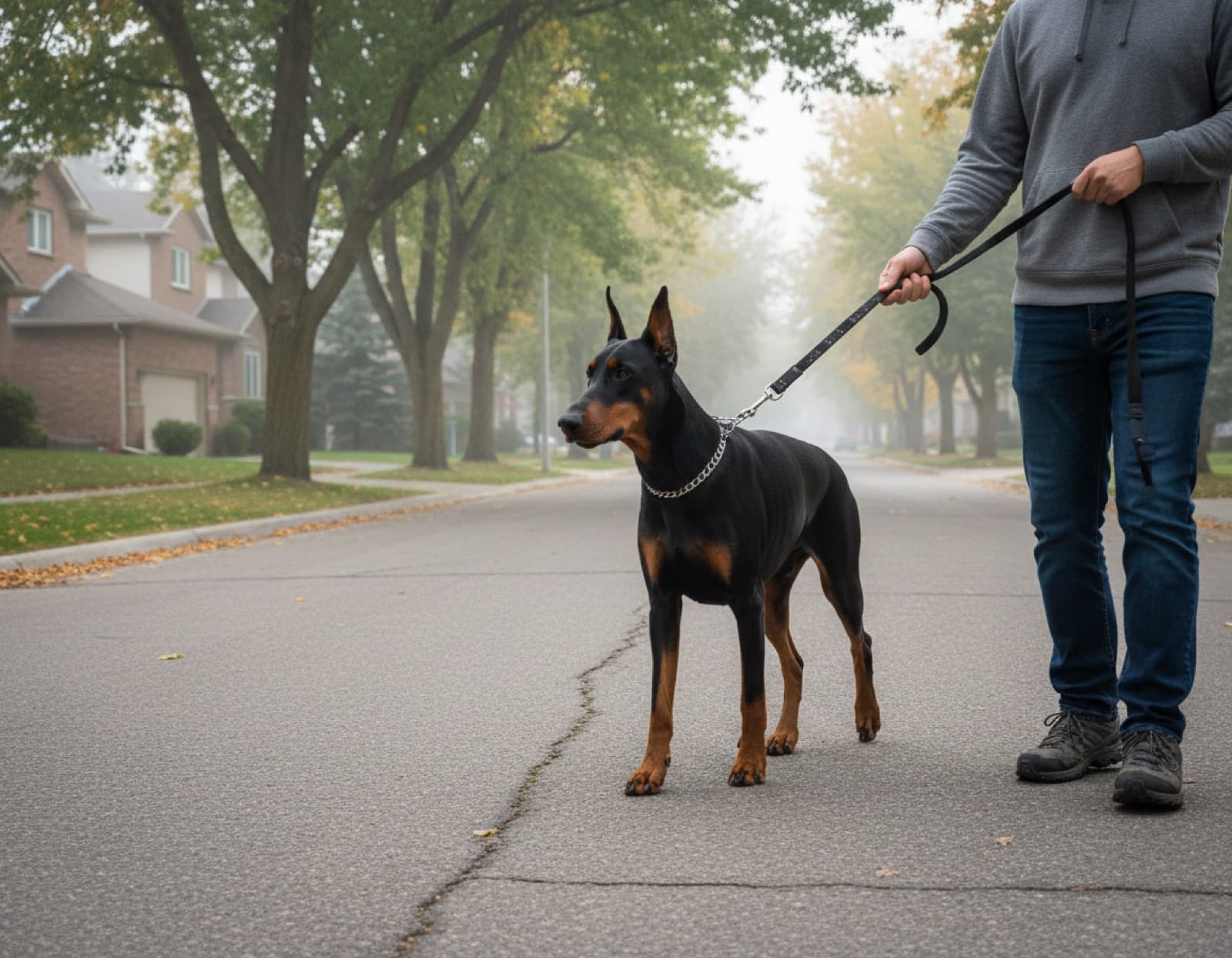
Week 3: routine expansion, vet visit, and first trainer session
Week 3 is the expansion week. The Doberman has a settled routine, the household trust is real, and the dog is ready for slightly more variety. Three milestones for this week:
- First force-free trainer session. Book a private intro session with a Calgary force-free trainer like Raising Canine or Pup City Pup Academy. Group classes typically start around week 4 once the trainer has assessed your specific dog. The trainer can flag any breed-specific patterns (over-arousal, alert-barking, leash reactivity) early.
- Vet first visit. Book the wellness exam within the first 7 to 10 days. See the checklist below. For a Doberman, the baseline cardiac auscultation is the single most important addition.
- First off-leash trial at a fenced area. Try the Southland off-leash park or a quiet early-morning corner of Bowmont Park. Bring a 30-foot long line as a safety net. Bring high-value treats. Practice recall in a low-distraction corner before unclipping. Five minutes of successful recall beats 30 minutes of chasing the dog around. Even a recall that goes well in week 3 does not mean off-leash on open trails yet.
Walks lengthen to 40 to 60 minutes and start building toward the 60 to 90 minute adult routine. Add light enrichment: a sniffari walk where the dog leads, a snuffle mat at dinner, a puzzle toy in the afternoon. Mental enrichment matters as much as physical exercise for an intelligent working breed. A well-exercised body with an under-stimulated mind still produces a destructive Doberman.
Week 4: the new normal
By week 4, the household has its rhythm and the Doberman feels at home. The velcro bonding pattern is fully established. This is when the full adult routine starts: 60 to 90 minutes of daily exercise, mental enrichment, the full training schedule, and the first daycare trial if one is planned.
- Full daily exercise. 60 to 90 minutes split across two outings. Morning sniffari plus evening longer walk works for most adults. Puppies stay on the 5-minutes-per-month-of-age rule, twice a day, to protect growing joints.
- First daycare trial (if planned). A half-day at a force-free Calgary daycare like Pup City Pup Academy. The temperament assessment usually happens first. Daycare is useful ongoing socialisation for some Dobermans but overstimulating for others. Read your specific dog.
- Training class enrollment. Group classes at Raising Canine or another force-free Calgary trainer. The controlled-distraction practice a class provides cannot be replicated at home.
- Longer walks and varied environments. Fish Creek pathway, Nose Hill viewpoint trails (still leashed unless in marked off-leash zones), Edworthy Park along the river. Cooler morning or evening walks in summer above 22 degrees Celsius.
- The velcro pattern is now fully established. The dog follows you everywhere, cries briefly when you leave the room, sleeps near you, and treats your absence as the worst part of its day. This is the breed working as advertised. The alone-time foundation you built in weeks 1 to 3 prevents this from becoming separation anxiety.
- Settled crate behaviour. Most Dobermans at week 4 use the crate voluntarily with the door open.
- Alone-time tolerance. Most Dobermans at week 4 manage 4 to 6 hours alone calmly, with a Kong and a calm departure. If destructive panic or non-stop howling is happening, that is a red flag worth a call.
Browse adoptable Dobermans and Dobie mixes in Calgary
A 30-day plan only matters if there is a dog to bring home. Live listings from 15+ Calgary rescues, updated regularly. Foster reports include known health, temperament, and household fit.
See Available Dobermans →Calgary vet first-visit checklist for a Doberman
Book the wellness exam within 7 to 10 days of pickup. Calgary first-visit pricing typically runs $80 to $150. The standard checklist plus the Doberman-specific items:
- General wellness exam. Weight, body condition score, dental check, full physical.
- Vaccinations review. Confirm what the rescue has done, schedule any boosters or missing vaccines (rabies, DHPP, bordetella if daycare is planned).
- Microchip check. Scan to confirm the chip is in place and registered to you.
- Baseline cardiac auscultation. The single most important Doberman addition. Dilated cardiomyopathy (DCM) is a well-documented breed concern. The vet listens carefully for any early murmur or arrhythmia. A normal baseline at the first visit gives you something to compare against on every future exam. The Doberman Pinscher Club of America health and welfare page publishes ongoing DCM screening guidance.
- Baseline bloodwork including thyroid panel. Hypothyroidism is on the Doberman breed-watch list. A baseline T4 reading at the first visit lets the vet catch any drift over time.
- von Willebrand Disease (vWD) genetic test. vWD is a bleeding disorder with a genetic test commonly run for Dobermans. If the rescue did not provide a result, ask the vet to run the cheek swab. Knowing the status before any surgery (spay, neuter, dental, injury repair) matters because affected dogs need special blood-clotting management.
- Body condition score. A young Doberman often arrives a little under-conditioned from rescue. The vet documents the starting point so you know how the dog tracks over the first 3 months.
- Gait and spinal exam. Wobbler syndrome (cervical vertebral instability) is on the Doberman watch list. A baseline neuro and gait exam gives the vet a reference point if anything changes later.
- Parasite plan. Heartworm test if the dog is over 6 months and history is unknown. Flea, tick, and deworming protocol for Calgary's climate.
- Diet review. Bring the food bag label or a photo. Discuss any rescue-flagged sensitivities.
- Paperwork. Bring everything from the rescue. The vet copies what it needs into your file.
Enrol pet insurance before this exam. Anything noted at the wellness check can become a pre-existing exclusion. For Dobermans, the highest-cost items most often excluded are DCM treatment, vWD bleeding episodes, hip dysplasia surgery, and Wobbler syndrome management. These are exactly the items new owners most want covered. For complex cardiac cases, Western Veterinary Specialist Centre in southeast Calgary handles cardiology referrals from local clinics.
Force-free training basics
Dobermans were bred to work closely with people. They are one of the most trainable breeds when handled with positive reinforcement and one of the most damaged by aversive methods. The American Veterinary Society of Animal Behavior position statement on humane dog training recommends positive reinforcement as the standard of care and warns that aversive methods carry real risks of fear, anxiety, and aggression.
Marker training works well for Dobermans. A clicker or a clean verbal “yes” marks the moment the dog does what you want, followed immediately by a high-value treat. The marker becomes a precise communication tool the breed picks up fast.
Recall is the priority cue. A Doberman that ignores its recall in an open Calgary off-leash area is gone fast. Practice recall daily in low-distraction environments first (kitchen, backyard), then gradually add distraction (front yard, quiet street), then move to higher-distraction environments only after recall is reliable in calmer ones. Never call the dog for something the dog dislikes (a bath, a nail trim, being put in the crate). The recall must always predict good things, or the dog stops coming.
Why aversive methods backfire on Dobermans. The breed is intelligent, sensitive, and intensely bonded. A prong collar or e-collar creates a dog that avoids the human, hides, and develops generalised anxiety. The breed's natural trainability collapses under corrections. Aggression sometimes develops in response to the pain. Force-free methods preserve the working relationship the Doberman needs.
The velcro bonding pattern and alone-time work
Dobermans are famously velcro: they bond hard, bond fast, and prefer to be in the same room as their primary person at all times. The pattern is part of why people love the breed. It is also why separation anxiety is a real risk if alone-time work does not start on day 1.
The first 30 days are when you build alone-time tolerance gradually. The protocol is straightforward and works for almost every dog if it starts early enough. Day 1: 5 minutes alone in a closed-door room with a frozen Kong. Day 3: 15 minutes. Day 7: 30 minutes. Day 14: 60 minutes. Day 21: 2 to 3 hours. Day 30: half a workday. Always with a frozen Kong, always with a calm departure (no long emotional goodbye), always with a calm return (no big reunion). Match the duration to the dog's comfort, not the calendar. If the dog is panicking at 30 minutes, drop back to 20 and rebuild.
The key insight: a velcro Doberman left alone for 8 hours on day 7 of its new life is a recipe for true separation anxiety, which is much harder to undo than to prevent. Build the tolerance like building a muscle. Five minutes a day, then ten, then thirty. By day 30, most Dobermans manage a half workday calmly. If destructive panic or non-stop howling persists past week 4, contact a force-free trainer or veterinary behaviourist before it cements.
Red flags in the first 30 days
Most of the first 30 days goes smoothly. A few signs warrant a phone call to the rescue, the vet, or a force-free trainer:
- Extreme shutdown beyond 72 hours. Most Dobermans emerge from full decompression by day 3 or 4. A dog still hiding constantly at day 5 to 7, refusing to leave the crate even for potty trips, needs the rescue or a force-free trainer involved.
- Refusing food for 48+ hours. Especially if paired with vomiting, diarrhea, or lethargy. Call the vet. For puppies under 6 months, any skipped meal is worth a phone call.
- Severe panic when alone. Destructive panic, self-injury (chewing through the crate, scraping paws raw at the door), non-stop howling that lasts hours. This is a force-free trainer or veterinary behaviourist call, not a “wait it out” situation. The longer it goes unaddressed, the harder it is to undo.
- Leash reactivity not addressable with environmental management. Lunging, barking, or fixating on other dogs or people on walks that does not improve with distance, treats, or quieter routes within 2 weeks. A force-free trainer can build a counter-conditioning plan.
- Aggression of any kind. Stiff staring at family members, hard growls when handled around the face or food bowl, snapping, or biting. Call a force-free trainer within the week. Do not punish growling; growling is information.
- Limping that lasts more than 24 hours. Or stiffness after rest, or reluctance to use stairs. A Doberman vet visit is warranted (Wobbler syndrome is on the breed watch list).
- Sudden weakness, collapse, or unusual lethargy. A Doberman cardiac red flag. Same-day vet call.
- Owner overwhelm. If you are 2 weeks in and silently regretting the adoption, call the rescue. Most rescues have done this conversation hundreds of times. The first month is the hardest part of the entire 10 to 12 year relationship. You are not failing.
Calgary trainers, daycares, and ongoing support
A force-free Calgary trainer is the single best investment in a new Doberman's first 90 days. Group classes give controlled-distraction practice the home environment cannot. Private sessions handle anything breed-specific that comes up (over-arousal, leash reactivity, alone-time work).
- Raising Canine. Force-free Calgary trainer with group classes and private sessions. Strong on recall foundations, adolescent management, and reactive-dog protocols.
- Pup City Pup Academy. Calgary force-free training and daycare combined. The daycare option can be useful ongoing enrichment, though daycare is not for every Doberman: some find it overstimulating.
For force-free Calgary daycare, the temperament assessment usually happens before any boarding or full-day visits. A confident social Doberman often passes easily. A more reserved or over-aroused dog may do better with 1-to-1 walking instead. Daycare works best 1 to 2 days a week as supplemental enrichment, not as a 5-day-a-week solution to under-exercising at home.
For breed-specific support, the Doberman Pinscher Club of Canada publishes breed health resources and rescue contact information. The Doberman Pinscher Club of America health page covers the breed's ongoing DCM screening protocols. Talk to the rescue or foster who placed your dog: they know this specific Doberman better than any general resource will.
Frequently asked questions
What is the 3-3-3 rule for rescue Dobermans?
The 3-3-3 rule is the directional decompression timeline: 3 days, 3 weeks, 3 months. Three days is the deep decompression window where many Dobermans look shut down (quiet, hiding in the crate, skipping meals, sleeping a lot). Three weeks is when the routine clicks and the household trust starts. Three months is when you see the real dog: confident, velcro-bonded, alert, and the temperament the breed is known for. Dobermans tend to bond fast once decompression ends, so the velcro pattern often surfaces in week 1 or 2, but the full trust still takes about 3 months.
How long does it take a rescue Doberman to settle in?
Most rescue Dobermans follow the 3-3-3 timeline. The deepest decompression usually wraps by day 3 or 4. By the end of week 2, most Dobermans are following you between rooms, choosing to rest near you, and showing the velcro pattern the breed is famous for. Real bonding finishes around month 3. Dobermans from kennel backgrounds, late-life surrenders, or harsh prior training may need 6 months or longer. Keep the household calm, the routine predictable, and the early training sessions short and paid with high-value treats.
My rescue Doberman seems shut down. Is this normal?
For the first 72 hours, yes. A shut-down Doberman in days 1 to 3 sleeps a lot, hides in the crate, skips a meal or two, and avoids eye contact. This is normal decompression and the right response is patience, not pressure. Drop treats nearby. Do not pull the dog out of the crate. Do not invite visitors. Most Dobermans emerge by day 3 or 4. Shutdown that lasts past day 5 to 7, or that comes with refusing food for 48 hours, vomiting, or limping, is worth a call to the rescue or your vet.
When can I start training a rescue Doberman?
From day 1, in short 2 to 5 minute sessions. Dobermans are one of the most trainable breeds when handled with positive reinforcement. The first cues are simple: the dog's name, voluntary eye contact, a hand-touch. Pay every success with a high-value treat. Skip aversive tools (prong collars, e-collars, choke chains). Aversive methods backfire badly on Dobermans because the breed is sensitive and intelligent. The dog learns to avoid you instead of working with you. Group classes at a force-free trainer start around week 3 or 4.
How much exercise does a new Doberman need in the first month?
Build up gradually across the four weeks. Week 1 is mostly leashed home exploration plus 15 to 20 minute calm neighbourhood walks. Week 2 expands to 25 to 35 minute outings on quiet Calgary streets. Week 3 adds longer walks and the first vet visit. Week 4 reaches the full adult routine of 60 to 90 minutes of daily exercise plus mental enrichment. Puppies under 12 months follow the rough 5-minutes-per-month-of-age rule, twice a day, to protect growing joints. A bored Doberman becomes a destructive, anxious Doberman.
When should the first vet visit happen for a new Doberman?
Within 7 to 10 days of pickup. The wellness exam covers weight, body condition, vaccination review, microchip check, and parasite plan. For a Doberman specifically, ask the vet to add three baseline items: cardiac auscultation (listening for any early dilated cardiomyopathy murmur), baseline bloodwork including thyroid panel, and a von Willebrand Disease (vWD) genetic test if the rescue did not provide one. Calgary first-visit pricing typically runs $80 to $150. Enrol pet insurance before this exam so nothing noted becomes a pre-existing exclusion.
What is velcro bonding and why does it matter in the first 30 days?
Dobermans are a velcro breed: they bond hard and fast to their primary person and prefer to be in the same room. The pattern usually emerges in week 1 or 2 and intensifies through month 3. It is part of why people love the breed. It is also why separation anxiety is a real risk if alone-time work does not start on day 1. The first 30 days are when you build alone-time tolerance gradually. Five minutes alone with a frozen Kong, then 30, then 90, then a half day. Skip this and you have a 60-pound dog who panics every time you leave.
Should I take my new Doberman off-leash in week 1?
No. A newly adopted Doberman has no recall history with you yet. Week 1 is leashed only, in the yard or on quiet streets. Week 2 is leashed in slightly busier areas. Week 3 is the earliest reasonable first off-leash trial, and only at a fenced Calgary area like the Southland off-leash zone, with a 30-foot long line as a safety net and high-value treats. Even a successful week 3 recall trial does not mean off-leash on open trails. Build recall reliability over the first 2 to 3 months before trusting the dog fully off-leash in Bowmont or Nose Hill open areas.
Does my Doberman need a winter coat in Calgary?
Yes. The Doberman has a short single coat with minimal body fat. Below -10 degrees Celsius, a winter coat is required for outdoor time. Below -20 degrees Celsius, add booties to protect paw pads from ice and road salt. Limit outdoor sessions to 10 to 15 minutes in deep cold. The breed shivers visibly when uncomfortable, which is your cue to go home. Calgary winter also means salt on sidewalks: rinse paws after walks and watch for cracked pads. Indoor enrichment (snuffle mats, food puzzles, training games) carries the dog through cold snaps when full walks are not safe.
When should I start daycare or boarding with a new Doberman?
Not in week 1. The earliest reasonable trial is week 3 or 4, and only at a force-free Calgary daycare that does temperament assessments first. A half-day first visit beats a full day. For a Doberman, daycare can be useful ongoing enrichment once the dog is settled, but watch for over-arousal. Some Dobermans love daycare. Others find it overstimulating and prefer 1-to-1 walks. Read your specific dog. Daycare is not a substitute for the daily 60 to 90 minutes of structured exercise and bonding time the breed needs.
More Doberman guides
Doberman Adoption Calgary →
Where to adopt, real costs, why Dobermans end up in rescue, and what to ask the foster before applying.
Doberman Cardiac Monitoring Calgary →
Baseline screening, DCM watch items, and the Calgary specialty vet pathway for cardiac referrals.
Velcro Bonding and Separation Anxiety →
Why Dobermans bond so hard, alone-time work from day 1, and when to call a force-free trainer.
Adoptable Dobermans in Calgary →
Current Dobermans and Dobie mixes across 15+ Calgary rescues, updated regularly.
New dog? Start with these care guides
Everything a new adopter needs to set up a safe, happy home.