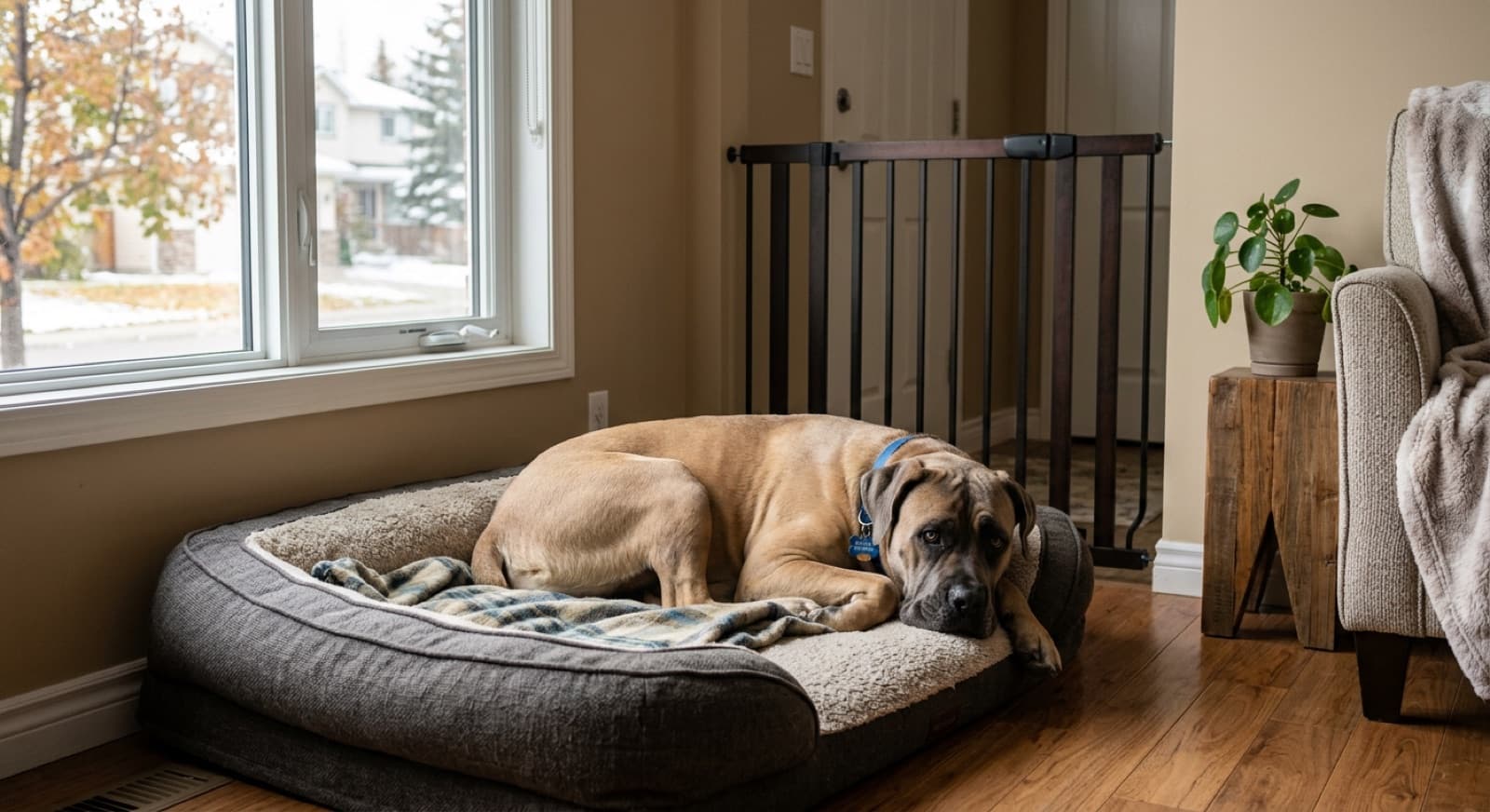
The honest version
Rescue Cane Corsos in Calgary come through AARCS, BARCS, Pawsitive Match, and a handful of guardian-breed-experienced foster networks. They arrive from owner surrenders, hoarding intakes, backyard-breeder seizures, and rural transports. Reddit Corso owners consistently describe the first 14 days as the make-or-break period. The dog you meet on day one is rarely the dog you have on day 90. The 3-3-3 rule holds, and often stretches. 3 days to decompress, 3 weeks for real personality to emerge, 3 months to feel fully bonded. Two things make Cane Corsos different from other large-breed rescues: they are guardian-breed reactive, not friendly-default, and they bond hard to a single chosen handler. Most regret in the Calgary Corso rescue network comes from rushing visitors, dog parks, off-leash, or training. This is the playbook for not doing that.
The 3-3-3 Rule for Cane Corsos
The standard 3-3-3 framework applies, with guardian-breed layers. Cane Corsos bond hard once they bond, but they bond on their own timeline. Many look distant, watchful, or shut down for the first two weeks and start choosing a person in week 3. That is normal, not a setback.
3 Days: Decompression
Overwhelmed and cautious. Many Cane Corsos refuse food for 24 to 48 hours, sleep most of the day, or freeze when approached. Some growl if handled too soon. All of this is normal. Your job is to be predictable, quiet, and non-demanding. No handling beyond essential leash trips for potty. No visitors. No introductions. No training.
3 Weeks: Settling and personality emerges
Routines feel familiar. The dog you actually adopted starts showing up. Could be a confident guardian who alerts at every sound. Could be a velcro shadow attached to one person. Could be a leash-reactive dog whose history nobody knew. Could be an under-socialized dog who freezes near children. Whatever shows up in weeks 2 to 4 is closer to baseline than what you saw on day one.
3 Months: Fully bonded
Real bond forms. The famous Cane Corso loyalty usually appears by month 2 to 3. Recall begins on a long line. Leash skills start to click. Trust is two-way. By month three, most rescue Corsos are at 70 to 80 percent of their long-term personality, and you can begin structured socialization, controlled outdoor exposure, and a steady force-free training routine with a Calgary trainer who knows guardian breeds.
Large-Breed Setup (Different From Other Rescue Setups)
A 100-pound dog needs different infrastructure than a 30-pound dog. Underbuilt setups fail under guardian-breed strength. Calgary rescues consistently flag the same gaps when adopters do not size up.
Crate: 48 inches minimum
- • A wire crate sized for 70 to 110 pound dogs, divider removed, set up before the dog arrives.
- • Heavy-duty pan and reinforced corners. A stressed Corso can bend or pop apart a flimsy starter crate.
- • Cover with a breathable blanket on three sides for a den feel. Leave the front open.
- • Large orthopedic bed inside, low to the ground. Cane Corsos lean and lounge heavily.
- • Crate placement in a quiet corner. Not the front door, not the family-room traffic lane.
Beds, gates, and gear
- • Multiple large orthopedic beds in chosen rest spots. Joints take a beating on hard floors for large breeds.
- • Baby gates rated for large dogs. The lightweight pressure-mounted versions are not enough. Use wall-mounted or extra-tall gates.
- • Food and water bowls at floor level are fine. Cane Corsos eat happily from any height. Skip elevated feeders unless your vet recommends one for a specific reason.
- • 6-foot fixed leash plus a martingale or properly fitted flat collar with a clear ID tag (City of Calgary licence required).
- • Back-clip Y-front harness for car rides and reactivity work. Skip retractable leashes entirely.
- • If you drive an SUV, truck, or any vehicle where the dog has to jump down more than knee height, get a ramp. Heavy dogs slamming joints day after day causes lasting damage.
Yard and home
- • Escape-proof fenced yard before the dog arrives. 6-foot solid fencing is the standard for guardian breeds in Calgary.
- • Walk the perimeter, check gaps under gates, confirm latches close securely, and remove leaning items the dog could use to climb.
- • No off-leash front yards, even briefly, for the first 60 days.
- • Storage of food, garbage, and chemicals in cabinets a 100-pound dog cannot nose open.
- • A second leash and a slip lead kept by the door for emergencies.
- • A clear plan for who handles the dog on outdoor trips during week one. Same person, same route, same time.
Floor surfaces and home flow
- • Slippery hardwood and tile cause hip and joint strain in large breeds. Add runner rugs in hallways and around food bowls.
- • Keep nails trimmed so the dog can grip.
- • A predictable home flow: where the dog sleeps, where they eat, where they rest. Move the dog as little as possible in week one.
Day One: Setup and First 24 Hours
Set up before the dog arrives. A Corso-proofed home is not the same as a generic dog-proofed home. Crate size, gate strength, fence height, and visitor protocols all matter more.
Before the dog arrives
- • Pick a quiet room as the safe space. Spare bedroom or main floor corner works. Low traffic, dim lighting.
- • 48 inch crate set up with a large orthopedic bed inside, blanket draped on three sides.
- • Floor-level food and water bowls, with the same food the foster fed.
- • Baby gates installed at room boundaries and any stairs you want to restrict.
- • 6-foot leash and harness ready by the door.
- • Yard perimeter walked and confirmed secure.
- • All household members briefed: no eye contact in the first hours, no reaching over the head, no baby-talk, no crowding, no visitors for 14 to 30 days.
- • Kids briefed separately: stay calm, sit on the floor, let the dog approach you, no hugs, no following the dog into the safe room.
- • Resident pets behind a closed door. No introductions in week one.
- • Stock soft high-value treats (cooked chicken, training-sized soft treats) for low-pressure bonding.
- • Winter coat sized for a 100 pound dog if adopting between October and April.
First 24 hours
- • Leash on before exiting the car. Even indoors, keep the leash dragging for the first day. Easy to pick up if the dog needs guidance, no grabbing collars.
- • Walk the dog calmly through the yard to potty first. Then inside to the safe room.
- • Show water and food. Leave food down 15 minutes, remove if untouched.
- • Sit nearby quietly. Read, watch TV. No direct eye contact, no reaching over the head, no baby-talk.
- • Absolutely no visitors. No neighbour kids. No social media unboxing.
- • Other pets stay separate behind a closed door. Scent-swap with a blanket if you want, no face-to-face.
- • If the dog hides in the crate or under a table and stays there, leave them alone. Drop treats nearby and walk away.
- • Night one: covered crate in your bedroom or the safe room. Many Corsos sleep better near a human, others want full privacy. Read what the foster reported.
- • No couch invitations on day one. No bed sharing. Set the rules from hour one because changing them later is hard with a guardian breed.
- • Refusing food for 24 to 48 hours is normal. Continue offering. Do not switch food in week one.
Week One: Routine and Bonding Only
No training, no daycare, no dog park, no off-leash, no introductions to anyone outside your household. Week one is one job: build a predictable rhythm and let the dog feel safe.
Daily rhythm to copy
- • Same wake time every day. Same outdoor potty rhythm.
- • 2 to 3 short leashed outdoor trips (10 to 20 minutes each) on a harness or martingale, on a 6-foot fixed leash. Quiet routes only.
- • No dog parks. No busy paths. No off-leash trails. The Bow River Pathway at 6 AM, fine. Sandy Beach on a Saturday afternoon, not yet.
- • 3 short low-pressure interaction sessions (5 to 10 minutes each): sit on the floor with treats, let the dog approach, soft pets only if invited.
- • Lots of rest. Rescue Cane Corsos often need 16 to 18 hours of sleep in week one. Resist the urge to interact more.
- • Same evening wind-down. Lights low, calm energy, predictable bedtime.
- • Crate door open during the day, closed at night for the first 2 weeks.
Week-one mistakes that cause month-two problems
- • Inviting visitors over to meet the new dog. One overwhelming day can trigger lasting suspicion of guests.
- • A welcome-home gathering. The single most common Calgary Corso adoption regret.
- • Taking the dog to a pet store or dog park. Both are sensory overload during decompression.
- • Letting kids crowd, hug, follow into the safe room, or chase. Kids sit on the floor, dog approaches first.
- • Forcing handling: nail trims, baths, brushing, ear cleaning. Save all of it for week 3+.
- • Harsh corrections, leash pops, scruffing, or alpha-rolling. Corsos shut down or push back under pressure.
- • Off-leash in any unfenced area. Recall does not exist yet, and a Corso loose in Nose Hill Park is a risk to everyone.
- • Introducing the resident dog or cat too soon. Wait at least 5 to 7 days, then neutral ground, on leash, with two handlers.
- • Leaving the dog alone for 6+ hours on day one. Build alone-time gradually starting at 15 to 30 minutes.
- • Switching food. Stick with the foster food for at least 2 weeks, then transition over 7 to 10 days.
- • Skipping the foster home call. Foster behaviour data is the single best resource you have.
Weeks 2 and 3: The Real Dog Shows Up
This is the chapter most adopters are not warned about. Week one was the muted, careful version. Weeks 2 and 3, the actual personality starts to emerge as the dog feels safe enough to behave normally. The surprises in this window are not regression. They are honesty.
Velcro attachment kicks in
Cane Corsos often pick one person and shadow them everywhere. The chosen person can do anything; everyone else gets cautious watchfulness. This balances out over months 2 and 3 if the whole household uses the same gentle protocols, but a strong primary-handler bond is breed character, not a problem to fix.
Leash reactivity emerges
Many rescue Corsos arrive shut down and reveal reactivity later. Could be other dogs, could be strangers, could be cyclists, could be everything moving. This is information, not a failure. Move walks to quieter routes, increase distance from triggers, and book a Calgary trainer who specializes in reactivity (not a general obedience class) before month 2.
Under-socialization gaps
Backyard-breeder Corsos and rural intakes often arrive with socialization gaps. Could freeze at the sound of a bicycle bell, the sight of a child in a stroller, or a man in a hat. Build positive associations slowly with distance and treats. Do not force exposure.
Resource guarding may appear
Food, toys, beds, or the chosen person. Common in dogs from chaotic backgrounds. Manage by not approaching the dog while eating, not taking items from their mouth, and trading high-value items for higher-value treats. If guarding is severe, call the rescue and a fear-free behaviourist before it escalates.
First gentle training
Short sessions (5 to 10 minutes), high-value treats, force-free. Name response, hand target, default sit. Build the marker word (“yes”). No leash corrections, no e-collars, no prong collars in week 3. Corsos push back under harsh handling more than almost any breed and the relationship damage is hard to repair.
Months 2 and 3: Bond Solidifies
By week 5 to 6, your Cane Corso recognises you as theirs. By month 3, the bond is real. This is when you layer in real training and bigger-world exposure at a Corso pace, with a structured socialization plan that respects the guardian-breed temperament.
What to add by month
- • Month 2: Force-free group class or private training with a Calgary trainer who knows guardian breeds. Short recall games indoors on a long line. Slow handling work: paw touches, ear checks, mouth peeks with treat rewards.
- • Month 2: First short alone-time stretches built up to 3 to 4 hours. Frozen lick mats, durable chew toys sized for power chewers.
- • Month 2: Daily walks at a steady pace, 30 to 45 minutes total on quieter routes. Skip the dog park.
- • Month 2: Structured socialization protocol begins. One new exposure at a time, at a distance the dog can handle, with treats. Calm coffee-shop patios at low traffic times work well. Busy festivals do not.
- • Month 2 to 3: First vet visit beyond the rescue check-up. Establish a fear-free clinic. Discuss weight management (lean Corsos live longer), hip and elbow scoring, dental care, and a vaccination check.
- • Month 3: First grooming visit if needed (nails, bath). Pick a fear-free Calgary groomer experienced with large guardian breeds and book a meet-and-greet first.
- • Month 3: Recall training on a 30-foot long line in fenced fields. Off-leash freedom in private fenced space only. Public off-leash trails wait until you have a solid recall, usually 6 to 12 months in.
- • Month 3: Begin introducing trusted visitors one at a time, outside on neutral ground, with treats. No surprise guests. The household pattern from week one carries forward.
Trauma Signs and When to Call the Rescue
Most rescue Cane Corsos show some of these in the first weeks. Most resolve with patience. A few are flags worth calling the rescue or a fear-free vet behaviourist about. Severe reactivity, fearful aggression, and full shutdown need outside help.
Common and usually resolve in 2 to 8 weeks
- • Refusing food the first 24 to 48 hours
- • Hiding in the crate or behind furniture for hours
- • Tucked tail and flattened ears around new people
- • Freezing or going stiff when reached for
- • Snapping or growling when handled too fast
- • Choosing one safe spot and refusing to leave it
- • Mild leash reactivity that appears in week 2
- • Housetraining accidents the first 7 to 10 days
Call the rescue and a fear-free vet behaviourist
- • Persistent shaking in a warm room past day 3
- • Refusing all food for more than 48 hours
- • Repeated growling or snapping at handlers, not just one event
- • Hiding or freezing constantly past day 5, no response to your presence
- • Attempting to escape the yard or the house
- • Severe reactivity to every passing stranger or dog
- • Fearful aggression you cannot safely manage
- • Severe shutdown that does not soften by week 3
Same-day vet, no waiting
- • Bloody diarrhea, persistent vomiting
- • Coughing or sneezing with eye or nose discharge (kennel cough or upper respiratory infection)
- • Limping or favouring a leg
- • Sudden bloated belly, retching without producing anything (possible bloat, which is a large-breed emergency)
Calgary rescues like AARCS, BARCS, and Pawsitive Match are foster-based and expect post-adoption support calls. Use them. The foster who lived with this dog knows more about the dog than anyone, and is your first call for behaviour questions.
The Honest Reality of Rescue Cane Corsos in Calgary
Calgary rescue Cane Corsos come from a few common backgrounds. Knowing the patterns helps you read foster notes and ask the right questions.
Owner surrenders
Adults surrendered because the family underestimated the breed. Often arrive housetrained and crate-trained, but with under-socialization gaps or untreated reactivity. The grief and confusion of losing their home can show as appetite loss and depression for 2 to 3 weeks. These dogs usually settle well with steady patience and a household that respects the guardian-breed temperament.
Backyard-breeder and seizure intakes
Younger Corsos from undersocialized litters or seized from neglect cases. May have weak bite inhibition, leash fear, deep handling fear, and longer settling. Health issues (skin, ears, weight) are more common. Foster homes do the heavy lifting. Expect the full 3-3-3 timeline to stretch to 6 to 12 months. These dogs reward consistency and gentle handling, and the bond when it forms is exceptional.
Rural transports
Working or yard dogs brought in from rural Alberta. Often confident with people they know, less confident with city stimuli (traffic, elevators, downtown noise). Calgary-specific habituation work in months 2 and 3 helps. Start with quiet residential routes, build toward busier areas at the dog’s pace.
Foster-to-adopt programs
Common in the Calgary Corso rescue network. You foster the dog for 2 to 4 weeks before finalizing adoption. This is the safest path for first-time guardian-breed owners. The foster home behaviour rarely matches the new home behaviour exactly, but a foster-to-adopt period catches the biggest surprises before papers are signed.
Foster Home Behaviour vs New Home Behaviour
Foster behaviour data is gold. What changes between foster and new home, and why it should not surprise you.
In foster (what the report says)
- • Settled routine, known schedule
- • Knows the foster family well
- • Housetraining usually reliable
- • Calm around foster’s dogs or cats
- • Sleeps through the night
- • Eats reliably
- • Visitors at the foster home handled well
First weeks in your home (what to expect)
- • Reset to week-one decompression mode
- • Wary of new humans, including you
- • Possible housetraining regression for 1 to 2 weeks
- • Different reactions to new pets
- • Restless sleep first few nights
- • May skip meals first 24 to 48 hours
- • Visitors should not visit yet, regardless of foster report
The foster report is your single best resource. Call them. Ask about the specifics: how the dog rides in a car, how they react to strangers approaching, what time they eat, what their alert triggers are, what their potty signals look like, whether they have shown any guarding. Most fosters love getting these questions, and a foster who lived with the dog can tell you in 10 minutes what a behaviourist would charge $300 to assess.
Calgary Climate Notes
Winter (-10C to -30C)
Cane Corsos have a thin single coat. They tolerate Calgary cold reasonably well to about -10C, then need help. A winter coat sized for a 100 pound dog is mandatory below -10C. Booties help below -15C, though many Corsos refuse them and you skip salt-treated sidewalks instead. Below -20C, keep trips short (5 to 10 minutes) and substitute indoor enrichment for long walks. Watch for shivering, lifted paws, and slowed movement.
Summer (22C to 30C)
Heat is the bigger watch-out. Cane Corsos overheat fast above 25C, especially overweight or older dogs and any dog with shorter muzzle features. Walk early morning or evening in heat waves. Carry water. Skip midday hikes. Test pavement with the back of your hand for 7 seconds; if it is too hot for your hand, it burns paws. Indoor cooling on hot days matters more than outdoor exercise.
Off-leash timing
No off-leash in public spaces for the first 60 to 90 days. Private fenced yards only. Calgary off-leash areas like Nose Hill, Sue Higgins, and Southland include other dogs, cyclists, and wildlife your new Corso has not been trained to ignore. Build recall on a 30-foot long line in quiet fields first. Public off-leash freedom often waits 6 to 12 months in.
Shoulder seasons (October, April, May)
Easiest months for Calgary Corso walks. Light coat plus comfortable temperatures. Use these months to build outdoor habits, structured socialization, and core conditioning on quiet routes before deep winter or summer heat limits options.
Ready to start the search?
Live Cane Corso listings from 15+ Calgary rescues, refreshed regularly. Foster reports usually include kid history, dog and cat history, handling tolerance, and reactivity notes.
See Available Cane Corsos →Frequently Asked Questions
Does the 3-3-3 rule apply to rescue Cane Corsos?
Yes, and the timeline often stretches longer. 3 days to decompress, 3 weeks for personality to emerge, 3 months to feel fully bonded. Reddit Corso owners consistently describe the first 14 days as the make-or-break period. Many rescue Corsos refuse food for 24 to 48 hours and stay reserved for 2 to 3 weeks. Real bonding often appears in month 2 or 3. Plan for the long arc.
What does day-one setup look like for a 100-pound dog?
Large-breed scale changes everything. A 48 inch wire crate, a large orthopedic bed, floor-level bowls, baby gates rated for large dogs, a 6-foot fixed leash with a martingale or flat collar, and a back-clip harness. If you drive an SUV or truck, a ramp prevents joint slams. The home must be sturdy. A scared 100 pound dog hitting a flimsy gate will go through it.
Can I have visitors over to meet the new dog?
No. Zero visitors for at least 14 days, ideally 30. This is the single most common day-one mistake with guardian breeds. A Cane Corso in decompression cannot also process strangers. Visitors during decompression cause lasting suspicion of guests in the new home. Wait. Introduce people one at a time, outside on neutral ground, after week 3.
When can my new Cane Corso go off leash?
Not for at least 60 days, and only in private fenced space. Most Calgary trainers say wait 90 days. Recall takes months to build with a guardian breed. A Cane Corso loose in a dog park during decompression is a recipe for a fight or a bite. Stick to leashed walks in quiet places for the first 8 to 12 weeks. Off-leash training starts in month 3 with a long line.
When should I start training?
Not in week one. Week one is bonding only. Around week 3 start short 5 to 10 minute sessions on name response, hand target, and a default sit. Force-free only. No leash corrections, no e-collars, no prong collars. Corsos push back under harsh handling more than almost any breed. Real training, leash skills, and recall scale up across months 2 and 3 with a Calgary trainer who knows guardian breeds.
What trauma signs mean call the rescue?
Persistent shaking in a warm room past day 3, refusing all food for more than 48 hours, repeated growling at handlers, hiding or freezing constantly past day 5, escape attempts, severe reactivity to every stranger, or fearful aggression you cannot safely manage. Calgary rescues like AARCS, BARCS, and Pawsitive Match expect post-adoption support calls. Use them. A veterinary behaviourist referral may also be appropriate.
How do I introduce kids or resident pets?
Not in the first 30 days minimum. Kids stay calm, low energy, and let the dog approach them. No crowding, no hugging, no following into the safe room. Resident dogs and cats stay behind a closed door for the first 5 to 7 days. First introductions happen on neutral ground, on leash, with two handlers, in week 2 or later.
How do Cane Corsos handle Calgary weather?
Cold tolerance is fine to about -10C. Below that, a winter coat helps and trips should stay short. Summer heat is the bigger watch-out. Corsos overheat fast above 25C. Walk early morning or evening in heat waves, carry water, skip midday hikes, and test pavement with the back of your hand. Hot asphalt burns large breed pads quickly.
More Cane Corso guides
Cane Corso Adoption Calgary →
Where to find a rescue Cane Corso in Calgary, real costs, foster network, and what to expect from each rescue.
Is a Cane Corso Right for You? →
Honest self-assessment for prospective Cane Corso owners in Calgary.
Cane Corso Training Calgary →
Force-free training for a guardian breed, recall, leash skills, and Calgary trainer recommendations.
Cane Corso Temperament & Aggression →
Guardian-breed temperament, reactivity, and the difference between protective and aggressive.
Cane Corso With Kids & Cats →
Honest assessment of Cane Corsos in homes with kids, cats, and other dogs.
Cane Corso Diet & Nutrition →
Large-breed feeding, weight management, and Calgary food sources for Cane Corsos.
Cane Corso Health Issues →
Hip and elbow dysplasia, bloat, cardiac issues, and the breed-specific health profile every adopter should know.
Cane Corso Cost of Ownership →
Real Calgary numbers for food, vet, training, insurance, and gear for a 100-pound dog.
Male vs Female Cane Corso →
Honest comparison of male and female Cane Corsos for Calgary households.
Cane Corso Apartment Living →
Whether a Cane Corso can live in a Calgary apartment, and what it actually takes.
Pet Insurance for Cane Corsos →
Why insurance matters for a large guardian breed and Calgary-specific provider comparison.
Buy or Adopt a Cane Corso? →
Comparison of rescue, foster, and breeder paths for prospective Cane Corso owners in Calgary.
New dog? Start with these care guides
Everything a new adopter needs to set up a safe, happy home.