Frank up front: this is a serious training commitment
A Cane Corso is not a starter dog. The breed is a working Italian guardian with a high arousal threshold, an emerging adolescent reactivity window between 12 and 24 months, and a bite force that does damage when training fails. Reddit Corso owners consistently report that aversive training backfires. Every “balanced” trainer who took on a Corso ended up describing the dog as “made worse” afterward. Force-free positive reinforcement is not a soft preference for this breed. It is the only method with a track record of producing safe adult Corsos. If you are not willing to commit 2 to 3 years to consistent training, hire force-free professionals, and accept lifetime maintenance, do not get a Cane Corso. Adopt a different breed. The math is that simple.
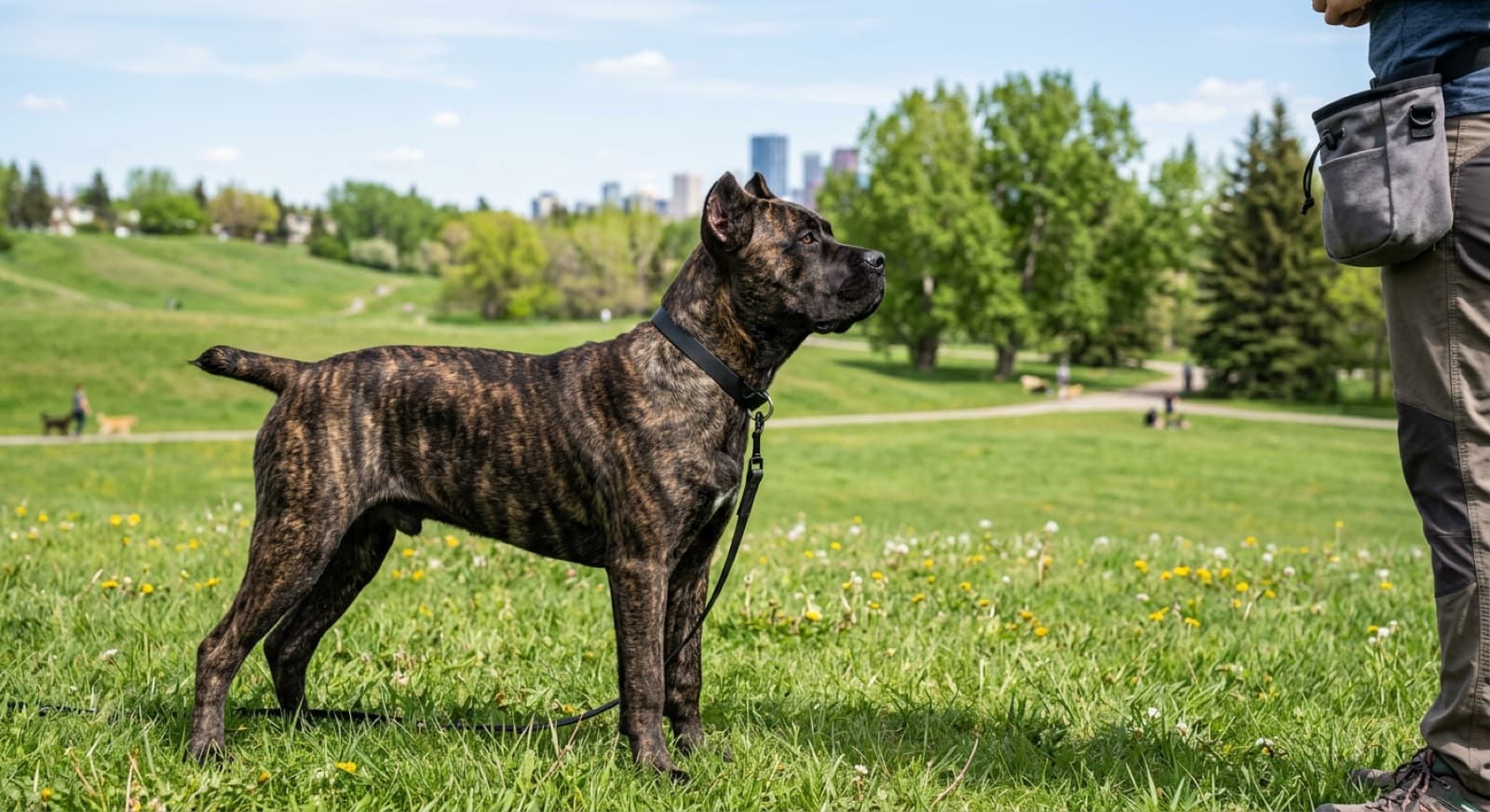
Why force-free is non-negotiable for guardian breeds
Aversive tools (prong collars, e-collars, alpha rolls, scruff shakes, harsh leash pops) suppress behaviour through pain or fear. That works in the short term on many breeds. It fails on guardian breeds for a specific reason: the dog learns that strangers, dogs, or novel triggers predict pain. The pairing builds reactivity instead of reducing it.
A pet store doodle who gets a leash pop near another dog might shut down. A Cane Corso who gets a leash pop near another dog learns that other dogs are dangerous and the smart response is to act first. That is the arousal blowback every force-free trainer warns about. Reddit threads on the breed are consistent. Every aversive trainer who took on a Corso describes the dog as made worse afterward.
Force-free positive reinforcement avoids this trap. You mark and pay the behaviours you want. You remove reinforcement from what you do not. The dog builds a track record of good choices instead of suppressed fear. For a 100 pound dog with a powerful bite, this is a safety decision, not a style preference.
What to avoid: prong collars, choke chains, slip leads, e-collars (shock collars), “stim” collars (same thing), citronella collars, vibration collars worn during training, alpha rolls, scruff shakes, leash pops, knee-to-chest corrections, dominance theory, any trainer who calls themselves “balanced” or talks about being “pack leader.”
Training Timeline by Age
| Age | Focus |
|---|---|
| 8 to 16 weeks | Critical socialization window. The most important 8 weeks of the dog's life. Calgary puppy class, positive exposure to strangers, kids, dogs, vet visits, urban sounds, varied surfaces. Bite inhibition through play. Crate love, name, baby recall, settle on a mat, gentle handling. |
| 4 to 6 months | Continue socialization. Loose-leash walking on front-clip harness. Long-line recall in fenced yards. Default check-in. Polite greetings. Leave it. Bite inhibition still being shaped through redirected play and toys. |
| 6 to 12 months | Adolescent regression starts. Hold the line. Proof cues with distractions. Build settle to 20 to 30 minutes. Long-line recall in busier parks. Start muzzle conditioning as preventive (not punishment) for future vet visits and any reactivity that emerges. |
| 12 to 24 months | Guardian instinct emerges. Biggest training window. Stranger-directed alertness, dog-directed reactivity, and territorial behaviour can all surface here. Hire a force-free trainer specifically for this window. Practice neutral exposures at distance. Avoid trigger-stacking and dog parks. |
| 2.5+ years | Adult brain finishes maturing. Reliable behaviours start to hold. Lifetime maintenance: weekly training sessions, ongoing neutral exposures, calm management of triggers. The Corso you have at 3 is the dog you live with for 8+ more years. |
The Socialization Window (8 to 16 Weeks)
Every breed has this window. For Cane Corsos, missing it is often unfixable. A Corso who did not get positive exposure to strangers, kids, dogs, urban sounds, and varied environments between 8 and 16 weeks frequently develops lifelong reactivity. We have seen rescue Corsos in this category and the work to manage them as adults is enormous.
If you are getting a puppy, start exposures the day you bring it home. Carry the puppy (before vaccinations are complete) to patios, hardware stores that allow dogs, friend visits, quiet downtown sidewalks, transit stations from a distance, and any varied environment Calgary offers. Pair every new thing with high-value treats. The puppy should think strangers and novelty predict cheese.
Calgary puppy class is essential. Dogma and ImPAWSible Possible take puppies from 8 to 10 weeks with proof of first vaccines. The off-leash puppy play in a controlled class is one of the highest-value socialization experiences a Corso puppy can get. Skip dog parks until fully vaccinated and even then, do them carefully.
What good socialization is: positive, low-intensity, varied exposures where the dog stays under threshold and gets paid. Five short, calm experiences beats one long, overwhelming one. Quality, not quantity. A flooded, overwhelmed puppy is being sensitized, not socialized.
The Adolescent Reactivity Window (12 to 24 Months)
This is the biggest training challenge most Corso owners face. A friendly 8 month old puppy who tolerated strangers and dogs becomes a 14 month old adolescent who barks at the door, lunges at strangers, stares at other dogs, or claims the yard. This is normal Cane Corso development. The guardian instinct is emerging on schedule.
What helps: consistent force-free training, distance from triggers (work on the other side of the park, not on the same sidewalk), high-value rewards for disengagement and check-ins, professional support, careful management to prevent practice of reactive behaviour.
What hurts: aversive corrections (escalate the reactivity), forcing the dog to “face it,” dog parks (uncontrolled exposures during a vulnerable window), allowing the dog to practice barking and lunging without intervention, dismissing the behaviour as “a phase.”
Many Calgary Corso owners hire a force-free trainer specifically for the adolescent window. This is money well spent. Practiced reactivity in a 100 pound guardian breed gets very hard to undo. Catching it early at 14 months is much easier than reversing it at 22 months.
Five Essential Cues for Every Cane Corso
1. Place / settle on a mat
The most useful cue for a guardian breed. Mat goes down, dog goes to it, gets paid for staying. Use for doorbells, guests, dinner, work-from-home calls, anything that would otherwise become a reactive event. Build duration in 5 second steps to 30+ minutes. Pair with frozen Kongs and lick mats. A Corso with a solid place cue is a Corso who can manage household stress without escalating.
2. Leave it
Cane Corsos pick up dropped meds, food on sidewalks, dead animals on trails, and anything else. A solid leave it is a safety cue, not a manners cue. Start with treats in a closed fist, build to treats on the floor, build to dropped items at a distance, build to passing food on walks. Pay heavily. Never use leave it as a correction.
3. Recall with distance and distraction
Long-line work in fenced yards from 4 months. Move to 15 to 30 foot long-line in parks at 6+ months. Pay every recall with chicken, cheese, or hot dog. Never call your Corso off a trigger without paying more than the trigger is worth. Never punish a slow return. Real off-leash reliability with a Corso typically arrives at age 2 to 3, not 1. Many Corso owners decide long-line walking forever is the safer call. Both are valid.
4. Default eye contact / check-in
The dog automatically looks at you when stressed instead of fixating on a trigger. Train it as a default behaviour, not a cued one. Capture every time the dog looks at you on walks and mark and pay. Within a few weeks, the dog will offer eye contact when uncertain. This single cue is worth more than any other for guardian breeds. It interrupts the fixation that precedes reactivity.
5. Loose-leash walking on a front-clip harness
Front-clip harness only. Freedom No-Pull (2 Hounds Design) is the most-recommended Calgary option for large guardian breeds. Balance Harness, Perfect Fit, Ruffwear Front Range also work. Never prong, choke, slip lead, or e-collar. Stop walking when leash tightens. Resume when it loosens. Real loose-leash takes 3 to 6 months of consistent work with a 100 pound dog. Stick with it.
Bite Inhibition for Puppies
Cane Corso puppies bite. Hard. Their jaw strength is already greater than most breeds at 12 weeks, and the adult jaw will do serious damage if bite inhibition is not shaped early. Bite inhibition is the dog's learned ability to control the force of its mouth. Every dog should have it. Guardian breeds especially must have it.
How to build it: redirect to appropriate chews (frozen Kongs, bully sticks, Benebone) every time puppy teeth meet skin. Yelp loudly and disengage briefly when the puppy bites hard during play, so the puppy learns that hard mouthing ends the fun. Mark and reward soft mouthing on hands during conditioning. Never punish puppy biting physically (no nose taps, no scruff shakes, no shoving fingers down the throat). Punishment escalates arousal and teaches the puppy that human hands predict pain.
Calgary puppy class supervised off-leash play is one of the best bite inhibition shapers because puppies teach each other to control their bites better than humans can. By 6 months, the puppy should have learned to bring full bite force down to gentle mouthing. By 12 months, all mouthing on humans should be over.
Browse adoptable Cane Corsos in Calgary
Many rescue Corsos come from owners who skipped training. Foster reports flag the cases that need experienced handlers vs first-time-Corso families.
See Available Cane Corsos →Crate Training (Safety + Travel)
Crate training is not optional for a Cane Corso. The crate is a safe sleep space, a management tool when guests arrive, a recovery space after vet appointments and surgeries, and the only safe way to travel by car. A loose 100 pound dog in a vehicle is a projectile.
Crate size: a Cane Corso needs a 48 inch (XL) crate minimum. Many adults need a 54 inch (XXL). The dog should be able to stand, turn around, and lie down comfortably.
Positive crate conditioning: feed every meal inside the crate for 2 to 4 weeks before closing the door. Offer chews and frozen Kongs inside. Build to closed-door 30 second periods, then minutes, then short absences. Never force the dog into the crate. Never punish-crate. The crate should be a safe space the dog chooses voluntarily.
Max crate time: 6 to 8 hours for an adult, 2 to 4 hours for a puppy. Beyond that you need a midday break or a dog walker.
Common Cane Corso behaviour problems
Growling at strangers. Take the growl seriously. Do not punish it. A growl is a warning. Punishing it teaches the dog to skip the warning. Increase distance, mark and reward disengagement, call a force-free trainer or behaviourist. Manage the environment so the dog is not practicing the behaviour.
Resource guarding. Stiffening over food, freezing over chews, growling when family members walk past with high-value items. In a 100 pound guardian breed this needs immediate professional help. Trade up instead of confronting. Manage the environment. Hire a CSAT or KPA-CTP credentialed trainer. Consider a behaviourist referral if biting has occurred.
On-leash reactivity to other dogs. Common in adolescence. Protocol: work at distance where the dog can see the trigger and stay under threshold. Mark and pay every disengagement. Use look-at-that or BAT 2.0 protocols. Avoid head-on passes on narrow sidewalks. Walk in quiet neighbourhoods and parks, not crowded paths. A force-free trainer experienced in reactivity is worth the money.
Door-charging when guests arrive. Manage first (baby gate or crate when doorbell rings). Train second. Build a solid place cue that you can deploy before opening the door. Many Calgary Corso owners crate or gate the dog for the first 5 minutes of any guest visit. That is fine and safer than letting it become a reactive event.
Counter-surfing. Smart 100 pound dog with a long reach. Clear counters until the dog is trained. Teach “off” and pay heavily. Increase mental enrichment. Never leave food unsupervised on counters for the first 18 months.
Calgary Force-Free Trainers (Vetted)
These trainers and businesses have a track record with guardian breeds and have publicly committed to force-free methods. Before signing up, ask directly: “Do you use any aversive tools? Do you use e-collars, prong collars, choke chains, or describe yourself as balanced?” A force-free trainer will say no without hesitation.
Dogma Training (Inglewood)
Multiple Calgary locations. Wide range: puppy classes, group obedience, private sessions, day training, behaviour modification. Experienced with guardian breeds and reactivity cases. Strong reputation in the Calgary force-free community.
ImPAWSible Possible (NW Calgary)
Strong puppy and reactive-dog programs. Good for separation anxiety, resource guarding, and adolescent reactivity cases. Several Corso owners in the Calgary community have used them.
Calgary K-9 (Marlborough)
Force-free service dog and companion trainer. Strong with high-needs cases, recall work, and large breeds. Verify force-free credentials before booking.
Sit Happens Calgary
Group classes and private sessions. Good for first-time large-breed owners and foundational obedience. Recommend pairing with a behaviourist if reactivity emerges.
Raising Fido
Owner-operated, private and small-group sessions. Strong individual attention for guardian and working breeds.
AVOID: any trainer who uses e-collars, prong collars, choke chains, slip leads, dominance theory, alpha rolls, or who describes themselves as “balanced.” These are dealbreakers for Cane Corsos specifically. Force-free credential signals: CCPDT, KPA-CTP, CDBC, PMCT, CSAT (separation anxiety specialty), Fear Free Certified.
When to involve a veterinary behaviourist
A veterinary behaviourist is a vet with board-certified specialty training in animal behaviour. They can prescribe behaviour-modifying medications when needed, assess medical contributors to behaviour problems, and write detailed behaviour plans for serious cases. For Cane Corsos, refer when:
- The dog has bitten a person or another animal hard enough to break skin
- Resource guarding is escalating despite force-free training
- Stranger-directed reactivity is severe or generalizing
- The dog is anxious enough that quality of life is compromised
- Force-free training alone is not making progress after 3 to 6 months of consistent work
Calgary referral: Dr. Jennifer Pelster at Calgary Veterinary Behaviour Services. Veterinary referrals required. Initial consultations run $400 to $600 for a 90 minute assessment with a written behaviour plan. Worth every dollar for serious cases.
Honest Calgary Training Costs
| Service | Calgary Price |
|---|---|
| Puppy class (6 to 8 weeks) | $200 to $450 |
| Group obedience class (6 to 8 weeks) | $200 to $400 |
| Private force-free trainer (per hour) | $80 to $200 |
| Day training (drop-off, per session) | $80 to $150 |
| Reactive dog class (6 weeks) | $300 to $500 |
| Veterinary behaviourist initial assessment | $400 to $600 |
Realistic first 2 years for a Cane Corso done right: $2,000 to $5,000 in training. Puppy class, intermediate class, 5 to 10 private sessions during adolescence, and possibly a behaviourist referral. Much cheaper than rehoming costs, surrendering to a rescue, or the legal and emotional fallout from a bite incident.
The Honest Timeline
A well-trained Cane Corso is a 2 to 3 year project followed by lifetime maintenance. Anyone who tells you otherwise is selling something. Here is what realistic progress looks like.
Months 1 to 6: foundation. Socialization, baby cues, crate love, bite inhibition, name, leash basics. The dog is biddable and cute and you feel good about the project.
Months 6 to 12: adolescent regression starts. The dog tests cues. The dog gets bigger and stronger. You begin to feel like everything is harder than it was at 4 months. This is normal.
Months 12 to 24: guardian instinct emerges. Reactivity may surface. This is the make-or-break window. Owners who hire a force-free trainer here usually come out the other side with a manageable adult dog. Owners who try aversive shortcuts here usually come out with a worse dog.
Months 24 to 36: adult brain matures. Cues hold. Behaviour stabilizes. The dog you have at 3 is the dog you live with for 8 more years.
Years 3+: lifetime maintenance. Weekly training sessions, ongoing neutral exposures, calm management of triggers, refresher courses if regression appears. A Corso is not a dog you train once. It is a dog you train forever.
Frequently Asked Questions
Why is force-free non-negotiable for a Cane Corso?
Aversive tools create arousal blowback in guardian breeds. The dog learns that strangers and dogs predict pain, which escalates the bite risk you were trying to prevent. Reddit Corso owners consistently report aversive training backfires. Force-free positive reinforcement is the only method with a safety track record on this breed.
When is the socialization critical period?
8 to 16 weeks. Missing this window often produces lifelong reactivity that is extremely difficult to reverse. Calgary puppy class is essential, not optional. Dogma and ImPAWSible Possible take puppies from 8 to 10 weeks with proof of first vaccines.
When does adolescent reactivity start?
12 to 24 months. The guardian instinct emerges in this window and it is the biggest training challenge most Corso owners face. Hire a force-free trainer specifically for this window. Avoid trigger-stacking and dog parks.
What cues does every Corso owner need?
Place / settle, leave it, recall with distance, default eye contact / check-in, and loose-leash walking on a front-clip harness. These five give you a manageable adult dog. Add muzzle conditioning and a calm doorway greeting cue.
How do I leash train a 100 pound Corso?
Front-clip harness only. Freedom No-Pull (2 Hounds Design), Balance Harness, Perfect Fit, or Ruffwear Front Range. Never prong, choke, slip lead, or e-collar. Stop walking when leash tightens. Real loose-leash takes 3 to 6 months of consistent work.
My Corso growls at strangers, what do I do?
Take the growl seriously, do not punish it. Increase distance, mark and reward disengagement, call a force-free trainer or veterinary behaviourist. Manage the environment so the dog is not practicing the behaviour. Punishing a growl teaches the dog to skip the warning and go straight to a bite.
How do I handle resource guarding?
In a 100 pound guardian breed, resource guarding needs immediate professional help. Trade up instead of confronting. Manage the environment. Hire a CSAT or KPA-CTP credentialed trainer. Consider a veterinary behaviourist referral if biting has occurred.
How much does Corso training cost in Calgary?
$200 to $450 for a group class. $80 to $200 per hour for a private force-free trainer. $400 to $600 for a veterinary behaviourist initial assessment. Realistic first 2 years: $2,000 to $5,000 done right. Much cheaper than the alternatives.
More Cane Corso guides
Cane Corso Adoption Calgary →
The full Calgary adoption playbook: rescues, costs, common surrender reasons.
Is a Cane Corso Right for You? →
Frank self-assessment of experience, time, and risk tolerance for a guardian breed.
Cane Corso Temperament & Aggression →
The guardian instinct, aggression risk factors, what actually predicts a safe adult dog.
Bringing Home Your Corso →
First-week protocol, decompression, the 3-3-3 rule applied to guardian breeds.
Corsos with Kids & Cats →
Family dynamics, multi-pet households, what to expect from a guardian breed.
Cost of Owning a Corso →
First-year, ongoing, and emergency cost realities for a 100 pound guardian breed.
New dog? Start with these care guides
Everything a new adopter needs to set up a safe, happy home.