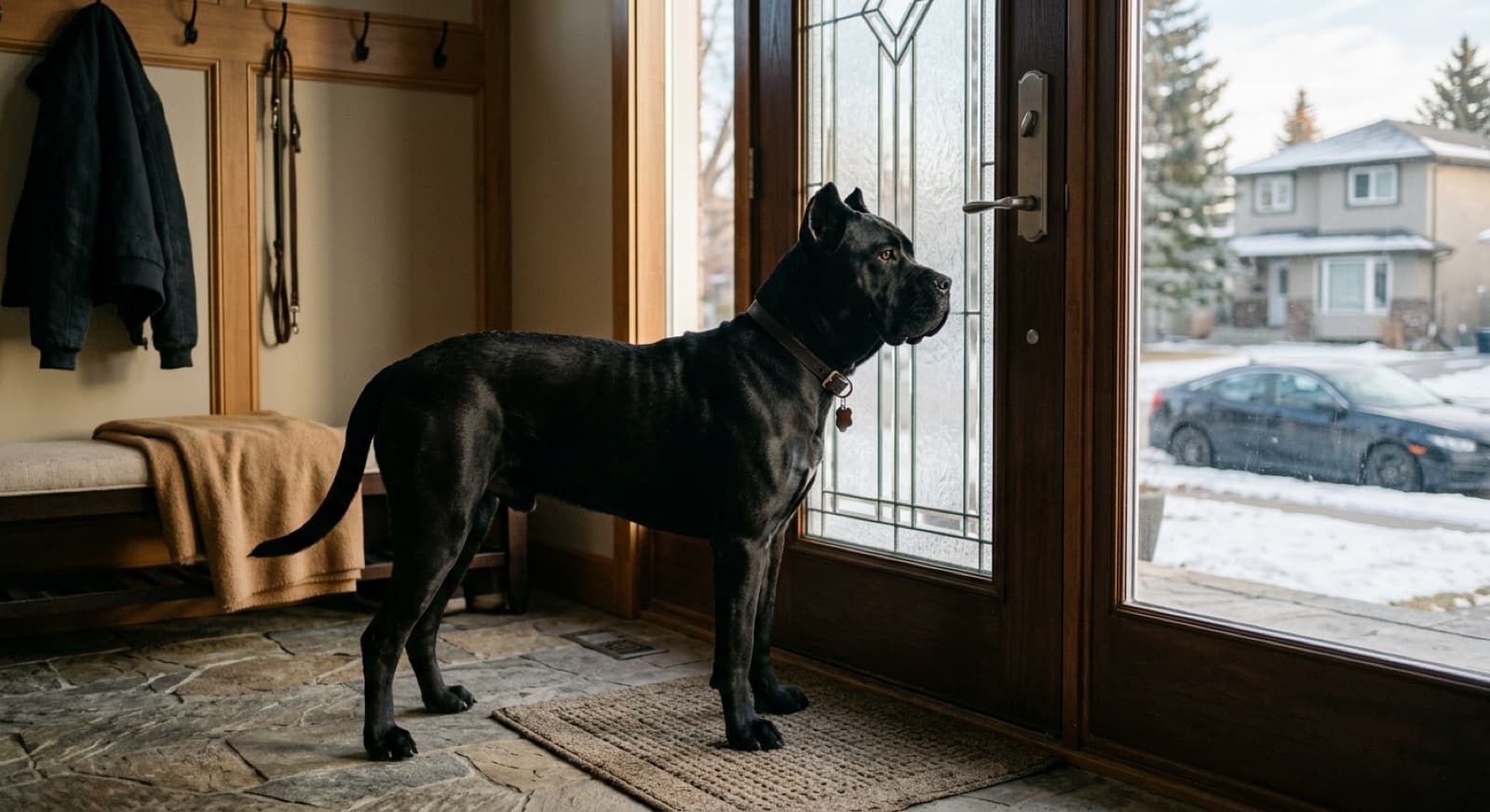
The honest version
Cane Corsos are naturally ALERT and PROTECTIVE, not naturally aggressive. The difference is critical. The Reddit r/canecorso owner consensus is clear and consistent: “my Corso is sweet at home, suspicious of strangers, will bark first and ask later.” That is normal, healthy guardian temperament. Bite force discussions are mostly myth: yes Corsos can bite hard, but so can any 100-pound-plus dog. CDC bite data and peer-reviewed studies show bite SEVERITY correlates with dog SIZE, not breed. The 12 to 24 month adolescent window is the most important behaviour management period of the dog's life. Guardian instinct emerges sharply here. Fear-aggression vs guardian-aggression are different problems with different fixes. Resource guarding is real, breed-typical, and fixable with proper management. Muzzle training is a SAFETY TOOL, not a punishment — train every Corso, every time, before you need it. Aversive training fails catastrophically on guardian breeds: it suppresses the warning system without fixing the underlying problem. Calgary force-free trainers with guardian-breed experience: Dogma, ImPAWSible Possible, Calgary K-9. Veterinary behaviourist: Dr. Pelster. Calgary has no breed-specific legislation targeting Corsos. Most Corsos go their entire lives without a single bite incident.
A Cane Corso who lunges at every stranger is a poorly raised example of the breed, not a normal Corso
The Italian breed standard calls for a dog that is discriminating, not indiscriminate. A Corso who calmly assesses strangers and follows the owner's cue is the breed standard. A Corso who explodes at every passing person has been failed by socialization, training, or genetics. The breed alone does not produce an aggressive dog. The work you put in across the first 24 months largely determines who your adult Corso becomes.
Alert and protective is not the same as aggressive
This is the most important distinction in the entire breed. Get this one right and most of the rest of Cane Corso ownership follows naturally.
Alert and protective means: notices things, watches, responds to the owner's cues, is willing to act on a real threat, returns to baseline after. This is what the breed is for. It is what 150 generations of Italian working dogs were selected to do.
Aggressive means: seeks out conflict, escalates without provocation, cannot be redirected, has a low threshold for what counts as a threat. This is not the breed standard. This is a malfunction.
The Reddit r/canecorso owner consensus is consistent across hundreds of threads: “my Corso is sweet at home, suspicious of strangers, will bark first and ask later.” That sentence describes a healthy, well-bred, well-socialized Cane Corso. It does not describe an aggressive dog.
Where owners get into trouble: they treat the alert response as the problem. They punish the dog for barking at a stranger. They yank the leash when the dog stares at someone. The alert response is not the problem — the failure to disengage after the alert is the problem. Punishing the alert teaches the dog to suppress warning, which produces dogs that go from quiet to act with zero warning. That is the dangerous Corso.
The healthy Corso barks at the stranger. You say “thank you, I see them, that is enough.” The dog stops barking and returns to your side. That is the breed working correctly.
Guardian breed psychology: the alert-assess-act-disengage continuum
All true guardian breeds share this four-stage continuum. Cane Corso, Presa Canario, Bullmastiff, Boerboel, Tibetan Mastiff, Caucasian Shepherd, Anatolian Shepherd, Great Pyrenees. Understanding the continuum is the foundation of good guardian breed ownership.
| Stage | What the dog does | Owner's job |
|---|---|---|
| 1. ALERT | Notices the thing. Ears up, body orients, may bark or vocalize | Acknowledge calmly. “Yes, I see them.” Do not punish the alert |
| 2. ASSESS | Decides if it is a real threat. Watches, reads body language, takes cue from owner | Provide clarity. Your calm body language tells the dog the answer |
| 3. ACT | Responds if threat is real. Could be a bark warning, blocking position, or engagement | Stay in control. Direct the dog if action is needed. Stop the dog if not |
| 4. DISENGAGE | Returns to baseline. Heart rate down, body relaxes, refocuses on owner | Cue disengagement and reward calmly. This is the trained skill |
Most “aggression” problems in Cane Corsos are actually disengagement problems. The dog noticed correctly. The dog assessed correctly. The dog may have even acted correctly. But the dog cannot come back down to baseline.
Disengagement is a TRAINING skill, not a genetic gift. It is built through hundreds of repetitions of: trigger appears, owner marks it, dog gets rewarded for refocusing. Over months. The Corso who reliably disengages on cue is a Corso who was patiently trained. The Corso who cannot disengage was not.
Your job as the owner is to be the thermostat. You see the trigger first. You name it for the dog. You cue disengagement before the dog escalates past the assess stage. Done well, this looks effortless. Done over a thousand repetitions, it becomes automatic for both of you.
The adolescent reactivity window: 12 to 24 months
This is the single most important behaviour management window of the dog's life. What happens here largely determines what your adult Corso becomes.
Between 12 and 24 months, the guardian instinct fully emerges. A Corso puppy who was friendly with every stranger at 8 months may start barking at strangers at 14 months. A dog who ignored other dogs at 10 months may start hard-staring at them at 16 months. This is not regression. This is not bad behaviour. The breed's genetic blueprint is switching on.
The Reddit r/canecorso forum is full of owners describing this exact pattern around 12 to 18 months. The honest reality: what you do in this window largely determines what your adult Corso will be.
The three rules of the adolescent window:
- Do not punish the alert. If your dog barks at a stranger and you correct them harshly, you teach them that strangers predict bad things from you. That builds reactivity, not reduces it. Mark the alert calmly and reward calm following
- Increase structured socialization, do not decrease it. Many owners pull back from socialization when the dog starts barking. Wrong move. Calm, positive exposure to varied people, dogs, and environments at safe distance teaches the dog that the world is largely not threatening
- Get a force-free trainer involved now, not later. A trainer who knows guardian breeds will help shape the alert-assess-disengage continuum during this critical window
The window closes around 24 to 30 months. Adult Corso temperament is largely set by 30 months. Invest the work now while the dog is still actively shaping their worldview.
Owners who do this work report calm, discriminating adult Corsos. Owners who skip it report adult Corsos who lunge at every passing person and have to live their whole life on the muzzle. Same breed, same dog, different two years of work.
The bite-force myth, busted with data
The 700 PSI Cane Corso bite force figure is internet speculation, not peer-reviewed data. The honest version is more reassuring AND more useful.
Yes, a Cane Corso can bite hard. So can any 100-pound-plus dog. The 700 PSI figure repeated across the internet has no traceable peer-reviewed source.
The most cited peer-reviewed bite force study (National Geographic, 2005) measured:
- Domestic dog average: around 320 PSI
- German Shepherd: around 238 PSI
- Rottweiler: around 328 PSI
- No direct Cane Corso measurement exists in this study
Even the high end of legitimate speculation puts Corsos in the same range as other large guardian breeds. Not 700 PSI. Not magical. Just a large strong dog.
What the actual data shows on bite severity: CDC bite statistics and peer-reviewed bite severity studies consistently find that bite SEVERITY correlates with dog SIZE, not breed. A 130-pound Cane Corso bite is more dangerous than a 25-pound Beagle bite because the dog is heavier and the jaw is bigger. A 130-pound Newfoundland bite would be equally dangerous. The breed is not the variable. Size is.
What the data also shows on bite incidents: bite INCIDENTS correlate with socialization gaps and owner experience, not breed alone. A well-socialized, well-trained Corso with an experienced owner has a vanishingly low bite risk. A poorly socialized Corso with an inexperienced owner has elevated risk. Same dog. Different outcomes.
The American Veterinary Medical Association position is explicit: breed is not a reliable predictor of bite risk. Individual dog history, socialization, and owner handling are.
The honest framing for Calgary owners: yes, your Corso has the physical capability to do serious damage if a bite happens. That capability never goes away. Your job is to make sure a bite never happens through proper socialization, force-free training, management of trigger exposure, and muzzle training for high-risk situations. Most Corsos go their entire lives without a single bite. That outcome is the norm, not the exception.
Fear-aggression vs guardian-aggression: different problems, different fixes
Misdiagnosing which category your dog falls into can make the problem dramatically worse. Get professional eyes on the dog before designing a plan.
FEAR-AGGRESSION
Pattern: dog freezes, then explodes. Body language before the explosion shows fear: whale eye, ears back, tail tucked, lip-licking, head turned away. Trigger is something the dog cannot predict or control. The dog is trying to drive the threat away because they think they will lose. More dangerous category because warning signs are subtle.
GUARDIAN-AGGRESSION
Pattern: confident body, forward stance, hard eye, vocal warning, then escalation if the warning is ignored. The dog is making a clear “you, leave” statement. Typical of the breed at full maturity. What guardian breed psychology produces by design.
Why the distinction matters:
- Fear-aggression requires confidence building, threshold management, and counter-conditioning over months. Aversive corrections make fear-aggression dramatically worse because they confirm the dog's belief that the trigger predicts bad things
- Guardian-aggression requires teaching disengagement, building owner-handler clarity, and managing trigger exposure so the dog does not over-rehearse the guarding response
Calgary force-free trainers and Dr. Pelster (veterinary behaviourist) can distinguish between the two in a single assessment session. The cost of guessing wrong is high.
A fear-aggressive Corso treated with corrections will escalate. A guardian-aggressive Corso treated only with desensitization may continue to rehearse without ever learning disengagement. Get a professional eyes on the dog before designing a plan.
Trainer consultation cost: $150 to $250. Veterinary behaviourist consultation: $400 to $800. Worth it.
Resource guarding: real, breed-typical, fixable with management
Resource guarding is common in Cane Corsos. It is not a sign of a broken dog. It is a sign of a dog who values their resources and has not been taught they do not need to defend them.
Resources Corsos commonly guard: food bowl, high-value chews (bully sticks, raw bones, antlers), sleeping spaces, the owner (yes, you), toys, sometimes specific furniture spots.
What NOT to do:
- Reach into the food bowl while the dog eats “to prove dominance.” This is old-school dominance theory and it produces resource guarding, it does not prevent it
- Take resources away without giving something better. This teaches the dog that you arriving predicts loss
- Punish the warning growl. The growl is information. Remove the warning and you get bites without warning
What to do:
- Trade-up training. Approach the dog with a high-value treat (cheese, chicken). The dog drops the resource. You give the treat AND return the resource. Repeat for weeks. The dog learns that your approach predicts good things and resources come back
- Feed in a calm separate space. Dog eats undisturbed. No need to test the dog's tolerance daily
- Manage high-value chews. Bully sticks and raw bones are given in a crate or designated space. Dog finishes, you collect when the dog is away. No conflict required
- Cue exchanges instead of grabs. “Trade” cue means “give me what you have, I will give you something better.” Train it on low-value items first, then graduate
Most Corso resource guarding resolves or becomes fully manageable within 3 to 6 months of consistent positive trade-up training. Calgary force-free trainers familiar with resource guarding in guardian breeds: Dogma, ImPAWSible Possible, Calgary K-9.
The hard case: severe resource guarding with bite history toward family members. This requires a credentialed behaviourist, not a regular trainer. Dr. Pelster (veterinary behaviourist) for Calgary cases.
On-leash reactivity to other dogs
Common in Cane Corsos, fixable with structured work. Often emerges during the 12 to 24 month adolescent window.
Why Corsos go reactive on-leash even if they are fine off-leash with familiar dogs:
- Leash frustration. Dog wants to investigate or engage but cannot move freely. Frustration translates into vocalization and lunging
- Trigger stacking. Combination of guardian instinct + close encounter + restricted movement = over-threshold response
- Lack of agency. Off-leash, the dog can move away from an unwanted dog. On-leash, they are stuck. Stuck dogs react
- Owner tension on the leash. You see the other dog, your shoulders tense, your dog feels it through the leash. They escalate because you signalled there was a problem
The fix is distance and pattern training:
- Identify your dog's threshold distance. The distance at which they notice another dog but do not react. Could be 50 feet, could be 200 feet. Start there
- Pattern game on every walk. Other dog appears at threshold distance. You mark it (“yes, I see them”) and feed high-value treats while the other dog walks past. Dog learns: other dog appears = good things rain from owner
- Reduce distance only when the dog reliably handles current distance. Over weeks. Not days
- Use a back-clip or front-clip harness, not a prong or martingale collar. Aversive collars increase reactivity in guardian breeds. They do not solve it
Most Corso owners can get reliable loose-leash walking past other dogs within 4 to 8 months of structured pattern work. Some Corsos will always need wider distance from unfamiliar dogs. That is temperament, not training failure.
Calgary off-leash parks (Nose Hill, Bowmont, Weaselhead) are usually wrong environments for reactive Corsos. Use long-leash hikes on Calgary trail systems (10 to 15 foot biothane line) for exercise without trigger density. Sniffspot rentals (private fenced backyards, $15 to $30 per hour) for safe off-leash exercise.
“My Cane Corso growls at my friends”: management playbook
Common, manageable, and how you handle it determines whether it gets better or worse.
The wrong response: punish the growl. Many owners hear a growl, scold the dog, send them away, or use a leash correction. This teaches the dog that growling predicts punishment. Result: the dog stops growling but does not stop feeling uncomfortable. You have removed the warning system without fixing the underlying problem. Now the dog goes from quiet to bite with no warning. This is how serious bite incidents happen with Corsos.
The right response: thank the dog for the information, then manage the situation.
Growling is communication, not defiance. Your Corso is saying “I am uncomfortable with this person right now.” Calm response sequence:
- Cue the dog to place or crate in a separate room
- Give them a high-value chew (bully stick, frozen Kong)
- Close the door
- The dog has been told their concern was heard. They have been removed from the trigger. The friend is in the house comfortable. The dog is not rehearsing escalation
The long fix: gradual positive exposure.
- Have your friend ignore the dog entirely on visits. No eye contact, no reaching out, no talking to the dog
- After several visits where nothing bad happens, the friend can drop treats on the floor while still ignoring the dog
- After more visits, the friend may make brief calm eye contact
- Months, not days
Most Corsos warm up to specific known people over time with patient exposure. Some Corsos never want strangers in the house and that is a temperament reality, not a fixable problem.
If your dog is in the “never wants strangers” category, build a lifestyle that respects it: dog goes to a quiet room when friends come over, your social life happens outside the house or at times when the dog is settled. That is responsible guardian-breed ownership, not a failure.
Owner-directed aggression: rare but possible
Rare in Cane Corsos with reasonable handling. When it does happen, the cause usually traces back to aversive training or punishment-based methods that damaged the relationship.
Cane Corsos are bred to be discriminating with strangers but reliable with their family. The breed standard specifically excludes dogs who show aggression toward their handler. When owner-directed aggression does occur, the most common causes:
- Aversive training methods. Prong collars, e-collars used as punishment, alpha rolls, leash pops, hitting the dog. Guardian breeds with strong nerve do not respond well to physical correction. They push back. Some push back hard
- Resource guarding escalation. Owner repeatedly took resources without trade-up training. Dog learned to defend resources from the owner. Now the dog is willing to bite over a chew toy
- Pain. Hip dysplasia, dental pain, ear infection, GI pain. A dog in pain who gets touched in the wrong spot may snap. This is not aggression. This is the dog telling you something is wrong
- Cognitive decline in older Corsos. Aging dogs can become unpredictable. Veterinary workup required
- Specific bad experience. A single traumatic event (the owner stepped on the dog and the dog yelped, then the owner reacted, then the dog associated the owner with the pain) can create lasting wariness
What to do if your Corso shows aggression toward you:
- Full medical workup immediately. Thyroid panel, pain assessment, orthopedic exam, dental exam, neurological screen. Sudden owner-directed aggression is medical until proven otherwise
- Stop all aversive training methods immediately. If you are using a prong, e-collar correction, leash pops, alpha rolls, stop. Replace with force-free methods
- Stop confrontational interactions. No more grabbing the collar, no more taking things from the dog without trade, no more “dominance” exercises. These do not work and they make this problem worse
- Veterinary behaviourist consultation. Not a regular trainer. Dr. Pelster (Calgary) or another credentialed behaviourist. Cost $400 to $800. Worth it
- Muzzle train in the meantime for any unavoidable handling situations
Most owner-directed aggression cases respond well to a proper plan from a behaviourist. The dogs that truly cannot be safely kept after a full behaviourist workup are very few. Do not let internet doom narratives push you toward rehoming or euthanasia before doing the work.
Muzzle training: a safety tool, not a punishment
Muzzle train every Cane Corso, every time, as a baseline life skill. Before you need it. The Reddit r/canecorso owner consensus is consistent on this.
Muzzle training is a SAFETY TOOL, not a punishment, and not a failure marker. It is admitting that your dog is large enough and capable enough that a safety tool is responsible ownership. Nothing more.
When you might need a muzzle:
- Vet visits. Especially first visit with a new vet, dental procedures, anything involving pain
- Grooming. Nail trims, ear cleaning, painful ear infections
- Introductions to children. Responsible introduction at minimum the first few times
- Emergency situations. Your dog is injured and needs to be moved
- Any unpredictable situation around your dog
The muzzle does not change your dog's temperament. It eliminates a low-probability worst-case outcome.
The right muzzle: basket-style. Baskerville, Trust Your Dog, or custom-fit. The dog can pant, drink, take treats. Closed-cup vet muzzles are for short procedures only and should not be used longer than 10 minutes.
Training timeline: 4 to 8 weeks of positive conditioning from puppy or new-rescue stage.
- Feed treats through the muzzle without strapping
- Short wears with treats inside
- Longer wears around the house
- Wears during normal activities (short walks, calm time)
- By the end, your dog should think the muzzle predicts good things
Many Calgary force-free trainers offer muzzle training workshops for $50 to $150. Worth every cent.
The asymmetry of muzzle training: if you train it and never need it, no harm done. If you do not train it and need it in an emergency, you have a dog who associates the muzzle with stress in the worst possible moment. Train every Corso.
The “should I rehome or euthanize” question
The last-resort question. Almost always unnecessary with proper training. But sometimes it is the right answer.
REHOMING should be considered when:
- The dog's temperament is fundamentally mismatched with your specific household (you have small children and a fear-aggressive Corso, you live in an apartment with constant trigger exposure, your work schedule cannot provide the structure the dog needs)
- AND the dog could thrive in a different home with the right structure
Many Calgary breed-specific rescues will accept Cane Corso surrenders with full behavioural history. Do not lie about the dog's issues. Honest surrender allows the rescue to match the dog with an appropriate adopter. Lying produces failed placements and worse outcomes for the dog.
EUTHANASIA should only be considered when:
- The dog has a documented bite history with serious damage
- AND a credentialed veterinary behaviourist (not a regular vet, not a trainer) has assessed the dog
- AND the behaviourist concludes that the bite risk cannot be safely managed even with the best possible structure
This is rare. Most Corsos labeled “unmanageable” by owners or general vets respond well to a proper behavioural plan from a force-free trainer or behaviourist.
Before either decision, exhaust the legitimate options:
- Full medical workup (thyroid panel, pain assessment, cognitive evaluation, neurological exam)
- Trainer evaluation from a force-free guardian-breed trainer
- Behaviourist consultation (Dr. Pelster in Calgary, or another credentialed veterinary behaviourist)
- 6 to 12 months of structured training following the behaviourist plan
- Environmental management improvements (fencing, baby gates, separate spaces, muzzle training)
Most “unmanageable” Corsos become manageable when this full sequence is followed. The dogs that genuinely cannot be safely kept after this sequence are very few.
Do not let internet doom narratives push you toward the worst outcome before you have done the work. Also do not let stubbornness keep an unsafe dog in your home if you have done the work and the answer is clear.
Why aversive training fails on guardian breeds
This is the single biggest mistake Cane Corso owners make. Aversive training (prong collars, e-collar punishment, leash pops, alpha rolls, dominance theory) does not produce a well-behaved Corso. It produces a Corso who has learned to suppress warning signals.
The marketing pitch for aversive training on guardian breeds usually sounds like this: “these are strong-willed dogs, they need a firm hand, you have to show them you are the boss.” This is dominance theory, and it has been thoroughly debunked by modern animal behaviour science.
What dominance theory got wrong: it was originally based on 1940s observations of captive wolves in artificial groups. Decades of wild wolf research (David Mech, Erik Zimen, others) found that natural wolf families are cooperative parent-led structures, not dominance hierarchies. The original captive-wolf studies were retracted by their own author. The dominance-based training that came out of those studies has no scientific foundation.
What aversive training actually does to a guardian breed:
- Suppresses warning signals. The dog learns that growling, hard eye, or stiffening predicts a leash pop. So they stop showing those signals. They do not stop feeling uncomfortable. They just stop telling you about it. You now have a dog who goes from quiet to bite with zero warning
- Damages the handler relationship. Guardian breeds are bred to look to their handler for cues. When the handler is the source of pain, the dog stops trusting the handler. A Corso who does not trust the handler is a Corso who makes decisions independently. That is the opposite of what you want
- Creates fallout aggression. Repeated aversive correction in the presence of triggers (other dogs, strangers) can produce conditioned aggression toward those triggers. The dog associates the trigger with the pain, not with the behaviour you were trying to correct
- Fails to teach disengagement. Punishment tells the dog what NOT to do. It does not teach the dog WHAT to do instead. Without a trained alternative behaviour, the dog has no exit from the arousal state
The right approach for Cane Corsos: force-free training (also called positive reinforcement or reward-based training). The dog is taught what to do, rewarded for doing it, and given clear cues for disengagement. The handler relationship is built on trust, not pressure.
This is not soft training. Force-free training for guardian breeds is structured, demanding, and requires patient consistency over months. But it produces dogs who reliably look to their handler under pressure, which is exactly what you want in a 120-pound dog with a guardian instinct.
Calgary force-free trainers with guardian-breed experience: Dogma, ImPAWSible Possible, Calgary K-9. Avoid trainers who advertise “balanced” methods, dominance-based training, or e-collar work for behavioural issues. They will make your Corso worse, not better.
Calgary force-free trainers and behaviourists
Calgary has strong force-free trainer options for guardian breeds. Calgary has no breed-specific legislation, so you have full access to all training options.
Dogma Training
Force-free positive reinforcement methods. Group classes, private sessions, behavioural consultations. Experience with guardian breeds. Initial consult $150 to $250.
ImPAWSible Possible
Specializes in reactivity and behavioural issues. Force-free methods. Good fit for adolescent Cane Corso reactivity work. Behavioural consultation $200 to $300.
Calgary K-9
Experience with large guardian breeds. Force-free methods for behavioural work. Group classes and private sessions. Consultation rates vary.
Dr. Pelster (Veterinary Behaviourist)
Calgary's veterinary behaviourist option for serious behavioural cases. Required for owner-directed aggression, severe resource guarding, fear-aggression with bite history. Consultation $400 to $800. Worth it for any case that exceeds what a regular trainer can address.
What to avoid: trainers who advertise “balanced” methods, prong collar or e-collar training for behavioural issues, dominance theory, alpha rolls, leash pops as a correction method. These methods will make Cane Corso behavioural problems worse, not better.
Calgary has no breed-specific legislation targeting Cane Corsos or other guardian breeds. Your training options are not restricted. Bylaw compliance follows the same rules as any other dog: leash law in public, license, vaccination, no dangerous dog designation unless one has been issued.
Frequently Asked Questions
Are Cane Corsos naturally aggressive?
No. Naturally ALERT and PROTECTIVE, not aggressive. The Reddit r/canecorso consensus: “sweet at home, suspicious of strangers, will bark first ask later.” Healthy guardian temperament. Aggressive Corsos almost universally trace back to insufficient socialization, aversive training, or fear from a specific bad experience.
Guardian breed psychology?
Four-stage continuum: ALERT, ASSESS, ACT, DISENGAGE. All true guardian breeds share this. Most “aggression” problems are actually disengagement problems. Disengagement is a TRAINING skill, not a genetic gift. Your job is to be the thermostat: mark the trigger, cue disengagement before escalation.
Adolescent reactivity at 14 months?
Normal and the most important behaviour window of the dog's life. Guardian instinct emerges sharply at 12 to 24 months. Do not punish the alert, increase structured socialization, get a force-free trainer involved. Window closes around 24 to 30 months. Adult temperament largely set by then.
Cane Corso bite force?
700 PSI figure is internet speculation, not peer-reviewed. Peer-reviewed dog bite force studies put guardian breeds in the 230 to 330 PSI range. Bite SEVERITY correlates with dog SIZE, not breed. Bite INCIDENTS correlate with socialization gaps and owner experience, not breed alone. AVMA: breed is not a reliable predictor.
Fear-aggression vs guardian-aggression?
Fear: dog freezes then explodes, body language shows fear (whale eye, ears back, tail tucked). Trying to drive threat away because they think they will lose. Guardian: confident body, hard eye, vocal warning, then escalation. Different fixes. Get professional eyes on the dog before designing a plan. Trainer $150 to $250, behaviourist $400 to $800.
Should I muzzle train my Cane Corso?
Yes, every Corso, every time. SAFETY TOOL, not punishment. Basket-style muzzle (Baskerville, Trust Your Dog). 4 to 8 weeks positive conditioning. Use for vet visits, grooming, kid intros, emergencies. The asymmetry: if you train it and never need it, no harm done. If you need it without training, worst possible moment.
My Corso growls at my friends?
Do NOT punish the growl. Punishing removes the warning system without fixing the discomfort. Now dog goes quiet to bite with no warning. Right response: cue to place or crate in separate room with chew. Long fix: friend ignores dog, drops treats over weeks. Some Corsos never want strangers in house. That is temperament reality.
Should I rehome or euthanize my reactive Corso?
Almost always unnecessary with proper training. Rehome when temperament truly mismatched with household AND dog could thrive elsewhere. Euthanize only after documented bite history with serious damage AND credentialed behaviourist assessment concludes risk cannot be safely managed. First: medical workup, trainer, behaviourist, 6 to 12 months structured plan.
Browse adoptable Cane Corsos in Calgary
Foster reports include temperament notes, socialization history, and any known reactivity triggers. Adult rescue Corsos with full behavioural history are often better matches than young puppies for owners new to the breed.
See Available Cane Corsos →Cane Corso Adoption Calgary
Where to find Cane Corsos in Calgary, adoption costs, rescue vs breeder paths, what to expect.
Is a Cane Corso Right for You?
Honest readiness assessment. First-time owner reality check, lifestyle fit, time and experience requirements.
Cane Corso Training Calgary
Training timeline, the five essential skills, force-free methods, Calgary trainer options.
Bringing Home a Cane Corso: First Week
Decompression, 3-3-3 rule, environmental management, what to expect in the first 30 days.
Cane Corso with Kids and Cats
Family integration, child safety, cat compatibility, multi-pet household management.
Cane Corso Health Issues
Hip dysplasia, bloat, cardiac issues, cherry eye, demodex, lifespan management.
Cane Corso Cost of Ownership
Realistic Calgary numbers: adoption, food, vet, training, insurance, total lifetime cost.
Male vs Female Cane Corso
Temperament differences, size, training differences, household fit considerations.
Cane Corso Diet and Nutrition
Large-breed puppy growth, adult feeding, bloat prevention, Calgary food sourcing.
Cane Corso in an Apartment
Calgary condo and apartment realities, landlord conversations, exercise without a yard.
Pet Insurance for Cane Corso
Calgary insurer comparison, breed acceptance, deductible math, what to look for.
Buy or Adopt a Cane Corso?
Reputable breeder identification, rescue paths, costs compared, ethics of each route.
New dog? Start with these care guides
Everything a new adopter needs to set up a safe, happy home.