The honest truth most websites will not tell you
Cane Corsos can be excellent family dogs. They are also one of the breeds most likely to end up in rescue when the placement is wrong. The difference is not luck. It is whether the dog was raised with kids from puppy stage, thoroughly socialized, and placed with a family who teaches strict dog-respect rules. A mismatched Corso family ends with a 100 pound stressed guardian breed in a home that cannot manage it, and then the dog gets returned. Calgary rescues have seen this pattern enough times that most of them now require kids 10+ for Corso placements, and some will only place with adult-only homes. This guide replaces wishful thinking with the real protocol: kid-by-age expectations, the multi-week cat introduction, same-sex dog aggression risk in adolescence, and the families who should not be adopting a Corso right now.
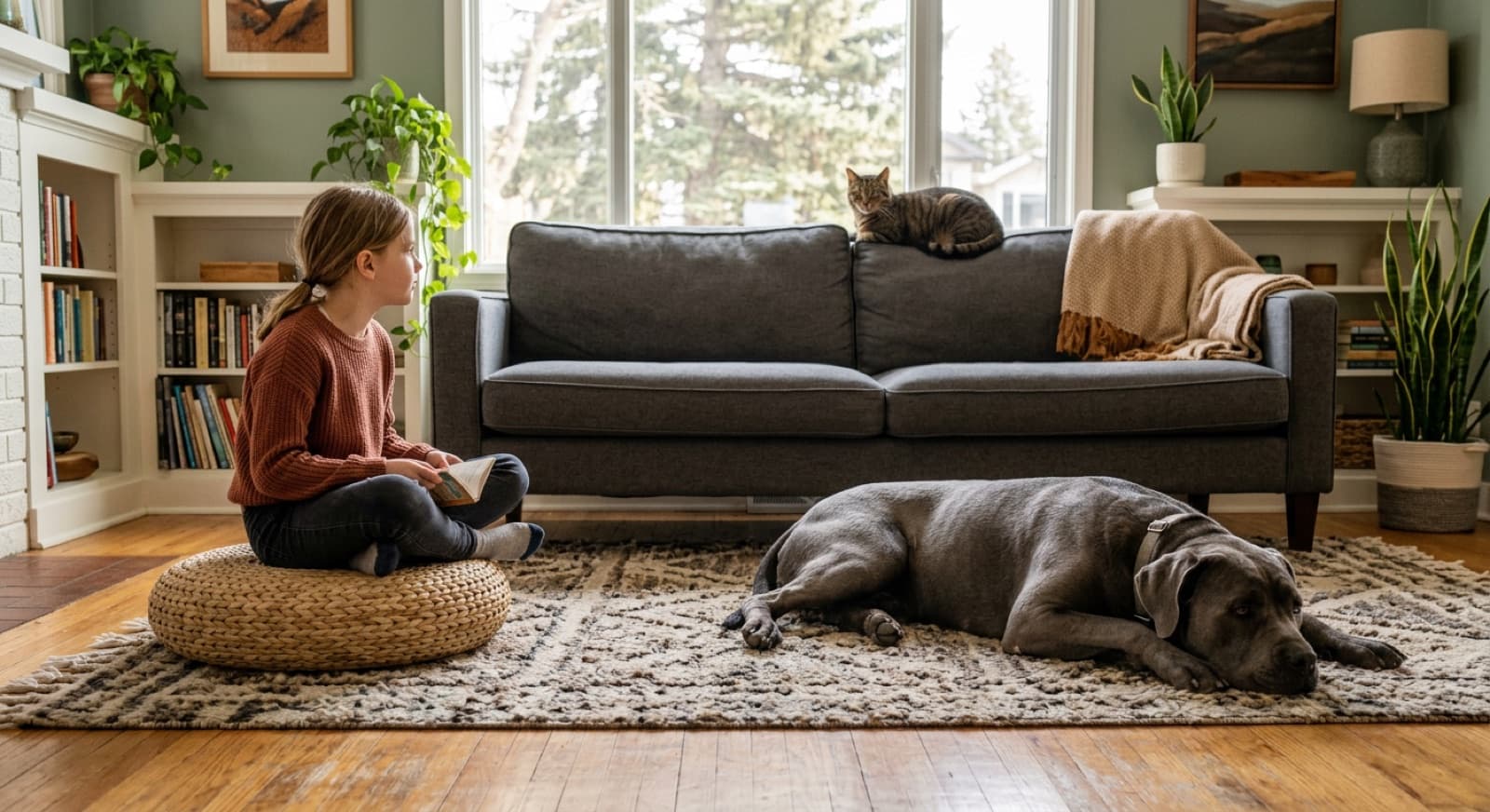
The Calgary Rescue Reality: Kids 10+ Is the Norm
Before falling in love with a profile, know that most Calgary rescues that handle Cane Corsos will screen out family applications with young children. The reasoning is honest and earned:
- Body mass risk. A 90 to 110 pound dog can knock down a small child during normal play. This is not aggression; it is physics.
- Guardian temperament. Corsos bond intensely with their family and can become resource-protective of kids or wary of unfamiliar adults near them. Kids need maturity to manage that.
- Failed-placement history. Rescues have returned too many Corsos from family homes that were not ready. The age cutoff protects the dog from a failed adoption.
- Visitor reality. Family kid homes have playdates, parties, and unfamiliar adults walking in. A Corso processes each of those moments. Calm management requires practice.
The reframing that helps: a Corso is not the dog you adopt while your kids are small. It is the dog you adopt when your kids are old enough to be part of the team, or after your kids have grown.
Cane Corsos with Kids: Compatibility by Age
| Kid age | Cane Corso compatibility | Supervision level |
|---|---|---|
| 0 to 2 years (babies) | Most Calgary rescues will not place. Body-mass risk plus guardian instinct is too high. | Constant if resident dog. Baby gates are non-negotiable. |
| 3 to 6 years (toddlers/preschool) | Almost no Calgary rescue will place. Knockdown risk plus toddler crowding triggers guardian breeds. | Constant. Direct adult line-of-sight at all times. |
| 7 to 9 years | Case by case. Some rescues place with settled adult Corsos and prepared families. Many do not. | Active supervision. Kid trained in dog-respect rules. |
| 10 to 12 years | Often works well with a calm adult Corso. Many Calgary rescues use this as their minimum. | Active supervision. Kid can join training sessions. |
| 13 to 17 years (teens) | Usually excellent. Calm, loyal companion. Teens can learn full handling responsibly. | Light. Teen can manage daily walks and training with adult backstop. |
| 18+ (adults only) | Best fit. Most Calgary Corso placements go to adult-only or grown-kid homes. | Standard adult dog management. |
The single most-important rule: never leave a Cane Corso unsupervised with any child under 10, regardless of how friendly the dog seems. This is not a breed-slander rule. It is a body-mass plus guardian-temperament rule.
Toddler Reality: Why It Almost Never Works
Most failed Corso family placements involve toddlers, and most of those failures are not bites. The pattern is knockdowns, accidental scratches during play, tail-whip injuries, and exhausted parents who realize the supervision load is unsustainable. The dog is rarely aggressive. The dog is just large, active, and built like a small horse around a 30 pound unsteady human.
Honest checklist for toddler-aged homes:
- Wait if you can. The right time for a Corso is when your youngest is at least 7, ideally 10. The dog will still be available.
- Foster-to-adopt is non-negotiable. If a rescue will consider placing with younger kids, they will require a 2 to 4 week foster trial first.
- Settled adult only. A 5 to 8 year old adult Corso with proven calm energy is a different proposition than a 10-month-old Corso adolescent. Never an adolescent with toddlers.
- Visitor management. Birthday parties, playdates, drop-in family. Each event needs a plan, every time. If that sounds like too much work right now, it is not the right year.
- Be honest about bandwidth. Constant supervision is real work. Newborn or toddler years are already at capacity. A 100 pound guardian on top of that is rarely sustainable.
Dog-Respect Rules for Kids in a Cane Corso Home
Every kid old enough to interact with the dog needs to know these rules. Adults teach them, reinforce them, and model them. A Corso who is given clear human leadership is calm; a Corso whose space is constantly invaded gets stressed.
1. No surprise hugging or face contact
No throwing arms around the dog, no kissing the dog on the face, no putting your face up to the dog when it is resting. Guardian breeds tolerate this from their person but rarely enjoy it from kids.
2. Never take food, toys, or bones
Kids do not approach the dog while it is eating, chewing a bone, or with a favourite toy. Resource guarding can develop quickly in guardian breeds; do not test for it.
3. Never wake a sleeping dog
If the dog is on its bed or sleeping anywhere, it is off-limits. Many dog-bite incidents start with a startled dog. The crate or bed is a sanctuary.
4. No riding, climbing, or rough handling
A Corso is not a pony. No sitting on the dog, no pulling tails or ears, no chasing through the house. Wrestling games are forbidden because they teach the dog mouth-on-arm is play.
5. Never alone with the dog under 10
No child under 10 in a room alone with the Corso, ever. Including five minutes to grab the laundry. Baby gates and crates make this manageable.
6. Read body language together
Teach older kids the early warning signals: lip lick, head turn, freeze, low growl. The dog rarely “snaps with no warning.” Kids who read the signals stay safe; adults who ignore them put everyone at risk.
School-Age Kids (5 to 12): Often the Best Pairing
When Calgary rescues place a Cane Corso in a family home, this is usually the age range they target. The reasons are concrete:
- Old enough to follow rules. A 7-year-old can be taught not to wake the dog or grab its bone, and will mostly remember.
- Strong daily bond forms. Corsos bond deeply with their family, and an older kid often becomes a primary attachment figure alongside the adults.
- Steady energy match. A settled adult Corso prefers calm companionship to chaos. School-age kids who can sit, read, and walk the dog suit this perfectly.
- Teen years are gold. Many Corso owners report the dog-teen bond is one of the strongest in the household. Quiet, loyal, protective in the right way.
The fit gets stronger as kids age. A Corso adopted into a home with 8-year-old kids will be 6 by the time the kids are 14. That is a peak family fit.
Cane Corsos with Cats: The Honest Picture
Corsos have moderate prey drive and significant individual variation. Some live happily with cats their whole lives. Others cannot share a home with a cat at any age. Three honest categories:
1. Low prey drive Corsos
Calm around cats from day one, soft body language, no fixation. Often Corsos raised with cats from puppyhood or older dogs with a long history of cat homes. These dogs integrate well over 6 to 10 weeks.
2. Moderate prey drive Corsos
Interested in the cat, may give chase if the cat bolts, can settle with training and management. Takes 2 to 4 months of careful introduction. Requires permanent baby-gate management; never fully unsupervised.
3. High prey drive Corsos
Fixates, stalks, hard-stares at the cat. Cannot live safely with a cat. No amount of training fixes this; the safety risk to the cat is real. The rescue will not place this dog with cats.
Foster-home observation over weeks of daily living is the only reliable signal. A shelter cat-test is a useful first filter, but it is not a forecast.
What “Cat-Tested at the Shelter” Really Means for a Corso
Cat-testing is a screening tool, not a forecast. With a Corso specifically, it is even less predictive than with a smaller breed because Corsos tend to hide arousal under stoic body language and behave differently in the home over time. Be clear about what the test tells you:
- What it measures. The dog's initial response to a calm, unfamiliar cat in a controlled environment, usually behind a barrier.
- What it does not measure. How the dog behaves with your specific cat, in your home, over weeks of daily exposure. Some dogs habituate and get safer; others become more reactive as they learn the cat's movement patterns.
- What “passed” means. The dog did not lunge, fixate, or escalate in a 5 to 30 minute window. It does not mean “safe with cats.”
- Corso-specific note. Stoic body language can mask arousal. A Corso who looks calm at the shelter may still fixate on a cat at home. Trust the foster report over the test result.
- What you still have to do. Run the full multi-week introduction protocol. Test results do not let you skip steps.
Ask the rescue directly: what was the test, how long did it run, what did staff observe, and is there a foster who can speak to home-cat behaviour? Honest answers earn trust.
Multi-Week Cat Introduction Protocol
Corsos generally need a longer protocol than calmer breeds. Plan for 2 to 4 months, not weeks. Slow is fast: the dogs who get rushed are the ones who fail and have to be returned. Watch your individual dog and cat; slow down if either stays stressed.
1. Full separation + scent swap
Different rooms, closed doors. Feed on opposite sides of the same door so each animal links the other's scent to food. Rotate bedding and toys so each carries the other's scent.
2. Visual contact through gates
Baby gate or screen door. Both can see but cannot touch. The cat has reliable escape routes (cat tree, high shelves). Reward the dog for calm, no-fixation behaviour with treats and praise.
3. Leashed parallel time
Dog on leash, cat free to approach or leave. Start with 5 minute sessions, end on calm. Build duration only if both animals stay relaxed. If the dog fixates or hard-stares, back up a step.
4. Longer leashed and dragline
Build to 30 minute sessions. Drop the leash but keep a dragline attached so you can grab control instantly. Cat should still have escape routes always available.
5. Supervised off-leash
Both free in shared rooms with handler directly present. Watch for pattern shifts; some Corsos do better over time, some get more reactive as they learn the cat's movements.
6. Gradual freedom, never fully unsupervised
Many Corso-cat households reach calm cohabitation by month 3 or 4. Most still use baby-gate separation when the family is out of the house. Permanent management is responsible long-term multi-pet life.
Most Calgary rescues that place Corsos in cat homes use foster-to-adopt and recommend permanent management (baby gates, separate feeding rooms) rather than full unsupervised access. This is not a failure; it is responsible long-term multi-pet life.
Browse adoptable Cane Corsos in Calgary
Foster reports list kid-tested, cat-tested, and small-dog compatibility notes. Corso rescue inventory is small in Calgary; many of the listings rotate between BARCS, AARCS, and Pawsitive Match foster networks.
See Available Cane Corsos →Cane Corsos with Other Dogs
Same-sex dog-dog aggression (DA) risk in adolescent Corsos follows a predictable pattern. Honest framing for any household with another dog already:
1. Adolescence is the inflection point
DA usually emerges between 12 and 24 months of age, even in dogs who were friendly puppies. A Corso who has been calm at 10 months may not be at 18 months.
2. Same-sex pairings carry the highest risk
Two female Corsos or two male Corsos in one home is the riskiest combination. Opposite-sex pairings tend to have a much better success rate.
3. Intact dogs raise the risk further
Two intact same-sex Corsos in one home is the riskiest version. Almost every Calgary rescue requires spay or neuter before adoption for this reason.
4. Small dogs in the home are risky
Size disparity plus possible impulse-grab makes this a high-risk pairing. Several Calgary rescues will not place Corsos with dogs under 15 to 20 pounds.
5. Corso with another Corso is doable, but specific
Opposite-sex, both spayed or neutered, both well-trained, with a structured introduction. Plan for crate-and-rotate management as a permanent option, not a failure.
Bringing a Baby Home to a Resident Cane Corso
Most resident dogs of any breed can adjust to a new baby with planning. With a Corso, plan early and expect a temperament reset; the guardian instinct can shift in unexpected directions when the family composition changes. Four-step protocol:
- Step 1. Scent introduction. Bring a blanket from the hospital home before the baby arrives. Let the dog smell it for several days. Pair the scent with calm praise and treats.
- Step 2. Classical conditioning. When the baby comes home, the dog gets good things every time the baby is present: treats, calm attention, special chews. The dog learns baby = good.
- Step 3. Baby-gated zones. The nursery and the baby's main play area are gated. The dog has access when adults are directly supervising; the rest of the time, gates separate.
- Step 4. Never unsupervised, period. A 100 pound Corso can knock over a crawling baby with a normal tail wag. This is a body-mass risk plus a guardian-temperament risk, not a dog character flaw.
If your dog shows tension, fixation, or avoidance when the baby arrives, contact a certified behaviour consultant immediately. The Pet Professional Guild lists Calgary-area force-free certified consultants who handle guardian breeds.
When NOT to Bring a Cane Corso Home
A frank list. If any of these describe your household right now, the right answer is to wait or choose a different breed:
- Families with kids under 7. Most Calgary rescues will not place. Even if one would, the supervision load is rarely sustainable.
- Homes with an infant plus a toddler. Two unsteady humans plus a 100 pound dog is too much risk and too much work.
- Homes with regular kid visitors. Frequent playdates, birthday parties, drop-in cousins. Each event is a management exercise. If that sounds exhausting, listen.
- Allergic family members. Corsos shed and produce normal dog dander. They are not hypoallergenic.
- Renters in BSL-restricted properties. Many Calgary landlords screen out guardian breeds. Insurance may also exclude.
- First-time large-breed owners. Start with a more forgiving breed. A Corso's training mistakes are expensive (literally and physically).
- Owners who travel often or work 60+ hour weeks. Corsos do not handle long solo days well, and they are too much dog for daycare to manage casually.
- Households with a resident small dog under 15 pounds. Most rescues will not place. The size disparity makes a stable cohabitation hard to guarantee.
Frequently Asked Questions
Are Cane Corsos good with kids?
They can be, with the right conditions: raised with kids from puppyhood, thorough socialization, and strict dog-respect rules. Most Calgary rescues require kids 10+ for placement. School-age and teen pairings work best with a settled adult Corso.
Why kids 10+ for Calgary Corso placements?
Body mass (90 to 110 pounds), guardian temperament that requires kid maturity to manage, and a long history of failed family placements with younger kids. The age cutoff protects the dog from a return adoption and the family from a year of stress.
Are Cane Corsos good with cats?
Sometimes. Moderate prey drive with wide individual variation. Foster-home observation over weeks is the only reliable signal. Plan for a 2 to 4 month introduction; some Corsos will never be safe with cats.
What does cat-tested mean for a Corso?
A 5 to 30 minute snapshot, not a forecast. Corsos hide arousal under stoic body language, which makes the test even less predictive than with smaller breeds. Always run the full introduction protocol, even with a cat-tested dog.
Can a Cane Corso live with small dogs?
Risky pairing. Size disparity plus occasional impulse-grab. Several Calgary rescues will not place Corsos with dogs under 15 to 20 pounds. Ask the rescue about their policy before applying.
Cane Corso with another Cane Corso?
Doable if opposite-sex, both spayed or neutered, and well-trained. Same-sex pairings carry significant DA risk during adolescence. Plan for crate-and-rotate management as a permanent option.
Bringing baby home to a resident Corso?
Scent introduction with a hospital blanket, classical conditioning (baby = good things), baby-gated zones, never unsupervised. Expect a temperament reset; guardian instinct can shift when family composition changes.
Which Calgary rescues place Cane Corsos?
BARCS Rescue, AARCS, and Pawsitive Match place Corsos through foster-to-adopt programs. Calgary Humane Society places them when they come through intake. Most placements are adult-only or kids 10+ minimum.
More Cane Corso guides
Cane Corso Adoption Calgary →
Breed overview, what to expect with a rescue Corso, and the Calgary rescue landscape.
Is a Cane Corso Right for You? →
Honest fit check covering lifestyle, housing, insurance, and the breed's management needs.
Cane Corso Training Calgary →
Force-free training that works with a guardian breed's drive and intelligence.
Bringing Home a Cane Corso →
The decompression timeline for a rescue Corso. Day 1 to month 3 expectations.
Temperament and Aggression →
Guardian instinct, adolescence, and the management protocols that actually work.
Male vs Female Cane Corso →
Sex differences in temperament, training, and same-sex DA risk.
Cane Corso Apartment Living →
Whether a Corso can live in a Calgary apartment and what that requires.
Cane Corso Cost of Ownership →
Real Calgary numbers on food, vet, insurance, and training for a guardian giant.
New dog? Start with these care guides
Everything a new adopter needs to set up a safe, happy home.