The short answer
Cocker Spaniels are uncommon in Calgary rescues, and the listings refer to two distinct breeds. American Cockers (20 to 30 lbs, domed skull, heavy feathering) and English Cockers (26 to 34 lbs, flatter skull, more moderate coat) are not interchangeable. Adoption fees for an adult dog commonly run $400 to $700; CKC breeder puppies cost $1,500 to $3,500. Apply at Calgary Humane Society, AARCS, BARCS, Pawsitive Match, ARF Alberta, Cochrane Humane, and Heaven Can Wait. Most Cockers end up in rescue because of chronic ear infections, grooming burnout, or a working-line dog placed in a show-line household. Lifespan is 12 to 15 years.

The Cocker Spaniel was once the most popular breed in North America. Today it sits in a quieter middle tier, and the dogs who arrive in Calgary rescues often carry the cost of that popularity boom: unmet grooming standards, chronic ear infections, and surrender stories built around medical-bill shock. This guide covers what most Calgary content skips: the difference between the two Cocker breeds, why working lines and show lines behave so differently, what adoption actually costs over the dog's lifetime, and how to read a rescue listing well enough to bring home the right Cocker for your household.
American Cocker Spaniel vs English Cocker Spaniel
Two distinct breeds share the Cocker Spaniel name. They diverged in the early 1900s when North American breeders selected for a smaller, fancier show dog and British breeders kept the working spaniel closer to its hunting roots. The American Kennel Club, the AKC for the English Cocker, and the Canadian Kennel Club all recognize them as separate breeds with separate standards.
| Trait | American Cocker Spaniel | English Cocker Spaniel |
|---|---|---|
| Weight | 20 to 30 lbs | 26 to 34 lbs |
| Height | 13.5 to 15.5 inches | 15 to 17 inches |
| Skull | Domed, rounded | Flatter, longer |
| Muzzle | Shorter, deeper | Longer, more typical spaniel |
| Coat | Very heavy feathering, longer body coat | More moderate, easier to maintain |
| Energy | Moderate, companion-leaning | Higher, working-leaning |
| Typical role today | Family companion, show dog | Family companion, gun dog, sport dog |
| Calgary rescue frequency | Less common | More common |
| Typical lifespan | 12 to 15 years | 12 to 15 years |
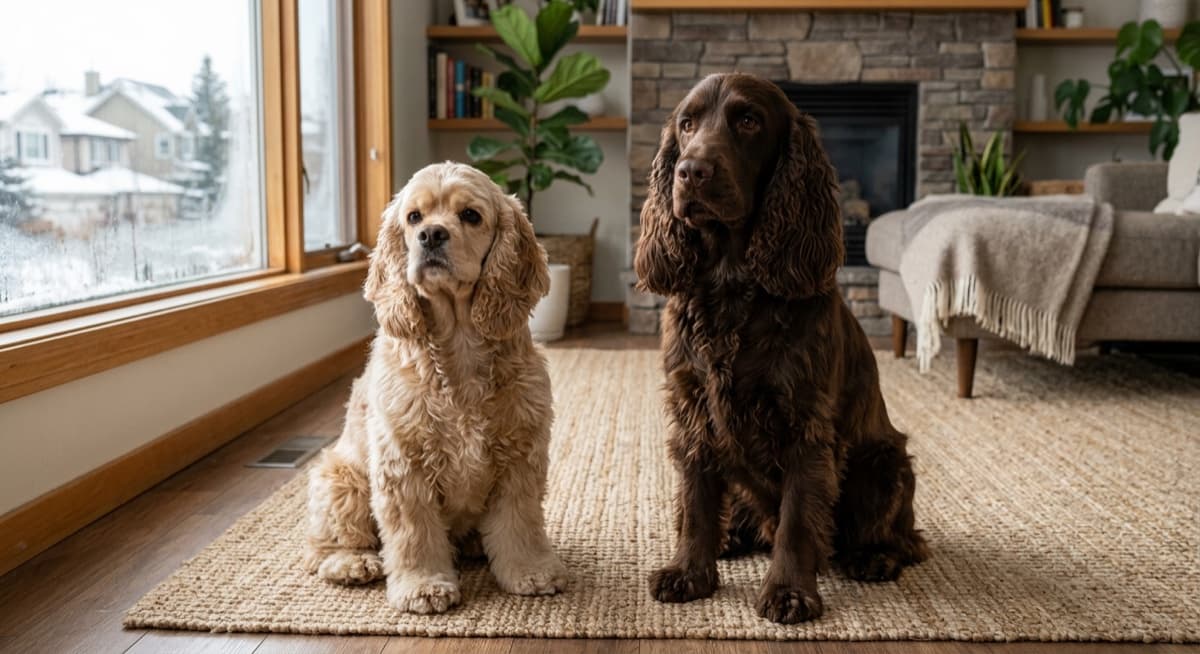
On a Calgary rescue listing, the photo often reveals the difference faster than the description. American Cockers look rounder in the face, with a clear stop above the muzzle and feathering that drapes well past the chest. English Cockers look longer overall, with a level head and feathering that stays closer to the body. If the listing only says “Cocker Spaniel,” call the rescue and ask which breed they intake records reflect.
Working line vs show line
Inside both breeds, there is a second important split: working line versus show line. The working line was bred to flush birds in the field. They are leaner, faster, mentally driven, and need real daily work. The show line was bred for the conformation ring. They are blockier, calmer, heavier-coated, and content with shorter walks.
Most Calgary rescue Cockers are mixed-origin and fall somewhere in the middle, but the working-line drive tends to dominate when present. A working-line English Cocker placed in an apartment with one 20-minute walk a day is the single most common backsliding pattern Calgary rescues see. The dog is not broken; the routine does not match the breeding.
How to tell from a listing or a meet-and-greet:
- Build: a lean, athletic frame with a thinner coat suggests working line. A blockier build with heavier feathering suggests show line.
- Behaviour at intake: rescues note dogs who pace, scan, or seek scent in their kennel runs versus dogs who settle. Pacing usually means working drive.
- Description language: “needs an active home,” “loves to work,” or “food-motivated and trainable” usually signals working line. “Loves the couch,” “mellow,” or “velcro dog” usually signals show line.
If your routine is 30 minutes of walking and a quiet evening, look for a show-line Cocker. If you run, hike at Nose Hill or Fish Creek, do scent work, or want a sport partner, look for a working-line dog. Mismatching this is harder to fix later than mismatching size or coat.
Where to adopt a Cocker Spaniel in Calgary
Cocker Spaniels are not high-frequency arrivals in Calgary rescues, but they appear several times a year between the major shelters. English Cockers currently appear more often than Americans, partly because Canadian gun-dog homes occasionally surrender working-line dogs that did not match the household.
Rescues to monitor in the Calgary area:
- Calgary Humane Society: the largest Calgary shelter; occasional Cocker and Cocker mix intakes.
- AARCS: foster-based; structured temperament assessments are useful for Cockers because of working-line drive variability.
- BARCS Rescue: Calgary foster-based; transports small to medium dogs and frequently lists Cocker mixes.
- Pawsitive Match: Calgary foster-based; the small companion lane often surfaces Cockers and Cockapoos.
- ARF Alberta: Calgary foster-based; medium-sized dogs frequently.
- Cochrane Humane Society: Cochrane-based, serves the broader Calgary region.
- Heaven Can Wait: Calgary rescue with a small-dog focus at times.
- Calgary Animal Services: the municipal facility; stray Cockers occasionally pass through.
- The national Cocker Spaniel breed club: a national breed club that sometimes facilitates breed-specific rehoming when an owner contacts them directly.
Listings clear quickly. Set up notifications and apply within a day or two when one appears. If you are flexible on appearance, consider Cocker mixes — Cockapoos, Spanadors (Cocker x Labrador), and English Cocker x Springer mixes surface more often and many make excellent family companions with the trainability of the parent breeds.
What does a Cocker Spaniel cost in Calgary?
Calgary adoption fees vary by rescue and inclusions. The realistic ranges:
| Source | Fee range | Typically includes |
|---|---|---|
| Calgary Humane Society | $405 adult (1 to 6 years), $270 senior | Spay or neuter, vaccinations, microchip, vet exam |
| AARCS | $425 adult, $150 senior | Spay or neuter, vaccinations, microchip, foster history |
| BARCS / Pawsitive Match | BARCS $650 / Pawsitive Match $475 (adult) | Spay or neuter, vaccinations, microchip |
| Breed-specific specialty rescue | $400 to $700 | Transport, foster-based temperament evaluation |
| CKC breeder puppy | $1,500 to $3,500 | Health testing, contract, breeder support |
Cocker lifetime cost runs higher than most small-medium breeds because of grooming and ear care. Realistic Calgary annual operating budget:
- Professional grooming: $80 to $130 per visit every 6 to 8 weeks. That is roughly $600 to $1,000 a year if you stay on schedule.
- Ear cleaning supplies and vet visits: ear infections recur in many Cockers; budget $200 to $500 a year for routine care and add more if a flare needs vet treatment.
- Pet insurance: $50 to $120 a month for mid-tier coverage, often worth it for this breed given the ear and eye predispositions.
- Food, training, licence: roughly $700 to $1,200 a year for a medium dog. Calgary requires a city dog licence for every dog three months and older under the Responsible Pet Ownership Bylaw (calgary.ca/bylaws-standards).
For a full lifetime cost breakdown, see our Calgary adoption costs guide.
Why so many Cockers end up in rescue
Many Calgary rescues say Cocker surrenders follow predictable patterns. Knowing them helps you set up a household that prevents the same outcome.
- Chronic ear infections and bill shock. Pendulous ears trap moisture and warmth. Many Cockers develop recurrent ear infections, and a flare-up vet visit can run $200 to $400. Three or four flares in a year is genuinely common, and unprepared owners surrender when the costs stack against the household budget.
- Grooming overwhelm. The coat needs full brushing several times a week and a professional groom every 6 to 8 weeks. Owners who pictured a wash-and-go family dog burn out, and the dog arrives at rescue heavily matted.
- Energy mismatch with working-line dogs. Working-line English Cockers placed in a low-activity household start to vocalize, dig, or guard resources. Owners read it as a behaviour problem rather than an exercise gap, and the dog gets returned.
- Resource guarding without a training plan. Cockers are food and toy guarders more than average. With a proper trade-up training plan, this is highly trainable, but unaware owners escalate the dog by punishing growls and end up with a bite incident.
- Lifestyle change. Divorce, baby, condo move, or a senior owner moving into assisted living. Calgary rescues see this pattern with companion breeds in particular because the dogs are deeply bonded to the household routine.
- Misread medical issues. Some “sudden aggression” surrenders trace back to untreated pain (ear, dental, eye, or joint), not to the dog's temperament. A vet workup before surrender often changes the outcome.
The takeaway: if you can budget for grooming and ear care, match the energy level honestly, and start a force-free training plan in the first month, the chronic Cocker problems are mostly preventable.
Is Cocker rage syndrome real?
Cocker rage was first described in the 1970s and gained traction in the 1980s as a hypothesized form of sudden idiopathic aggression that appeared most often in solid red and golden American Cockers. The term stuck in the public conversation and still drives some surrender decisions today.
Current consensus among veterinary behaviourists is much more measured. Most documented cases attributed to Cocker rage have been re-examined as resource guarding, pain-driven aggression (often unaddressed ear or dental pain), or learned defensive behaviour after punishment-based training. These cases responded to standard force-free behaviour modification and a thorough vet workup. A small subset may represent genuine idiopathic aggression that is poorly understood, but it is not a breed-wide condition and modern reputable lines do not show elevated risk.
Practical takeaway for Calgary adopters:
- Do not assume aggression in a rescue Cocker is a fixed breed trait. Most reactivity in this breed has a workable cause.
- Rule out medical pain first. Untreated ear, eye, dental, or joint pain is the single most common “sudden aggression” explanation in Cockers presented to behaviour vets.
- Engage a Calgary force-free trainer or veterinary behaviourist early if you see resource guarding or any defensive snapping. It is trainable, but the longer it goes unaddressed, the harder it gets.
- Choose a rescue that does foster-based assessments and shares behaviour notes honestly. AARCS, Pawsitive Match, and ARF Alberta all foster their dogs and can describe behaviour in real-home conditions.
What to expect from a rescued Cocker Spaniel
Cocker Spaniels were developed as flushing gun dogs in the United Kingdom, and the working heritage shapes daily life with the breed even in a city home.
- Velcro temperament. Most Cockers want to be near their person at all times. They do well with people who work from home or have flexible routines, and they are more prone than average to separation anxiety. See our Cocker separation anxiety guide for the prevention plan.
- Exercise. Plan for 45 to 60 minutes of daily exercise. Off-leash time at Nose Hill Park, Fish Creek Park, Bowmont Park, or Edworthy Park works well. Scent games add the mental work the breed needs.
- Grooming. Brush several times a week. Full groom every 6 to 8 weeks. The feathering on the ears, chest, legs, and belly mats fast in Calgary winters when snow and salt get into the coat.
- Ear care. Weekly ear checks. Clean only when needed, with a vet-recommended ear cleaner. See our Cocker ear care guide for the routine and the warning signs that need same-day vet attention.
- Training. Cockers are highly trainable and food-motivated. They respond well to force-free training and lose engagement under punishment. Start training in the first week with short, upbeat sessions.
- Calgary winters. The feathered coat handles cold reasonably, but accumulated snow and road salt cause skin irritation and matting. A quick rinse and a coat-spray detangler after winter walks helps. In routine cold below -20°C, limit walk length and watch for snow buildup between paw pads.
- Health. Beyond ears, watch for obesity, dental disease, progressive retinal atrophy, and hip issues. Annual screening eye exams are worth the cost for this breed.
The first month with a rescue Cocker
Many Calgary rescue Cockers arrive carrying months of low-grade neglect: untreated ear infections, dental tartar, a matted coat, undertreated allergies. Plan a full vet workup in the first one to two weeks. Book a groomer for the second or third week, once the dog has settled enough to handle handling.
The 3-3-3 settling rule applies, often with extra time. The first three days are decompression. The first three weeks are routine-building. The first three months are real bonding and behaviour calibration. Cockers in particular benefit from a quiet, predictable environment in the first two weeks — multiple visitors and exciting outings can stack up and slow the settling process.
For the full first-week Calgary plan, see our Bringing home a Cocker Spaniel guide.
Browse Cocker Spaniels in Calgary
See current Cocker Spaniels, English Cockers, and Cocker mixes across 15+ Calgary rescues in one place. Listings refresh regularly.
See Calgary Cocker Spaniels available now →Frequently Asked Questions
Where can I adopt a Cocker Spaniel in Calgary?↓
How much does a Cocker Spaniel cost in Calgary?↓
What's the difference between American and English Cocker Spaniels?↓
Why do Cocker Spaniels end up in rescue?↓
How long do Cocker Spaniels live?↓
Are Cocker Spaniels good with kids and other pets?↓
Is “Cocker rage syndrome” real?↓
What should I expect from a rescued adult Cocker Spaniel?↓
Continue reading
Cocker Spaniel ear care
Why the pendulous ear creates the breed-defining infection problem, the food-allergy connection, weekly prevention, and the warning signs that need same-day vet care.
Cocker Spaniel grooming
Coat maintenance, brushing routine, mat prevention, Calgary winter coat care, and what the 6 to 8 week professional groom actually covers.
Cocker Spaniel separation anxiety
Why velcro Cockers struggle with alone time, prevention from day one, the alone-time training plan, and when to involve a Calgary veterinary behaviourist.
Browse Calgary Cocker Spaniels
Currently available American Cockers, English Cockers, and Cocker mixes across all 15+ Calgary rescues, refreshed regularly.
New dog? Start with these care guides
Everything a new adopter needs to set up a safe, happy home.