The short answer
Cocker Spaniels are a velcro companion breed, bred for close human bonding, which is also why they show up disproportionately in separation anxiety reports. Velcro behaviour is normal (following you room to room, mild whining at closed doors). True SA is not. Persistent screaming for hours, destructive escape attempts, self-injury, soiling when alone. The fix is a four-phase desensitization plan: 5 to 60 seconds → 15 minutes → 2 hours → 6 hours, built over 3 to 4 months. Apartment owners in Calgary condo buildings should pair training with environmental management (white noise, covered crate, no hallway view) and a midday walker so the dog is not alone for full workdays during training. Crate training helps most Cockers but a small percentage do worse crated and need a baby-gated room instead. Calming aids are pairing tools, not fixes. “Cocker rage” is mostly disproven. Modern behaviourists treat those cases as resource guarding or pain-related aggression with a vet workup first. See a veterinary behaviourist if you see self-injury, full-duration vocalization, or no progress after 6 to 8 weeks of structured training. Any medication decision belongs with that vet team, not an article.
Almost every Calgary Cocker Spaniel owner we talk to describes the same first month. The dog follows them from room to room, settles at their feet when they sit down, cries at the bathroom door, and falls apart the first time they leave the apartment for groceries. On Reddit and in Calgary owner forums, the worst reports are blunt: the dog “screams for hours,” neighbours complain, the condo board sends a letter. That is the breed's wiring on display, and it is also a problem that can be solved.
Two things to know before reading on. First, Cocker Spaniels were developed as close working spaniels and house companions, and the American Kennel Club describes them as deeply people-oriented. That close-bond temperament is the breed's charm and its biggest behavioural risk factor. Second, separation anxiety in Calgary is not abstract: thin-walled condo buildings in the Beltline, Bridgeland, and Bowness amplify barking complaints, and Calgary has no breed bans but it does have a Responsible Pet Ownership Bylaw that lets neighbours file noise complaints. The training plan is the real fix; the apartment script is what gets you through the first 3 to 4 months while the plan takes hold.
This guide covers why Cockers are prone to SA, how to tell velcro behaviour from clinical anxiety, the four-phase alone-time protocol, crate training, apartment-barking management, calming aids, the “Cocker rage” myth, the resource-guarding angle, and when to escalate to a veterinary behaviourist. For broader rescue-dog decompression context, see our first-week rescue dog guide and the 3-3-3 decompression rule.
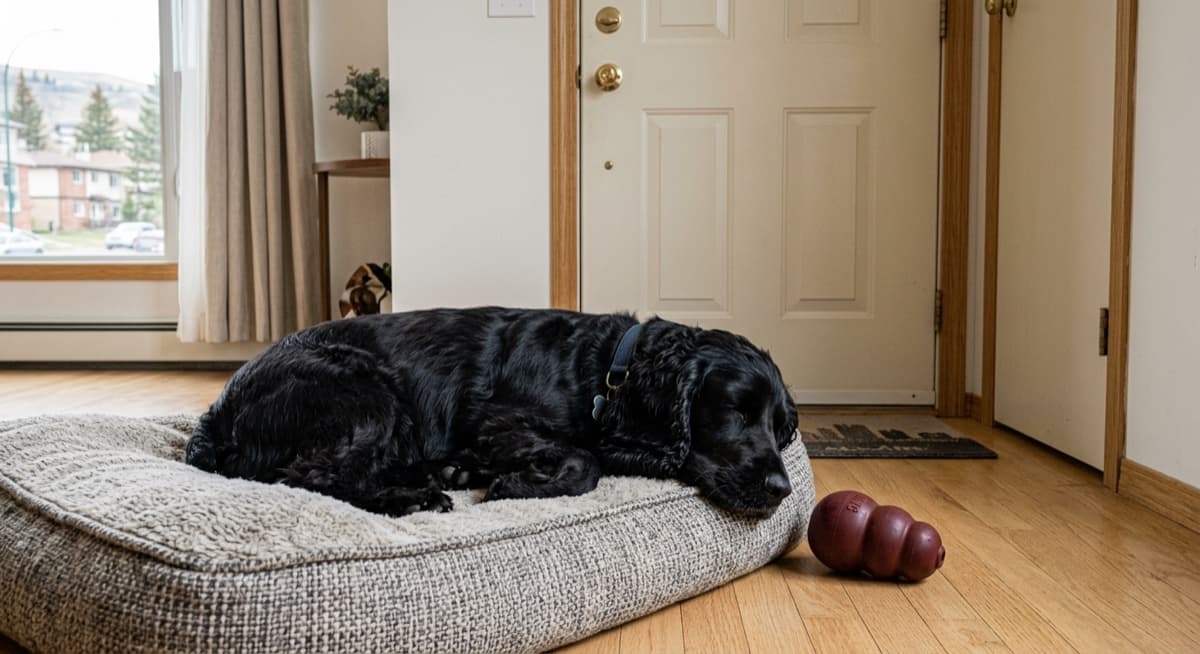
Why Cocker Spaniels are prone to separation anxiety
Cockers were bred to work alongside hunters as flushing spaniels and to live indoors as family companions. Both jobs select for a dog that pays close attention to its person all day. Centuries of that selection produce a temperament wired for human contact. When a modern Cocker ends up in a Calgary household where the human leaves for an 8-hour workday with no preparation, the gap between what the breed expects and what it gets is what produces the screaming, the destruction, and the condo complaints.
Behaviour research collected by the International Association of Animal Behaviour Consultants (IAABC) and the Certification Council for Professional Dog Trainers (CCPDT) consistently lists companion spaniels among the breed groups most often referred for separation-related cases. That is not a sentence about your individual Cocker. Many Cockers learn alone time without trouble. It is a sentence about base rates. Going in knowing the risk lets you build the alone-time protocol from day one instead of reactively, after the neighbours complain.
Velcro behaviour vs true separation anxiety
The two get confused, and the confusion matters. Velcro is normal Cocker character and does not need treating. True SA is a clinical problem and needs a structured plan.
| Behaviour | Velcro (normal) | True SA (clinical) |
|---|---|---|
| Following you around the house | Yes, all the time | Yes, plus panic when blocked |
| Vocalization when you leave | First 1 to 5 minutes, then settles | Persistent or escalating for full absence |
| Destruction | Rare, boredom-style chewing of toys | Doorframes, windowsills, escape attempts |
| Self-injury | None | Torn nails, bloody paws, raw mouth from crate bars |
| House soiling when alone | None (in a house-trained dog) | Yes, in a dog otherwise reliable |
| Eating, drinking, food puzzles | Normal when alone | Refuses food, ignores frozen Kong, vomits |
| Return behaviour | Enthusiastic but settles quickly | Trembling, pacing, slow to recover |
If three or more of the right-hand-column behaviours show up across a 2-week window, treat the dog as a true SA case from the start. That means a structured plan, not just hoping it settles, and a vet conversation if any of the safety items (self-injury, escape attempts, refusing food and water) are present.
The four-phase alone-time plan
Gradual desensitization is the protocol every credentialed behaviour body recommends. It is what IAABC, CCPDT, and most veterinary behaviourists train. The Cocker-specific version:
Phase 1 (weeks 1 to 2): 5 seconds → 60 seconds
Build the safe space first (crate, pen, or baby-gated room with bedding the dog already sleeps on). Feed every meal there with the door open. Practise absences of 5, 10, 30, 60 seconds while you stay in the dog's line of sight. Return calmly. The dog should not have time to escalate. If they vocalize, your last step was too long. Drop back. Goal: dog stays relaxed for 60 seconds of separation while you are still in the apartment.
Phase 2 (weeks 3 to 4): out of sight, up to 15 minutes
Step out of the room. Close the door behind you. Build from 30 seconds to 1, 3, 5, 10, 15 minutes. Add “fake departures” (pick up keys, put on a coat, then sit back down) so the dog stops associating those cues with you leaving. Frozen Kong or lick mat as a positive distraction during the longer reps. Goal: dog stays calm and engaged with enrichment for 15 minutes with you out of sight.
Phase 3 (weeks 5 to 8): real short absences, up to 2 hours
Actually leave the apartment. Start with the hallway (30 seconds), then a building lap, then a 10-minute walk, then a 30-minute errand, then 1 hour, then 2. Set up a camera (phone or pet cam) so you can see how the dog is doing rather than guessing. Goal: dog rests calmly for 2 hours alone with no vocalization past the first 5 minutes.
Phase 4 (months 3+): 6-hour workday tolerance
Build to 4 hours, then 6. For a full Calgary workday, pair the home stretch with a midday dog walker for the first year so the dog is never alone for more than 4 to 5 hours unbroken. By month 6, most Cockers trained on this protocol handle a workday with a midday break calmly. Push past 6 hours alone only after that 6-month baseline is stable.
The rule that matters most: move forward only when the dog stays calm at the current stage. Pushing too fast is the single most common reason this plan fails. If a step fails, drop back two steps and rebuild. The whole protocol takes 3 to 4 months of consistent work. There is no shortcut.
Browse adoptable Cocker Spaniels in Calgary
Many rescue Cockers are 3 to 7 year old adults who have already worked through the velcro phase in their previous home. Easier to integrate into a working household than a 10-week puppy with zero alone-time history.
See Available Cockers →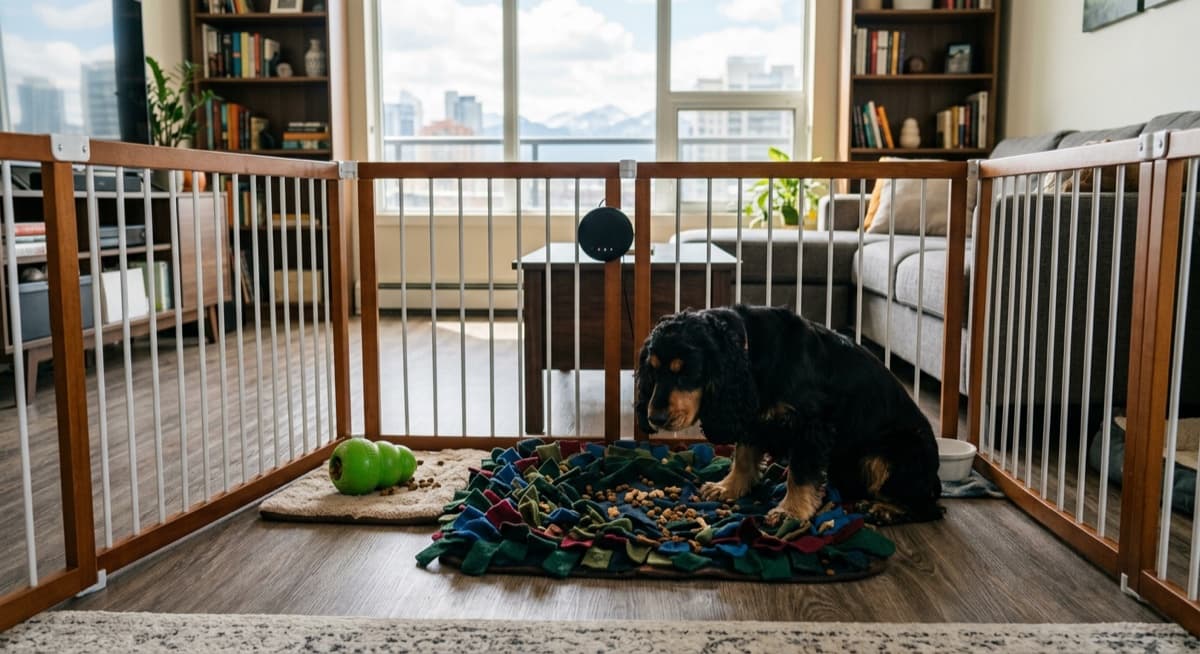
Apartment & townhouse barking: the Calgary condo script
Reddit threads about Cocker Spaniel separation anxiety are loudest from apartment and townhouse owners. The dog “screams for hours,” neighbours bang on walls, condo boards send notices. Calgary has no breed bans but does enforce its Responsible Pet Ownership Bylaw, which includes a noise provision that lets neighbours file complaints. Thin walls in newer Beltline and East Village builds, and adjacent units in Bowness and Bridgeland townhouses, make this a real problem that is not just embarrassing. It can threaten a tenancy or a strata standing.
The training plan above is the real fix. While it is taking hold, layer the following management on top:
- White noise or classical music. A box fan or a music speaker positioned between the dog and the hallway door masks corridor sounds that trigger reactivity.
- Visual barriers. Set up the dog's safe space away from the unit door. Block any line of sight to the hallway, the elevator lobby, or the street. A covered crate or a pen against an interior wall works well.
- Enrichment for the first 30 to 45 minutes alone. That is the highest-arousal window. Frozen Kong, lick mat, snuffle mat, food-dispensing puzzle. Multiple options so the dog cycles between them.
- Midday break during training months. Hire a force-free Calgary dog walker for 30 to 45 minutes mid-day. Splits a workday into two manageable halves and prevents practice of the panic pattern. Most Calgary walkers charge $20 to $35 per visit.
- Talk to your neighbours. Brief them: you have a new rescue, you are working on a structured behaviour plan with a clear timeline, expect noisy patches for the next 2 to 3 months. Most neighbours soften when they know there is a plan.
- Document the plan. If your condo board has already issued a notice, send a written response describing the protocol, the timeline, and the steps you are taking. Documentation is what protects you if the board escalates.
Some of the product links in this section are Amazon affiliate links — we may earn a small commission at no extra cost to you. It never changes which products we recommend.
What does not work and will make it worse: bark collars (citronella, vibration, shock, all suppress the symptom and intensify the underlying anxiety), “cry it out” (the dog rehearses the panic pattern and gets better at it), leaving the TV on with no other management (does almost nothing on its own), and a second dog as the “fix” (helps with general loneliness, not separation anxiety from the human bond. Solve the training piece first).
Crate training: works for most, not all
Most Cocker Spaniels settle into a crate well when it is built as a positive space. Feed every meal in the open crate for the first week. Add 30-second closed-door sessions while you sit right next to it, then build to 1, 3, 5 minutes. By month 2, your Cocker should be comfortable in the crate for 1 hour while you are home. By month 4, 3 to 4 hours alone with the crate as their safe space.
Three things to know about crate training a Cocker specifically:
- Never start by closing the dog in alone for hours. That is the single most common reason crate training fails. The first closed-door session should be measured in seconds, not hours, and you should be right beside the crate.
- A small minority of true SA dogs do worse in crates. They escalate when confined: broken teeth from biting bars, torn nails from digging at the floor, panicked vocalization that crate covering cannot mask. If you see escape-style behaviour after 2 weeks of careful crate intro, switch to a baby-gated room or pen with no top. Same protocol, more space.
- The crate is a tool, not the fix. A crate plus no alone-time plan is just a smaller box for the dog to panic in. Build the desensitization plan first; the crate makes it easier, not unnecessary.
Boring departures, boring returns
How you leave and how you come home shapes the dog's arousal level. Most owners get this backwards.
- Leaving: no long goodbye, no kissing the dog goodbye at the door, no last-second reassurance. Put on your coat, hand the dog their frozen Kong, leave. Sixty seconds of warm-up cues are enough.
- Returning: calm hello, no high-pitched greeting, ignore the dog for the first 30 seconds. Hang up your coat, put down your bag, then say hi. Big greetings on return teach the dog that your absence was the bad part. Calm greetings teach them it was just a normal part of the day.
- Fake departure cues during training. Pick up keys, then sit back down. Put on shoes, then take them off. Open the door, close it, sit on the couch. Decouples the cues from the absence so the dog stops pre-loading anxiety.
Enrichment during alone time. A Cocker who has work to do is a Cocker who is not rehearsing the panic pattern. Stack two or three enrichment items per absence: frozen Kong stuffed with kibble and a smear of canned food, snuffle mat with a scatter of treats, lick mat with wet food spread thin, food-dispensing puzzle ball. Rotate so they do not get bored. The job is to fill the highest-arousal first 30 to 45 minutes with calm focused activity, not an empty room and a TV.
Calming aids: pairing tools, not fixes
Calming aids can take the edge off mild velcro anxiety and they pair well with a structured training plan. Used on their own, they do not fix true separation anxiety. The categories most Calgary Cocker owners try:
- Pheromone diffusers and sprays. Synthetic dog-appeasing pheromone, plug-in or wearable collar. Mild effect for some dogs, no effect for others. Worth trying for 4 to 6 weeks.
- Snug-fit anxiety wraps. Gentle constant pressure, similar concept to a weighted blanket. Mixed evidence but harmless to try.
- Background sound. Classical music, dedicated dog-calming playlists, white noise machines, a box fan. Genuinely useful, especially in apartments where corridor sound is a trigger.
- Lick mats and licking-based enrichment. Sustained licking has a measurable calming effect on most dogs. The single highest-ROI item on this list.
Supplements and over-the-counter calming products. The American Animal Hospital Association recommends checking with your regular vet before adding any supplement because quality varies by brand and some interact with medications. Anything beyond environmental aids (chews, drops, supplements that claim a behavioural effect) is a conversation with your veterinary team, not a guess from a pet-store shelf.
Resource guarding: brief but important
Some Cocker Spaniels show resource guarding: growling, snapping, or biting when a person approaches their food, toys, chew, or resting spot. Resource guarding is its own behaviour problem and is separate from separation anxiety, though both can show up in the same dog. It is also frequently the underlying issue behind the “Cocker rage” folk diagnosis (more on that next).
What we want to say here is short: do not try to fix resource guarding alone. Cases handled badly escalate quickly. The bite history grows and the dog gets harder to help. Ask your regular vet for a behaviour referral, or contact a credentialed force-free behaviour consultant through the IAABC directory filtered to your area. In the meantime, manage the environment: do not approach the dog when they have a resource, pick up high-value items when you can do so safely, and avoid the “reach in and take it away” pattern that gets recommended in older training material. It makes guarding dramatically worse, not better.
The “Cocker rage” label, briefly
“Cocker rage syndrome” appears in a lot of older online discussion as a supposed sudden-onset aggression unique to Cocker Spaniels. Modern veterinary behaviourists treat it as a folk diagnosis. Cases that historically got that label are now mostly understood as resource guarding, fear aggression, or pain-related aggression, all conditions with identifiable triggers and known treatment paths. The breed's name attached to the syndrome is part of why it persisted; the underlying behaviours are not Cocker-specific.
If your Cocker has shown sudden aggression that surprised you, the first step is always a full vet workup. Pain, neurological issues, ear infections, thyroid problems, and other medical causes get missed when behaviour gets labelled too early. The American Veterinary Medical Association recommends a vet-led behaviour workup for any aggression case before any training plan is built, because trying to train a dog out of pain-driven aggression does not work and prolongs the dog's suffering. Get the workup, then build the behaviour plan with a credentialed consultant.
When to involve a veterinary behaviourist
Ask your regular vet for a referral to a veterinary behaviourist if you see any of the following:
- Self-injury (torn nails, bloody paws, raw mouth from chewing crate bars or doorframes).
- Persistent vocalization for the full duration of alone time, not just the first 5 to 10 minutes.
- Destructive escape attempts (chewed doors, broken windows, bent crate bars).
- Refusing food, water, or familiar enrichment when alone.
- House soiling when alone in a dog that is otherwise reliable.
- No measurable progress after 6 to 8 weeks of structured training.
- Aggression toward people, including resource guarding that has produced a bite or near-bite.
A veterinary behaviourist is a vet with advanced credentialing in behaviour medicine. They can co-ordinate a treatment plan that combines structured behaviour modification with whatever medical workup the case needs. Any decision about medication (what, how much, how long) belongs with that vet team and your dog's individual case. We do not name drugs, doses, or protocols here because that is not what an article is for. The right path is: vet referral → behaviourist consult → integrated plan you implement at home with their guidance.
Finding a force-free Calgary trainer
For separation anxiety specifically, the trainer's credentials matter more than their proximity. Look for one of the following:
- CCPDT-CSAT. Certified Separation Anxiety Trainer. The specialist credential for this issue. Many CSAT trainers work remotely with Calgary clients over video.
- CCPDT-KA. Certified Professional Dog Trainer Knowledge Assessed. Strong general credential.
- IAABC-ADT or IAABC-CDBC. IAABC credentialing for behaviour consultants. Both are appropriate for SA cases.
- Veterinary behaviourist referral. For severe cases as covered above.
The IAABC directory and the CCPDT directory both let you filter by location and specialty. Cross-check against any Calgary force-free trainer you find through word of mouth. Avoid any trainer who uses prong collars, e-collars, alpha-rollovers, or “dominance”-style methods for a Cocker with separation anxiety or guarding. Those approaches reliably make the behaviour worse, not better, and the credentialed bodies above explicitly do not endorse them.
Can a Cocker Spaniel work in a full-time-out-of-home household?
Yes, with planning. The Calgary households where it works share a few patterns:
- Alone-time training started day one. The first week is not just decompression. It is also the first phase of the four-phase plan above.
- Midday break for the first year. Dog walker, daycare 2 to 3 days a week, hybrid work schedule, or a neighbour who pops in. Pick one. Do not skip this for a working Cocker.
- Adult adoption when possible. A 3 to 7 year old rescue Cocker who is past the velcro puppy phase is dramatically easier to integrate into a working household than a 10-week puppy with zero alone-time history. See our adult adoption logic guide. Same reasoning applies to Cockers.
- Enrichment baked into the workday. Frozen Kong before you leave, lick mat for the walker visit, food-dispensing puzzle for the afternoon stretch.
- A plan for the weekly off-day. Saturday cannot be 14 hours of constant contact if Monday is going to be 8 hours alone. Calibrate so the contrast is not extreme. The dog learns to settle on quiet days at home, too.
The Calgary households where it does not work share their own pattern: adopted impulsively, no alone-time plan, expected the dog to “just adjust” to an 8-hour workday from day one, ended up with screaming, condo complaints, and a return to rescue within 3 months. The breed is not the problem; the absent plan is.
Frequently asked questions
Why are Cocker Spaniels prone to separation anxiety?
Centuries of breeding as close working spaniels and house companions select for a dog wired for human contact. That bond is the breed's charm and also its biggest behavioural risk factor. SA shows up disproportionately in companion breeds: Cockers, Havanese, Cavaliers, Toy Poodles. Knowing the risk lets you build the alone-time plan from day one instead of reactively.
How do I tell velcro behaviour from true separation anxiety?
Velcro is following you around, mild whining at closed doors, settles within minutes when you leave. True SA is persistent or escalating vocalization for the full absence, destructive escape attempts, self-injury, soiling when alone in a house-trained dog, refusing food or familiar enrichment when alone. If three or more of those clinical signs appear, treat it as true SA and build the structured plan.
What is the alone-time training plan?
Four phases over 3 to 4 months: 5 to 60 seconds while you are in sight; 30 seconds to 15 minutes out of sight; 30 minutes to 2 hours actually out of the apartment; 4 to 6 hours with a midday walker for the first year. Move forward only when the dog stays calm at each stage. Going too fast is the most common reason this fails.
How do I stop my Cocker barking in a Calgary apartment?
Run the training plan above, plus environmental management (white noise, covered crate or pen away from the unit door, no line of sight to the hallway, enrichment to fill the first 30 to 45 minutes alone. Hire a midday walker during the training months. Document the plan in writing if your condo board has issued a notice. Skip bark collars. They make underlying anxiety worse.
Does crate training work for Cocker Spaniels?
For most, yes, when built positively, with meals fed in the open crate first, short closed-door sessions added gradually, and the dog never started by being shut in for hours. A small minority of true SA dogs do worse in crates (escape attempts, self-injury). If you see that pattern after 2 weeks of careful intro, switch to a baby-gated room or open pen.
Do calming aids and supplements help?
Pheromone diffusers, snug wraps, white noise, and lick mats can take the edge off mild anxiety and they pair well with a training plan. They do not fix true SA on their own. Anything beyond environmental aids (supplements, calming chews, anything with a behavioural claim) is a conversation with your regular vet, per AAHA guidance, not a guess from a pet-store shelf.
When should I see a veterinary behaviourist?
When you see self-injury, full-duration vocalization, destructive escape attempts, the dog refusing food and water when alone, no progress after 6 to 8 weeks of structured training, or any aggression case. Ask your regular vet for a referral. Any medication decision belongs with that vet team. Not an article.
Is “Cocker rage” real?
Mostly disproven. Modern veterinary behaviourists treat cases that historically got that label as resource guarding, fear aggression, or pain-related aggression, all conditions with identifiable triggers and treatment paths. Any sudden-onset aggression deserves a full vet workup first to rule out pain, neurological, or thyroid causes before behaviour labels get attached. AVMA recommends a vet-led behaviour workup for any aggression case.
More Cocker Spaniel guides
Cocker Spaniel Adoption Calgary →
Where Cockers appear in Calgary rescues, English vs American, adoption fees, lifespan, common surrender reasons.
Bringing Home a Cocker Spaniel →
First-week Calgary guide. Supply checklist, the 3-3-3 settling rule applied to a velcro spaniel, daily routine, vet visit timing.
Cocker Spaniel Ear Care Calgary →
The dominant breed health concern. Cleaning schedule, infection warning signs, Calgary vet costs, when to see a specialist.
Adoptable Cocker Spaniels Calgary →
Live listings of adoptable Cocker Spaniels and Cocker mixes across Calgary's rescue network. Updated every 2 days.
New dog? Start with these care guides
Everything a new adopter needs to set up a safe, happy home.