The short answer
A deaf Dalmatian trains on the same reward-based principles as any dog; you just replace sound cues with visual and vibration cues. Build a positive attention cue (a floor tap the dog feels, a taught shoulder touch, or a soft vibration-collar buzz used as a tap, never a shock), teach a visual marker in place of a clicker, and teach hand signals for the everyday cues. The two things that change are getting attention without a voice and safety: a deaf dog can never be relied on to hear a recall, so off-leash means a fully fenced area only, with a long line everywhere else. Teach a gentle wake routine so the dog is never startled awake.
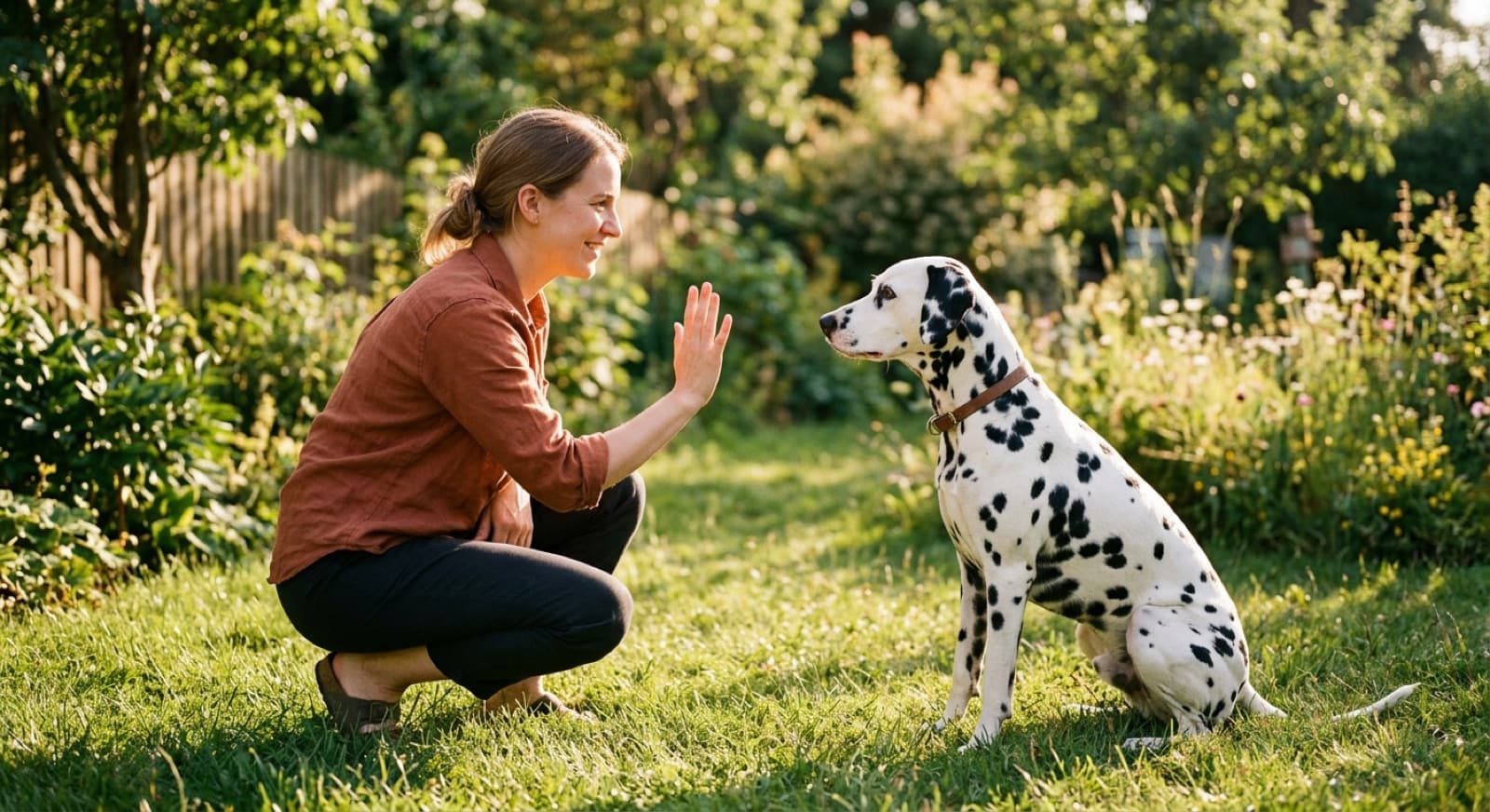
Deafness is one of the most common traits in the breed, so if you adopt a Dalmatian there is a real chance it is deaf or hard of hearing in one or both ears. New adopters often panic at the word “deaf.” They should not. Deaf dogs are trainable, safe, and affectionate, and many people who have lived with one say they would happily do it again. What a deaf dog needs is an owner who swaps sound for sight and touch, and who builds a few safety habits into daily life. This guide is that playbook.
First, confirm what your dog can hear
Congenital deafness is genuinely common in Dalmatians, one of the traits the breed is best known for, which is why responsible breeders hearing-test their litters. A 2020 study in the Journal of Veterinary Internal Medicine found roughly 18 percent of UK Dalmatians had some congenital deafness, and one-eared (unilateral) deafness is easy to miss because the dog still responds to sound. The only way to know for certain is a BAER test, which objectively checks each ear and can be done from about six weeks of age. If you adopt a Dalmatian whose hearing is unknown, ask your Calgary vet to arrange one; knowing whether your dog hears in one ear, both, or neither shapes everything below. For the medical background, see our Dalmatian health guide.
Getting attention without sound
This is the one genuinely new skill. With a hearing dog you say its name; with a deaf dog you need a way to say “look at me” that it can feel or see. The goal is to make checking in with you the best thing that happens all day. Common tools:
- Vibration through the floor. A firm foot-stomp or hand-tap on the floor sends a vibration a deaf dog can feel. Works well indoors on solid floors.
- A taught touch cue. A gentle touch on the same spot (shoulder or hip) that you have conditioned to mean “good things,” so the dog turns toward you rather than being startled.
- A vibration collar (not a shock collar). A vibration-only collar set to a soft buzz can act as a long-distance tap on the shoulder. It must never be a shock or static tool; those are the wrong approach for any dog and especially a deaf one.
- A flashlight at night. A quick flick of light on the ground in front of the dog draws its eye in the dark yard.
Whatever you choose, pair it with a treat every single time at first. The dog learns that the buzz or tap always means turn to you and get rewarded, which is what makes it reliable later.
A visual marker and core hand signals
With hearing dogs, people use a clicker or the word “yes” to mark the instant a dog does the right thing. A deaf dog needs a visual marker instead: a flat thumbs-up or a quick open hand that you always follow with a treat. Once the dog understands that the marker means a reward is coming, you can teach anything.
From there, teach the everyday cues as clear hand signals: an attention or watch-me signal, sit, down, stay, and come. You can borrow common signals or invent your own; the only rules are that each is visually distinct and that everyone in the household uses the same ones. Teach exactly as you would a hearing dog, luring the behaviour, then marking and rewarding, just without the words. Deaf dogs often pick this up fast precisely because they are already watching you closely.
Recall and off-leash safety: the non-negotiable
A deaf dog cannot hear a recall, a car, another dog, or a warning shout. That single fact sets the safety rules, and they are not optional. Off-leash means a securely fenced area, always. No matter how good your visual recall is, an open, unfenced space is not safe for a deaf dog, because you cannot call it back the instant something goes wrong.
You can still build a strong visual recall: a big, obvious “come” signal that the dog checks in for, practised first on a long line. The long line is the deaf dog's best friend in open areas, giving it room to move while you keep physical control. In Calgary, that means favouring fully fenced off-leash areas over the big unfenced natural parks. Our Calgary off-leash parks guide flags which areas are fully fenced. Add a tag or embroidered collar noting the dog is deaf, and consider a lit or reflective collar for Calgary's dark winter afternoons.
Waking a deaf dog without startling it
A hearing dog wakes to footsteps; a deaf dog can be startled awake by a hand appearing out of nowhere, which is stressful and, in a startled dog, occasionally risky. The fix is a gentle, predictable wake routine. Many owners place a hand close to the sleeping dog so it catches their scent, or touch the same spot lightly and consistently, then immediately offer a treat as it wakes so being woken always means something good. Teach children this rule above all, and make it a firm household law that nobody grabs or startles a sleeping deaf dog. Done consistently, waking becomes a non-event.
The household, and when to get help
A deaf dog does best when the whole home is on the same page: the same hand signals, the same wake routine, the same attention cue. If you have another, hearing dog, it can genuinely help, since deaf dogs often take social cues from a confident housemate. Keep sessions short, positive, and consistent, and remember that a deaf dog reads body language and facial expression closely, so stay calm and clear.
If you want to shortcut the trial and error, a force-free, reward-based Calgary trainer with deaf-dog or hearing-impaired experience can help you build a reliable attention cue and visual recall faster. Choose someone who works entirely with positive reinforcement, and steer clear of anyone who reaches for aversive tools, which are the wrong approach for any dog and make no sense at all for a deaf one that cannot connect a correction to your cue. If you have just brought your dog home, our first week with a rescue dog guide covers settling in.
Open to adopting a deaf Dalmatian?
Deaf and one-eared-deaf Dalmatians are often the ones waiting longest in rescue, and they make wonderful companions for an owner ready to train visually. If you are open to one, you widen your options and give a great dog the informed home it needed.
See Calgary Dalmatians available now →Frequently Asked Questions
Are deaf Dalmatians harder to train?↓
How do I get a deaf dog to pay attention to me?↓
What hand signals should I teach a deaf dog?↓
Can a deaf Dalmatian be off-leash?↓
How do I wake a deaf dog without scaring it?↓
Is it worth working with a trainer for a deaf dog?↓
Continue reading
Where to adopt, costs, energy, and family fit.
Deafness, urate stones, and preventive care.
Which areas are fully fenced, for a deaf dog.
Live listings across Calgary rescues.
New dog? Start with these care guides
Everything a new adopter needs to set up a safe, happy home.