The honest version
Dachshunds come in two CKC sizes (mini at 11 lbs or under and standard at 16 to 32 lbs) and three coat types (smooth, long, and wirehaired). Tweenies and Teacups are not CKC varieties. English Cream is a colour, not a size. Double dapple is a controversial breeding pattern linked to deafness and blindness. Minis typically live 1 to 2 years longer than standards, around 14 to 16 versus 12 to 14. IVDD risk affects about 25% of all Dachshunds regardless of size. Calgary breeder pricing runs $1,500 to $3,500 depending on size and colour. Anyone advertising mini Dachshund puppies under $500 is almost always selling problems. Most of what looks like a confusing breed market is actually the same dog in different sizes and coats with breeder labels stacked on top.
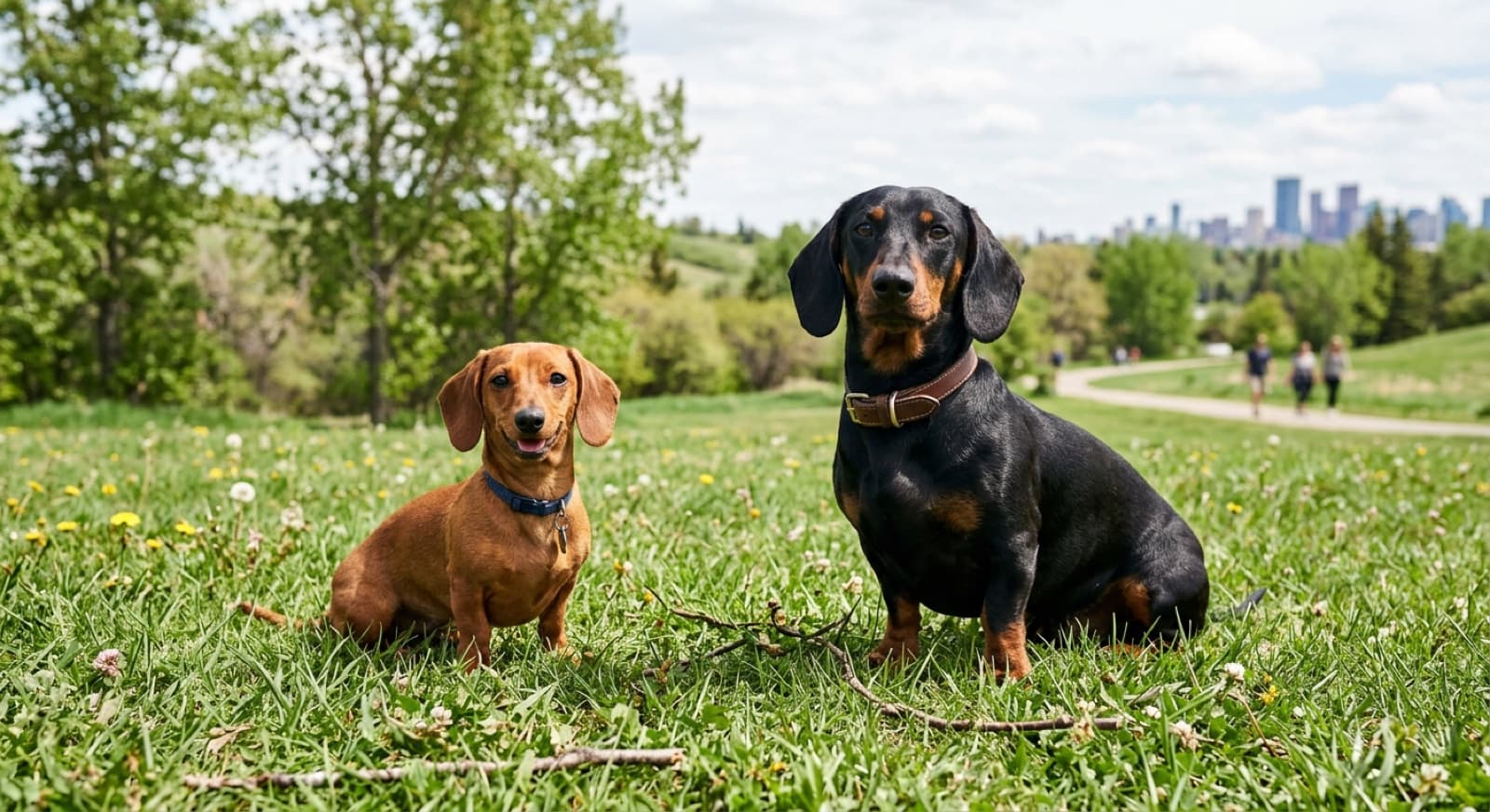
The CKC breed standard: two sizes, three coats, many colours
The Canadian Kennel Club and Dachshund Club of Canada recognize Dachshunds as one breed with two size varieties. Both varieties share the same body shape, the same three coat types, and the same colour list. The standard does not include a Toy, Teacup, Kaninchen (rabbit), or Tweenie variety. Those terms come from breeders or international clubs and are not part of how Canadian Dachshunds are registered or shown.
Calgary buyers shopping for a Dachshund encounter dozens of size and colour labels because breeders use them as marketing. Some are descriptive and harmless (long-haired red, smooth black and tan). Others are misleading or unethical (Teacup, double dapple, rare blue). Understanding what the CKC standard actually allows is the simplest way to filter good breeders from bad ones.
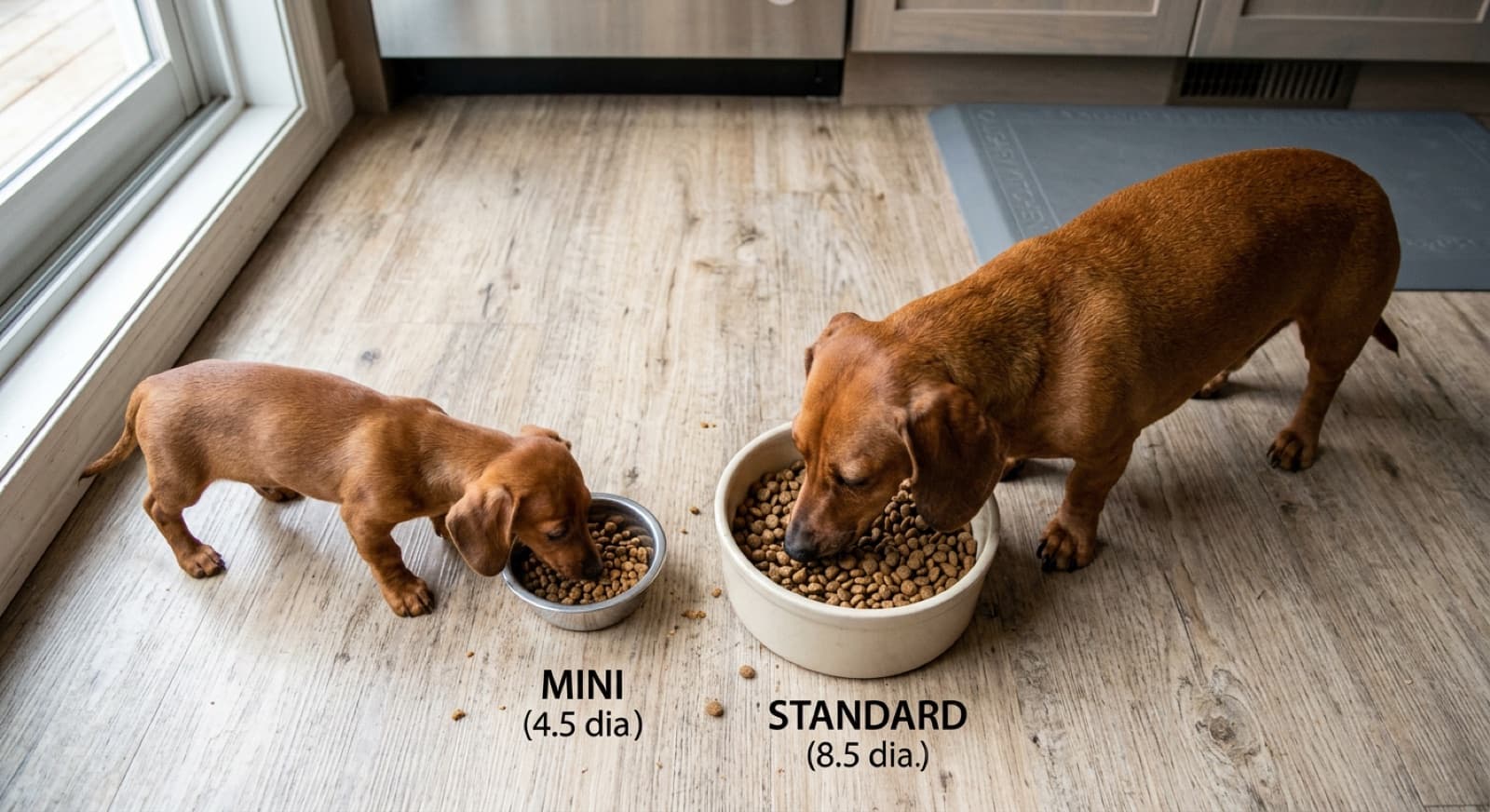
Size comparison
| Trait | Mini Dachshund | Standard Dachshund |
|---|---|---|
| Adult weight | 11 lbs or less | 16 to 32 lbs |
| Shoulder height | 5 to 6 inches | 8 to 9 inches |
| Lifespan | 14 to 16 years | 12 to 14 years |
| IVDD lifetime risk | ~25% (slightly higher per body size) | ~25% |
| Apartment fit | Excellent, under most weight caps | Good, some buildings cap at 20 lbs |
| Calgary breeder price | $1,800 to $3,500 | $1,500 to $3,000 |
| Rescue availability | Rare, adopted fast | More common |
| Typical exercise | 30 to 40 min daily | 40 to 60 min daily |
Weights and heights reflect the CKC standard. Calgary pricing is based on 2026 breeder listings across Alberta. There is no CKC size between mini and standard.
Tweenies, Teacups, and other size labels
Tweenie Dachshund (12 to 15 lbs)
Informal term, not in the CKC standard. Tweenies are healthy Dachshunds that fall between mini and standard, usually the result of breeding a mini to a standard or a mini that grew larger than expected. They cannot be shown as either variety. Adopters get a perfectly normal dog. The label only matters for breeders who want to register or show the dog.
Teacup or Toy Dachshund (under 8 lbs)
Marketing label. Not recognized by the CKC. Typically bred down through runt-to-runt pairings, which concentrates health problems. Common issues include open fontanels (soft spot on the skull), liver shunts, hypoglycemia, dental crowding, and severe IVDD risk because of skeletal under-development. Calgary buyers paying $4,000+ for Teacup puppies are usually funding unethical breeding. Avoid.
Kaninchen or Rabbit Dachshund (under 8 lbs)
Recognized by the German national kennel club (FCI) as the smallest of three varieties. Not a CKC variety in Canada. Kaninchen-line Dachshunds occasionally appear in Calgary through European imports. They are functionally similar to a small mini and are healthier than a Teacup because European breeders enforce stricter health testing. Still uncommon and not necessary for most adopters.
The three coat types
Smooth coat
The original Dachshund coat. Short, sleek, and close to the body. Sheds moderately year-round. Easiest to maintain with a weekly wipe-down and an occasional bath. Smooth coats handle Calgary summers well but need a jacket below -10C and booties below -20C because there is no insulation against sidewalk salt. The most common coat in Calgary rescue and the most affordable from breeders.
Long coat
Silky feathered hair on the ears, chest, legs, belly, and tail. Reputation for a gentler temperament, possibly from spaniel ancestry in the early breeding lines. Needs brushing 2 to 3 times a week to prevent mats behind the ears and on the chest. Professional grooming every 6 to 8 weeks at $50 to $80 in Calgary salons. Handles cold weather better than the smooth coat thanks to the feathering.
Wirehaired
Coarse double coat with a beard and bushy eyebrows. Bred for hunting through heavy brush. Often described as the most terrier-like and stubborn coat variety, likely from wirehaired terrier crosses in the breeding lines. Needs hand-stripping every few months to keep the wiry texture, or it goes soft and frizzy. Calgary groomers who can hand-strip are uncommon and charge $80 to $120. Most pet wirehaireds get clipped instead, which is fine but changes the coat texture.
Colour variations
The CKC recognizes a long list of Dachshund colours. The common ones are red, black and tan, chocolate, cream, blue (dilute black), and isabella (dilute chocolate). Patterns include dapple (merle), brindle, piebald, and sable. All standard colours appear in both mini and standard sizes and all three coats.
Red
The most common colour in Calgary rescues. Solid red ranges from light golden to deep mahogany. Healthy, no breed-specific issues tied to the colour.
Black and tan
The classic Dachshund look. Solid black body with tan markings on the eyebrows, muzzle, chest, and legs. The second-most common colour in Calgary listings.
Chocolate
Brown body, often with tan markings. Appears in both pure chocolate and chocolate and tan. Less common than red or black and tan but not rare.
Cream and English Cream
Cream is a recessive colour that appears across breeding lines. English Cream is a specific cream lineage from English breeders, usually long-haired, often premium-priced at $3,000 to $4,500. The dog is genetically still a Dachshund. The premium reflects bloodline rarity and breeder marketing, not a health or temperament difference.
Dapple (merle)
Mottled patches of darker colour on a lighter base. Standard CKC pattern when bred responsibly (one dapple parent crossed with a non-dapple). Single-dapple dogs are healthy.
Double dapple (avoid)
Result of breeding two dapple parents. Puppies often show large white patches and look distinctive. They also have high rates of deafness, blindness, microphthalmia (small eyes), and missing eyes. Reputable Canadian breeders refuse double-dapple pairings. A Calgary breeder advertising double dapple is a red flag.
Brindle and piebald
Standard CKC patterns. Brindle is dark tiger striping over a base colour. Piebald is a patch pattern with white and a solid colour. Both are healthy when bred properly.
IVDD risk: mini vs standard
Intervertebral disc disease (IVDD) is the defining Dachshund health concern. Lifetime prevalence in the breed sits around 25%, the highest of any breed in the world. Both minis and standards carry the long-back, short-leg conformation that drives it. There is no size variety that escapes IVDD risk.
The relative risk per body size is slightly higher in minis. The proportion of spinal stress to body weight is greater in a 9 lb mini than a 24 lb standard. In practice, however, both varieties present at Calgary vet clinics with IVDD at similar rates. Standards have more absolute force on the spine. Minis have proportionally more.
Calgary owners can lower IVDD risk in both varieties the same way. Keep the dog at a lean weight (no extra padding). Use ramps for couches, beds, and stairs. Avoid jumping. Never lift the dog under the chest. Build core strength with controlled walking and avoid high-impact play. Our deeper guide on Dachshund IVDD recovery walks through what an episode looks like and what Calgary specialist care costs.
Lifespan differences
Mini Dachshunds typically live 14 to 16 years. Standards typically live 12 to 14. The 1 to 2 year gap is consistent with the general size-vs-lifespan pattern in dogs: smaller dogs outlive larger ones. Both varieties can outlive these averages with good weight management, IVDD prevention, and dental care. Both can fall short if obesity, dental disease, or a serious IVDD episode hits early.
The biggest lifespan-shortener in this breed is weight. Even 1 to 2 extra pounds on a mini doubles spinal stress. An obese standard often develops back problems, joint disease, and metabolic disease that compound. Keeping a Dachshund lean is the single highest-ROI health intervention in either size.
Calgary breeder pricing and what cheap listings mean
Mini Dachshund puppies from Calgary breeders run $1,800 to $3,500 in 2026. Standards run $1,500 to $3,000. English Cream Dachshunds run $3,000 to $4,500. Long-haired and wirehaired puppies often price 10 to 20% above smooth-coated equivalents because litters are smaller.
Anyone advertising mini Dachshund puppies under $500 in Calgary or surrounding Alberta is almost always one of three things: a backyard breeder skipping health testing, an unethical operation breeding double dapples or teacups, or a scam taking deposits on dogs that do not exist. Reputable Alberta breeders charge $2,000+ because they health-test parents for IVDD risk factors, eye conditions, and cardiac issues, and they raise puppies in-home with vet care.
For a fraction of breeder pricing, Calgary adoption fees run $300 to $700 through general rescues like Calgary Humane Society, AARCS, BARCS, and Pawsitive Match. Adult-rescue Dachshunds usually come with documented temperament, kid history, cat history, and housetraining status. That information is often more useful than a puppy unknown.
Calgary rescue availability
Standard Dachshunds appear in Calgary rescues more often than minis. Mini puppies get adopted within days of listing because of social-media demand. Standard adults sit in foster longer because adopters often want puppies or minis specifically. That makes a standard adult Dachshund a quietly excellent option for a Calgary adopter ready to skip puppyhood, training a name, and uncertainty about adult size.
Mixes (Dachshund crossed with Chihuahua, Jack Russell, or Beagle) appear more often than purebreds in Calgary rescue. They share the long-back conformation in most cases and need the same IVDD prevention. Coat and temperament vary more in mixes, which is fine for adopters who are flexible.
Browse adoptable Dachshunds in Calgary
Live listings from 15+ Calgary rescues, refreshed regularly. Mini and standard Dachshunds plus Dachshund mixes (Chiweenies, Dorkies, Doxle crosses). Foster reports usually include adult size, coat type, kid history, cat history, and IVDD risk notes.
See Available Dachshunds →Which one is right for your Calgary household?
Choose a mini if…
- You live in a Calgary condo or apartment with a weight cap.
- You want the longest possible lifespan (14 to 16 years on average).
- You are an experienced small-dog owner comfortable with vigilant IVDD prevention.
- You prefer a dog small enough to travel with easily.
- You have older kids (5+) and can supervise toddlers carefully.
Choose a standard if…
- You want a slightly sturdier frame around young kids or active dogs.
- You enjoy longer Calgary walks and outdoor time.
- You prefer adopting from rescue (standards are more available).
- You want a calmer reputation on average (varies by individual).
- Your building does not have a small-dog weight cap.
Consider a Tweenie or mix if…
- You are flexible on adult size and want a quicker rescue match.
- You do not need a CKC-registered dog for sport or show.
- Foster notes about temperament and trainability matter more to you than size variety.
Frequently Asked Questions
What is the size difference between a mini and a standard Dachshund?
The CKC recognizes two sizes. Mini Dachshunds weigh 11 lbs or less and stand 5 to 6 inches at the shoulder. Standard Dachshunds weigh 16 to 32 lbs and stand 8 to 9 inches. No in-between size exists in the CKC standard. Dogs that fall between 12 and 15 lbs are called Tweenies, an informal term used mostly when a mini and standard are crossed. Tweenies are healthy dogs but cannot be shown.
Are minis and standards the same breed?
Yes, same breed in two sizes. Both share the same body shape, the same three coats, and the same colour list. Temperament is mostly the same with some Calgary owners reporting standards as slightly calmer and minis as more vocal. Minis tend to outlive standards by 1 to 2 years.
Are Teacup or Toy Dachshunds a real variety?
No. Teacup and Toy are marketing labels, not CKC varieties. They typically describe dogs bred under 8 lbs through runt-to-runt breeding, which concentrates health problems including open fontanels, liver shunts, hypoglycemia, dental crowding, and severe IVDD risk. Calgary buyers paying premium prices for Teacup Dachshunds are usually funding unethical breeding. A healthy mini at 9 to 11 lbs is the legitimate small size.
What coat types do Dachshunds come in?
Three: smooth, long-haired, and wirehaired. Smooth is the original Dachshund coat. Long-haired has feathered hair on the ears, chest, legs, and tail and a gentler reputation. Wirehaired has a coarse double coat with a beard and bushy eyebrows and a more terrier-like temperament. All three appear in both mini and standard sizes.
What is double dapple and why should I avoid it?
Double dapple is the result of breeding two dapple (merle) parents. The puppies show large white patches and look distinctive. They also have high rates of deafness, blindness, microphthalmia (small eyes), and missing eyes. Reputable Canadian breeders refuse double-dapple breeding. If a Calgary breeder advertises double dapple, walk away.
How do mini and standard lifespans compare?
Minis typically live 14 to 16 years. Standards typically live 12 to 14. The 1 to 2 year gap is consistent across veterinary data. Smaller dogs generally outlive larger dogs. Calgary owners who manage weight, avoid stairs and jumping, and use ramps see their dogs reach the upper end of the range.
How much do Dachshund puppies cost in Calgary?
Mini Dachshund puppies run $1,800 to $3,500. Standards run $1,500 to $3,000. English Cream Dachshunds run $3,000 to $4,500. Adoption fees from Calgary rescues are $300 to $700 regardless of size or coat. Anyone advertising mini Dachshund puppies under $500 in Calgary is almost always a backyard breeder or a scam.
Is a mini or standard better for a Calgary apartment?
Both work but minis are easier on average. Minis weigh under 11 lbs and meet most Calgary building weight limits. Standards at 16 to 32 lbs are still apartment-workable but some buildings cap pets at 20 lbs. The bigger apartment question is not size, it is barking. Dachshunds were bred to vocalize at prey and stranger noise in shared hallways triggers them. Plan for training.
More Dachshund guides
Dachshund Adoption Calgary →
Where to find a rescue Dachshund in Calgary, real costs, mini vs standard availability, and how adoption screening works.
Is a Dachshund Right for You? →
Honest truths about Dachshund ownership and a self-assessment for prospective Calgary adopters.
Dachshund Health Issues →
IVDD, dental crowding, obesity, and the breed-specific health profile every Calgary adopter should know.
Dachshund IVDD Recovery →
What an IVDD episode looks like, Calgary specialist costs, surgery vs conservative care, and the long recovery arc.
Buy or Adopt a Dachshund →
Real Calgary breeder pricing vs adoption fees, what cheap puppy listings actually mean, and how to vet a breeder.
Dachshund Cost of Ownership →
Annual and lifetime cost breakdown for a Dachshund in Calgary, including IVDD-affected scenarios and pet insurance.
New dog? Start with these care guides
Everything a new adopter needs to set up a safe, happy home.