You are not alone, and your dog is not broken
Pit Bull separation anxiety is one of the most common reasons owners reach out to Calgary rescues for help. A recent Reddit thread on the topic drew over 190 comments from desperate owners describing scratched-bloody paws, neighbours complaining about howling, and the heartbreak of watching their dog panic every time the door closes. If you are reading this, you are probably exhausted. The good news: most Pit Bulls with SA can recover with a structured plan. The honest news: it takes 6 to 18 months of consistent work, and severe cases need medication. This guide is the full Calgary recovery playbook, written without shortcuts and without judgment.
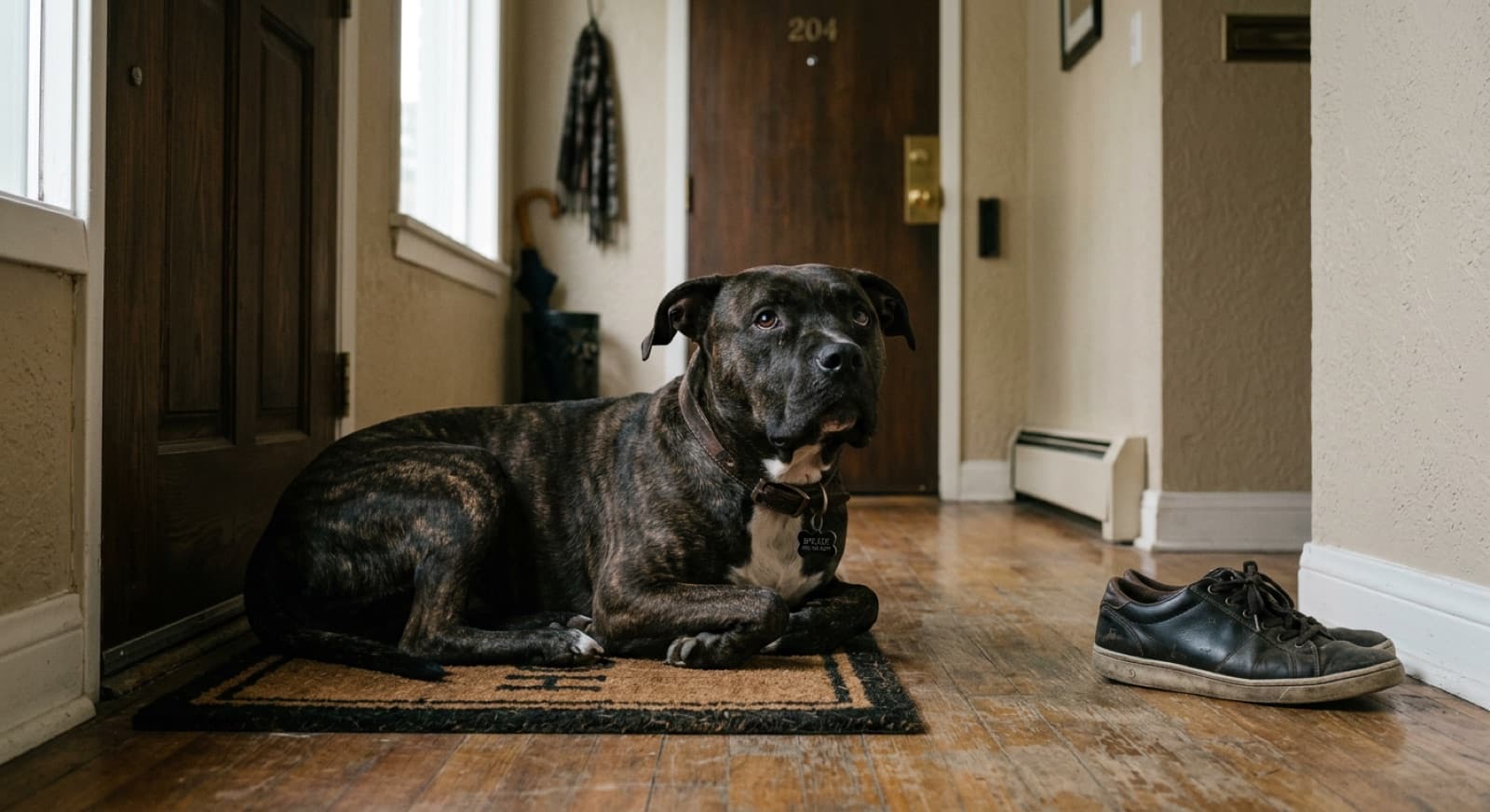
Velcro is breed-typical. Panic is not.
Pit Bulls are a velcro breed by nature. Bonded affection, lap sitting, leg-leaning, room-to-room following — that is normal. Pathological anxiety is different.
Healthy Pit Bull attachment looks like this:
- Wants to be in the same room as the primary person
- Picks the closest possible nap spot to family activity
- Greets returning family with full-body wiggling
- Can settle alone for moderate periods if conditioned well
- Calms down within minutes after the owner leaves
Clinical separation anxiety looks different. The dog panics. The panic starts within minutes (often before the door closes). The dog cannot self-regulate. Behaviour escalates over time if the dog keeps having solo alone-time without intervention.
Many Calgary rescue Pit Bulls carry extra risk factors: shelter trauma from long kennel stays, BSL-driven displacement from Ontario or Montreal, multiple home transitions, or histories of being left alone for full workdays in past placements. None of those backgrounds make the dog broken. They mean the dog needs a thoughtful recovery plan, not a quick fix.
True SA vs Boredom Destruction
Boredom (manageable)
- • Starts 1 to 2 hours after departure
- • Destructive chewing of accessible items
- • Settles when given proper enrichment
- • No vocalizing, or brief and intermittent
- • No house-soiling
- • Eats food and treats when offered
- • Greets you calmly on return
Separation anxiety (escalate)
- • Starts within minutes (often before you leave)
- • Drooling so heavy the dog is wet on arrival home
- • Self-injury at exit points (bloody paws, broken teeth)
- • Soils indoors despite housetraining
- • Persistent vocalizing audible to neighbours
- • Escape attempts (chewing door frames, jumping windows)
- • Refuses food and treats when alone
- • Frantic greeting on return that lasts 10+ minutes
The diagnostic step: prop a phone up (or use a Wyze or Furbo camera) and record the first 30 minutes after departure. Many owners are stunned when they watch the footage and realize the dog never settles. Calgary force-free trainers can review the video and confirm the pattern.
The Step-by-Step Desensitization Plan
The core method is gradual exposure to alone time, always staying below the panic threshold. Every panic episode sets recovery back, so slow is fast.
Find your dog's current threshold
Watch the camera footage. At what point does panic start? 5 seconds? 30 seconds? 10 minutes? That is the upper limit of your starting point. Begin training at half that duration. If your dog panics at 30 seconds, start at 10 to 15 seconds. Never start at the panic threshold itself.
Make leaving boring
Drop the dramatic goodbyes. No emotional farewells, no extended cuddling at the door, no apologetic tone. Pick up keys, put on shoes, leave with no fanfare. Return calmly. Ignore the dog for 1 to 2 minutes after re-entry, then greet calmly. Excited departures and returns reinforce the idea that leaving is a big event.
Tiny absences, paired with enrichment
Start with 5 seconds out the door. Then 10, 30, 60. Sit in the car. Walk to the mailbox. Stand on the porch. Always return BEFORE the dog reaches panic. Pair every departure with high-value enrichment: frozen Kong, lick mat with peanut butter, bully stick, frozen bone broth in a snuffle mat. The dog should think leaving means “best treat of the day arrives.”
Break departure cues
Keys, shoes, jackets, and bags become anxiety triggers because they predict departure. Break the prediction. Pick up keys 50 times a day without leaving. Put on shoes and sit on the couch. Grab a bag and put it back down. Repeat until the cues no longer trigger panic. Some dogs need 100+ repetitions before the cue loses meaning.
Build duration incrementally
Move from seconds to minutes to hours over weeks and months. Week 1 to 4: under 5 minutes. Week 5 to 8: 5 to 30 minutes. Month 3: 30 to 90 minutes. Month 4 to 6: 1 to 3 hours. Month 6 to 12: build to workday length. Track progress on a simple chart. Setbacks are normal — when they happen, drop back to the previous successful duration for a week, then build again.
Prevent solo panic episodes in parallel
While training, use daycare, dog walkers, family, or work-from-home to cover the hours you cannot supervise. Every solo panic episode strengthens the anxiety. Calgary daycare $35 to $55/day. Midday walker $25 to $40/visit. The cost is real but smaller than the cost of letting recovery stall for years.
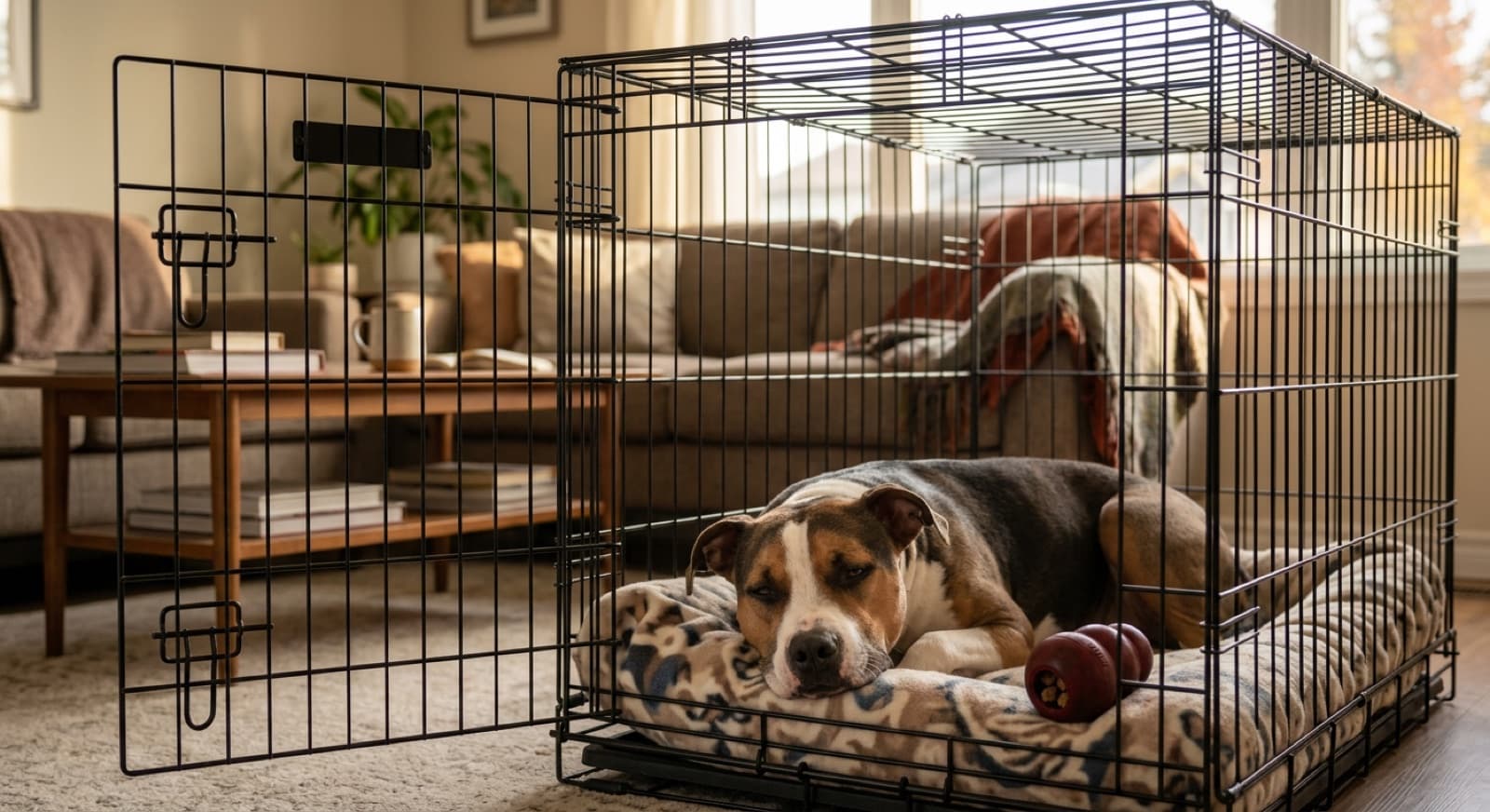
Crate use: helpful for some, traumatic for others
This is one of the most contested questions in Pit Bull SA recovery. The honest answer is that crates help some dogs and traumatize others. The dog tells you which.
When crates help: some Pit Bulls find a positively conditioned crate calming. The covered den feels safe. The dog naps inside even when the door is open. Containment prevents destructive escape attempts that injure the dog. For these dogs, the crate is a refuge.
When crates make things worse: other Pit Bulls panic in crates regardless of conditioning. They break teeth on the bars, soil inside, scream continuously, bend metal trying to escape, or develop bloody paws and torn nails. Forcing a crate-averse SA dog into a crate creates lasting trauma that compounds the original anxiety.
How to tell which: introduce the crate slowly with the door open. Feed every meal inside. Toss high-value chews in throughout the day. Cover the crate with a light blanket. Watch what happens over 1 to 2 weeks.
- If the dog enters voluntarily and naps inside, crating is likely safe
- If the dog refuses to enter even for food, do not force it
- If the door closing for 30 seconds triggers panic, do not force it
- If signs of distress appear (whale eye, panting, drooling, frantic motion), stop
The alternative when crating fails: use a baby gate to restrict to one safe room, an exercise pen for partial containment, or a dog-proofed bedroom with the door closed. Many Pit Bulls do better with more space and less containment.
Calming Aids That Actually Help
No calming aid replaces desensitization. But several lower baseline anxiety enough to support training.
| Aid | Cost | What it does |
|---|---|---|
| Adaptil (DAP pheromone) | $30 to $50 diffuser, $20 collar | Synthetic dog-appeasing pheromone. Calms moderate anxiety. Works for roughly 50 percent of dogs. |
| Thundershirt | $45 to $60 | Pressure wrap that calms some dogs through proprioceptive input. Try at home first. |
| Calming music (Through a Dog's Ear, classical playlists) | Free | White noise plus slow tempo lowers cortisol in many dogs. Run during every departure. |
| Frozen Kong / lick mat | $15 to $25 | Long-duration enrichment redirects the first 20 to 40 minutes of alone time. Essential daily tool. |
| L-theanine, Zylkene, Solliquin | $30 to $60/mo | Nutraceuticals with mild calming effect. Ask your vet before stacking with prescription meds. |
| CBD oil | $40 to $80/mo | Mixed evidence. Some dogs respond, many do not. Vet supervision recommended. |
Layer 2 to 3 of these on top of desensitization training. None of them are a standalone solution. If the dog has severe SA, calming aids may help a little but you will likely need prescription medication too.
Some of the product links in this section are Amazon affiliate links — we may earn a small commission at no extra cost to you. It never changes which products we recommend.
Browse adoptable Pit Bulls in Calgary
Foster reports often note alone-time tolerance, crate compatibility, and SA history. Critical information for owners building a recovery plan or screening for a calmer-baseline dog.
When to call a vet behaviourist
Moderate to severe SA usually needs medication. That is not a training failure or a moral failure. Lowering baseline cortisol with medication is often the only way the dog can actually learn from desensitization training.
Escalate to a vet behaviourist if any of these occur:
- Self-injury attempting to escape (bloody paws, broken teeth, head wounds, torn nails)
- Persistent vocalizing for 30+ minutes audible to neighbours
- Refusing all food and toys during alone time
- Severe physical symptoms (continuous drooling, vomiting, panic-level panting)
- House-soiling despite reliable housetraining
- No improvement after 8 weeks of consistent protocol work
- The dog is destroying property to the point you cannot afford to keep leaving
Calgary veterinary behaviour resources:
- Dr. Jennifer Pelster, Calgary Veterinary Behaviour Services. The only board-certified veterinary behaviourist in Calgary. Referral required. Initial consult $300 to $600, follow-ups $200 to $400. Wait times 2 to 8 weeks. Book early.
- Western Veterinary Specialist & Emergency Centre. Acute crisis stabilization and bridge medication.
- Calgary North Veterinary Hospital. Behaviour-savvy primary vet for medication management.
- University of Calgary Faculty of Veterinary Medicine. Behaviour referrals and case consultation.
Medications used for Pit Bull SA
Your regular vet can prescribe most SA medications after a behaviour consult. Severe cases benefit from a vet behaviourist running the protocol.
Fluoxetine (Prozac, Reconcile)
Daily SSRI. The most common first-line medication for canine SA. Takes 4 to 6 weeks to reach full effect. $30 to $80 per month for a Pit Bull-size dose. Generally well tolerated. Long-term, often 6 to 18 months. Reconcile is the veterinary-branded version with a chewable formulation.
Trazodone
Situational anti-anxiety. Useful for predictable triggers like departure. Given 1 to 2 hours before alone time. $30 to $60 per month. Often combined with fluoxetine in moderate to severe cases. Faster onset than SSRIs (60 to 90 minutes).
Clomipramine (Clomicalm)
Tricyclic antidepressant. Health Canada labelled for canine separation anxiety. $40 to $80 per month. Used when fluoxetine is not tolerated or not effective enough. Daily dosing.
Gabapentin, Sileo, alprazolam
Adjunct or bridge medications used in specific cases. Sileo (oromucosal dexmedetomidine) for predictable acute triggers. Gabapentin for combination anxiety. Alprazolam (a benzodiazepine) for short-term acute use under close supervision.
Reading: American Veterinary Society of Animal Behaviour (AVSAB) publishes evidence-based protocols on canine SA. Worth bringing printed materials to your vet visit if SA is new territory for them.
Calgary force-free trainers experienced with SA
SA training requires patient, reward-based methods. Aversive tools (shock collars, prong collars, alpha rolls) make SA dramatically worse. Calgary force-free options:
- Dogma Training. Multiple Calgary locations. Reward-based group and private sessions. Solid SA experience.
- ImPAWSible Possible (Linda Skoreyko). Strong separation anxiety focus. Karen Overall relaxation protocol experience. Often the first force-free trainer Calgary vets refer to for SA cases.
- Calgary K-9. Force-free private training, in-home behaviour consults, SA-specific protocols.
- Sit Happens. Reward-based group classes and in-home training.
- Raising Fido. Force-free, behaviour modification specialty.
Typical pricing: $150 to $300 for an initial behaviour consult, $80 to $150 per follow-up, $400 to $1,200 for a full SA training package (typically 6 to 10 sessions). Cheaper and faster than a vet behaviourist for mild to moderate cases. For severe cases, run both in parallel.
The Honest Cost and Timeline
Cost of treatment (Calgary, moderate to severe case):
- Vet behaviour consult: $300 to $600 (one-time)
- Vet behaviourist follow-ups: $200 to $400 each (2 to 4 over a year)
- Medication: $30 to $80 per month, ongoing 6 to 18 months
- Force-free trainer package: $400 to $1,200
- Daycare and walker support: $300 to $1,100 per month during recovery
- Calming aids (Adaptil, Thundershirt, Kongs): $100 to $200 first year
Honest first-year total for a moderate case: $4,000 to $8,000. Severe case: $6,000 to $12,000+.
Recovery timeline:
- Mild case (panic at 30+ min alone, no self-injury): 3 to 6 months
- Moderate case (panic at 10 to 30 min, vocalizing, some destruction): 6 to 12 months
- Severe case (immediate panic, self-injury, refusing food): 12 to 18 months
There are no quick fixes. Owners who expect a 2-week solution burn out. Owners who plan for 12 months see most dogs through to a stable place. Many Pit Bulls recover to 80 percent of normal alone-time tolerance and stay there. That is a win. Perfect freedom from anxiety is rare; manageable life with the dog is the realistic goal.
When to consider rehoming (last resort)
This section exists because the question deserves an honest answer, not because rehoming is the recommended path. The reality: in rare cases, after months of consistent work with medication, a vet behaviourist, and a force-free trainer, the dog is still injuring itself and the household cannot continue. At that point, the kindest choice for the dog may be returning to the original rescue.
Before considering rehoming, you should have completed:
- At least 6 months of consistent desensitization work
- A vet behaviourist consult with Dr. Pelster or equivalent
- A medication trial at therapeutic dose for at least 8 weeks
- A force-free trainer engagement
- Environmental modifications (different containment, daycare, walker support)
If you have done all of the above and the dog is still suffering, the kindest option is sometimes a different home. Many Pit Bulls who fail in solo-working households thrive in retired-owner or work-from-home households where solo time is rare. Rescues understand this and would rather take a dog back than have you struggle.
How to do it ethically: contact the original rescue first. Most Calgary rescues have a return clause specifically because they know SA is sometimes a mismatch problem, not a dog problem. A breed-rescue-savvy household is a far better outcome than the dog injuring itself for years or being surrendered to Animal Services. There is no shame in this path when you have genuinely done the work.
That said, this is a last resort. Most owners who commit to the full 6 to 18 month plan see real improvement and never need to consider rehoming. The vast majority of Pit Bulls with SA can recover. Start with the plan, not the exit.
Frequently Asked Questions
Are Pit Bulls prone to separation anxiety?
Velcro affection is breed-typical. Pathological anxiety is different. Many Calgary rescue Pit Bulls carry shelter or BSL displacement trauma that raises SA risk. Most cases can be treated with a structured 6 to 18 month plan.
SA vs boredom: how do I tell?
Boredom starts 1+ hour in, settles with enrichment, no vocalizing or soiling. SA starts within minutes, includes drooling, self-injury, exit-point focus, refusing food, soiling. Use a camera to confirm.
My dog scratches until she bleeds. What do I do?
That is severe SA. Stop solo absences immediately. Book a vet appointment this week. Request a referral to Dr. Pelster at Calgary Veterinary Behaviour Services. Hire a force-free SA trainer. Most severe cases need medication plus behaviour modification running in parallel.
Does crating help?
Depends on the dog. Some Pit Bulls find positively conditioned crates calming. Others panic, break teeth on bars, and self-injure. Introduce slowly with the door open. If the dog refuses to enter or panics with the door closed, do not force it.
What is the desensitization plan?
Find the panic threshold, train below it. Make leaving boring. Start with 5-second absences, build incrementally to hours over months. Always pair with enrichment. Break departure cues. Cover the hours you cannot train with daycare or walker support.
When should I medicate?
Moderate to severe SA, especially when training alone is not making progress in 6 to 8 weeks. Fluoxetine (Prozac) $30 to $80/mo, trazodone $30 to $60/mo, clomipramine $40 to $80/mo. Medication lowers baseline cortisol so the dog can learn from training.
Where do I find a Calgary vet behaviourist?
Dr. Jennifer Pelster at Calgary Veterinary Behaviour Services. Referral required from your regular vet. Initial $300 to $600. Wait times 2 to 8 weeks. Calgary force-free trainers (Dogma, ImPAWSible Possible, Calgary K-9) work in parallel for day-to-day training.
How long until recovery?
Mild cases 3 to 6 months. Moderate 6 to 12 months. Severe 12 to 18 months. No quick fixes. Most dogs reach 80 percent of normal tolerance, which is a real win. Plan for a year and most dogs get there.
More Pit Bull guides
Pit Bull Adoption Calgary →
The full Calgary Pit Bull playbook covering rescues, fees, what to expect, BSL background, and what shelters wish adopters knew.
Bringing Home a Pit Bull: 3-3-3 →
The decompression timeline and what the first weeks look like. SA often emerges around week 3 to 6 as the bond forms.
Pit Bull Training Calgary →
Force-free training methods, Calgary trainers, why aversive tools make SA worse, and the daily routine that builds confidence.
Is a Pit Bull Right for You? →
Honest self-assessment built from Calgary surrender patterns. Workday schedule, housing, BSL travel, and SA risk fit.
Pit Bull Exercise + Energy →
How much exercise is enough, what enrichment looks like, and why under-exercise can mimic SA in the early weeks.
Pit Bull Cost of Ownership →
First year and lifetime Calgary costs, including behaviour budget for SA-prone dogs and what insurance covers.
New dog? Start with these care guides
Everything a new adopter needs to set up a safe, happy home.