The short version
Pit Bulls are velcro-affectionate, highly food-motivated, biddable, and intelligent. They are also a high-arousal breed group with serious pain tolerance, which means the wrong training method does not just fail. It builds aggression. Force-free positive reinforcement is the only approach that fits the breed. This guide walks the full training plan: crate, leash gear, mental stimulation, recall, nipping, greetings, adolescence, and the Calgary force-free trainers who actually work with this breed. Plan for the long-line years. Reliable off-leash recall on most Pit Bulls arrives around age 2 to 3, not at the end of puppy class.
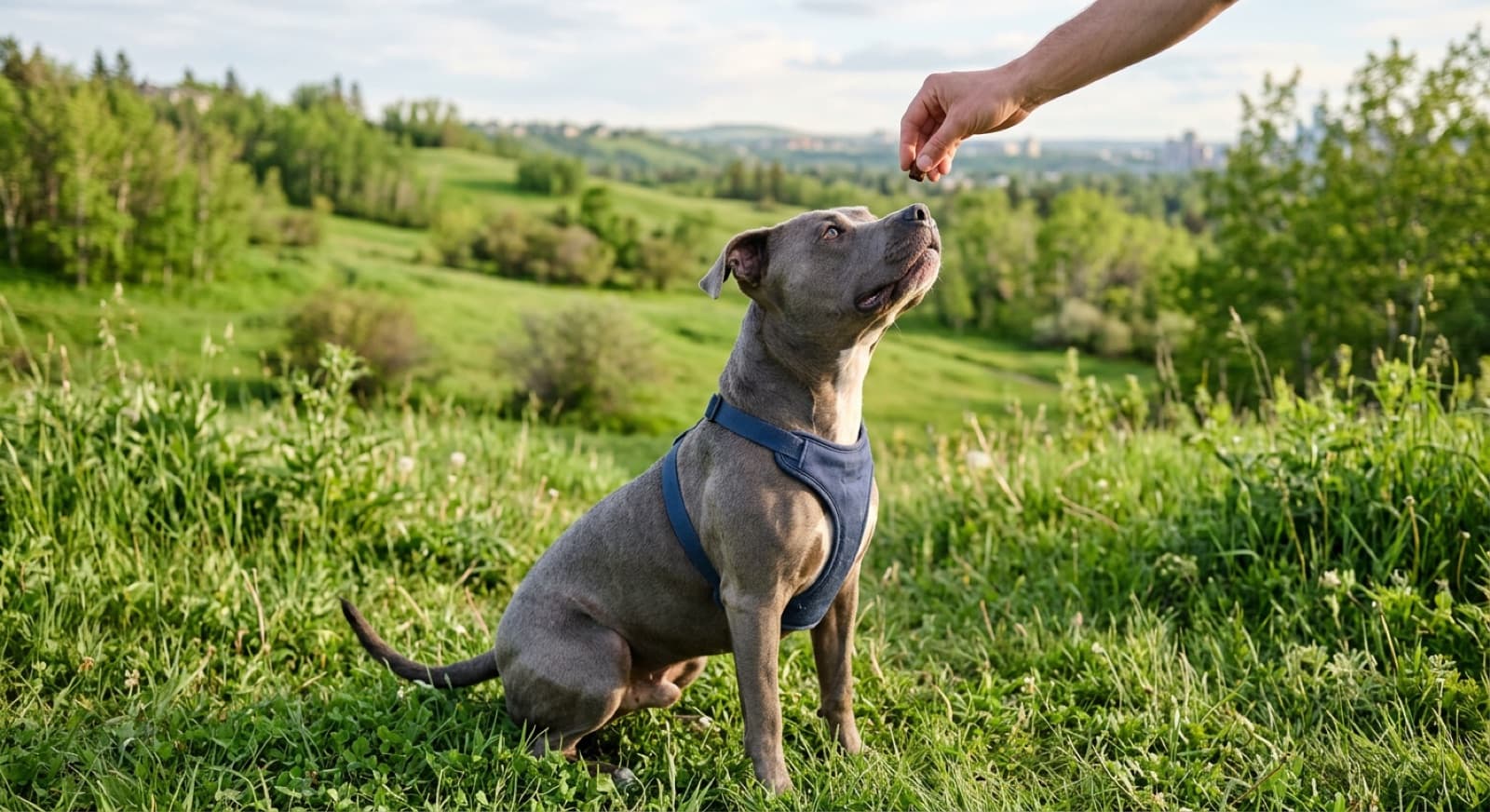
Why force-free is non-negotiable for Pit Bulls
Pit Bulls are wired differently from a Golden or a Cavalier. The breed group was selected over generations for high drive, high arousal, and high pain tolerance. That last part is the one most owners miss. A prong collar, choke chain, or e-collar that would shut down a soft breed does not shut down a Pit Bull. It either does nothing or it pushes arousal past the point where the dog can think.
The science is settled. Multiple peer-reviewed studies and the joint position statements from the American Veterinary Society of Animal Behaviour, the American College of Veterinary Behaviorists, and the Pet Professional Guild all confirm the same thing: positive reinforcement outperforms aversive methods on every measured outcome. Faster learning. Better retention. Lower stress markers. Stronger handler bond. For a high-arousal breed group, the gap widens.
Outdated dominance theory (alpha rolls, “be the pack leader,” correction-based methods) was built on disproven 1970s wolf research. It has caused real harm to bully breeds and is the leading reason rescue Pit Bulls show up with bite histories. The dog was not born aggressive. The dog was trained into it by someone using tools that did not match the breed.
Force-free positive reinforcement does the opposite. The dog sees a trigger (squirrel, dog, person, doorbell), looks at you, gets paid. Over reps, the trigger predicts good things and the arousal drops. That is the loop that builds reliable Pit Bulls. Every Calgary force-free trainer we list below works this way and refuses aversive tools.
Training Timeline by Age
| Age | Focus |
|---|---|
| 8 to 16 weeks | Critical socialization window. Name, baby recall, sit, settle on a mat, crate love, handling for vet and grooming, trade game. Expose to many people, dogs, sounds, surfaces, Calgary environments. This window closes hard at 16 weeks. |
| 16 weeks to 6 months | Loose-leash walking with a front-clip harness, polite greetings, settle duration. Start long-line recall in fenced yards. Heavy mental stim. Group puppy class. |
| 6 to 12 months | Adolescent regression begins. Selective hearing. Hold the line. Proof cues with distractions. Build settle to 30 minutes. Long-line recall at fenced parks. |
| 12 to 18 months | Peak adolescent challenges. Leash reactivity can emerge. Same-sex dog aggression can appear in intact dogs. Manage triggers. Do not stop training. Consider a reactive-dog class if needed. |
| 18 to 30 months | Adult brain emerges. Recall starts to firm up. Add sports (rally, nose work, dock diving). Refine alone-time and door manners. |
| 2.5 to 3+ years | Most Pit Bulls reach reliable off-leash recall here, not earlier. Keep practicing weekly. Bully drive never fully retires; manage triggers for life. |
Crate Training Step by Step
Most Pit Bulls love their crate within 2 to 4 weeks of positive conditioning. The breed is den-seeking. For anxious rescue Pit Bulls, the crate often becomes the most calming spot in the house. Done wrong, the crate becomes a punishment box. Done right, the dog walks in voluntarily.
Step 1. Pick the right crate
Big enough for the dog to stand, turn, and lie flat. Not bigger. Wire crate with a cover or a plastic airline crate both work. For adult Pit Bulls plan on a 42 inch crate.
Step 2. Feed every meal inside, door open
For the first week, every meal happens inside the crate with the door propped open. The dog learns the crate predicts food.
Step 3. Toss high-value treats and frozen Kongs in throughout the day
Door open. The crate becomes a treasure box. The dog walks in voluntarily looking for goodies.
Step 4. Close the door for 10 seconds, open before they finish eating
Build duration in tiny steps. 10 seconds, 30 seconds, 1 minute, 5 minutes. Never close the door when the dog is anxious.
Step 5. Build absences
Once the dog is calm with the door closed for 10 minutes, start leaving the room. Then leaving the house for 5 minutes. Then 30. Build slowly.
Hard limits. Max crate time is 6 to 8 hours for an adult Pit Bull, 2 to 4 hours for a puppy. Never punish-crate. Never slam the door. Never force-shove the dog in.
Browse adoptable Pit Bulls in Calgary
Adult rescue Pit Bulls often have foster training notes attached. The temperament reports flag which dogs already crate-load, walk on a front-clip, or need work.
See Available Pit Bulls →Leash Training and Gear
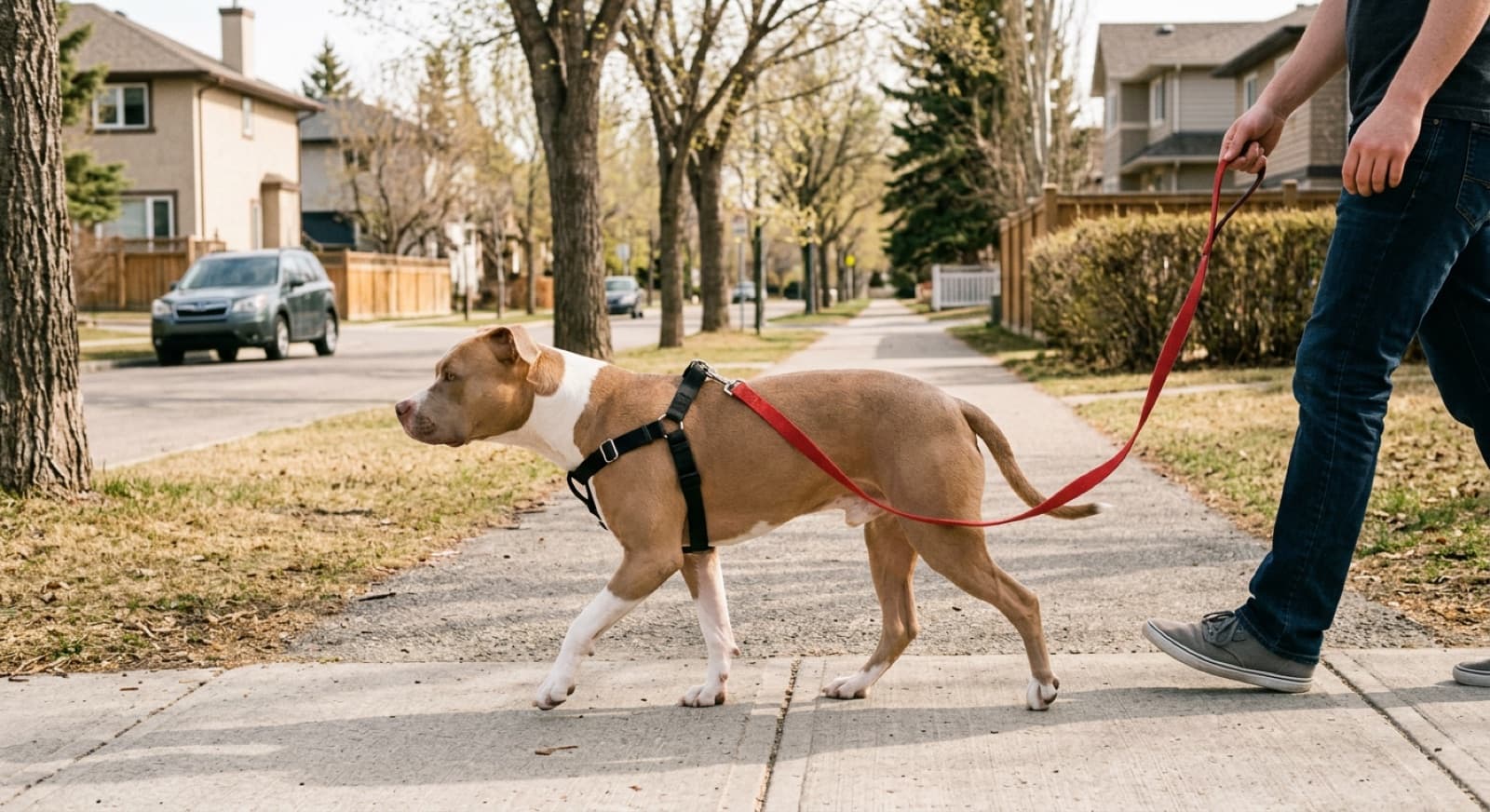
A front-clip harness is the only gear we recommend for Pit Bulls. The breed pulls hard and a standard back-clip harness actually teaches them to pull harder (sled-dog physics: opposition reflex). Front-clip redirects forward pulling without choking the trachea.
The two harnesses that fit Pit Bull chests: the 2 Hounds Freedom No-Pull harness (with the martingale connector) and the Blue-9 Balance Harness. Both available at Calgary pet stores and online. Pair with a 4 to 6 foot flat leash for walks and a 15 to 30 foot biothane long-line for park work.
Do not use: prong collars, choke chains, slip leads, head halters (Halti, Gentle Leader can damage the neck on a strong puller), e-collars. The breed has too much pain tolerance for any of these to work as designed. They either fail or they escalate arousal until the dog cannot think.
The loose-leash protocol. Reward the dog for walking near you with frequent small treats. The moment the leash tightens, stop walking. Wait. The dog turns to look at you. Mark, reward, resume. Repeat for weeks. Pit Bulls learn this fast because they are food-motivated. Real results in 6 to 12 weeks of daily practice.
Mental Stimulation Menu
Pit Bulls are smart and they hyper-fixate on toys. Both are training assets if you channel them. Under-stimulated Pit Bulls become destructive, vocal, and reactive. Pick 2 to 3 of these daily and rotate weekly.
Kong (stuffed and frozen)
Stuff with wet food, kibble, peanut butter (xylitol-free), pumpkin. Freeze. 30 to 60 minutes of engagement. Pit Bull jaw strength means use the black Kong Extreme.
Lick mats
Smear with wet food, yogurt, or pumpkin. Lower-arousal than chews. Good for settle work and pre-bed wind-down.
Snuffle mats
Hide kibble in fabric strips. Pit Bulls love nose work. 10 to 15 minutes of foraging burns mental energy.
Puzzle feeders
Kong Wobbler, Outward Hound levels, Nina Ottosson puzzles. Make every meal a small project.
Scent work / “find it”
Hide treats around the house and yard. Pit Bulls take to nose work fast. Calgary clubs offer formal nose work classes.
Flirt pole
Cat-toy-on-a-stick for big dogs. Channels prey drive in a structured way. End every session with an “all done” cue to teach off-switch.
Trick training
Spin, bow, target, place. Pit Bulls are biddable and learn tricks fast. Builds focus and burns mental energy.
Long-line sniff walks
30 minutes of sniffing on a long-line at River Park or Edworthy is more tiring than 60 minutes of structured leash walking.
Stop the Nipping and Mouthing
Pit Bull puppies mouth hard. The breed is high-drive and the play style includes teeth. The standard advice (“yelp like a littermate”) creates frustration and overarousal in bully breeds and we do not recommend it. The yelp escalates the puppy, not calms them.
What works: redirect to a toy. When teeth meet skin, freeze (motion fuels mouthing), pick up a tug or chew, offer it. The moment teeth go on the toy, mark and praise. Repeat for weeks. The puppy learns that toys earn engagement and skin earns nothing.
Play the trade game daily. Hold a chew. Say “trade.” Swap for a higher-value chew or treat. Return the first chew. Build this from 8 weeks. A solid trade cue prevents resource guarding (a real concern in food-motivated breeds) and saves you from ever grabbing something out of a Pit Bull's mouth.
Manage arousal. Overtired puppies bite harder. Most nipping spikes when the puppy is overstimulated. Build naps into the day. Crate the puppy with a frozen Kong for forced rest. Two-hour wake windows max for puppies under 4 months.
Crate vs Free-Roaming for Anxious Rescue Pit Bulls
Most anxious rescue Pit Bulls do better with a crate than free-roaming a house. The crate is smaller, predictable, and lowers the dog's threat-monitoring load. A free-roaming anxious Pit Bull paces, hyper-vigilates, and develops barrier reactivity at windows.
The transition path: weeks 1 to 4 home, crate-only when unsupervised. Weeks 4 to 12, add an exercise pen room (laundry room, kitchen with a baby gate). Months 3 to 6, trial short free-roaming periods of 15 to 30 minutes while you are home but in another room. Month 6+, evaluate. Some Pit Bulls earn free-roam status by 6 to 12 months. Some need the crate for life and that is fine.
Signs your Pit Bull is not ready for free-roaming: chewing furniture or shoes, scratching at doors, raiding counters, pacing, barking at windows. Those are stress behaviours. Go back to the crate, increase mental stim, and re-trial in 6 to 8 weeks.
Recall Training
Recall is the hardest skill for a Pit Bull and the most important. Pit Bulls can hyper-fixate on squirrels, other dogs, or scent, and lose recall when arousal spikes. The fix is layered training over months.
Stage 1: indoor recall. Pay every “come” with chicken or cheese. Start in the kitchen, build to room-to-room.
Stage 2: fenced yard. Add light distractions. Same payout. The dog learns “come” always pays.
Stage 3: long-line at fenced parks. Calgary has two strong options for this. Sue Higgins Off-Leash Park (SE) has perimeter fencing. Bowmont Park Silver Springs Gate (NW) has a fenced area. Use a 15 to 30 foot biothane long-line. Practice recall amid real distractions. Pay big.
Stage 4: long-line at unfenced parks. Once the dog is solid at fenced parks, move to River Park, Edworthy, or Nose Hill on the long-line. Keep paying.
Hard rules. Never call the dog off a trigger you cannot out-pay. Never punish a slow return. Most Calgary Pit Bull owners we talk to report reliable off-leash recall around age 2 to 3, especially for males. The long-line years are not optional. They are the work.
Greeting People and Door Manners
Pit Bulls are velcro-affectionate and want to greet every person enthusiastically. A 60 pound dog launching at a guest is not cute and is not safe. The skill is “four paws on the floor.”
Sit-for-pets. The dog only gets attention from people when sitting. Jumping earns the person turning away. Sitting earns the person petting. Practice with family first, then willing friends.
Settle on a mat. Pick a mat near the front door. Reward the dog for lying on it. Build duration to 5, 10, 30 minutes. Practice during doorbell rehearsals. Pair with a frozen Kong or lick mat for longer holds.
By 12 months, most Pit Bulls can hold settle on a mat for the duration of a guest arrival if you have done the reps. Without the reps, the same dog will be on the guest before the door closes.
Calgary Force-Free Trainers
Dogma Training (Inglewood)
Multiple Calgary locations. Puppy classes, group obedience, private sessions, day training, behaviour modification. Strong reputation with bully breeds and Calgary's most established force-free program.
ImPAWSible Possible (NW Calgary)
Strong puppy and reactive-dog programs. Often the first stop for Pit Bull owners dealing with leash reactivity or resource guarding.
Calgary K-9 (Marlborough)
Force-free companion trainer with experience in high-needs and high-drive dogs. Good for recall work and reactive-dog cases.
Sit Happens (multiple Calgary locations)
Group classes and private sessions. Good for first-time Pit Bull owners who want a structured group setting.
Raising Fido (online and in-person)
Hybrid model with online coaching plus in-person sessions. Good for owners with scheduling constraints or rural locations.
AVOID: trainers using e-collars, prong collars, choke chains, dominance theory, or who describe themselves as “balanced.” These methods backfire hard on Pit Bulls. Credentials to look for: CCPDT, KPA-CTP, CDBC, PMCT.
Calgary Training Costs (2026)
| Service | Typical Calgary cost |
|---|---|
| Puppy socialization class (6 to 8 weeks) | $200 to $300 |
| Basic obedience group class (6 to 8 weeks) | $250 to $400 |
| Reactive-dog group class (6 to 8 weeks) | $350 to $450 |
| Private session (1 hour) | $80 to $160 |
| Day training (per week, trainer-led daytime) | $400 to $800 |
| Behaviour consult and plan (3 to 4 hours) | $300 to $600 |
First-year budget for a typical Calgary Pit Bull adoption: a puppy or basic obedience class ($200 to $400) plus 2 to 4 private sessions ($300 to $600). Reactive-dog programs run higher if needed. Force-free certified trainers cost more than balanced trainers and are worth every dollar on this breed.
Adolescent Challenges (8 to 18 months)
Selective hearing. The Pit Bull who came when called at 6 months stops listening at 10 months. Brain rewiring is real. Hold the line. Do not stop the long-line work. Pay every recall with high-value food. Reliable recall returns around 2 to 3.
Leash reactivity emerging. Frustrated barking and lunging at other dogs on leash often shows up around 10 to 14 months. This is frustration, not aggression. Manage distance. Cross the street. Use barriers. Consider a reactive-dog class. Force-free counter-conditioning works.
Same-sex dog aggression emerging. Some Pit Bulls (especially intact males around 12 to 18 months) develop same-sex DA. This is a real breed-trait risk, not a training failure. Manage the dog. Avoid dog parks. Walk on-leash. See our dedicated guide below if patterns set in.
Confidence growth and testing. Adolescent Pit Bulls test boundaries. The settle cue you trained at 6 months gets ignored at 12 months. Re-train. Pay better. Be patient. The dog is not being defiant. The brain is reorganizing.
What to do. Do not drop training. Do not stop the long-line. Manage triggers. Avoid setting the dog up to fail. Most adolescent reactivity softens by age 2.5 to 3 if you train through it.
For deeper work on dog-dog issues, read our companion guide: Pit Bull Dog Aggression Management Calgary →
Frequently Asked Questions
Why is force-free training non-negotiable for Pit Bulls?
Pit Bulls have high arousal and high pain tolerance. Aversive tools (prong, choke, e-collar, leash pops) either do nothing or escalate arousal until the dog cannot think. Force-free positive reinforcement builds the bond and the reliable behaviours. Outdated dominance theory has caused real harm to this breed group.
What does the science say?
Multiple peer-reviewed studies confirm positive reinforcement outperforms aversive methods for every breed, especially high-drive bully breeds. The AVSAB, ACVB, and Pet Professional Guild all formally oppose aversive tools.
How do I crate train a Pit Bull?
Five steps over 2 to 4 weeks: pick the right crate size, feed every meal inside with the door open, toss treats and frozen Kongs in throughout the day, close the door briefly while they eat, build duration in tiny increments. Most Pit Bulls love the crate.
What leash gear should I use?
A front-clip harness only. The 2 Hounds Freedom No-Pull and the Blue-9 Balance Harness both fit Pit Bull chests. Pair with a 4 to 6 foot flat leash and a 15 to 30 foot biothane long-line. No prong, choke, slip lead, or e-collar.
How do I stop the nipping?
Redirect to a toy and play the trade game. Skip the yelp method (it creates frustration in bullies). Manage arousal with forced naps and crate breaks.
How do I train recall?
Four stages over months: indoor recall, fenced yard, long-line at fenced parks (Sue Higgins, Bowmont Silver Springs Gate), long-line at unfenced parks. Pay every recall with chicken or cheese. Reliable off-leash recall arrives age 2 to 3.
How much does training cost in Calgary?
Group classes $200 to $450 for a 6 to 8 week course. Private trainers $80 to $160 per hour. Day training $400 to $800 per week. Reactive-dog programs $500 to $1200 for a specialized course.
What changes during adolescence?
Selective hearing, leash reactivity emerging, and same-sex dog aggression possible in intact males around 12 to 18 months. Hold the line on training, manage triggers, and most patterns soften by 2.5 to 3.
More Pit Bull guides
Pit Bull Adoption Calgary →
The full Calgary adoption playbook: rescues, costs, common surrender reasons.
Is a Pit Bull Right for You? →
Honest truths and self-assessment for the breed.
Bringing Home a Pit Bull (3-3-3) →
The 3-3-3 decompression rule and first-week protocol.
Pit Bull Exercise & Energy →
Daily exercise needs, Calgary parks, off-switch training.
Pit Bull Separation Anxiety →
Velcro breed alone-time protocol and prevention.
Pit Bulls with Kids & Cats →
Family dynamics, multi-pet households, what to expect.
Pit Bull Adolescence →
The 8-to-18 month window: regression, reactivity, holding the line.
Pit Bull Dog Aggression Management →
Same-sex DA, management protocols, when to call a behaviourist.
Pit Bull Cost of Ownership →
First-year and lifetime cost math for Calgary.
BSL & Calgary Bylaws →
Calgary's breed-neutral approach and responsible ownership rules.
Pit Bull Housing & Insurance →
Rental restrictions, home insurance gotchas, what to ask.
Pet Insurance for Pit Bulls →
Which Calgary providers cover the breed and what to watch for.
Pit Bull Health Issues →
Skin allergies, hip dysplasia, demodex, and Calgary vet planning.
Buy or Adopt a Pit Bull? →
Rescue versus breeder honest comparison for Calgary.
New dog? Start with these care guides
Everything a new adopter needs to set up a safe, happy home.