The honest framing modern rescues have settled on
Pit Bulls are not nanny dogs. They are also not killers. They are dogs. Individual variation in temperament, prey drive, and dog-dog tolerance is enormous within the Pit Bull type, and that variation matters more than the label. Modern rescue groups like Bad Rap and Best Friends Animal Society explicitly retired the “nanny dog” framing because it is historically false and because it encourages parents to relax supervision in a way that any 50 to 80 pound dog can make dangerous. This guide replaces the myth with the real protocol: kid-by-age expectations, the multi-week cat introduction, same-sex dog aggression risk in adolescence, and which Calgary rescues will not adopt to homes with small dogs. The goal is to help families who want a Pit Bull go in with their eyes open.
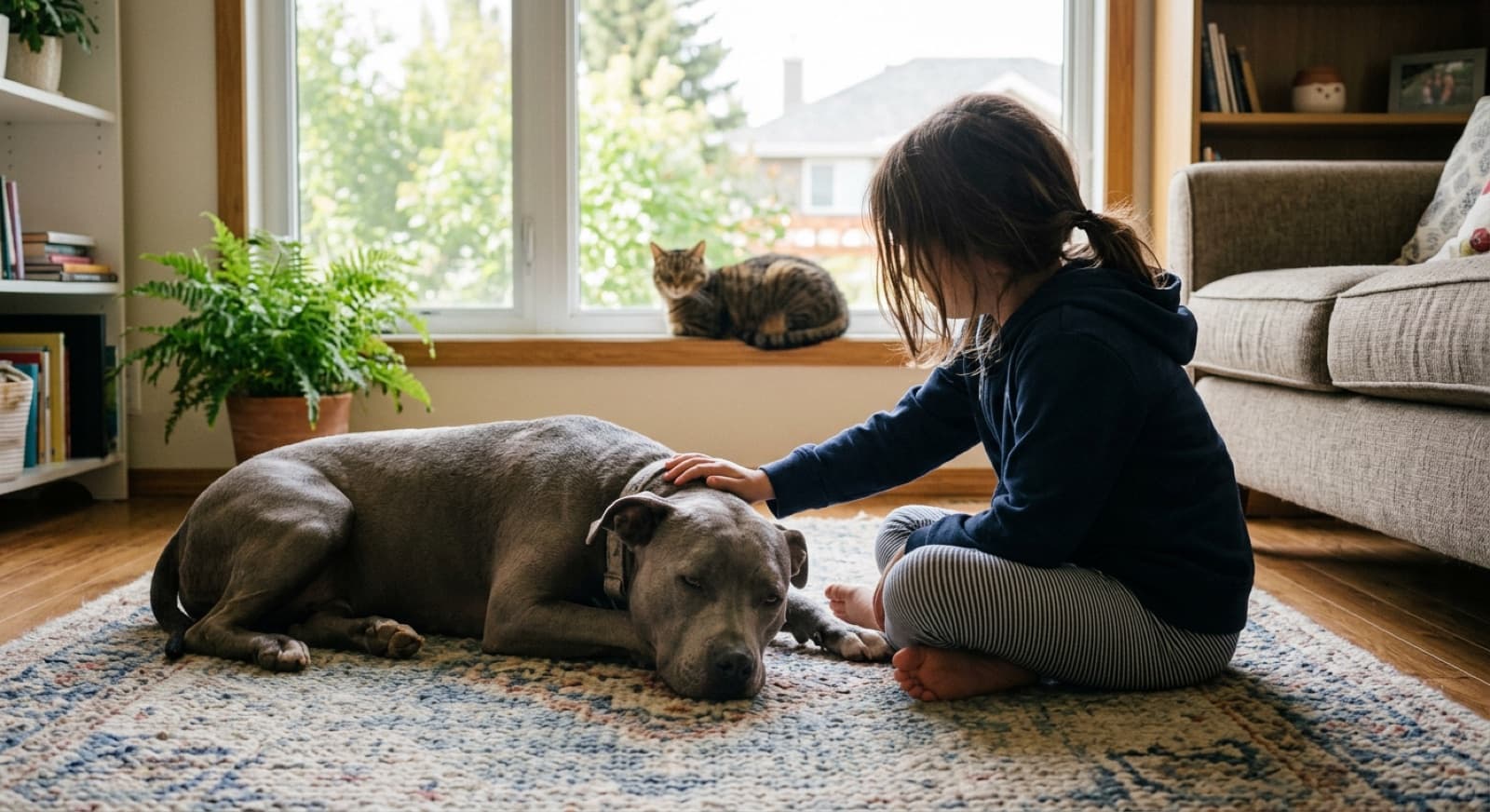
The “Nanny Dog” Myth Has Been Retired
Bad Rap, the most respected Pit Bull rescue in North America, formally stopped using the “nanny dog” label years ago. Best Friends Animal Society followed. Calgary rescues that handle Pit Bull-type dogs took the same position. The reasoning is simple, and it matters for any family considering this breed type:
- The history is false. Pit Bulls were not bred as child caretakers. The “nanny dog” story was popularized in a 1971 article and has no documented origin in actual breed history.
- The framing is dangerous. Telling parents a breed is naturally good with kids encourages relaxed supervision, which is the single biggest risk factor in any dog-child household.
- Individual dog matters more than breed. Many Pit Bulls are wonderful with kids. Many are not. The label tells you nothing useful about the dog in front of you.
- Honest framing protects everyone. The dog (who gets blamed when supervision fails), the kid (who learns dog-respect rules), and the family (who plans for reality, not myth).
The replacement framing from modern rescue: Pit Bulls are not better or worse with kids than any other breed. Individual dog, plus supervision, plus training matters. Adopt that framing and the rest of this guide makes sense.
Pit Bulls with Kids: Compatibility by Age
| Kid age | Pit Bull compatibility | Supervision level |
|---|---|---|
| 0 to 2 years (babies) | Mixed. Depends entirely on individual dog history and arousal level. | Constant. Never unsupervised, ever. Use baby gates as default. |
| 3 to 4 years (toddlers) | Mixed. Knockdown risk from normal play. Toddler crowding triggers some dogs. | Constant. Direct adult line-of-sight whenever both are in the same room. |
| 5 to 8 years (kids) | Often excellent pairing. Kid can learn dog-respect rules; dog gets steady companion. | Active supervision. Kid taught to read dog body language. |
| 9 to 12 years (older kids) | Excellent for most calm Pit Bulls. Strong bond often forms. | Passive supervision. Adult in the home; kid can run walks and training. |
| 13+ years (teens) | Excellent. Especially good for quiet or anxious teens. Loyal, calm companion. | Light. Teen can manage full daily care if dog is settled. |
The single most-important rule: never leave a Pit Bull (or any dog over 30 pounds) unsupervised with a child under 5. This is not a breed-specific rule. It is a body-mass rule. Toddler knockdowns happen with friendly dogs of every breed.
The Real Supervision Protocol
Same rules as any 50+ pound dog with kids. Pit Bulls do not need special handling; they need the supervision every large dog needs.
1. Never alone, never
No child under 5 alone with the dog at any time, including five minutes while you grab the laundry. Use baby gates as physical separation when you cannot directly supervise.
2. Teach dog-respect early
Kids learn: do not climb on the dog, do not bother the dog while sleeping or eating, no face-to-face contact, no grabbing tails or ears. Same rules with any breed.
3. Give the dog a retreat
Crate or quiet room where the dog can leave kid chaos. Kids learn that the retreat is off-limits. Many Pit Bulls love crates if introduced positively.
4. Watch arousal during play
Pit Bulls can play hard. Running kids plus an aroused dog equals knockdown risk and accidental injury, even from friendly contact. Break up high-arousal play before it tips.
5. Body language education
Adults learn the “ladder of aggression” (lip lick, head turn, freeze, growl, snap). Most dog-child bite incidents follow ignored early warning signals. The dog rarely “snaps with no warning.”
6. School-age sweet spot
Kids 5 to 12 are often the best Pit Bull pairing. Old enough to follow dog-respect rules, young enough to want a daily companion. Many Calgary rescues prefer placing with this age range.
Toddler Reality Check
Most failed Pit Bull family placements involve toddlers, not bites. The common pattern is knockdowns, accidental scratches during play, and tail-whip injuries. The dog is not aggressive; the dog is large and active around a small unsteady human.
Honest checklist for toddler homes:
- Pre-adoption foster trial. AARCS, BARCS, and Pawsitive Match all support foster-to-adopt specifically for this reason.
- Baby gates as default. The dog has access to common space when adults are watching; the toddler-only zones are gated.
- Settled adult dog, not puppy. A 4 to 7 year old adult Pit Bull with calm energy is a better toddler pairing than a 9-month-old adolescent.
- Foster reports beat shelter notes. Ask: how did the dog do in a foster home with kids? Real-living data is more useful than shelter staff observations.
- Be honest about your bandwidth. Constant supervision is real work. If your family is in survival mode with a newborn or toddler, this is not the right year to add a 60 pound dog.
Pit Bulls with Cats: The Honest Picture
Some Pit Bulls live happily with cats. Others cannot share a home with a cat at any age. Prey drive in Pit Bull-type dogs varies because the underlying breed type has terrier heritage, and terrier prey drive is real. Three honest categories:
1. Low prey drive Pit Bulls
Calm around cats from day one, soft body language, no fixation. These dogs integrate well over 4 to 8 weeks using the standard protocol.
2. Moderate prey drive Pit Bulls
Interested in cats, may chase if cat runs, can settle with training and management. Takes 2 to 4 months of careful work. Requires permanent baby-gate management.
3. High prey drive Pit Bulls
Fixates, stalks, hard-stares. Cannot live safely with a cat. No amount of training fixes this. Cat-test failures fall here. The rescue will not place this dog with cats.
The only reliable way to know which category your dog fits is foster-home observation over weeks of daily living. Trust the foster report more than the shelter cat-test.
What “Cat-Tested at Shelter” Really Means
Cat-testing is a useful screening tool, but it is a 5 to 30 minute snapshot, not a forecast. Be clear-eyed about what it does and does not tell you:
- What it measures. The dog's initial response to a calm, unfamiliar cat in a controlled environment (usually behind a barrier).
- What it does not measure. How the dog will behave with your specific cat, in your home, over weeks of daily exposure. Dogs learn and habituate; some get safer, some get worse.
- What “passed” means. The dog did not lunge, fixate, or escalate in that 5 to 30 minute window. It does not mean “safe with cats.”
- What you still have to do. Run the full multi-week introduction protocol. Cat-test results do not let you skip steps.
- Foster reports beat shelter tests. If you have a foster report of 4+ weeks of calm cohabitation, that is far more reliable than any shelter test.
Calgary rescues that cat-test (AARCS, BARCS, Calgary Humane Society) will tell you the test result and what it actually means. Ask the question directly.
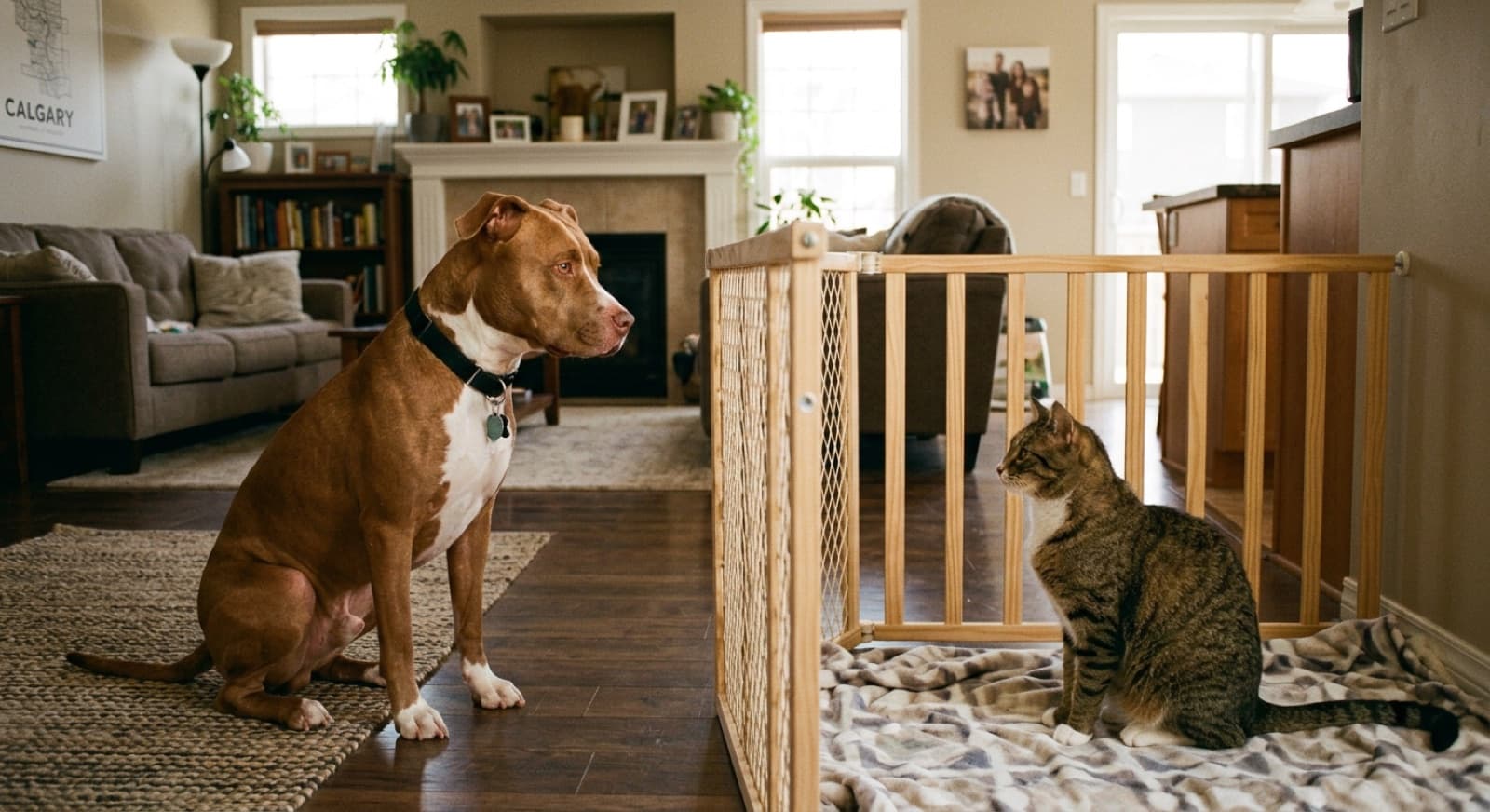
Multi-Week Cat Introduction Protocol
Pit Bulls usually need a longer protocol than calmer breeds. Plan for 2 to 4 months, not weeks. Slow is fast: the dogs who get rushed are the ones who fail and have to be returned. Watch your individual dog and cat; slow down if either stays stressed.
1. Full separation + scent swap
Different rooms, closed doors. Feed on opposite sides of the same door so each animal links the other's scent to food. Rotate bedding and toys so each carries the other's scent.
2. Visual contact through gates
Baby gate or screen door. Both can see but cannot touch. The cat has reliable escape routes (cat tree, high shelves). Reward the dog for calm, no-fixation behaviour.
3. Leashed parallel time
Dog on leash, cat free to approach or leave. Start with 5 minute sessions, end on calm. Build duration only if both animals stay relaxed. If the dog fixates or hard-stares, back up a step.
4. Longer leashed and dragline
Build to 30 minute sessions. Drop the leash but keep a dragline attached so you can grab control instantly. Cat should still have escape routes always available.
5. Supervised off-leash
Both free in shared rooms with handler directly present. Watch for pattern shifts. Some dogs do better over time; some get more reactive as they learn the cat's movement. Adjust accordingly.
6. Gradual freedom, never fully unsupervised
Many Pit Bull-cat households reach calm cohabitation by month 3 or 4. Most still use baby-gate separation when the family is out of the house. Permanent management, not full freedom.
Most Calgary rescues that place Pit Bulls in cat homes use foster-to-adopt and recommend permanent management (baby gates, separate feeding rooms) rather than full unsupervised access. This is not a failure; it is responsible long-term multi-pet life.
Browse adoptable Pit Bulls in Calgary
Foster reports list kid-tested, cat-tested, and small-dog compatibility notes. Many Calgary Pit Bulls have lived in foster homes with kids or cats for weeks before listing, which is far more reliable than shelter tests.
See Available Pit Bulls →Pit Bulls with Small Dogs: High-Risk Pairing
This is the multi-pet pairing where the most Calgary rescues draw a hard line. Several Pit Bull-focused rescues will not adopt to homes with toy breeds (under 15 pounds) at all. The reasoning is honest:
- Same-sex DA risk. Pit Bulls have higher rates of same-sex dog-dog aggression that emerges in adolescence. Mixed in a small-dog home, a normal scuffle becomes a serious injury.
- Size disparity. A 60 pound Pit Bull and a 10 pound small dog. Even friendly play turns dangerous fast. A correction that would not hurt another large dog can kill a Yorkie.
- Prey-drive crossover. Small dogs that run, yelp, or move erratically can trigger predatory response in dogs that are perfectly safe with calm adult dogs of similar size.
- Adolescence surprises. Many small-dog-Pit Bull pairings work fine for the first year, then fail when the Pit Bull hits 12 to 18 months. The rescue has seen this pattern many times.
If you already have a small dog, ask the rescue directly about their policy before applying. Honest rescues will tell you no on the phone rather than after you have fallen in love with a profile.
Same-Sex DA and Pit Bull with Pit Bull
Dog-dog aggression risk in Pit Bull-type dogs follows a predictable pattern. Honest framing for anyone considering a multi-Pit Bull home:
1. Adolescence is the inflection point
DA usually emerges between 8 and 18 months of age, even in dogs who were friendly puppies. A Pit Bull who has been calm with other dogs at 9 months may not be at 14 months.
2. Same-sex pairings carry the highest risk
Two female Pit Bulls or two male Pit Bulls in one home is the riskiest combination. Opposite-sex pairings tend to have a much better success rate.
3. Intact dogs raise the risk further
Two intact same-sex Pit Bulls in one home is the riskiest version. Almost every Calgary rescue requires spay or neuter before adoption for this reason.
4. Crate and rotate is a real option
Some multi-Pit Bull homes operate on a crate-and-rotate schedule, where dogs are never together unsupervised. This is responsible long-term management, not failure.
5. Most rescues will not place two same-sex Pit Bulls
If you have a resident Pit Bull, expect rescues to look for opposite-sex matches and to ask detailed questions about your management plan.
Bringing a Baby Home to a Resident Pit Bull
Most resident dogs of any breed adjust to a new baby with planning. Four-step protocol that works for Pit Bulls:
- Step 1. Scent introduction. Bring a blanket from the hospital home before the baby arrives. Let the dog smell it for several days. Pair the scent with calm praise and treats.
- Step 2. Classical conditioning. When the baby comes home, the dog gets good things every time the baby is present: treats, calm attention, special chews. The dog learns baby = good.
- Step 3. Baby-gated zones. The nursery and the baby's main play area are gated. The dog has access when adults are directly supervising; the rest of the time, gates separate.
- Step 4. Never unsupervised, period. Same rule as any 50+ pound dog. A friendly Pit Bull can knock over a crawling baby with normal tail wagging. This is a body-mass risk, not a breed risk.
If your dog shows tension, fixation, or avoidance when the baby arrives, contact a certified behaviour consultant immediately. The Pet Professional Guild has a Calgary listing of force-free certified consultants.
Frequently Asked Questions
Good with kids?
Individual dog, not breed. The “nanny dog” framing is retired. School-age kids (5 to 12) are often the best pairing. Toddlers under 5 need constant supervision because any 50+ pound dog poses knockdown risk.
Why is “nanny dog” retired?
The history is false (no documented origin) and the framing encourages relaxed supervision, which is the biggest risk factor in any dog-child household. Bad Rap and Best Friends Animal Society both retired the label.
Good with cats?
Some are, some are not. Pit Bull-type dogs have variable prey drive due to terrier heritage. Foster-home observation over weeks is the only reliable way to know. Plan for a 2 to 4 month introduction.
What does cat-tested actually mean?
A 5 to 30 minute snapshot, not a forecast. The dog passed an initial test, but real cat-tolerance only emerges over weeks of daily home life. Always run the full introduction protocol, even with a cat-tested dog.
Can Pit Bulls live with small dogs?
Some can, many cannot. Size disparity, same-sex DA risk, and prey-drive crossover make this one of the highest-risk pairings. Several Calgary Pit Bull rescues will not adopt to homes with dogs under 15 pounds.
Are Pit Bulls dog-aggressive?
Some are, especially during adolescence (8 to 18 months). Same-sex pairings carry the highest risk. Spay or neuter, careful management, and supervision are the standard mitigations.
Bringing baby home to a resident Pit Bull?
Scent introduction with a hospital blanket, classical conditioning (baby = good things), baby-gated zones, never unsupervised. Same protocol as any large-breed dog meeting a new baby.
Which Calgary rescues place family-friendly Pit Bulls?
BARCS Rescue, AARCS, Pawsitive Match, and Calgary Humane Society all place Pit Bull-type dogs. Foster-to-adopt is the most honest way to test family fit. Most will not place with homes that have small dogs.
More Pit Bull guides
Pit Bull Adoption Calgary →
Breed overview, what to expect with a rescue Pit Bull, and the Calgary rescue landscape.
Is a Pit Bull Right for You? →
Honest fit check covering lifestyle, housing, insurance, and the breed's management needs.
Bringing Home a Pit Bull (3-3-3) →
The decompression timeline for a rescue Pit Bull. Day 1 to month 3 expectations.
Pit Bull Dog-Aggression Management →
Same-sex DA, adolescence, and the multi-dog management protocols that actually work.
Pit Bull Training Calgary →
Force-free training methods that work with the breed's drive and intelligence.
Pit Bull Adolescence Calgary →
The 8 to 18 month window when DA can emerge. What to watch for and how to manage.
Pit Bull BSL and Calgary Bylaws →
Calgary's breed-neutral approach, responsible ownership rules, and travel considerations.
Pit Bull Housing and Insurance →
Finding pet-friendly rentals and home insurance carriers that cover Pit Bulls in Calgary.
New dog? Start with these care guides
Everything a new adopter needs to set up a safe, happy home.