The short answer
Portuguese Water Dogs are rare in Canadian rescue because the breed is low-volume nationwide. Apply broadly to Calgary Humane Society, AARCS, BARCS, Pawsitive Match, ARF Alberta, Cochrane Humane Society, and Heaven Can Wait, and set up notifications because new arrivals move fast. Adoption fees are typically $500 to $900 versus $2,500 to $4,000 for an ethical CKC breeder puppy with a six to eighteen month wait. The Portie is a working water dog: 60 to 90 minutes of daily exercise, a low-shed single coat that needs professional grooming every six to eight weeks, and a love of water that suits Calgary's summer rivers beautifully.
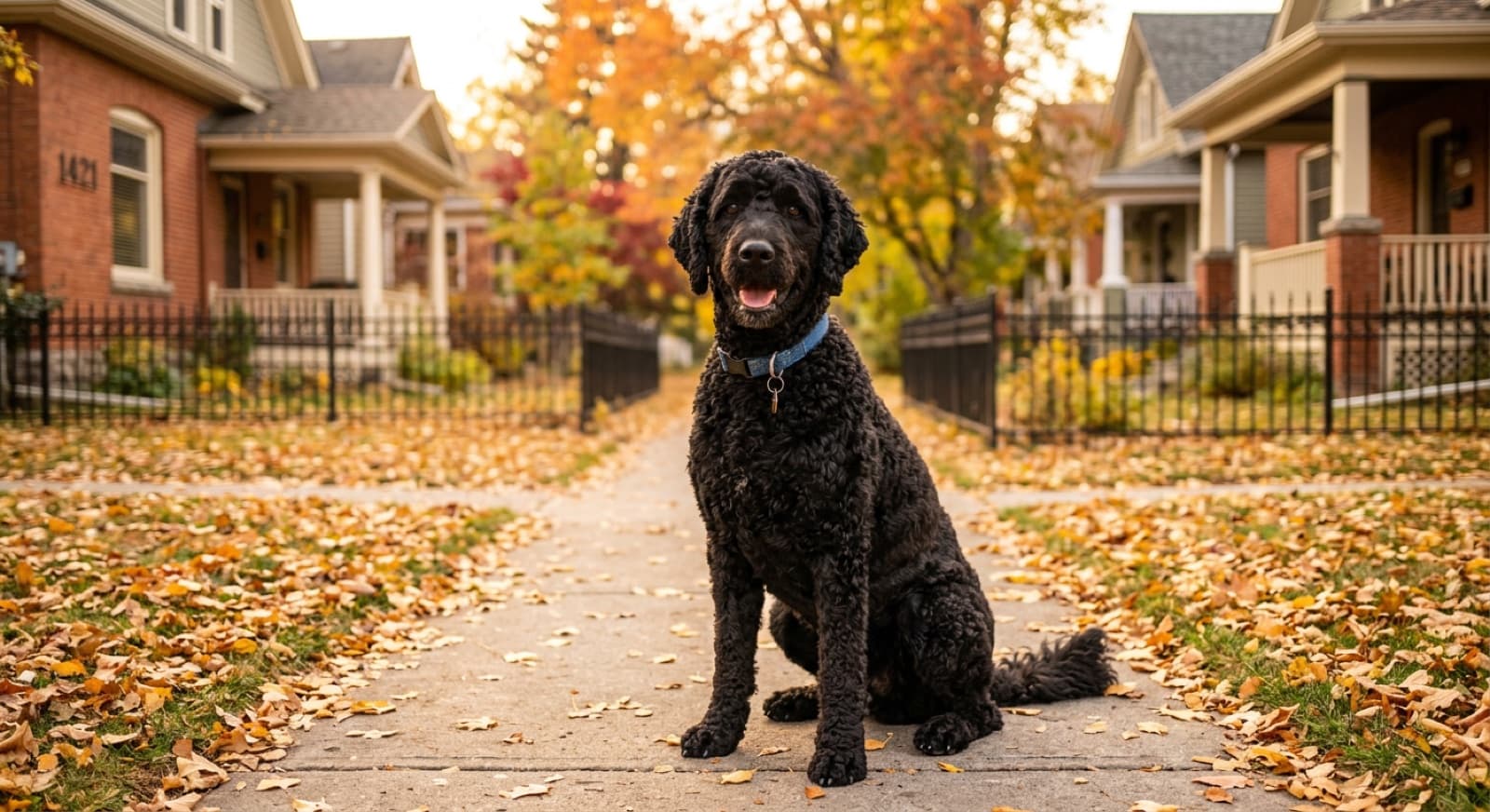
The Portuguese Water Dog (Portie, PWD, or in Portuguese, Cão de Água Português) is a medium-sized working breed developed on the coast of Portugal to retrieve fishing gear, herd fish into nets, and carry messages between boats. The breed nearly went extinct in the mid-twentieth century before a small group of Portuguese breeders rebuilt the gene pool. Most North American Porties trace their lineage back to those rescue lines. Today the breed is best known to Calgary adopters through Bo and Sunny Obama, the First Family dogs at the White House from 2009 to 2024. The Obama profile drove a wave of interest in the breed, and the Canadian breeder waitlists have run six to eighteen months ever since. This guide covers where the breed actually appears in Calgary rescue, what a Portie costs to live with, why so few surface in shelter intake, and how to evaluate a CKC breeder honestly when rescue is not realistic for your timeline.
The Portuguese Water Dog at a glance
Porties are a medium-sized, athletic breed with a single low-shed coat, webbed feet, and a strong working drive. According to the American Kennel Club and the Canadian Kennel Club, the breed standard accepts both curly and wavy coat varieties equally, with colours including black, white, brown, and combinations of those with white.
| Trait | Typical range |
|---|---|
| Adult weight | 35 to 60 lbs (16 to 27 kg) |
| Adult height (shoulder) | 17 to 23 inches (43 to 58 cm) |
| Lifespan | 11 to 13 years |
| Coat | Single layer, low-shed, curly or wavy; black, white, brown, or combinations |
| Energy level | High; needs a daily job |
| Exercise needs | 60 to 90 minutes daily plus mental work |
| Temperament | Working, biddable, water-driven, affectionate with family |
The webbed feet are not a marketing detail. The Portie is a true water dog with structural adaptations for swimming, and most healthy adults can swim for hours. Calgary owners who do not give their Portie access to water tend to see the working drive redirect into less helpful outlets. The breed is biddable and genuinely trainable, which separates Porties from more independent working breeds, but the workload is real.
Where to adopt a Portuguese Water Dog in Calgary
Intake is rare because the breed is genuinely low-volume across Canada. The Portuguese Water Dog Club of Canada estimates that fewer than 200 puppies are CKC-registered nationally each year, which is a small fraction of the Labrador or Golden numbers. That low baseline means Calgary rescues see a Portie only every several months, and the dog is usually placed within days of listing. The strategy is the same as any low-volume breed: apply broadly, set up alerts, and be ready to move quickly.
Calgary-area rescues to monitor:
- Calgary Humane Society: the largest local shelter; occasional Portie or doodle-mix intakes from owner surrenders.
- AARCS: foster-based; structured “good with” evaluations are useful for a working breed with high exercise demands.
- BARCS Rescue: Calgary foster network; medium dogs frequently, and Portie-mix or doodle-mix surrenders from time to time.
- Pawsitive Match: Calgary foster-based; sporting and working breeds appear regularly.
- ARF Alberta: Calgary foster network; broad medium-dog inventory.
- Cochrane Humane Society: Cochrane-based, serves the Calgary region.
- Heaven Can Wait: based in High River, Calgary placement common.
- Calgary Animal Services: the municipal facility, occasional surrendered Porties when allergy mismatch or exercise mismatch hits a family hard.
The single best move is to set up notifications on the LocalPetFinder Portuguese Water Dog breed page. Live listings from all Calgary rescues land there as they appear, and you will catch a new arrival before most adopters do.
Two breed-specific networks are worth knowing. The Portuguese Water Dog Club of Canada coordinates a national referral pipeline that occasionally moves owner-surrendered dogs into Alberta. The Portuguese Water Dog Club of America operates a parallel U.S. network with a Canadian liaison; serious applicants who fit the breed profile occasionally get matched through that channel. Both clubs run more thorough screening than a general rescue, including home visits, vet reference checks, and detailed questions about your exercise routine, your grooming plan, and your prior working-breed experience.
What does a Portuguese Water Dog cost in Calgary?
Calgary fees vary by rescue and what is included. The realistic ranges below are directional, not quotes:
| Source | Fee range | Typically includes |
|---|---|---|
| Calgary Humane Society | $500 to $700 | Spay or neuter, vaccinations, microchip, vet exam |
| AARCS | $600 to $800 | Spay or neuter, vaccinations, microchip, foster history |
| BARCS / Pawsitive Match / ARF Alberta | $500 to $800 | Spay or neuter, vaccinations, microchip, foster notes |
| PWD Club of Canada referral | $700 to $900 | Transport, foster-based evaluation, breed-specific screening |
| CKC-registered breeder puppy | $2,500 to $4,000 | Health screening, contract, breeder support, six to eighteen month waitlist |
The adoption fee is only the entry cost. Annual care for a Portie in Calgary runs higher than many medium breeds because of the every six to eight week grooming requirement and the active-dog gear list. Plan for:
- Professional grooming: $80 to $130 per session every 6 to 8 weeks at Calgary salons. That works out to $600 to $1,200 per year. The single coat does not shed out on its own; it keeps growing and needs trimming and de-matting on a steady schedule. Skip this and the coat mats to the skin, which then requires a shave-down.
- Home grooming tools: a slicker brush, metal comb, detangling spray, and grooming scissors for between-salon touch-ups. Budget $80 to $150 once, then refill consumables every year or two.
- Active-dog gear: a well-fitted Y-front harness, 6 to 8 foot leash, long line for water work, life jacket if you plan on serious paddleboarding or boating, and weatherproof boots and coat for Calgary winters. Budget $200 to $400 in the first month.
- Food and treats: $70 to $120 per month depending on quality tier and dog size. Porties are athletic and eat appropriately for a 35 to 60 lb working dog.
- Vet and preventive care: roughly $500 to $900 per year for routine wellness, vaccines, parasite prevention, and dental.
- Pet insurance: worth considering given the breed-specific cardiac and storage-disease risk. Plan for $50 to $90 per month for a Portie.
- Calgary dog licence: required for every dog three months and older under the Responsible Pet Ownership Bylaw 3M2006. A small annual fee that improves the odds of recovery if your dog ever goes missing.
First-year totals typically land between $3,000 and $5,000 once you add gear, training, grooming, and licence on top of the adoption fee. For a full breakdown of lifetime ownership cost in Calgary, see our Calgary adoption costs guide.
The Bo Obama context: visibility and the expectations gap
Most Calgary adopters first learn about Portuguese Water Dogs through Bo and Sunny Obama. Bo arrived at the White House in 2009 as a gift from Senator Ted Kennedy, and Sunny joined in 2013. Both lived as First Family dogs until 2021. The breed was chosen partly because Malia Obama has dog allergies, and the Portuguese Water Dog's low-shed single coat is well tolerated by many mild-to-moderate dog-allergy households. Bo passed away in 2021 and Sunny in 2024.
That visibility had two consequences for the breed. On the positive side, more Canadian families learned that a low-shed, hypoallergenic-tolerated working dog actually exists outside the Poodle and Doodle world. Portuguese Water Dog Club of Canada registrations climbed steadily after 2009. Ethical CKC breeder waitlists lengthened from a few months to the current six to eighteen month range.
On the less positive side, the White House dogs created some unrealistic expectations. Bo and Sunny were professionally trained and exercised on a structured daily schedule. They appeared on national television as calm, biddable, photogenic dogs. The reality for a pet owner is different. The same working drive that made the breed retrieve fishing gear in cold Portuguese water also drives a young Portie at the Calgary off-leash park. Owners who pictured Bo and meet a 14 month old Portie at full working drive sometimes feel ambushed. The breed is genuinely workable, but the workload is not optional.
Adopters arriving through the Bo channel benefit from reading the breed honestly before applying. The companion guide Is a Portuguese Water Dog right for you? covers the household honesty test in detail.
Why Portuguese Water Dogs end up in Calgary rescue
Intake is rare. The Portie is a wanted breed and most owners who buy a puppy from a CKC breeder keep the dog for life. When surrenders do happen, the patterns are consistent year over year. Understanding them helps you build a household where it does not happen to your dog.
- Exercise demand mismatch. Owners read about the “medium-sized family dog” framing and budget 30 to 45 minutes of walking per day. The Portie needs 60 to 90 minutes of real physical work plus mental enrichment. The mismatch typically shows up around month four to six when the dog starts redirecting unspent energy into destructive house behaviour.
- Grooming workload fatigue. The every six to eight week salon visit at $80 to $130 catches families by surprise. So does the between-salon home brushing. Owners who underestimated the workload sometimes let the coat mat to the skin, which forces a shave-down and a longer recovery.
- Allergy turnout mismatch. The breed is hypoallergenic-tolerated, not hypoallergenic-guaranteed. Families where a member tolerated the puppy sometimes react to the adult dog as the coat changes and the dander production stabilises. When a child or partner cannot live in the home with the dog, the dog is surrendered.
- Lifestyle changes. Babies, moves to smaller condos, divorces, owner illness. Common across breeds but particularly hard on an active dog who needs a daily job.
- Backyard-breeder cast-offs. A small number of poorly bred Porties end up surrendered when behavioural or health issues surface that the seller misrepresented. These dogs often need more recovery work than the breed average.
None of these are problems with the breed. They are problems with the match or the source. Calgary rescues that run foster-based programs (AARCS, Pawsitive Match, ARF Alberta, BARCS) are the best resource for a Portie whose adult temperament is already known, which avoids most of the patterns above. Read Is a Portuguese Water Dog right for you? before applying.
Adult versus puppy: which Portuguese Water Dog is right for you?
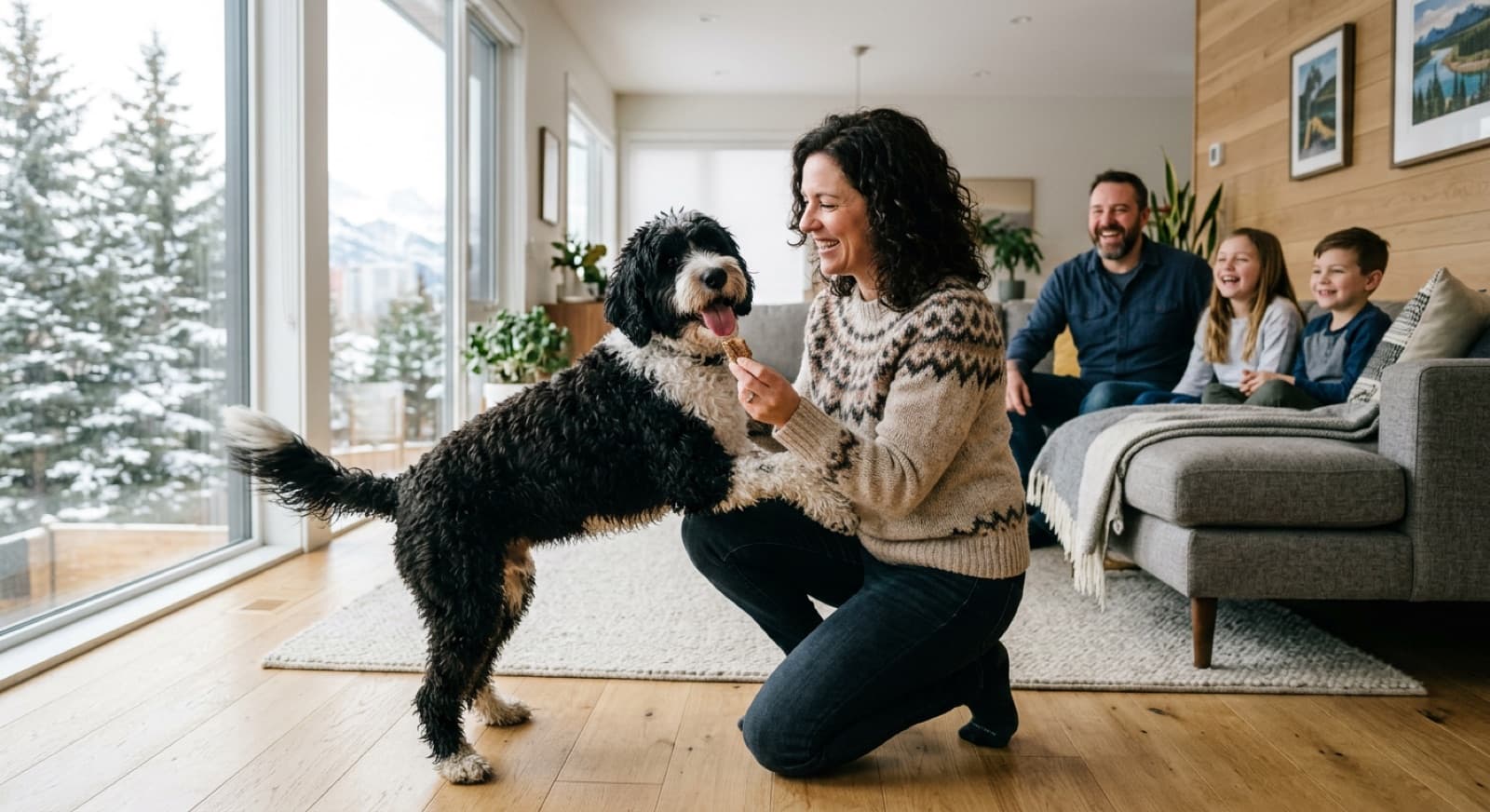
For most Calgary adopters, an adult Portie with a known temperament from a foster home is the safer fit. Puppies are very rare in Canadian rescue because the breed is low-volume nationwide. Most rescue Porties in Alberta are 2 to 6 year old young adults surrendered by owners who could not keep up with the exercise and grooming workload. These dogs are typically well past the puppy nipping, already house-trained, and have known compatibility with kids, cats, or other dogs from their foster placements.
Why the adult-from-foster path tends to work best:
- Known temperament baseline. A 3 year old foster Portie has revealed their working drive, water enthusiasm, and biddability level already. The foster can tell you what a typical day actually looks like.
- Known coat type and grooming pattern. Curly versus wavy is visible by 8 weeks but the mature coat develops fully by age 2. An adult dog gives you certainty about salon visit frequency and home brushing workload.
- Known compatibility. The foster knows how the dog handles cats, kids, other dogs, water, and structured training environments.
- Skip the puppy socialisation race. The 6 to 16 week window is the most critical period for any working breed; if it was handled well in the past, the adult dog reflects that work already.
- The Rule of 3s still applies. Three days of overwhelm, three weeks of settling, three months of true adjustment. A 3 year old rescue Portie follows this arc whether their first family was the rescue or the surrendering home.
- Lifespan math still favours the adult. A 4 year old Portie adopted today has 7 to 9 years ahead, which is most of the dog's life.
Puppies make sense if you specifically want to shape socialisation from week 8, you have the flexibility for 12 to 18 months of structured training, and you have prior experience with working breeds. The Portie puppy waitlists with ethical CKC breeders run six to eighteen months, so most Calgary “Portie puppy” adopters end up waiting that long or unintentionally buying from a backyard source.
The ethical CKC breeder framework
Because rescue intake is rare, a real portion of Calgary Portie families do end up going through an ethical breeder. The case for rescue is strongest when you can accept “next dog who appears, regardless of timing”; the case for an ethical breeder is strongest when you have a specific timeline, you want documented health screening, and you want to shape socialisation from week 8. Either path can be ethical. Buying from an unverified Kijiji listing is not.
How to vet a Portuguese Water Dog breeder in Canada:
- Verify Canadian Kennel Club registration on the breeder, not just the puppy. CKC membership comes with a code of ethics that backyard breeders are not signatory to.
- Ask for parent health clearances in writing. The breed-required tests are: hip evaluation (OFA or PennHIP), eye certification (CERF or OFA), GM1 gangliosidosis DNA test (a fatal Portuguese-specific storage disease), JDCM DNA test (Juvenile Dilated Cardiomyopathy, also Portuguese-specific), and Addison's disease screening. The two Portuguese-specific DNA tests are non-negotiable; both conditions are fatal and both are eliminated entirely by responsible breeding because they are simple-recessive inherited disorders that can be tested for in the parent dogs.
- Confirm membership in the Portuguese Water Dog Club of Canada. Members agree to a breed-specific code of ethics that includes the required testing above.
- Visit the home or request a live video tour of where puppies are raised.
- Expect the breeder to interview you. Ethical Portie breeders ask detailed questions about your exercise routine, your grooming plan, your home, your fenced yard, and your prior working-breed experience. Breeders who do not ask questions are a red flag.
- Confirm a written take-back contract. Ethical breeders take their dogs back at any age, for any reason. This is also why so few Porties end up in general rescue; the breeders absorb them.
- Cross-reference the breeder against the PWD Club of Canada and the PWD Club of America breeder directories. Both organisations publish member breeder lists.
The realistic Canadian price floor for an ethically bred CKC Portie is $2,500 to $4,000. Below $2,500 the breeder almost certainly skipped some combination of health testing, breed club membership, or proper parent care. The math does not work otherwise. GM1 and JDCM DNA tests alone cost the breeder hundreds of dollars per parent dog, hip and eye screening adds more, and proper whelping and early socialisation add weeks of breeder labour. A $1,500 “purebred Portie puppy” on Kijiji is almost always a problem listing.
Curly versus wavy: the two recognised coat varieties
Both the curly and wavy coat varieties are recognised by the Canadian Kennel Club and the American Kennel Club. The breed standard accepts both equally; neither is “more correct” than the other. Coat type is genetic and inherited, and a single litter can produce both varieties from the same pair of parents.
| Trait | Curly coat | Wavy coat |
|---|---|---|
| Texture | Dense, tight curls close to the body | Silky, loose waves that fall down the body |
| Grooming workload | Slightly higher; mats form faster | Slightly lower; easier home brushing |
| Salon visit cadence | Every 6 weeks typical | Every 7 to 8 weeks typical |
| Shedding | Minimal | Minimal |
| Cold-weather insulation | Slightly better | Slightly less |
Both coats are single-layer, which is why both shed minimally. In a Calgary rescue listing, the coat type is usually visible from the photos, and the foster can confirm. If you have a strong preference, mention it in your application. If you are flexible, the dog selects you on temperament; the coat is a secondary consideration.
Two grooming styles are common in the breed: the lion clip (the traditional working clip with the hindquarters and muzzle shaved and the rest of the coat left long) and the retriever clip (the whole coat trimmed to a uniform short length, easier for pet owners). The lion clip is historical; the original Portuguese fishermen kept the front of the dog coated for warmth in cold water and shaved the hindquarters so the dog could kick freely. Most Calgary pet Porties get the retriever clip for practicality.
The hypoallergenic reality: tolerated, not guaranteed
The Portuguese Water Dog is widely tolerated by people with mild to moderate dog allergies. The single low-shed coat releases far less dander and hair than a double-coated breed. The Obama family chose the breed in part because Malia Obama has dog allergies. Many Calgary adopters with allergy histories live comfortably with a Portie.
The honest message: no dog is 100 percent hypoallergenic. Dog allergies are triggered by proteins in saliva, dander, and urine, not just by shed hair. A low-shed coat reduces dander dispersal, but it does not eliminate the proteins themselves. Individual reactions vary widely. Some allergic people tolerate a Portie completely; others react despite the low shed.
Practical Calgary advice for allergy-sensitive adopters:
- Spend time with the specific dog before committing. The rescues we work with will arrange meet-and-greets. Visit on more than one day, ideally over a couple of hours each time.
- Sit on the floor with the dog and pet them. If you react in 20 minutes, you would not live well together. If you do not react over a sustained visit, the odds of long-term tolerance are good.
- Visit a Portie owner's home if possible. A home environment with dander present in the carpet and upholstery is a more realistic test than a clean rescue meeting room.
- Plan on weekly bathing and frequent brushing to keep dander production low. Many allergy-sensitive Calgary Portie families bathe weekly.
- Air filtration helps. A HEPA filter in the bedroom and central air filtering reduces airborne dander in any home with a dog.
- Talk to an allergist before committing if reactions have ever been severe. A skin or RAST test for dog dander can give you a clearer baseline.
Calgary climate fit: water-loving summer, manageable winter
The Portie's single low-shed coat is the climate variable to plan around. A well-conditioned Portie handles Calgary cold to roughly minus 15 degrees Celsius without additional layers. Below that a winter coat is sensible, particularly during chinook freeze-thaw cycles when wind chill spikes and salted Beltline and Inglewood sidewalks add abrasion. The single coat does not insulate as well as a true double-coated working breed like a Husky or a Samoyed; treat the Portie like an active medium dog with moderate cold tolerance, not a polar breed.
Practical Calgary winter routine:
- Walk in a winter coat below minus 15 degrees Celsius, especially in wind.
- Booties are usually not required on packed snow, but salt irritation in central neighbourhoods is real; a quick paw rinse on return solves it.
- Watch for ice-ball formation in long curly coat between the toes; trim the foot hair short during winter.
- Keep working drive engaged. A Portie with no winter outlet redirects energy at home. Indoor scent work, treadmill time, structured training, or weekly daycare at facilities like Pup City Doggy Daycare carry the dog through the coldest weeks.
Summer is where this breed shines. Porties were bred to work in cold Atlantic water; they swim instinctively and most adults will spend hours in water given the chance. The Bow River, Glenmore Reservoir, and Sandy Beach are natural Portie playgrounds from May through September. Practical Calgary summer routine:
- Build swims into the weekly routine. Many Calgary Portie owners hit the river or reservoir two to three times a week in summer.
- Use a long line at unfenced river spots until the dog is recall-proofed. Porties are biddable but a young one can still chase a goose into rapids.
- Above 25 degrees, walk before 8am or after 8pm during July and August.
- Provide constant water and shade. The Portie is more heat-tolerant than a double-coated breed, but not unlimited; the working drive can mask early heat-stress signs.
- After every swim, rinse the coat to remove silt and salt from river runoff, and dry the ears thoroughly to prevent infection. Porties have drop ears and trap moisture more than a prick-eared breed.
Browse adoptable Portuguese Water Dogs in Calgary
See current Porties and Portie mixes across Calgary rescues in one place. Inventory updates regularly, and because the breed is rare, set up notifications and apply quickly when a listing appears.
See Available Portuguese Water Dogs →Frequently Asked Questions
Where can I adopt a Portuguese Water Dog in Calgary?↓
How much does it cost to adopt a Portuguese Water Dog in Calgary?↓
Are Portuguese Water Dogs hypoallergenic?↓
Why do Portuguese Water Dogs end up in Calgary rescue?↓
What is the difference between a curly and a wavy Portuguese Water Dog coat?↓
Were the Obama family dogs Portuguese Water Dogs?↓
How much exercise does a Portuguese Water Dog need in Calgary?↓
Are Portuguese Water Dogs good in Calgary winters?↓
What health issues affect Portuguese Water Dogs?↓
Should I adopt a puppy or an adult Portuguese Water Dog?↓
How does a Portuguese Water Dog compare to a Standard Poodle or a Goldendoodle?↓
Continue reading
Is a Portuguese Water Dog right for you?
The household honesty test, the Bo Obama expectations reset, and the questions every Calgary adopter should answer before applying.
Portuguese Water Dog vs Poodle vs Doodle
Side-by-side on temperament, coat care, exercise, and price. Which low-shed breed fits a Calgary household best.
Portuguese Water Dog Health Issues
Portuguese Water Dog health issues to plan for: Addison’s disease, juvenile heart disease, GM1 storage disease, eye disease, hips and the breed club’s DNA tests.
Adoptable Portuguese Water Dogs in Calgary
Live Portie and Portie-mix listings across Calgary rescues, refreshed regularly. Set up notifications for new arrivals.
Adoptable Goldendoodles in Calgary
The Doodle alternative to a Portie. Same low-shed appeal, different temperament, often easier to find in Calgary rescue.
Calgary dog adoption costs guide
Lifetime ownership cost in Calgary across food, vet, grooming, insurance, training, gear, and emergencies.
New dog? Start with these care guides
Everything a new adopter needs to set up a safe, happy home.