The short answer
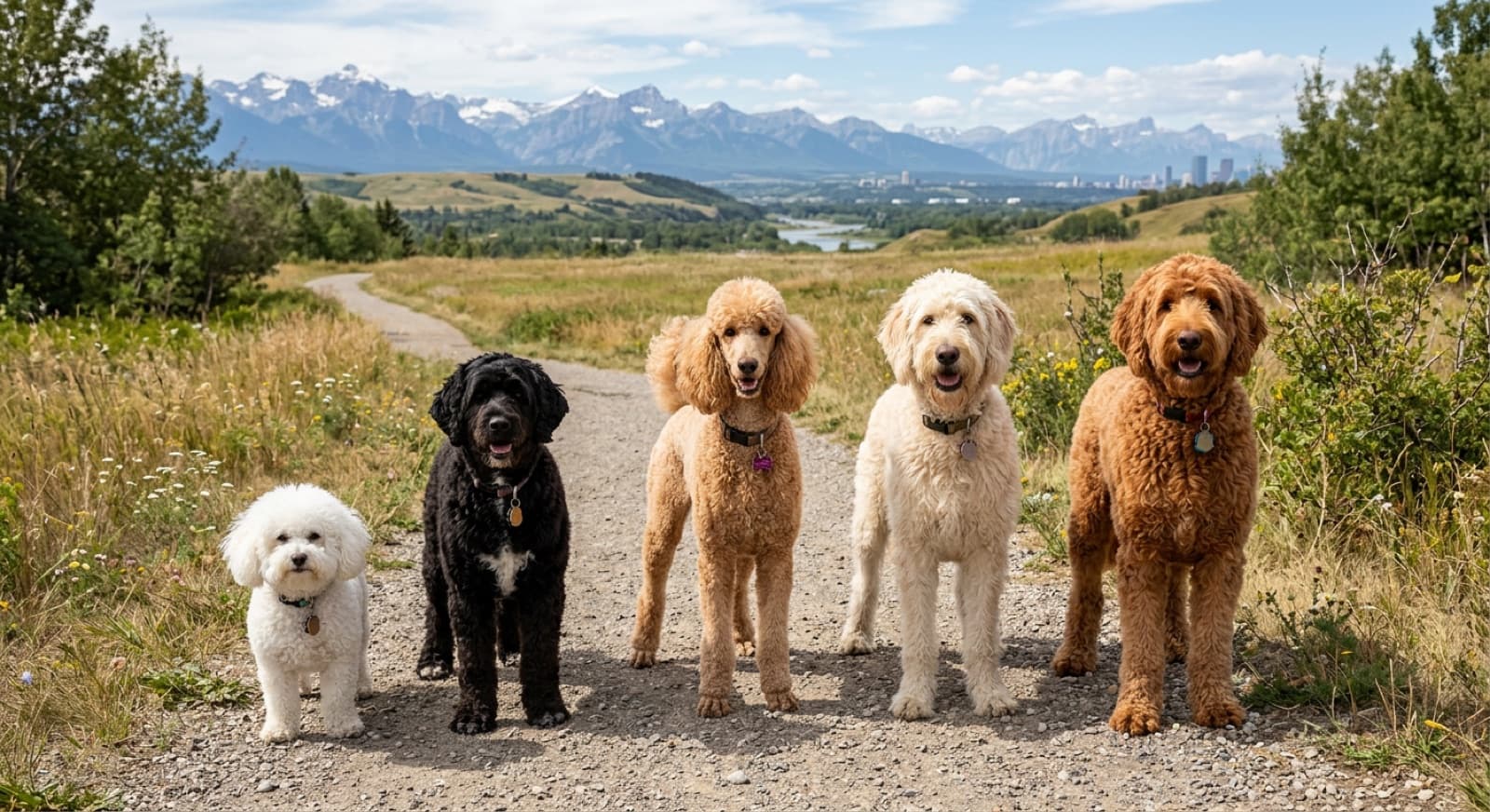
Calgary adopters searching for a hypoallergenic dog usually compare five breeds: Portuguese Water Dog (PWD, 35 to 60 lbs), Standard Poodle (45 to 70 lbs), Goldendoodle (50 to 90 lbs), Labradoodle (50 to 80 lbs), and Bichon Frise (12 to 18 lbs). All five are low-shedding rather than truly hypoallergenic (no dog is 100% hypoallergenic). The Poodle and PWD are the most predictable. Doodles are coat-lottery unless DNA-tested. The Bichon fits Calgary condos best.
At-a-glance comparison
Five low-shed breeds, ordered roughly by smallest adult weight to largest.
| Breed | Adult Weight | Lifespan | Coat Type | Grooming Cost | Energy | Origin | Best For |
|---|---|---|---|---|---|---|---|
| Bichon Frise | 12 to 18 lbs | 14 to 15 yr | Curly single | $50 to $80 | Medium | France 1300s | Apartment, condo, small-dog families |
| Portuguese Water Dog | 35 to 60 lbs | 11 to 13 yr | Curly or wavy single | $80 to $130 | High | Portugal 1200s | Active family with water routine |
| Standard Poodle | 45 to 70 lbs | 12 to 15 yr | Curly single | $90 to $140 | Medium-high | France/Germany 1500s | Intelligent active families |
| Labradoodle | 50 to 80 lbs | 12 to 14 yr | Varies (F1 to multigen) | $80 to $130 | High | Australia 1980s | Active families, outdoor lifestyle |
| Goldendoodle | 50 to 90 lbs | 10 to 15 yr | Varies (F1 to multigen) | $80 to $130 | Medium-high | USA/Canada 1990s | Family-oriented retriever fans |
Why these five breeds get compared
Calgary families who land on this comparison usually start with one question. Someone in the household has allergies, or asthma, or sensitivity to dander, and the family wants a dog that does not trigger symptoms. Allergy-friendly is the search term. Hypoallergenic is the label they keep seeing online. Low-shed is the more accurate description.
All five of these breeds get marketed as the allergy-friendly answer. The Standard Poodle and Bichon Frise are CKC and AKC recognized as low-shedding. The Portuguese Water Dog earned famous attention when the Obama family adopted Bo and then Sunny, both PWDs, because their daughter Malia had allergies. The Goldendoodle and Labradoodle exist because crossbreeders deliberately bred the Poodle into Retriever lines to create a family-friendly dog with reduced shedding.
So all five breeds share a market position. They are the answer for the allergy-prone household. But they are very different daily-life dogs, and the differences are easy to miss when the marketing focus is just on coat shedding. A 90-lb Goldendoodle and a 15-lb Bichon Frise belong to the same low-shed category but the lived experience of owning each is totally different. This article walks through the practical differences a Calgary household needs to know before choosing.
The other reason these five get compared is grooming. All five require professional grooming roughly every 6 to 8 weeks plus daily owner brushing. There is no low-maintenance option in this category. A Calgary owner who is not prepared to brush daily and pay $50 to $140 per grooming appointment should consider a different breed entirely, or commit to learning home grooming.
Portuguese Water Dog
Size: 35 to 60 lbs, 17 to 23 inches at the shoulder.
Origin: Portuguese fishing villages along the Algarve coast, with breed records going back to the 1200s. Bred to retrieve nets, deliver messages between boats, and herd fish into nets. The breed nearly went extinct in the 1930s and was saved by a Lisbon shipping magnate who established the modern breeding program. The breed reached North America in the 1960s and was AKC-recognized in 1983.
Temperament: Intelligent, biddable, athletic, retriever-style work ethic. Strong attachment to family with significant separation anxiety risk if left alone for long periods. Less independent than a Standard Poodle but more focused than a Doodle. Generally good with kids and other dogs when socialized early.
Coat: Single coat (no undercoat), either curly or wavy. The curly variety has tight ringlets across the body. The wavy variety has looser waves with a more natural drape. Both shed minimally, but both mat easily without daily brushing. Professional Calgary grooming runs $80 to $130 every 6 to 8 weeks for either the lion clip or the retriever clip.
Energy: High. The PWD was bred for full-day water work and needs 60 to 90 minutes of structured exercise daily, ideally with swimming opportunities in summer. Without sufficient outlet, the breed becomes destructive and develops anxiety-driven behaviour.
Calgary fit: excellent for families with active outdoor routines, access to Bow River or Glenmore Reservoir swimming, and someone home most of the day. Apartment fit is poor unless the owner commits to multi-hour daily outdoor time. See the cluster hub at our Portuguese Water Dog adoption guide and the right-for-you guide at is a Portuguese Water Dog right for you.
Breed parent club: Portuguese Water Dog Club of Canada.
Standard Poodle
Size: 45 to 70 lbs, 18 to 24 inches at the shoulder.
Origin: France and Germany, 1500s. Bred as a water retriever for waterfowl hunting, hence the breed name (from the German word “Pudel,” meaning to splash). The continental show clip with the lion-style trim originally served a practical purpose: insulating vital organs and joints while leaving the rest of the body free to swim through cold water. The breed has three size varieties recognized by the CKC: Standard (over 15 inches), Miniature (10 to 15 inches), and Toy (under 10 inches). This comparison covers only the Standard.
Temperament: Highly intelligent (ranked second by Stanley Coren behind the Border Collie). Trainable but independent-minded. Will think for itself and sometimes outsmart owners. Excellent with kids and other dogs when socialized. Less prone to separation anxiety than the PWD but still strongly bonded to family.
Coat: Dense curly single coat. Sheds minimally but the coat keeps growing and felts into mats without daily brushing. Most pet owners choose the sport clip or modified continental clip for practicality. Professional Calgary grooming runs $90 to $140 every 6 to 8 weeks.
Energy: Medium-high. Standard Poodles need 45 to 75 minutes of daily exercise plus significant mental enrichment. They excel at agility, obedience, dock diving, and scent work. Underexercised Poodles develop destructive habits quickly because the brain needs work, not just the body.
Calgary fit: excellent across most household types. Suburban families, working professionals (with daily walks and enrichment), and seniors all do well with Standard Poodles. The breed adapts to apartment life better than the PWD if exercise needs are met. See our Poodle grooming guide for the full grooming workload breakdown and is a Poodle right for you for the lifestyle fit guide.
Breed parent club: Poodle Club of America. CKC registration through the Canadian Kennel Club.
Goldendoodle
Size: 50 to 90 lbs for the Standard Goldendoodle. Mini and Medium Goldendoodles exist at smaller sizes (Mini at 15 to 35 lbs, Medium at 35 to 50 lbs) but the most common variety is the Standard.
Origin: United States and Canada, 1990s. First-generation crosses between a Golden Retriever and a Standard Poodle, deliberately bred to combine Retriever temperament with Poodle low-shedding. The breed is not recognized by the AKC or CKC. There is no formal breed standard, no parent-club health testing requirement, and no consistent coat or temperament target.
Temperament: Family-oriented and biddable, leaning toward the Golden Retriever side in most cases. Good with kids, generally good with other dogs, sociable with strangers. The Doodle temperament marketing is largely accurate for well-bred F1 and F1B dogs. The catch is breeder quality varies widely.
Coat: Highly variable. F1 (50% Poodle) ranges from heavily shedding to barely shedding within the same litter. F1B (75% Poodle) tends toward lower shedding. Multigenerational (F2 and beyond) can be selected for coat consistency. None are guaranteed hypoallergenic. Professional Calgary grooming runs $80 to $130 every 6 to 8 weeks.
Energy: Medium-high. 45 to 75 minutes daily exercise plus mental enrichment. The Golden Retriever side moderates the Poodle drive somewhat, making the Goldendoodle slightly less intensity-driven than a working-line Standard Poodle.
Calgary fit: excellent for active suburban families. Poor fit for households expecting low-shed guaranteed without testing. The Doodle coat lottery is the biggest disappointment we hear from Calgary Doodle adopters who chose the breed specifically for allergies. See our Goldendoodle adoption guide for the cluster hub.
Labradoodle
Size: 50 to 80 lbs for the Standard Labradoodle. Mini and Medium varieties exist at smaller sizes.
Origin: Australia, 1980s. First bred by Wally Conron for the Royal Guide Dog Association of Australia, who wanted a guide dog suitable for an allergy-sensitive client. Conron has since said in interviews that he regrets popularizing the cross because it opened the door to unethical Doodle breeding worldwide. Like the Goldendoodle, the Labradoodle is not AKC or CKC recognized and has no formal breed standard.
Temperament: Active, friendly, food-motivated, biddable. The Labrador influence makes Labradoodles slightly more athletic and less velcro-attached than Goldendoodles in most lines. Good with kids and other dogs when socialized.
Coat: Three coat types are commonly described in Labradoodle marketing: hair (sheds like a Lab), wool (curly, low-shed, Poodle-like), and fleece (wavy, low-shed, somewhere between). Within an F1 litter all three coat types can appear. Coat-testing through Embark or a similar DNA panel identifies the furnishing gene that predicts low-shedding. Professional Calgary grooming runs $80 to $130 every 6 to 8 weeks.
Energy: High. The Labrador side adds working drive. 60 to 90 minutes daily exercise plus mental enrichment. Labradoodles do well in active Calgary households with hiking, biking, or swimming routines.
Calgary fit: excellent for active families. Similar concerns to the Goldendoodle around breeder quality and coat lottery. The Australian Labradoodle (a multigenerational line developed by Tegan Park and Rutland Manor) has more breed consistency than typical F1 Labradoodles but the dogs are uncommon and expensive in Canada.
Bichon Frise
Size: 12 to 18 lbs, 9 to 12 inches at the shoulder.
Origin: Mediterranean (likely Tenerife or mainland Spain), 1300s. Brought to France in the 1500s and favoured as a companion dog by French and Italian nobility. The breed name comes from the French “bichon à poil frisé” (curly lap dog). The Bichon Frise Club of America was founded in 1964 and the AKC recognized the breed in 1973. CKC recognition followed shortly after.
Temperament: Friendly, gentle, cheerful, sociable with strangers and other dogs. Less independent than a Poodle. Strong attachment to family with moderate separation anxiety risk. Good with kids when supervised (small size means accidental injury from rough handling is the main concern). Generally good with cats and other small pets.
Coat: Curly single coat with a dense outer coat over a softer undercoat. Sheds minimally but mats easily without daily brushing. The signature round powder-puff trim requires professional grooming every 6 to 8 weeks at $50 to $80 in Calgary. Some owners learn home grooming with clippers to reduce ongoing costs.
Energy: Medium. 30 to 45 minutes daily exercise satisfies most Bichons. Indoor play counts toward total activity. The breed is well-suited to apartment life and senior owners.
Calgary fit: excellent for condo and apartment dwellers, seniors, families with older kids, and households looking for a low-shedding small dog. Calgary winter cold (-30°C cold snaps are common) is a concern for any small dog. A coat or sweater for outdoor walks below -10°C is standard practice.
Breed parent club: Bichon Frise Club of America.
The hypoallergenic reality
No dog is 100% hypoallergenic. All five of these breeds reduce allergen load compared to a double-coated shedding breed. None eliminate it.
Allergy reactions are triggered by proteins in dander (dead skin), saliva, and urine, not by hair itself. A low-shedding dog reduces airborne dander because less hair is being deposited around the home with each shed. But the dog still produces dander, still licks itself, and still urinates. The question is whether a specific allergy-prone person reacts to a specific dog, not whether the breed is theoretically hypoallergenic.
The Standard Poodle and Portuguese Water Dog are the most consistently low-shedding of the five. The single-coat structure plus the curly hair pattern traps loose dander in the coat rather than releasing it into the air, where it gets caught by grooming and brushing rather than spread around the home.
The Bichon Frise is similar but smaller, so total dander production is lower simply by virtue of body size.
Goldendoodles and Labradoodles are the unpredictable category. An F1 (first-generation) Doodle has a 50/50 chance of inheriting the furnishing gene that produces low-shedding. Two F1 puppies from the same litter can have completely different shedding profiles. F1B (75% Poodle) and multigenerational lines tend toward more consistent low-shedding but it is still a probability range, not a guarantee.
The Calgary practical test: spend several hours with the specific dog you intend to adopt before committing, ideally in a small enclosed space. Pet the dog, hold the dog, sit on the floor with it. If symptoms develop within 30 minutes, the match is unlikely to work long-term. If you tolerate the dog for two or three hours without symptoms, it is a reasonable bet. Most Calgary rescues will facilitate this kind of meet-and-greet, and the PWD Club of Canada specifically encourages it before placing PWDs with allergy-sensitive families.
For severe allergy cases or households with asthma, consult an allergist before adopting. Some allergy-prone people react to all dogs regardless of breed.
Coat varieties and grooming workload
All five breeds need daily owner brushing plus professional grooming every 6 to 8 weeks. The exact workload varies by breed and coat style.
Portuguese Water Dog: two coat varieties, both single-coated. The curly variety has tight ringlets requiring daily brushing with a slicker brush plus a metal comb to catch deep mats. The wavy variety has looser waves and can sometimes get away with three to four brushings per week. Calgary owners choose between the lion clip (dramatic, traditional, with the rear half clipped short) or the retriever clip (uniform short length all over). The retriever clip is the practical Calgary winter choice. Professional grooming runs $80 to $130 every 6 to 8 weeks.
Standard Poodle: the most coat-style options of the five. Continental clip (show-style with the lion shape), modified continental (less dramatic), English saddle, sport clip (short and practical), puppy clip (uniform medium length). For Calgary pet owners the sport clip and puppy clip are most common. Daily brushing required at any length because the coat felts into mats fast. Professional grooming runs $90 to $140 every 6 to 8 weeks.
Doodle (Goldendoodle and Labradoodle): coat lottery within F1 generation. Some Doodles have a hair coat that sheds like a Lab. Others have a wool coat that mats like a Poodle. Most are somewhere in between (fleece coat). The grooming workload depends on which coat type the individual dog inherited. Most Calgary Doodle owners choose the puppy clip or teddy bear cut. Daily brushing required. Professional grooming runs $80 to $130 every 6 to 8 weeks.
Bichon Frise: the signature round powder-puff trim. Daily face-washing required because tear staining around the eyes is common and shows badly on white coats. Daily brushing required. Some Bichon owners use a shorter Schnauzer-style cut for easier maintenance. Professional grooming runs $50 to $80 every 6 to 8 weeks.
The hidden Calgary cost: a fully matted dog (from skipped brushing) often needs to be shaved short rather than detangled, at $150 to $250. Repeated matting can damage the coat permanently and may require breed-specific recovery grooming over multiple appointments. Daily brushing is the most expensive single skill to skip in any low-shed breed household.
Training and temperament differences
All five breeds are trainable. The path looks different for each.
Portuguese Water Dog: retriever-style biddability. Highly motivated by water-based work, fetch games, and partnership-style training. The PWD wants a job and responds best to consistent daily structured training sessions. Boredom turns into destructive behaviour fast. Calgary force-free trainers like Raising Canine or Pup City Pup Academy work well with the breed.
Standard Poodle: the highest raw intelligence of the five (ranked second by Stanley Coren). This is a benefit and a complication. Poodles learn new commands in under five repetitions in most cases, but they also figure out how to open doors, find food, and outsmart owner-imposed routines. Mental enrichment is non-negotiable. A Standard Poodle without daily problem-solving outlets becomes neurotic.
Goldendoodle: typically leans toward the Golden Retriever side for biddability. The food motivation plus people-pleasing nature makes Doodles relatively easy to train through positive reinforcement. The catch is some F1 Doodles inherit Poodle-style independent thinking and challenge the owner more than expected.
Labradoodle: similar to the Goldendoodle but with more food motivation and slightly higher activity drive from the Labrador side. Generally easy to train through positive reinforcement.
Bichon Frise: friendly, small companion. House training takes longer than the larger breeds (a common small-dog pattern in Calgary, partly because owners under-commit to crate routines for tiny dogs). Once trained, Bichons are generally well-mannered and adaptable.
The shared rule across all five: aversive training methods (prong collars, e-collars, alpha-style dominance) are wrong for every breed in this category. All five are sensitive, partnership-oriented dogs that develop fear-based behaviour quickly with harsh handling. Work with a Calgary force-free trainer from the first week home.
Calgary-specific considerations
Calgary climate, lifestyle, and infrastructure shape which of these breeds works best where.
Winter coat protection: short-trimmed coats (sport clip Poodle, retriever clip PWD, short Doodle puppy cut) lose insulation in Calgary winters. A coat or sweater for outdoor walks below -10°C is standard. -30°C cold snaps require shortened outdoor time (10 to 15 minutes maximum) plus paw protection (boots or paw balm against road salt). Bichons feel cold faster than the larger breeds and need winter coats earlier in the season.
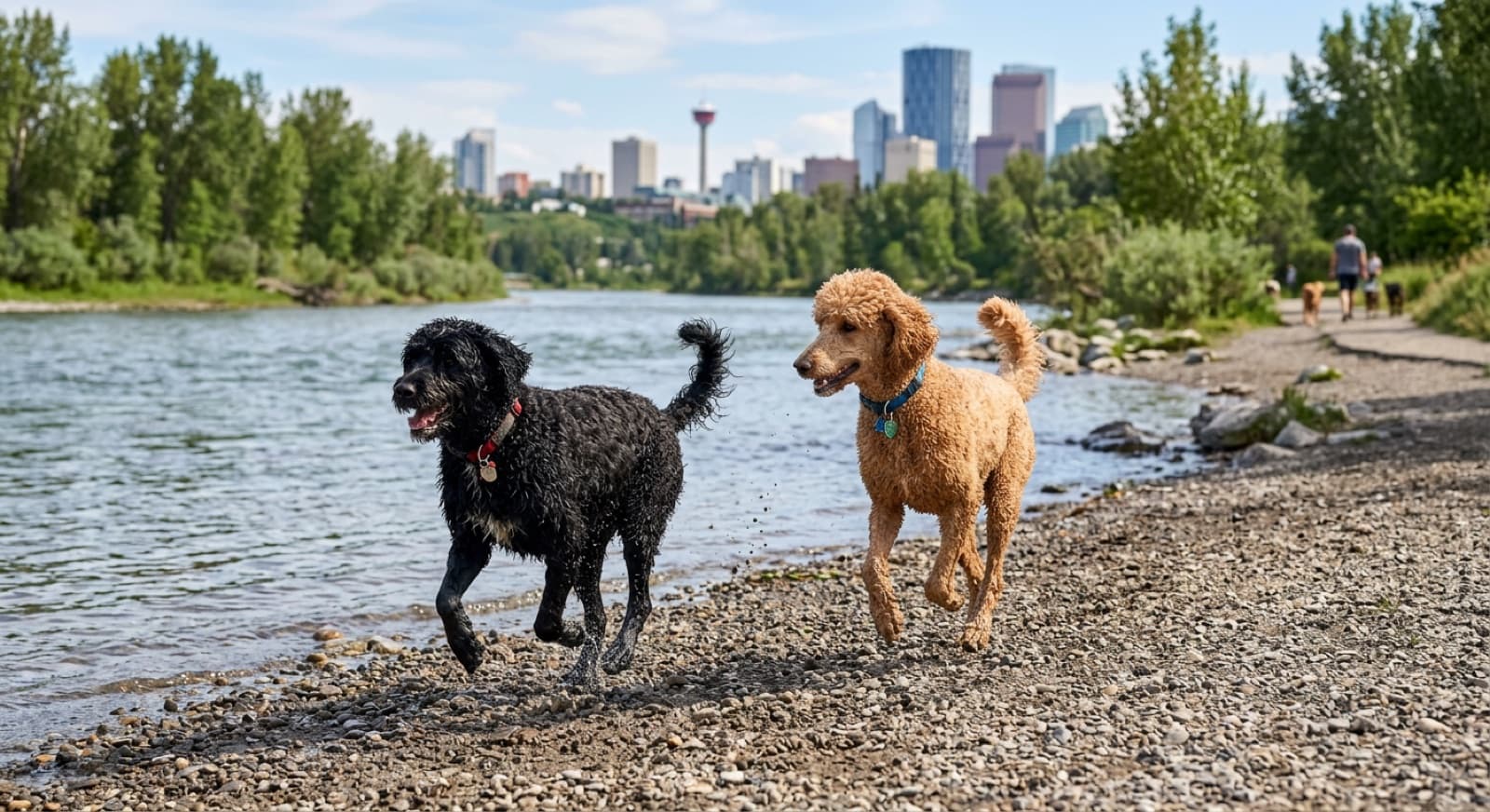
Summer water access: PWDs, Labradoodles, and Standard Poodles all love water and benefit from access to it. Calgary swimming spots include Sandy Beach on the Elbow River, the Bow River off-leash sections, and Glenmore Reservoir (leashed only, no off-leash swimming). Beaverdam Flats and Carburn Park also have river access. For active PWD owners, regular summer swimming is a near-requirement for the dog's mental health.
Condo board pet restrictions: Calgary condo boards vary widely on weight limits, breed restrictions, and total dog count. Many downtown buildings cap dogs at 20 or 25 lbs, which excludes the PWD, Standard Poodle, and most Doodles. Confirm the building's pet policy in writing before adopting. The Bichon Frise is almost always permitted under condo weight caps.
Grooming salon availability: Calgary has strong grooming infrastructure. Established salons in Bowness, Marda Loop, Inglewood, and Beltline all handle all five breeds. Booking 4 to 6 weeks ahead is standard for established groomers, so plan the next appointment when you book the current one.
Off-leash parks: Calgary's off-leash network (Nose Hill, Fish Creek, Edworthy, Tom Campbell's Hill, Bowmont, Sue Higgins) suits the four larger breeds well. PWDs and Doodles thrive in off-leash environments because of their social retriever temperament. Standard Poodles can be more selective. Bichons need careful supervision in off-leash areas because their small size makes them vulnerable to overly enthusiastic large-dog play.
Veterinary cost baseline: Calgary 2026 annual veterinary cost for a healthy adult dog of any of these breeds runs roughly $600 to $1,200 for routine care, before any breed-specific health issues develop. Pet insurance through Trupanion or Petsecure averages $80 to $120 per month for medium-large breeds. See the Calgary adoption costs guide for the full annual breakdown.
Which breed is right for you?
A decision framework based on the most common Calgary household types.
Active outdoor family with water access: Portuguese Water Dog is the top pick. Bred for water work, thrives with daily swimming or active outdoor routines, predictable low-shed coat. Labradoodle is a close second if PWD rescue availability is poor.
Suburban family with kids: Goldendoodle or Labradoodle for the family-friendly retriever temperament. Standard Poodle as a more predictable alternative if breeder quality is a concern. PWD if the family is active enough.
Working professional, suburban or detached home: Standard Poodle. Adapts well to moderate routines, mentally satisfied with structured training, less prone to severe separation anxiety than the PWD.
Apartment or condo dweller: Bichon Frise. Small, low-shed, content with moderate exercise. The four larger breeds are difficult fits in small urban living spaces unless the owner commits to multi-hour daily outdoor routines.
Senior or first-time owner: Bichon Frise for the lowest-friction option. Standard Poodle if intellectual engagement is desired. The PWD and Doodles are not first-time-owner breeds because of exercise demand and breeder-quality risk.
Severe allergy household: Standard Poodle as the most consistently low-shedding option. PWD second. Bichon third (smaller dander load). Doodles only if DNA-tested for the furnishing gene and met in person before committing.
Budget-conscious household: Bichon Frise for the smallest size and lowest grooming bill. Adoption fees through Calgary rescues run $300 to $500 for any of these breeds, versus $2,500 to $5,000 from a breeder. See the Poodle adopt vs buy guide and Doodle adopt vs buy guide.
Health screening compared
Each breed has its own health screening priorities. Reputable breeders test breeding pairs before producing litters, and Calgary rescues should provide health history for adoptable dogs where available.
Portuguese Water Dog: GM1 storage disease (DNA test, fatal if affected, breeder screening eliminates the risk), Juvenile Dilated Cardiomyopathy (JDCM, DNA test), Addison's disease, hip dysplasia (OFA evaluation), Progressive Retinal Atrophy (PRA, DNA test). The PWD Club of Canada lists required screening for breeding dogs. See our dedicated PWD adoption guide for the full screening list with Calgary costs.
Standard Poodle: Addison's disease (common in the breed, no genetic test, requires lifelong adrenal supplementation if diagnosed), gastric dilatation-volvulus (GDV or bloat, prophylactic gastropexy at spay/neuter is standard practice), hip dysplasia (OFA evaluation), Progressive Retinal Atrophy (DNA test), sebaceous adenitis (skin condition, no DNA test, biopsy diagnosis). See Poodle health issues for the full breakdown.
Goldendoodle: inherits health risks from both parent breeds. From the Golden Retriever side: hip dysplasia, elbow dysplasia, cancer (Goldens have one of the highest cancer rates of any breed), Subaortic Stenosis (heart condition), eye conditions. From the Poodle side: Addison's, bloat, sebaceous adenitis, PRA. Hybrid vigour does not eliminate these risks. Reputable Doodle breeders test parent dogs for all the conditions on both sides. Many Doodle breeders skip testing entirely.
Labradoodle: inherits from both parent breeds. From the Labrador side: hip and elbow dysplasia, exercise-induced collapse (EIC, DNA test), centronuclear myopathy (CNM, DNA test), PRA. From the Poodle side: same as Goldendoodle. Same testing concern: reputable breeders test, many do not.
Bichon Frise: patella luxation (kneecap dislocation, common in small breeds), bladder stones (calcium oxalate stones are breed-typical, diet management reduces risk), ear infections (the dense coat plus pendulous ears traps moisture, regular ear cleaning required), tear staining (cosmetic, not health-threatening), allergies and skin conditions, hip dysplasia (less common than in larger breeds but possible).
Calgary specialty veterinary care: for breed-specific cardiac evaluations (relevant for PWD JDCM, Poodle Addison's, Doodle inherited heart conditions), Western Veterinary Specialist Centre and VCA Canada West both offer cardiology consultations. Annual cost roughly $250 to $450 for a cardiac screening.
Calgary rescue reality
Availability through the Calgary rescue network varies dramatically by breed.
Portuguese Water Dog: rare. The PWD Club of Canada estimates only a few hundred PWDs total in the country, and most are with active breeding or sport homes. Calgary rescues occasionally receive surrenders but the wait can be months to a year through the parent-club rescue program. AARCS and BARCS see PWD-mix dogs more often than purebred PWDs.
Standard Poodle: occasional. The Poodle Club of Canada coordinates rescue placements through provincial chapters. Calgary general rescues (AARCS, Pawsitive Match, MEOW Foundation, BARCS) see Standard Poodles every few months on average. Adult and senior Poodles are more often available than puppies.
Goldendoodle and Labradoodle: the most commonly surrendered to Calgary rescues of the five breeds. The pandemic Doodle boom (2020 to 2022) created a wave of impulse adoptions, and many of those dogs landed in rescue once owners realized the grooming workload, exercise needs, and training commitment. AARCS and BARCS both see Doodle surrenders every month. Foster-to-adopt programs are common because Doodle temperament varies and rescues want to confirm fit before placement.
Bichon Frise: occasional. Smaller dogs tend to stay in homes longer because they are easier to manage as households age and downsize. Calgary rescues see senior Bichons more often than puppies, which can be a good thing if you want a calmer, already-trained dog.
Outside the rescue network: Kijiji and Facebook Marketplace listings for these breeds in Calgary are common, but vetting becomes the buyer's responsibility. “Free to good home” or low-priced listings often involve dogs with undiagnosed health conditions, behaviour issues, or unethical breeding backgrounds. The rescue network screens dogs before placement, which is a meaningful advantage over private rehoming sites.
See the PWD adoption hub, Goldendoodle adoption hub, and Poodle adopt vs buy guide for the full rescue contact lists and verification rules.
Browse adoptable Portuguese Water Dogs in Calgary
PWDs are rare in Calgary rescue but the parent-club network occasionally places dogs through Alberta foster homes. See current listings and join the wait list.
See Available PWDs →Frequently Asked Questions
Is a Portuguese Water Dog hypoallergenic?
No dog is 100% hypoallergenic, and the PWD is no exception. Portuguese Water Dogs do carry a low-shedding single coat (curly or wavy), which produces less loose hair and dander than a double-coated breed. Many allergy-prone families tolerate them well, which is partly why the Obama family chose Bo and Sunny. But people react to dander, saliva, and urine proteins, not just hair. Spend several hours with the specific dog you intend to adopt before committing, ideally in a small enclosed space. The Portuguese Water Dog Club of Canada and breed-specific Calgary rescues will often facilitate meet-and-greets for this reason.
Which is more allergy-friendly: PWD, Poodle, or Doodle?
The Standard Poodle and the Portuguese Water Dog are the most consistently low-shedding of the five breeds covered here. Both have single coats and predictable shedding patterns. The Bichon Frise is also low-shed but smaller, so total dander load is lower simply by virtue of size. Doodles (Goldendoodle, Labradoodle) are the least predictable. A first-generation (F1) Doodle inherits a random mix of Poodle and Retriever coat genetics, so some shed heavily and some barely shed. F1B (75% Poodle) and multigenerational Doodles tend toward lower shed but it is not guaranteed. If allergy management is the deciding factor, prioritize the Poodle or the PWD over an unverified Doodle.
How much does grooming cost for each breed in Calgary?
Calgary professional grooming runs roughly $80 to $130 every 6 to 8 weeks for a Standard Poodle, Portuguese Water Dog, Goldendoodle, or Labradoodle (size, coat condition, and matting drive the range). The Bichon Frise is smaller and runs $50 to $80 for the same frequency. Owner-side daily brushing is non-negotiable for all five. Skipping a week between Calgary grooms means the coat felts into matting, and a fully matted dog often needs to be shaved short at $150 to $250 because the mats cannot be brushed out humanely. Annual grooming budget is $700 to $1,200 for the four larger breeds, $400 to $700 for the Bichon.
Is a Goldendoodle or Labradoodle easier than a Poodle?
Easier in some ways, harder in others. Doodles tend to inherit the Retriever side of the family for biddability and friendliness, which can make early training feel more straightforward than a high-IQ Standard Poodle that questions everything. The Doodle catch is coat unpredictability and breeder quality. Most Calgary Doodles come from unregulated breeders rather than parent-club-recognized programs, so health screening, temperament selection, and coat consistency vary wildly. A well-bred Standard Poodle from a Canadian Kennel Club breeder is usually a more predictable outcome than an F1 Doodle from a backyard litter. Calgary rescues see Doodle surrenders more often than Poodle surrenders for this reason.
Are Doodles really recognized breeds?
No. The Goldendoodle and Labradoodle are crossbreeds, not recognized breeds. Neither the Canadian Kennel Club nor the American Kennel Club registers them. There is no parent-club breed standard, no formal health testing requirement, and no consistent coat or temperament target. Some breeders are conscientious and do the same health testing they would on a registered Poodle parent. Many do not. This is why two F1 Goldendoodle puppies from different litters can look and behave like totally different breeds. By contrast, the Portuguese Water Dog, Standard Poodle, and Bichon Frise are all CKC-recognized with established standards and breed-specific health testing.
What is the difference between F1, F1B, and multigen Doodles?
F1 is a first-generation cross: one purebred Poodle parent and one purebred Golden Retriever or Labrador parent. F1B is an F1 bred back to a Poodle, producing 75% Poodle genetics and typically more reliable low-shedding. Multigen (F2, F3, etc.) means two Doodles bred together over multiple generations, sometimes selected for coat consistency. For allergy households, F1B and multigen tend to shed less than F1, but it is still a probability range, not a guarantee. Coat-testing through Embark or a similar DNA panel can identify the furnishing gene that predicts low-shedding, and reputable Calgary Doodle breeders test before placing puppies in allergy-sensitive homes.
Which breed is best for a Calgary condo or apartment?
The Bichon Frise at 12 to 18 lbs is the easiest condo fit of the five. Quiet, small, low-shed, and content with moderate exercise. The Portuguese Water Dog, Standard Poodle, and Doodles are all medium-to-large breeds (35 to 90 lbs depending on the breed) that need a meaningful daily exercise commitment and become destructive in cramped spaces with inadequate activity. The PWD specifically was bred for full-body water work and struggles most without sufficient outlet. For a downtown Calgary condo without elevator access to outdoor space, the Bichon is the realistic choice. For a townhouse or larger condo with a yard or quick park access, any of the five works with the right exercise routine.
Are any of these breeds good with kids?
All five can be excellent family dogs, with caveats. The Portuguese Water Dog, Goldendoodle, and Labradoodle are generally the most kid-tolerant by temperament, which is part of why doodles became popular family dogs in the first place. The Standard Poodle is wonderful with kids in the right household, but the breed is sensitive and does not tolerate rough handling from young toddlers as patiently as a Lab-cross might. The Bichon Frise is friendly but small and fragile (12 to 18 lbs), so households with toddlers need to supervise carefully to prevent accidental injury to the dog. Across all five, the individual dog matters more than the breed average. Foster-tested adult adoptions through Calgary rescues are the most reliable way to confirm kid-compatibility before commitment.
Which breed is right for first-time owners?
The Bichon Frise is generally the easiest first-time-owner breed of the five. Small size means physical handling is easier, exercise needs are moderate, and the temperament is consistently friendly. The Goldendoodle and Labradoodle are often marketed as first-time-friendly, but the coat-care commitment is heavier than new owners expect. The Standard Poodle and Portuguese Water Dog are both highly intelligent and trainable, but the intelligence cuts both ways. A bored Standard Poodle or PWD will redirect that brain into counter-surfing, door-opening, and creative problem-solving the owner did not anticipate. For first-time Calgary owners committed to daily training and grooming, any of the five works. For first-time owners looking for the lowest-friction option, the Bichon is the honest pick.
Can I find any of these breeds through a Calgary rescue?
Yes, with varying frequency. Goldendoodles and Labradoodles are the most commonly surrendered to Calgary rescues, partly because the surge in pandemic Doodle adoptions created a wave of returns once owners realized the grooming workload and exercise needs. AARCS, BARCS, and Pawsitive Match see them periodically. Standard Poodles appear occasionally through the Poodle Club of Canada rescue network and general Calgary rescues. Bichons appear occasionally. Portuguese Water Dogs are the rarest in Calgary rescue, because the breed itself is uncommon in Canada (the PWD Club of Canada estimates only a few hundred Canadian PWDs total). For a PWD specifically, expect a waitlist of months to a year through the parent club rescue program.
Portuguese Water Dog Adoption Calgary
Rescue sources, real costs, health screening, breeder verification, and the breed-vs-buy reframe.
Is a Portuguese Water Dog Right for You?
Honest lifestyle-fit guide. Exercise demand, water-routine match, family compatibility, Calgary climate.
How to Groom a Poodle
A Poodle grooming guide: why the coat mats, the one brushing skill that matters, the coat change nobody warns you about, the clip styles decoded, and the honest cost.
Goldendoodle Adoption Calgary
Calgary Doodle rescue reality, F1 vs F1B coat lottery, breeder vetting, surrender patterns.
Adoptable Portuguese Water Dogs
Live listings of PWDs from the Calgary rescue network, updated regularly.
Adoptable Poodles in Calgary
Live listings of Standard, Mini, and Toy Poodles from the Calgary rescue network.
New dog? Start with these care guides
Everything a new adopter needs to set up a safe, happy home.