The short answer
A Samoyed needs 2 to 3 brushing sessions per week outside of coat blow and daily brushing during the spring and fall coat-blow cycles, which last 2 to 4 weeks each. Plan on roughly 20 to 40 minutes per session if you line-brush properly. Professional grooming runs $80 to $130 per session in Calgary every 6 to 8 weeks, or roughly $500 to $1,200 annually. Bathe every 6 to 8 weeks at most; over-bathing destroys the coat. Use a high-velocity dryer, not a regular blow-dryer. Never shave the coat.
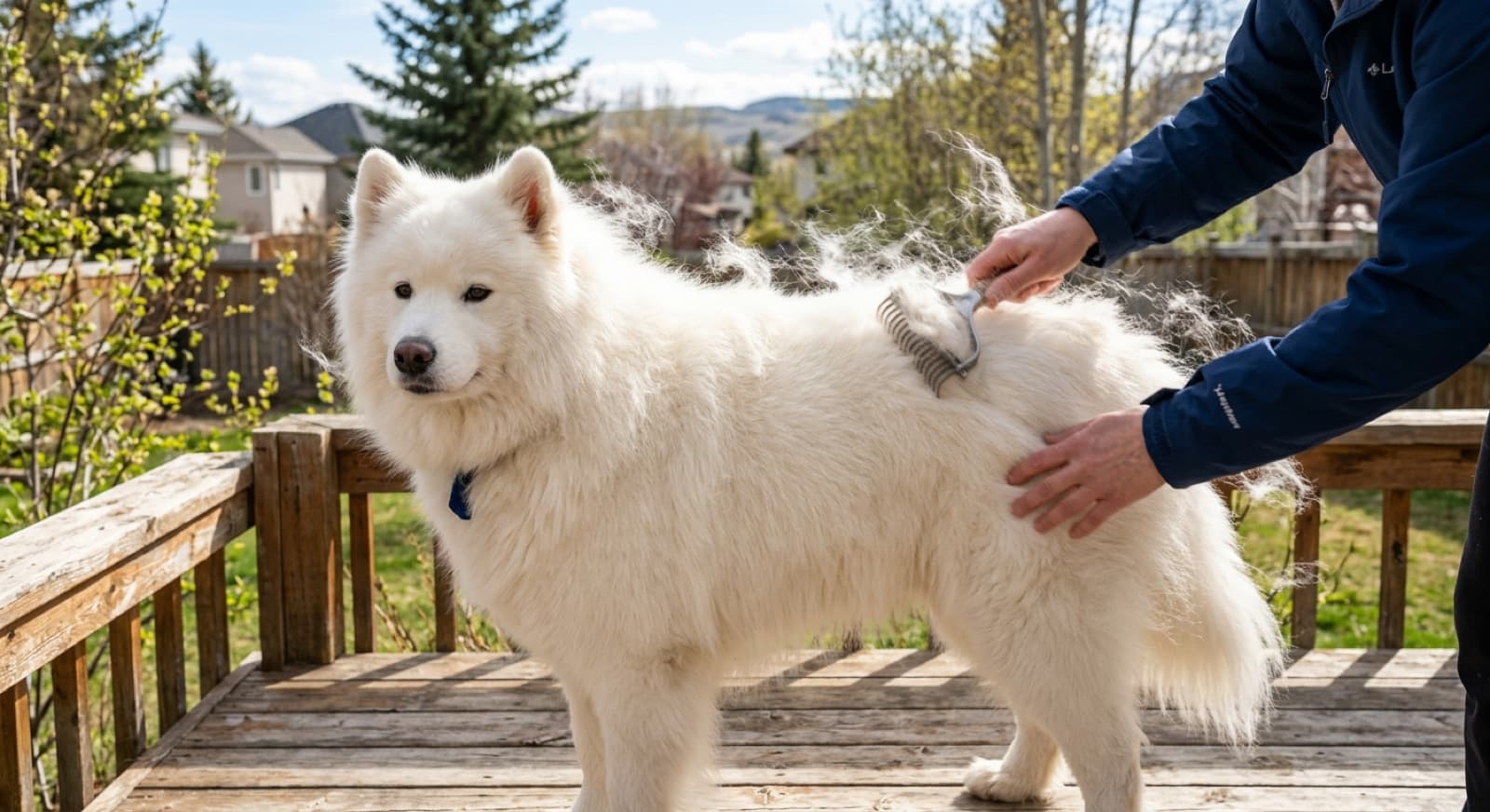
Line brushing to the skin is the only technique that reaches the undercoat where mats actually form.
The Samoyed coat is the breed's defining feature and the single biggest reason owners surrender them. The dense white double coat is built for an Arctic working life, not a low-maintenance pet lifestyle. In our experience working with Calgary rescue families, the owners who succeed with the breed are the ones who understood the grooming commitment before they brought one home and built a realistic weekly routine around it. The owners who didn't are the ones we meet again when their matted, hot-spotted Samoyed lands in a foster home. This guide covers what the breed actually requires: the coat anatomy that explains why, the weekly brushing routine, the dramatic coat-blow cycles, the tool kit you need, Calgary professional grooming pricing, why you should never shave the coat, and how Calgary winters and summers change the routine.
The Samoyed coat is a working system, not a fashion choice
Every grooming decision for this breed makes sense once you understand the coat anatomy. The Samoyed has a true double coat: a dense, wool-like undercoat against the skin and a longer, harsh, stand-off guard coat on top. The two layers do different jobs.
The undercoat is the insulator. Soft, dense, and water-resistant, it traps a layer of warm air against the skin in winter and (this surprises new owners) a layer of cool air against the skin in summer. The undercoat is what releases dramatically twice a year during coat blow. The Canadian Kennel Club breed standard describes the undercoat as “short, soft, thick, close wool.”
The guard coat is the protective shell. Longer, harsh-textured hairs that stand off the body, repel dirt and water, reflect UV in summer, and shed snow in winter. Guard hairs grow on a different cycle and shed lightly year-round but do not blow out seasonally like undercoat does. This is the layer you damage permanently if you use the wrong tools (Furminator blades) or shave the dog.
When the breed is in working condition, the two layers work together. Snow brushes off the guard coat without soaking through to the skin. Sun reflects off the white coat surface. Air circulates through the structure. A well-maintained Samoyed coat is largely self-cleaning, which is why over-bathing causes more problems than dirt does. Owners who fight the coat's structure lose. Owners who work with it have a manageable routine.
The weekly brushing routine: 2 to 3 sessions, line-brushed to skin
Outside of coat-blow season, a Samoyed needs 2 to 3 thorough brushing sessions weekly. Each session takes 20 to 40 minutes if you line-brush properly. Surface brushing (running a brush over the top of the coat) leaves the undercoat untouched and matting continues underneath a coat that looks fine to a stranger. Mats at the skin become a vet-clipping problem within weeks.
The line-brushing technique:
- Have the dog stand or lie comfortably on a non-slip surface. Most owners we work with use a rubber bath mat on a low bench.
- Start at one rear leg. Part the coat horizontally in 1 to 2 inch sections, lifting the top layer with your free hand so you can see skin.
- Brush each section from the skin outward with a slicker brush or pin brush, working in the direction of hair growth. The brush should reach the skin without dragging.
- Move 1 to 2 inches up the dog and repeat. Work the rear legs, hips, sides, shoulders, chest, neck ruff, and finally the tail and pants.
- Use the undercoat rake on the dense areas (hips, shoulders, ruff) after the slicker work. The rake pulls loose undercoat that the slicker missed.
- Finish with a pin brush through the guard coat to lift and align it. This is what gives the coat the signature stand-off look.
Pay extra attention to the friction zones where mats form first: behind the ears, under the collar, in the armpits, behind the elbows, on the belly, on the rear pants (the long fur on the back of the thighs), and around the genitals. These spots need a fingertip check after every walk on Calgary winter trails, where snow balls form and pack into the coat.
During coat blow (spring and fall, 2 to 4 weeks each), this routine becomes daily. Skip a day during coat blow and you will spend the next session pulling clumps out instead of brushing efficiently.
The coat blow: surviving spring and fall undercoat release
Twice a year, a Samoyed releases the entire dense undercoat to make room for the new seasonal layer. In Calgary, the cycles run roughly March to May (winter undercoat releases for spring) and September to November (summer undercoat releases for new winter growth). Each cycle lasts 2 to 4 weeks of dramatic shedding. Owners who weren't warned describe it as the dog “falling apart.” That is exactly what it is.
What coat blow actually looks like:
- Tufts and clumps of soft white undercoat lifting away from the body, often hanging in patches.
- Fur drifting across hardwood floors, sticking to upholstery, weaving into carpet, and landing in food bowls.
- The dog looking visibly “moth-eaten” for a few weeks as the new coat grows in.
- A vacuum that needs emptying every other day. We are not exaggerating.
The coat-blow survival plan:
- Daily brushing for 30 to 60 minutes. Non-negotiable. Skipping days lets the loose undercoat felt against the skin and form mats that go to the skin.
- Heavy use of the undercoat rake. The slicker brush still has a role for surface work, but the rake is what pulls the volume out.
- Brush outdoors if possible. Calgary spring chinook days are ideal. Set up on the back deck and let the wind take the fluff. Backyard birds will pick it up for nest material; some owners we work with leave a small basket out and report the same.
- Consider a deshed-bath-blow-out grooming appointment with a Calgary salon that has a high-velocity dryer. One professional session at the start of coat blow can knock out 60 to 70 percent of the loose undercoat in 2 to 3 hours. Owners typically book at the first sign of clumping and again midway through.
- Vacuum daily. A robot vacuum on a daily schedule is the single best Calgary owner investment during coat blow. Pair it with weekly deep-vacuum on upholstery.
Owners who underestimate coat blow are the most common Samoyed surrender story we hear from Calgary rescues. They knew the breed shedded; they didn't know what coat blow actually looked like. By week two of spring blow, the household is buried in fur, the dog is matting, and the surrender call goes to AARCS or Calgary Humane Society. Walking in with the plan above prevents that outcome.
The Samoyed tool kit: what you actually need
The Calgary owners we work with consistently recommend the same short tool list. Avoid the marketing-heavy alternatives. Furminator-style blades cut guard hairs at the surface and damage coat texture over months. Stick to brushes that work the coat without cutting it.
| Tool | Calgary price | What it does |
|---|---|---|
| Slicker brush (large) | $25 to $55 | Surface and section brushing, removes loose hair without cutting guard coat. |
| Undercoat rake | $25 to $50 | Pulls the dense undercoat the slicker can't reach. The coat-blow workhorse. |
| Pin brush | $20 to $45 | Finishing the guard coat, lifting and aligning the stand-off texture. |
| Mat splitter or dematting comb | $15 to $30 | Breaks small mats apart so you can brush them out without cutting. |
| High-velocity dryer (home model) | $180 to $350 | Blows loose undercoat out, dries the coat after baths without trapping moisture. |
| Nail grinder | $50 to $90 | Smooth nail trims for a breed that often hates clippers. |
| Ear cleaner (vet-recommended) | $15 to $25 per bottle | Routine ear-cleaning every 2 to 4 weeks. Heavy coat traps moisture in the ear. |
| Whitening shampoo | $25 to $45 | Used sparingly (every third bath) to brighten the coat without stripping oils. |
Some of the product links in this section are Amazon affiliate links — we may earn a small commission at no extra cost to you. It never changes which products we recommend.
Total starting kit: roughly $350 to $700 in Calgary, with the high-velocity dryer being the biggest line item and the biggest single quality-of-life upgrade for owners managing the breed at home. Owners who pass on the HV dryer either learn to love their groomer or fight matting forever.
Calgary pet retailers carry most of the kit. Tom & Sawyer, Tail Blazers, Pet Planet, and the larger chain stores all stock slickers and undercoat rakes. HV dryers are easier to find online or through grooming-supply retailers.
Bath protocol: every 6 to 8 weeks max, HV dryer required
Bathing a Samoyed wrong does more damage than not bathing them at all. Two rules matter more than anything else: bathe infrequently, and dry completely with a high-velocity dryer.
Frequency. Every 6 to 8 weeks is the upper limit outside of accidents (mud, urine, skunk). The protective oils in the coat take roughly 4 to 6 weeks to fully restore after a bath, and stripping them more often than that leads to a coat that yellows, mats faster, and loses the stand-off texture. The owners we work with who fight matting most often bathe weekly “to keep him clean” and have no idea their routine is the cause.
Shampoo. Use a quality whitening shampoo for the white coat, but only every second or third bath. A gentle moisturizing shampoo for the other baths. Avoid medicated shampoos unless a vet has prescribed them. Always dilute shampoo with water before applying (most product instructions recommend 1 part shampoo to 4 parts water for a long-coated breed) so it distributes evenly through the coat.
Brush before the bath, not after. A matted coat tightens further when wet. Pre-bath brushing is mandatory. If a mat is wet, you almost certainly cannot brush it out and a groomer will need to clip it.
Drying technique. This is where home baths most often go wrong. After rinsing, use a high-velocity dryer on a low-to-medium setting to push water and loose undercoat out from skin to surface. Hold the nozzle 4 to 6 inches from the coat and work in the direction of hair growth. The goal is to dry the dog completely, not just the surface. A coat that feels dry on top but has trapped moisture in the undercoat will mat within 24 hours, and the mats will reach the skin.
Regular blow-dryers are not a substitute for HV dryers. Regular dryers bake heat into the coat and dry the surface while leaving the dense undercoat damp. If you do not own an HV dryer, book the bath with a Calgary groomer specifically to access their salon dryer. Many groomers offer a bath-and-blow-out service separate from full grooming.
Calgary winter complicates the bath schedule. Walking a wet Samoyed home through -20°C is not safe. Plan baths around weather windows where the dog can dry indoors completely before going back outside. Some owners we work with reserve baths for chinook days when the temperature swing makes drying time easier.
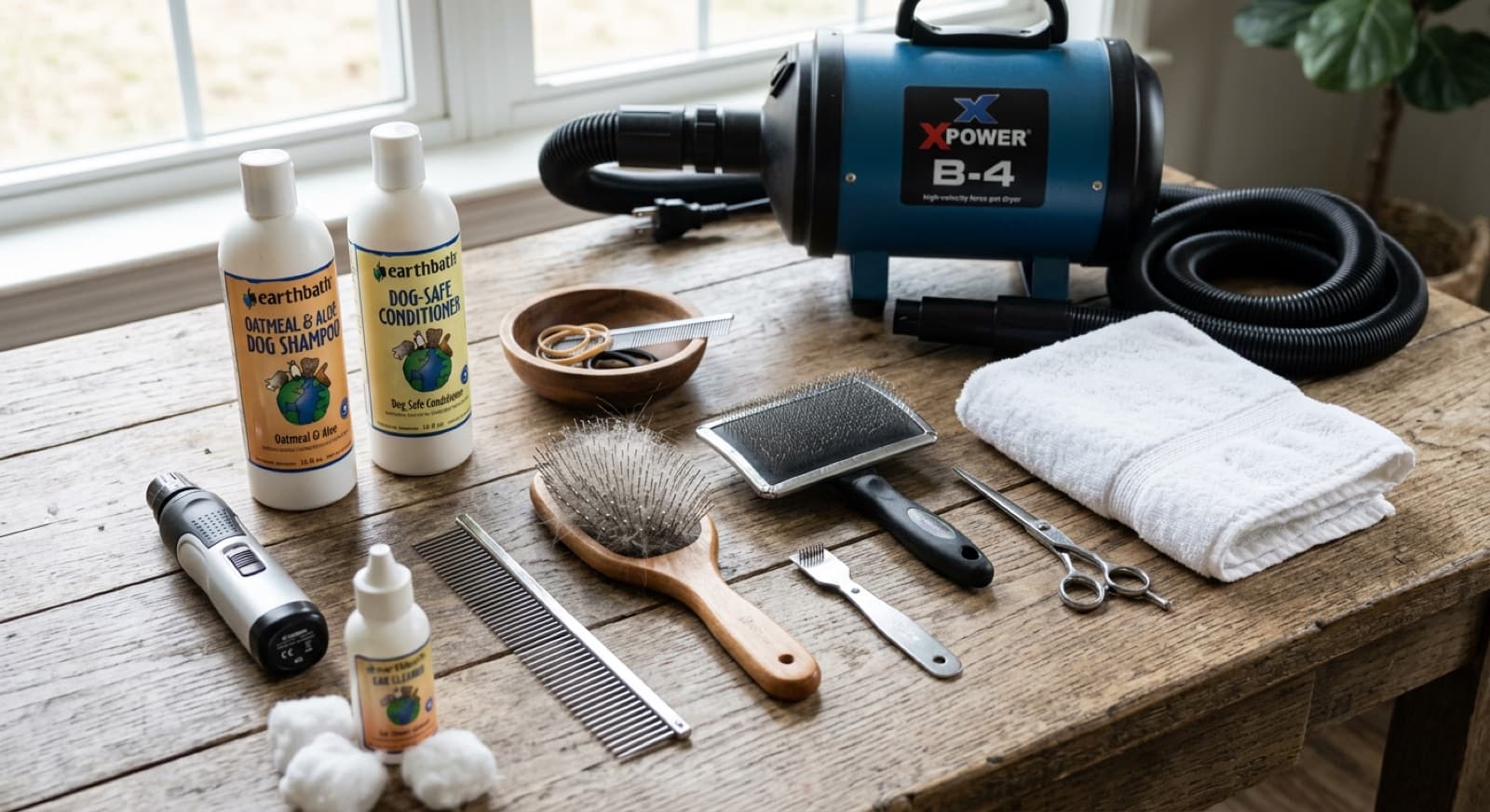
A complete Samoyed tool kit. The HV dryer in back is the single biggest quality-of-life upgrade for owners managing the coat at home.
White-coat maintenance: tear stains, paw pads, and yellowing
The Samoyed's white coat shows every stain. Most yellowing and tear staining is cosmetic, not medical, but a few targeted habits keep the coat looking close to its natural colour without resorting to bleach-style products.
Tear staining. Wipe the area under and beside the eyes daily with a damp cloth or a tear-stain wipe. Most tear staining comes from porphyrin in tears reacting with light over time. Daily wipes prevent buildup. If staining suddenly worsens or you see redness, swelling, or discharge, book a vet visit; entropion (eyelashes rolling inward) is a known Samoyed health issue and can cause persistent tearing.
Mouth area. Wipe around the mouth after meals and water. Yellowing here comes from saliva and food residue and is easy to prevent with a damp cloth.
Paw pads and feet. The fur between the pads catches snow, salt, gravel, and mud. Trim the pad fur with rounded scissors every 3 to 4 weeks (or ask the groomer to). After Calgary winter walks, rinse the paws with lukewarm water to remove salt and check for ice balls. Salt-stained paws can yellow the fur permanently if left between walks.
Pants and undercarriage. The long fur on the rear legs and belly catches urine spray on male dogs and ground moisture on both sexes. A 2-minute wipe after walks prevents the yellow tint that long-coated white dogs are prone to.
Diet and coat quality. Some owners we work with report that omega-3 supplementation (fish oil) improves coat shine and reduces dander over 4 to 8 weeks. There is reasonable evidence behind this for double-coated breeds, but check with your vet before starting any supplement, especially if your dog is on medication. The most reliable coat-quality intervention is high-quality food appropriate for the dog's life stage, not a supplement add-on.
What professional groomers use. Most Calgary salons working on white-coated breeds use a quality whitening shampoo, a clarifying treatment for hard-water mineral buildup, and a final blueing rinse (a very faint blue tint that visually cancels yellow on the white coat). Ask your groomer what they use and whether the products are safe for the dog's skin; some whitening products are harsh and not suitable for sensitive breeds.
Calgary professional grooming: what to expect and what it costs
Most Calgary Samoyed owners use a professional groomer every 6 to 8 weeks even if they brush diligently at home. The combination of home brushing plus a professional bath and blow-out keeps the coat in working condition without burning out the owner.
| Service | Calgary price | Frequency |
|---|---|---|
| Standard full grooming (bath, blow-out, nails, ears, sanitary trim) | $80 to $130 | Every 6 to 8 weeks |
| Coat-blow reset (deshed + bath + extended blow-out) | $130 to $180 | Spring and fall |
| Bath and blow-out only | $55 to $90 | As needed between full grooms |
| Nail trim or grind only | $15 to $25 | Every 3 to 4 weeks |
| Mat-removal upcharge | $20 to $80 added | If matting present at intake |
Annual professional grooming cost: roughly $500 to $1,200 depending on how often you book full grooms versus bath-only appointments. Coat-blow seasons push this higher because of the extra dryer time.
What a good Calgary groomer should do for a Samoyed:
- Refuse to shave the coat. A groomer who offers to shave a Samoyed “to make summer easier” or “for a puppy cut” is not the right groomer for this breed. Walk away.
- Use a high-velocity dryer. Not a regular dryer, not air-drying. The HV is what makes the appointment worth the cost.
- Line-brush the entire dog. Surface brushing in 20 minutes is not a Samoyed groom.
- Trim only what is appropriate. Sanitary trim, paw-pad trim, slight foot tidy. The coat itself stays full length.
- Communicate about matting. A reputable groomer will show you mats they find and explain the de-matting plan or recommend a clip-down if a mat reaches the skin.
Ask the groomer about their Samoyed (or generally Spitz-breed) experience before booking. The breed is not common enough in Calgary that every salon has worked on one. A groomer experienced with Huskies, Malamutes, or other double-coated working breeds is the right fit.
Never shave a Samoyed: the rule that has no exceptions
This is the most important rule in Samoyed grooming and the one most commonly broken by well-meaning owners and uninformed groomers. Never shave a Samoyed. Not for summer. Not for “a fresh start.” Not because it's matted. (A vet-clipped medical strip for hot-spot treatment is the only exception, and that is done by a vet for a medical reason on a small area.)
The reasons, in order of impact:
- The coat insulates against summer heat just as well as winter cold. The double coat reflects solar radiation off the white guard hairs and traps a layer of cooler air against the skin. Shaving removes the cooling system. Shaved Samoyeds typically overheat faster than coated ones in Calgary July sun.
- UV exposure on pink skin. A shaved Samoyed has pale skin exposed to direct sun. Sunburn and increased skin-cancer risk follow.
- The coat does not always grow back correctly. Known in the breed community as “shave shock,” post-shave regrowth is often patchy, wiry, missing the guard coat entirely, or never returning to original texture. Some dogs grow only undercoat after a shave, which mats endlessly. The change can be permanent.
- Loss of the coat's self-cleaning property. The guard coat is what repels dirt and water. Shave it and the dog needs more bathing, which strips remaining oils, and the cycle continues.
- Insect and debris protection vanishes. The coat is a physical barrier. Shave it and the dog is more vulnerable to mosquitoes, ticks (which are increasingly present along Calgary river paths), grass seeds, and minor scrapes.
The solution to a too-hot Samoyed in Calgary summer is brushing out the undercoat thoroughly during spring blow so the coat insulates correctly, plus walking at cool hours and providing shade and water. The solution is never clippers. If a groomer suggests shaving, find a different groomer. If a friend tells you their last Samoyed was “fine” after a shave, ask whether the coat grew back the same. Most of the time, it didn't.
For more on the heat-management side, see our Samoyed summer heat safety guide, which covers walking schedules, cooling tactics, and signs of heat distress for Calgary owners.
Calgary climate and the Samoyed coat
Calgary's weather extremes test the Samoyed coat year-round, but most of the problems are manageable with small routine adjustments.
Winter (-20°C and colder). Snow balls form between the toes and pack into the long fur on the legs and belly. Pre-walk paw balm and post-walk paw rinses prevent the buildup. Salt and de-icer chemicals on sidewalks burn pads and stain the coat. Carry a small water bottle and rinse paws at the door, or use indoor wipes. Snow that packs into the coat melts inside the house and matting starts at the moisture point if you don't towel-dry promptly after walks.
Chinook winds and dry winter air. Calgary's dry winter air pulls moisture out of the coat and skin. Some dander and flaking is normal. Persistent dandruff with itching usually signals something more, often thyroid or skin issues. Daily fish-oil supplementation (with vet approval) and a humidifier in the dog's main sleeping room help in February when indoor humidity drops below 25 percent.
Spring (April through June). Coat blow plus muddy off-leash trails. Walking at Bowmont Park, Nose Hill, or Fish Creek Provincial Park during spring melt means coming home with a dog covered in clay-coloured mud on a white coat. Rinse with cool water at the door (full baths are still capped at every 6 to 8 weeks; mud-rinses don't count), towel dry, and brush only when dry. Brushing a wet, dirty coat tangles it.
Summer (June through August). The double coat actively helps with heat regulation if it's in working condition. Brush out spring undercoat completely so air can circulate. Walk early morning before 8 AM or late evening after 7 PM. Use the Bow River at Edworthy Park or Sandy Beach for cooling wades (Samoyeds enjoy water and are decent swimmers, unlike some heavy double-coated breeds). After river wades, rinse off river grit and dry with the HV dryer or a towel before the moisture mats the undercoat.
Fall (September through November). Second coat blow plus prairie grass seeds (foxtails) catching in the long fur. Check the coat, paws, and ears for grass seeds after off-leash time. Foxtails can migrate under skin and require veterinary removal.
Browse Samoyeds in Calgary
See current Samoyeds and Samoyed mixes across 15+ Calgary rescues in one place. The breed is uncommon in local rescue, so listings refresh regularly and applications fill quickly when one appears.
See Calgary Samoyeds available now →Coat and skin red flags: when to see a vet
Most Samoyed coat issues respond to a better brushing routine. Some don't, and those signal a medical problem worth checking. Book a vet visit if you see:
- Mats at skin level with pink, red, or weeping skin underneath. Trapped moisture under a mat causes hot spots, fungal infections, and pressure sores. Don't try to brush these out; book a vet or a vet-affiliated groomer for a careful clip-down.
- Hot spots. A hot spot is a sudden, moist, red, often circular patch of skin the dog licks or chews compulsively. The coat around it mats fast. Hot spots need vet treatment (typically clipping the area, antiseptic flush, sometimes antibiotics or steroids).
- Dramatic coat thinning outside of coat blow. Symmetrical thinning on the flanks, tail, or belly often signals thyroid issues (hypothyroidism is documented in Samoyeds). A blood panel rules it in or out.
- Persistent dandruff with itching. Some flaking is normal in Calgary's dry winter. Itching plus flaking usually points to allergies, parasites (mites), or a primary skin condition.
- Strong skin odour. Yeast infections in the skin folds, between toes, or in the ears produce a distinctive musty or sweet odour. Treatable but needs a vet diagnosis.
- Sudden colour change. Yellow, pink, or brown staining that appears suddenly (not gradually from urine or tears) can indicate skin yeast, allergies, or saliva over-licking from an underlying issue.
- Coat that won't grow back after a shave. If you (or a previous owner) shaved the dog and the coat is patchy, wiry, or absent months later, that is shave shock. A vet dermatology consult at Western Veterinary Specialist Centre can assess whether anything restorative is possible (often it isn't, but ruling out thyroid or hormonal causes matters).
For a broader look at health monitoring across this breed, see our Samoyed health issues guide, which covers the major breed-specific conditions Calgary owners should screen for.
Frequently Asked Questions
How often should I brush my Samoyed in Calgary?↓
What is a Samoyed coat blow and how long does it last?↓
How much does professional Samoyed grooming cost in Calgary?↓
Should I shave my Samoyed in Calgary summer?↓
How often should I bathe a Samoyed?↓
Do I need a high-velocity dryer for a Samoyed at home?↓
What brushes do I actually need for a Samoyed?↓
Why is my Samoyed coat turning yellow?↓
When should I see a vet about coat or skin issues?↓
How do I line-brush a Samoyed correctly?↓
Continue reading
Samoyed summer heat safety
Walking schedules, cooling tactics, signs of heat distress, and why brushing matters more than shaving for Calgary summer heat.
Samoyed health issues
Hip dysplasia, thyroid, eye conditions, and Samoyed hereditary glomerulopathy. Calgary screening priorities for owners.
Samoyed adoption in Calgary
Where to find a Samoyed in Calgary rescue, what to budget, and why the breed ends up surrendered more often than people expect.
Browse Calgary Samoyeds
Currently available Samoyeds and Samoyed mixes across all 15+ Calgary rescues, refreshed regularly.
New dog? Start with these care guides
Everything a new adopter needs to set up a safe, happy home.