The short answer
Purebred Samoyeds are rare in Calgary rescue; Samoyed mixes appear regularly. Apply broadly to Calgary Humane Society, AARCS, BARCS, Pawsitive Match, ARF Alberta, Cochrane Humane Society, and Heaven Can Wait, and set up notifications so you see new listings quickly. Adoption fees are typically $400 to $800 versus $3,000 to $8,000 for an ethical Canadian breeder puppy with a one to three year wait. Calgary winters suit the breed perfectly. Summers above 20°C need planning. Grooming runs $80 to $130 per professional session every 6 to 8 weeks.
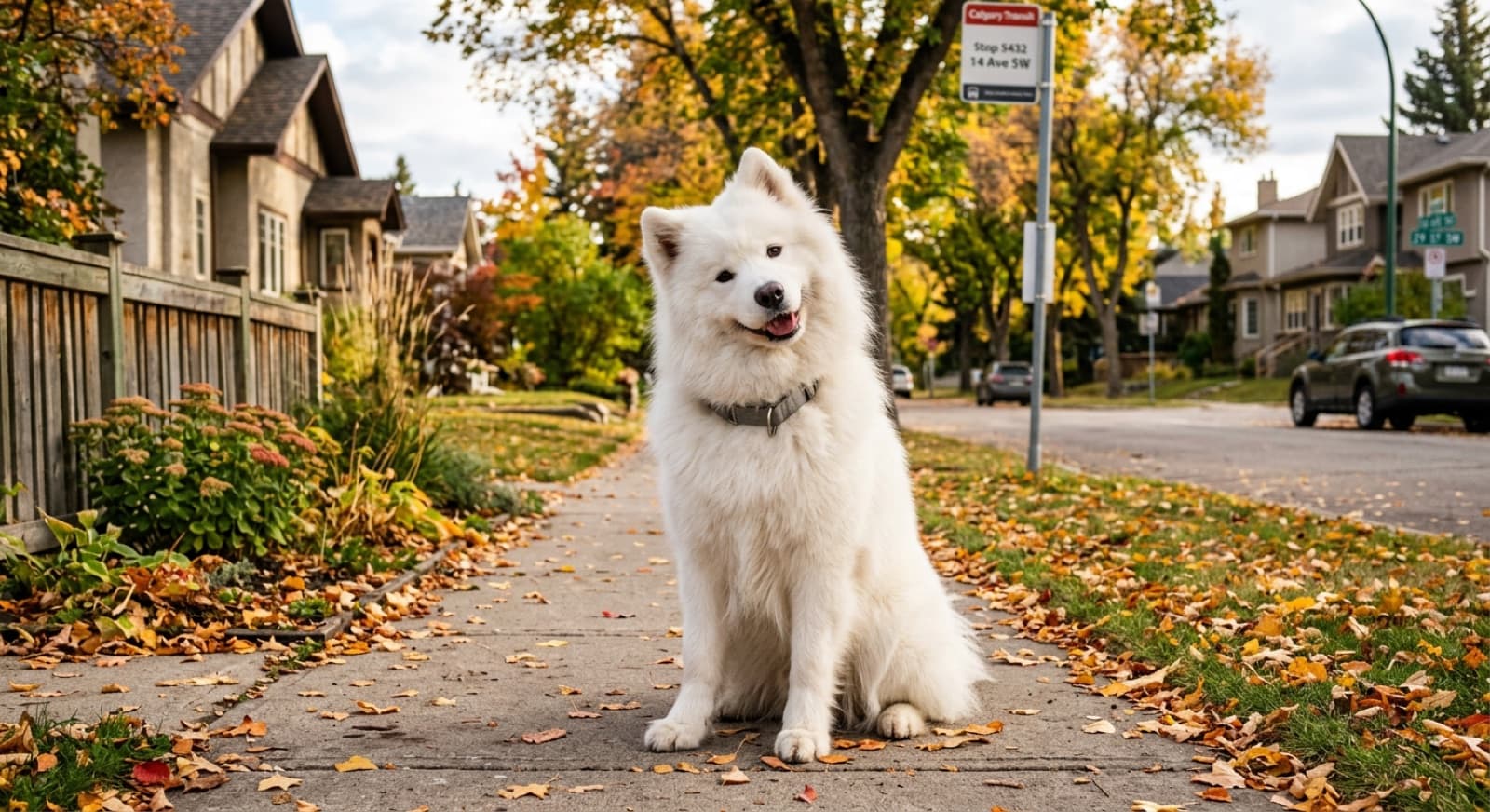
The Samoyed is one of the oldest working breeds on record, developed by the Samoyedic peoples of Siberia to herd reindeer, pull sleds, and sleep alongside their families for warmth. The trademark “Sammy smile,” the white double coat, and the friendly working-dog temperament make Samoyeds instantly recognizable. The breed is also one of the harder ones to bring home in Calgary. Purebreds rarely surface in rescue, ethical breeders carry one to three year waitlists, and a long list of Kijiji listings claim to sell Samoyeds at suspiciously low prices. This guide covers where the breed actually appears in Calgary rescue, what a Samoyed costs to live with, why so many young Sams end up surrendered, and how to read “cheap Samoyed” listings honestly.
The Samoyed at a glance
Samoyeds are a medium-sized, working-built breed with a dense white double coat, a curled tail carried over the back, and the famously upturned mouth that gives the breed its smiling expression. According to the American Kennel Club and the Canadian Kennel Club, the breed standard is consistent across both registries.
| Trait | Typical range |
|---|---|
| Adult weight | 35 to 65 lbs (16 to 30 kg) |
| Adult height (shoulder) | 19 to 23 inches (48 to 58 cm) |
| Lifespan | 12 to 14 years |
| Coat | Dense double coat, white to biscuit |
| Energy level | Moderate to high; working-dog stamina |
| Exercise needs | 60 to 90 minutes daily plus mental enrichment |
| Temperament | Friendly, vocal, people-oriented, independent |
Samoyeds are not a giant breed, but the coat makes them look larger. A well-conditioned 50-pound Sam in full coat reads as a 70-pound dog at a glance. Calgary apartment buildings sometimes treat them as medium-large for that reason, so verify your building's weight rules before applying to adopt.
Where to adopt a Samoyed in Calgary
Samoyeds and Sam mixes are uncommon in Calgary rescue but they do come through. The strategy is the same as any in-demand breed: apply broadly, set up alerts, and be ready to move quickly when a listing appears. In our experience working with Calgary adopters, the families who land a Samoyed are the ones who applied to multiple rescues before a dog was even listed.
Calgary-area rescues to monitor:
- Calgary Humane Society: the largest local shelter, occasional Samoyed or Sam-mix intakes from owner surrenders.
- AARCS: foster-based; structured “good with” evaluations are useful for a vocal, people-oriented breed.
- BARCS Rescue: Calgary foster network; medium dogs frequently and Sam mixes from time to time.
- Pawsitive Match: Calgary foster-based; northern and working breeds appear regularly.
- ARF Alberta: Calgary foster network; broad medium-dog inventory.
- Cochrane Humane Society: Cochrane-based, serves the Calgary region.
- Heaven Can Wait: based in High River, Calgary placement common.
- Calgary Animal Services: the municipal facility, occasional stray or surrendered Sams.
The single best move is to set up notifications on the LocalPetFinder Samoyed breed page. Live listings from all 15+ Calgary rescues land there as they appear, and you will catch a new arrival before most adopters do.
National-level breed rescues are also worth knowing. The Samoyed Association of Canada maintains breeder and rescue information for adopters across the country, including the occasional Alberta placement. Transport from out of province is possible for serious applicants. Expect a more thorough application process than a general rescue, including a home visit, vet reference checks, and detailed questions about your daily routine and grooming plan.
What does a Samoyed cost in Calgary?
Calgary fees vary by rescue and what is included. The realistic ranges below are directional, not quotes:
| Source | Fee range | Typically includes |
|---|---|---|
| Calgary Humane Society | $400 to $600 | Spay or neuter, vaccinations, microchip, vet exam |
| AARCS | $500 to $700 | Spay or neuter, vaccinations, microchip, foster history |
| BARCS / Pawsitive Match / ARF Alberta | $400 to $700 | Spay or neuter, vaccinations, microchip, foster notes |
| Breed-specific or transport rescue | $600 to $800 | Transport, foster-based temperament evaluation |
| CKC-registered breeder puppy | $3,000 to $8,000 | Health screening, contract, breeder support, 1 to 3 year waitlist |
The adoption fee is only the entry cost. Annual care for a Samoyed in Calgary runs higher than most medium breeds because of grooming. Plan for:
- Professional grooming: $80 to $130 per session every 6 to 8 weeks at Calgary salons. That is roughly $500 to $1,200 per year if you stay on schedule.
- Home grooming tools: a high-quality undercoat rake, slicker brush, and de-shedding tool. Budget $150 to $250 once, then replace every few years.
- Food and treats: $50 to $90 per month depending on quality tier.
- Vet and preventive care: roughly $400 to $800 per year for routine wellness, vaccines, parasite prevention, and dental.
- Pet insurance: recommended for this breed. Plan for $50 to $90 per month given Samoyed-specific kidney, eye, and diabetes risks.
- Calgary dog licence: required for every dog three months and older under the Responsible Pet Ownership Bylaw. A small annual fee.
First-year totals typically land between $2,500 and $4,500 once you add gear, training, and licence on top of the adoption fee. For a full breakdown of lifetime ownership cost in Calgary, see our Calgary adoption costs guide.
Why Samoyeds end up in Calgary rescue
Understanding why this breed gets surrendered helps you build a household where it does not happen to your dog. The patterns we hear from Calgary rescues are consistent year over year, and most surrenders are 1 to 5 year old young adults whose owners bought a puppy without fully understanding the breed.
- Grooming workload underestimated. The Samoyed double coat needs weekly brushing minimum, daily during spring and fall coat blow. Owners who pictured a low-maintenance fluffy dog hit the wall around month four.
- Vocal nature mismatched with home. Samoyeds bark, howl, and “talk.” In a Beltline condo or a townhouse with shared walls, the noise becomes a neighbour complaint and a landlord notice within a few months.
- Separation anxiety. The breed bonds deeply with its people and does not cope well alone for long stretches. Working-from-office households without a midday plan often see destruction, vocalizing, and escape attempts.
- Summer heat reality. Calgary owners discover that their dog who loved -25°C in February cannot tolerate +28°C in July. The schedule restructuring (early walks, no midday, AC during heat domes) is more than some households are willing to absorb.
- Financial mismatch. Grooming plus pet insurance plus diet plus the occasional specialty vet visit adds up faster than first-time owners expect.
- Buyer's remorse from impulse Kijiji purchases. Owners who paid $1,500 for a poorly bred “Samoyed” from an unverified source often surrender within the first year when the dog turns out to be sick, fearful, or unsocialized.
- Lifestyle changes: babies, moves, divorces, illness, allergies in the family. Common across breeds but particularly hard on a coat-heavy dog when household time drops.
None of these are problems with the breed. They are problems with the match. Calgary rescues that run foster-based programs (AARCS, Pawsitive Match, ARF Alberta, BARCS) are the best resource for a Samoyed whose adult temperament is already known, which avoids most of the patterns above. Read our companion guide, Is a Samoyed right for you?, before applying.
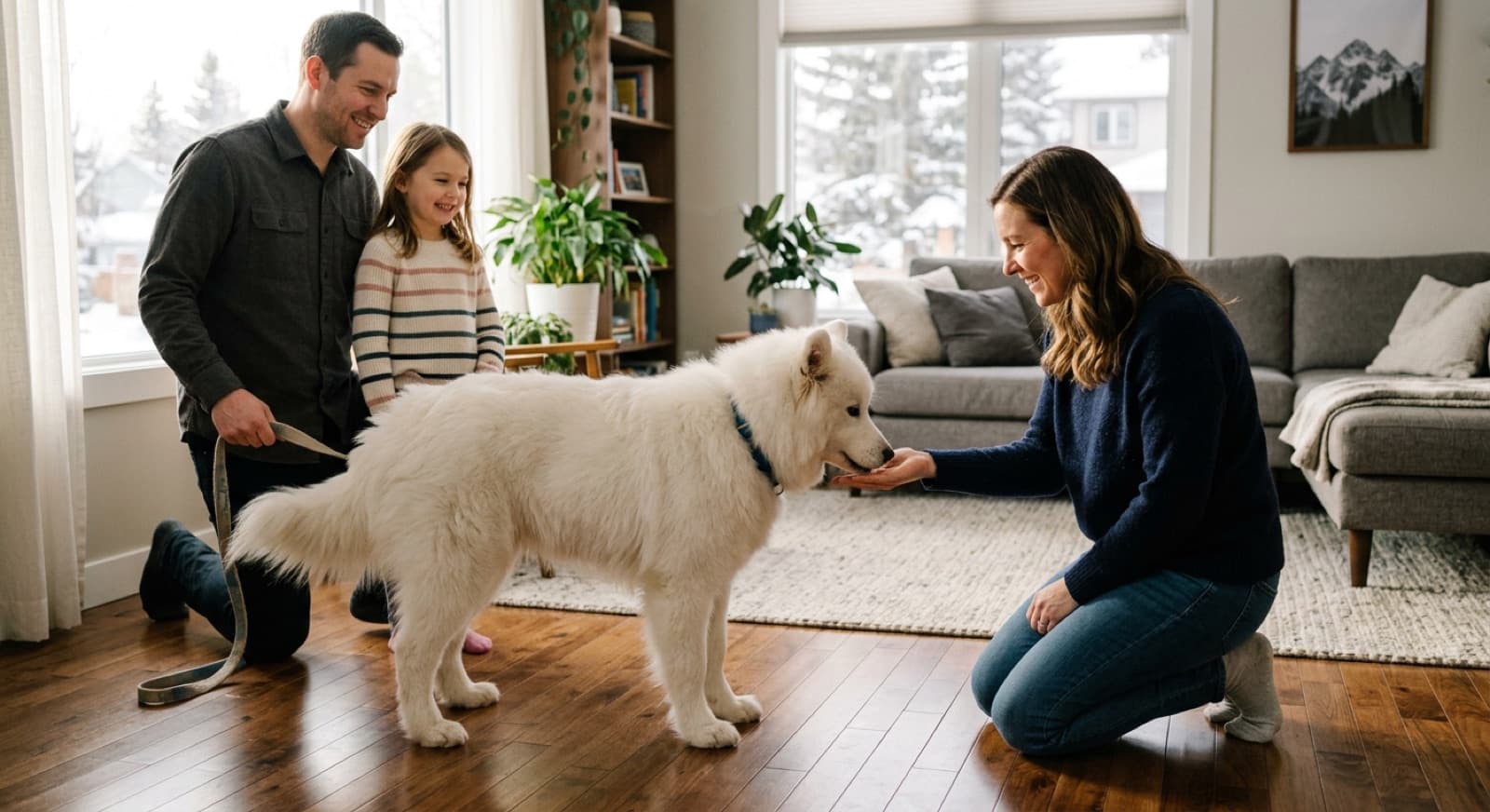
Adult versus puppy: which Samoyed is right for you?
For most Calgary adopters, an adult Samoyed with a known temperament from a foster home is the safer fit. Most rescue Sams in Alberta are 1 to 5 year old young adults surrendered by owners who could not keep up with the workload. These dogs are typically well past the puppy chaos, already house-trained, and have known compatibility with kids, cats, or other dogs from their foster placements.
Why the adult-from-foster path tends to work best:
- Known coat and shedding pattern. A 3-year-old foster Sam has been through at least one full coat blow. The foster can tell you what to expect at home.
- Known vocalness. Some Sams talk constantly; others are relatively quiet. A foster knows which one you are bringing home.
- Known separation tolerance. The foster knows how the dog handles 4 hours alone versus 8 hours alone.
- Skip the puppy socialization race. The 6 to 16 week window is the most critical period for any working breed; if it was handled well in the past, the adult dog reflects that work already.
- Lifespan math still favours the adult. A 3-year-old Samoyed adopted today has 9 to 11 years ahead, which is most of the dog's life.
Puppies make sense if you specifically want to shape socialization from week 8, you have the flexibility for 12 to 18 months of structured training, and you have prior experience with vocal working breeds. The Samoyed puppy waitlists with ethical Canadian breeders run one to three years, so most Calgary “Samoyed puppy” adopters end up either waiting that long or unintentionally buying from a backyard source. For first-week guidance once your dog arrives, see Bringing home a Samoyed: the first 30 days.
Common Samoyed mixes in Calgary rescues
Most Calgary “Samoyed” listings are mixes. Be honest about this when you set your expectations. Mixes are still excellent dogs, and in many ways they make better family pets than purebreds, but daily life with each mix is genuinely different.
- Samoyed-Husky: the most common Sam-adjacent listing in Calgary. Higher prey drive than a purebred Sam, more independent, often an escape artist. Coat is dense but typically not as fluffy. Best for active households with a securely fenced yard.
- Samoyed-Golden Retriever: friendlier-than-purebred temperament, slightly easier to train, similar grooming workload. Coat tends to be cream or biscuit. Often the best Sam mix for first-time owners.
- Samoyed-Border Collie: very high drive, very vocal, very smart. Needs structured exercise and mental work daily. Best for owners with prior working-dog experience.
- Samoyed-Eskimo or Samoyed-Spitz: visually closest to a purebred Sam, often slightly smaller, similar grooming.
- Samoyed-mix of unknown origin: the most common label on Calgary rescue intake. Ask for the foster's temperament notes and read them carefully before applying. The notes matter more than the breed label.
The realistic message: if you want a fluffy white dog who smiles, plays in the snow, and bonds hard with the family, several mixes deliver almost exactly that experience. Holding out for a purebred can mean waiting one to three years on a breeder list or paying a premium for a dog whose lineage cannot be verified.
Buying versus adopting: reading the Kijiji listings
For most Calgary households, adoption is the right starting point. The math is straightforward: a $400 to $800 rescue fee with a vetted, spay-neutered, foster-evaluated dog versus $3,000 to $8,000 for a breeder puppy with a one to three year wait.
The case for rescue is strongest when:
- You want a known adult temperament rather than rolling the dice on a puppy.
- You can accept “Samoyed mix” rather than “purebred Samoyed.” Most rescue Sams in Calgary are mixes.
- You want to keep one more dog out of the surrender cycle that hits this breed hard between ages 1 and 3.
- You do not want to wait one to three years on a breeder list.
The case for an ethical breeder is real but narrow. It applies when:
- You need a verifiable health-screened puppy (Samoyed Hereditary Glomerulopathy, hip OFA, eye CERF, thyroid panel).
- You are prepared to wait one to three years and budget $3,000 to $8,000.
- You want to shape socialization from week 8 in a household with specific exposure goals (kids, other dogs, busy public spaces).
How to vet a Samoyed breeder in Canada:
- Verify Canadian Kennel Club registration on the breeder, not just the puppy.
- Ask for parent health clearances in writing: hip OFA, eye CERF or OFA, thyroid, plus a Samoyed Hereditary Glomerulopathy genetic test on the sire.
- Visit the home or request a live video tour of where puppies are raised.
- Expect the breeder to interview you. Breeders who do not ask questions are a red flag.
- Confirm a written take-back contract. Ethical breeders take their dogs back at any age, for any reason.
- Reference the breeder against the Samoyed Association of Canada code of ethics breeder list.
Now the warning. The most common Calgary search for this breed is some version of “Samoyed puppy for sale Calgary cheap.” Almost every listing under $2,000 is a problem. The realistic picture:
- $500 to $1,500 “Samoyed” on Kijiji: almost always a Husky-Eskimo mix, an undocumented backyard litter, or an outright scam asking for a deposit on a dog that does not exist.
- $1,500 to $2,500 “purebred” with no health clearances: typically a commercial breeder or puppy mill that runs the dogs hard and surrenders the burnt-out parents to rescue around age 4 to 6.
- $3,000 to $8,000 from a CKC member breeder with documented testing: the realistic ethical Canadian floor. Yes, the price is high. The math reflects health testing, breeder vet costs, careful pairing, and a take-back lifetime obligation.
- “Mini Samoyed” or “Teacup Samoyed”: not a real variation. The marketing usually covers an Eskimo or American Eskimo Dog being sold at a premium.
The rescues we work with see most of these “cheap Samoyed” dogs land in shelter intake within 18 months. The dog is the casualty. Skip Kijiji, Facebook Marketplace, and pet-store listings entirely. If a puppy is the only acceptable outcome, wait the one to three years on a Samoyed Association of Canada breeder list.
Calgary climate fit: winter ideal, summer demanding
Samoyeds were developed in Siberian temperatures well below -30°C. Calgary winters are easy for this breed. A well-conditioned Sam will choose snow over the couch, handle routine winter walks below -20°C without booties on packed surfaces, and run happily at Nose Hill Park, Fish Creek Park, Bowmont Park, Edworthy Park, or Tom Campbell's Hill through the coldest months. Watch for road salt irritation on Beltline and Inglewood sidewalks; a quick paw rinse on return solves it.
Summer is the harder season. Above 20°C most Sams start to slow down. Above 25°C the heat-stroke risk is real. The double coat insulates against heat as well as cold, but only when the undercoat is properly maintained. Practical Calgary summer routine:
- Walk before 8am or after 8pm during July and August.
- Check pavement temperature with the five-second rule before walking. If the back of your hand cannot rest on it for five seconds, it is too hot for paws.
- Brush out the undercoat thoroughly during spring blow so the coat insulates correctly. Never shave a Samoyed; the undercoat is the insulator and removing the guard coat increases sunburn risk and worsens heat regulation.
- Provide shade and constant water on patios. Sams will not always self-regulate when they are excited.
- Watch for early heat-stroke signs: heavy panting, brick-red gums, stumbling, lethargy. Wading in the Bow River pathway or at Sandy Beach is good for cooling, but supervise carefully.
Our dedicated Samoyed summer heat safety guide covers the schedule, gear, and emergency response in more detail.
Browse adoptable Samoyeds in Calgary
See current Samoyeds and Samoyed mixes across 15+ Calgary rescues in one place. Inventory updates regularly, so set up notifications and apply quickly when a listing appears.
See Available Samoyeds →Frequently Asked Questions
Where can I adopt a Samoyed in Calgary?↓
How much does it cost to adopt a Samoyed in Calgary?↓
Why are purebred Samoyeds rare in Calgary rescue?↓
Why do Samoyeds end up in rescue?↓
Are Samoyeds good first-time dogs in Calgary?↓
How long do Samoyeds live?↓
What Samoyed mixes show up in Calgary rescues?↓
Are Samoyeds good in Calgary winters?↓
Can a Samoyed handle Calgary summers?↓
Should I adopt a puppy or adult Samoyed?↓
Continue reading
Is a Samoyed right for you?
Household honesty test, lifestyle fit, and the questions every Calgary adopter should answer before applying.
Samoyed grooming and shedding
Weekly brushing routine, coat-blow season, professional grooming costs, and why you should never shave a Sam.
Samoyed summer heat safety
Calgary summer schedule, gear, early heat-stroke signs, and the cooling routine every Sam owner should run.
Bringing home a Samoyed
The 3-3-3 decompression timeline, grooming setup, vocal management, and the first month routine for a Calgary Sam.
Samoyed health issues
Hereditary Glomerulopathy, diabetes, PRA, cataracts, hip dysplasia, and what to ask the vet at each life stage.
Separation anxiety and barking
Why Sams struggle with alone time, vocal management for shared-wall Calgary homes, and the training plan that works.
New dog? Start with these care guides
Everything a new adopter needs to set up a safe, happy home.