The short answer
Calgary July averages 22 to 26°C and regularly hits 30°C or higher. Samoyeds were built for Siberian winters, and the dense double coat insulates against heat the same way it insulates against cold. Plan around four thresholds: below 20°C is normal exercise, 20 to 25°C means morning and evening only, 25 to 30°C is indoor or shaded routine, and above 30°C is no outdoor exercise. Test pavement with the seven-second rule. Never shave the coat. Watch for excessive panting, bright-red gums, drooling, weakness, or collapse, and treat heat stroke as an emergency vet visit even after the dog seems to recover.
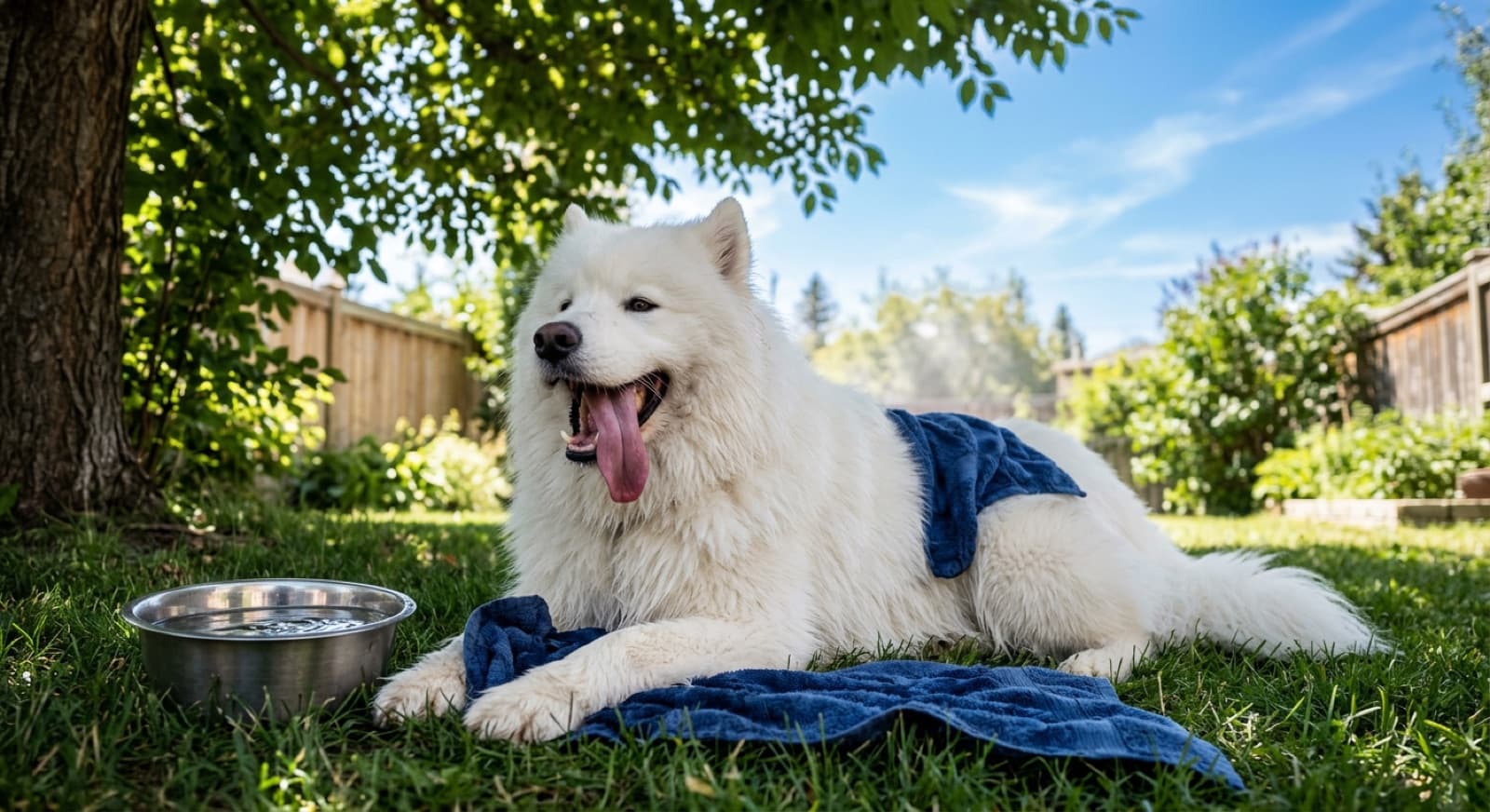
Samoyeds are the most weather-mismatched breed in Calgary. They love our winters more than almost any other dog. They struggle with our summers more than most owners expect. The same coat that makes them happy at -30°C makes them dangerously hot at 25°C. This guide is built for Calgary specifically: our July heat dome stretches, our chinook spikes, our river pathways, and the daily schedule that keeps a Samoyed safe from May through September.
Why Samoyeds suffer in heat
The Samoyed evolved with the Samoyedic peoples of Siberia. The breed was built to herd reindeer, pull sleds, and sleep with the family on top of children for shared body heat. The coat is the single most important adaptation. The dense, woolly undercoat traps a layer of insulating air against the skin. The longer, straight guard hairs above it deflect snow, sun, and wind. Together they create a thermal envelope that works brilliantly down to -40°C.
The same envelope works against the dog in summer. Heat from the sun, from pavement, and from the dog's own body cannot easily escape through that double layer. Dogs do not sweat through their skin the way humans do. The primary cooling surfaces are the mouth (panting moves air over saliva-coated tongue tissue, which evaporates heat) and the paw pads (which are sparse sweat glands). Both are limited. A working Samoyed running a sled team at -20°C can dump heat efficiently. The same Samoyed standing on hot asphalt at 28°C cannot.
Add Calgary's elevation. We sit at 1,045 metres above sea level, which means thinner air and stronger UV exposure than dogs at sea level get. A Samoyed in a Calgary backyard on a 25°C day is dealing with more direct solar load than a Samoyed in Vancouver at 25°C, even when the thermometer reads the same.
Temperature thresholds for Calgary Samoyed owners
These are working thresholds based on Calgary climate, breed physiology, and what experienced Calgary Samoyed owners report. Treat them as the starting point. Adjust cooler for puppies, seniors, dogs with underlying conditions, and humid days.
| Ambient temperature | Risk level | What to do |
|---|---|---|
| Below 20°C | Normal | Regular walks, hikes, off-leash time, and play. Most comfortable range for the breed. |
| 20 to 25°C | Caution | Shift to morning and evening. Shorter sessions. Carry water. Watch panting closely. Avoid midday sun. |
| 25 to 30°C | High risk | Indoor or shaded only. Skip pavement entirely. Sunrise walks and after-8pm cool-downs. Midday is for indoor enrichment. |
| Above 30°C | Emergency prevention | No outdoor exercise. AC if possible. Cool floors, cooling mats, frequent water, monitor closely. Vet if any heat stress signs. |
The thresholds tighten quickly when humidity climbs. Calgary is dry most summers, but the occasional thunderstorm humidity push or smoke event from BC wildfires changes the math. On a humid 22°C smoky day, treat the dog like it is 28°C. Panting is less effective when the air is already saturated.
The Calgary summer daily schedule
A working Calgary summer routine for a Samoyed looks different from spring or fall. The schedule below is what most experienced Samoyed owners we work with use during the July and August stretches:
- 5:30 to 7:00 am. Main outdoor session. Sunrise walks along the Bow River pathway, off-leash time at Nose Hill Park before the sun gets high, or a wade at Sandy Beach. This is your one guaranteed exercise window most days.
- 7:00 to 10:00 am. Breakfast, indoor rest, light enrichment (puzzle feeders, frozen Kongs, sniff games on cool tile floors).
- 10:00 am to 6:00 pm. Indoor. AC if you have it; closed blinds and cool basement floor if you do not. This is enrichment, training, and rest time, not walk time.
- 6:00 to 8:00 pm. Continue indoor on a typical day. If the temperature has dropped to high teens and the sun is behind the buildings, a short shaded-pathway walk is fine.
- 8:00 to 10:00 pm. Second outdoor session if temperatures have dropped below 22°C. Edworthy Park shaded trails work well as the sun sets. Glenmore Reservoir pathway is a favourite late-evening route.
Mental exercise matters more than physical exercise in a Samoyed summer. A 20-minute scent game, a frozen treat puzzle, or a training session indoors tires a Samoyed out as effectively as a long walk and avoids the heat completely. Our Samoyed separation anxiety and barking guide covers the indoor enrichment options Samoyed owners lean on year-round.
Cooling protocol: what actually works
Samoyeds respond well to a layered cooling strategy. Stack two or three of these on a hot day rather than relying on one:
- Paddling pool in the yard or on the patio. A shallow plastic kiddie pool with 10 to 15 cm of cool water lets a Samoyed cool the belly, groin, and paws (the surfaces that actually shed heat). Most Sams will lie down in it on a hot day without prompting.
- Cooling mats. Gel-filled or self-cooling mats placed on the floor give a cool surface for resting. Replace warm mats every few hours.
- Frozen Kong or puzzle. Wet kibble, plain yogurt, or a low-sodium broth frozen into a Kong gives mental enrichment and core cooling at the same time. Works year-round.
- Wet towels on cooling surfaces. Damp (not soaking) towels over the paw pads, groin, and armpits transfer heat efficiently. Do not drape a wet towel over the back. The undercoat traps the wet against the skin and can actually slow cooling.
- Frozen water bottles in the bed. A frozen 1L bottle wrapped in a thin towel placed in the dog's usual rest spot gives them a cool surface to choose.
- Tile or concrete floors. Calgary basement concrete is often 18 to 20°C even on a 30°C day. Encourage rest in cool rooms.
- Air conditioning. If you have AC, use it. If you do not, a single window AC unit in the room where the dog sleeps is worth the investment for a Samoyed household.
- Fresh cool water everywhere. Multiple bowls. Refresh frequently. Ice cubes are fine in moderation; some Sams enjoy crunching them.
Heat stress recognition: the warning signs
Heat stress moves in stages. Early signs are reversible with shade, rest, and water. Late signs need a vet. Memorize the early signs so you can act before it becomes an emergency.
Early signs (act now, cool the dog):
- Heavy, fast panting that does not slow with rest
- Thick, ropy drool
- Bright pink or red gums (normal gums are bubblegum pink, not red)
- Slowing down, lagging behind, refusing to walk
- Seeking shade repeatedly, lying down in unexpected places
- Hot ears or paw pads to the touch
Late signs (emergency, vet immediately):
- Stumbling, weakness, or wobbly gait
- Vomiting or diarrhea (sometimes with blood)
- Confusion or unresponsiveness
- Bright red or purple gums
- Body temperature above 40°C (104°F) if you have a thermometer
- Collapse, seizure, or unconsciousness
The American Veterinary Medical Association hot weather safety guidance is clear on the threshold: body temperature above 41°C is life-threatening and can cause organ damage within minutes. By the time you see collapse, you have a narrow window.
Emergency response: what to do if your Samoyed overheats
If you see late-stage heat stress signs, follow this sequence:
- Move to shade or AC immediately. Even five degrees of ambient drop helps.
- Wet the cooling surfaces with cool (not ice-cold) water. Paw pads, groin, armpits, belly, and ears. Cool tap water is right; ice water is not.
- Do not use ice or ice packs directly. Severe cold causes peripheral blood vessels to constrict and traps heat in the core, which is the opposite of what you need. AVMA guidance recommends cool-water immersion or evaporative cooling over ice.
- Offer small amounts of cool water. Do not force-drink. Vomiting will make things worse.
- Call the vet on the way. Calgary 24-hour emergency clinics include Western Veterinary Specialist Centre and CARE Centre Animal Hospital. Tell them you are en route with a suspected heat stroke. They can prep IV fluids and cooling equipment before you arrive.
- Go to the vet even if the dog appears to recover. Heat stroke causes internal damage that does not show externally for 24 to 48 hours. Kidney failure, clotting disorders, and brain swelling are documented late complications. Bloodwork and IV support during the window after a heat event significantly improve outcomes.
Do not put a Samoyed in a cold-water bath unless they are fully alert. The shock can worsen the situation in an already unstable dog. Cool-water immersion is appropriate but should be supervised by a vet when possible.
Why you must never shave the coat
Calgary groomers see this every spring. An owner with an overheated Samoyed asks for a shave to keep the dog cool. The result is the opposite of what they hoped, and sometimes the coat never grows back the same.
The double coat works as a two-way insulator. The undercoat traps a layer of cool air against the skin in summer, in the same way it traps warm air in winter. The guard coat reflects UV and direct sun. Shaving removes both. The pink skin underneath is now exposed to direct Calgary UV, which is intense at our elevation. Sunburn is the immediate risk. Heat stroke risk often goes up, not down, because the dog has lost the air-trapping undercoat that was actually doing the cooling.
The second issue is shave shock. In some Samoyeds, the double coat grows back patchy, with the undercoat dominating and the guard coat never fully returning. The dog ends up with a permanently fuzzy, fluffy texture that traps moisture and is harder to maintain. There is no reliable way to predict which dogs will be affected.
The right summer grooming approach is to brush the undercoat out thoroughly during spring coat blow (typically May and June in Calgary), which removes the heaviest insulation while preserving the structural guard coat. Our Samoyed grooming and shedding guide covers the exact tools and frequency that work for Calgary's shed cycle.
Calgary summer venues that work for Samoyeds
The right venue at the right time of day makes a big difference. Calgary has several spots that work well for a Samoyed during summer:
- Bow River pathway (early morning). The riverside pathway from Edworthy Park east through Sandy Beach to Stampede Park is shaded for long stretches and gives river access at multiple points. Best between 5:30 and 8:00 am.
- Sandy Beach. Off-leash river access on the Elbow River. The current is mild and shallow at the beach itself, which is ideal for a Samoyed wade. Park along 14A Street SW.
- Glenmore Reservoir at dawn. The pathway loop runs about 16 km. The reservoir-side stretches are cool well into morning and the breeze off the water helps.
- Edworthy Park shaded trails. The Douglas Fir trail and the lower river paths stay shaded much of the day. Late afternoon and evening work well here as the sun drops behind the ridge.
- Nose Hill Park (early morning only). Open prairie with no shade once the sun is up. Strictly a sunrise venue in July and August.
- Indoor doggy daycare for hot afternoons. When you have to work and the house has no AC, an air-conditioned daycare for an afternoon is a legitimate Samoyed safety move on 30°C+ days, not a luxury.
- Cool basements. If you have one, this is where your Samoyed will probably spend most of July anyway. Lean into it.
Avoid Stampede Park crowds during the second week of July. The combination of heat, asphalt, and crowds is the worst-case Calgary summer environment for a Samoyed. If you must be there, carry the dog through pavement stretches or skip it.
Pavement and paw protection
Asphalt heats up much faster than air. On a 25°C day in direct Calgary sun, blacktop can hit 45°C. On a 30°C day, asphalt can reach 50 to 55°C. Paw pads burn at sustained contact temperatures above 50°C, and the damage can range from blistered pads to deep tissue burns.
The seven-second rule is the simplest field test. Press the back of your hand flat on the pavement for seven seconds. If you cannot hold it, your Samoyed cannot walk on it. Apply the test every time you are unsure, especially on south-facing sidewalks that absorb the most sun.
Practical paw protection for Calgary summers:
- Walk on grass, dirt, or shaded path surfaces. Even within a city walk, route around long asphalt stretches.
- Booties. Quality summer booties (not the winter ones) protect from hot pavement. Most Samoyeds tolerate them with a few days of practice.
- Pup Wax or Musher's Secret. Wax-based paw balm provides some protection on moderately warm pavement. Not a substitute for booties on 50°C asphalt.
- Walk on the grass strip between sidewalk and curb. Often shaded and cooler than the concrete.
- Carry water for paw rinse. Cool water poured over paw pads after a walk helps if the dog has been on warm pavement.
- Check pads after every summer walk. Pink or reddened pads, limping, or licking are early signs of pavement burn.
Senior Samoyeds in Calgary summers
Senior Samoyeds (typically 8 years and older) have lower heat tolerance for several stacking reasons. Cardiac output drops slightly with age, which reduces the dog's ability to move warm blood from the core to the cooling surfaces. Hip and elbow arthritis often worsens in heat, so a senior may already be uncomfortable before any heat stress kicks in. Cognitive changes can mean a senior dog does not self-regulate as well as a younger one. They will keep walking when they should stop.
Adjust the thresholds for a senior Samoyed:
- Treat 22°C as the avoid-pavement threshold instead of 25°C.
- Skip outdoor exercise above 25°C entirely. The morning walk goes to 5:30 am or it does not happen.
- Provide a paddling pool or cooling mat as a default summer fixture, not an emergency tool.
- Watch for confusion, weakness, or sudden refusal to walk on warm days. These can appear at lower temperatures in older dogs.
- Talk to your vet about whether the dog's arthritis medication needs a summer adjustment.
- Senior bloodwork in late spring catches issues that summer heat will exacerbate. Western Veterinary Specialist Centre and other Calgary clinics can run senior panels.
A senior Samoyed in Calgary summer can live a happy, comfortable life. It just requires more aggressive cooling and more conservative scheduling than a five-year-old Sam.
The chinook factor: surprise heat outside summer
Calgary's chinook winds are the wildcard. A chinook can spike temperatures from -20°C to +15°C in a matter of hours. Your Samoyed, who was happily lying in fresh snow in the backyard at breakfast, can be overheating on a 15°C afternoon walk by 3pm. The coat is mid-winter density. The dog's body is acclimated to cold. A sudden swing of 30+ degrees catches both off-guard.
The chinook risk windows are roughly October through March. Watch the forecast in those months and adjust on warm spike days:
- Shorten walks on the day of and the day after a major chinook spike.
- Skip the midday walk and shift to the cooler morning or late afternoon.
- Keep water available, including outside in a non-freezing bowl.
- Watch for panting and lying down on walks. These are clear signs even in winter.
- Carry a wet bandana for the dog's neck if a chinook hits during a planned long walk.
The same logic applies to surprise warm days in April and May. Calgary spring can hit 20°C while the dog still has full winter coat. Plan exercise around the cooler hours during the shoulder season transition. By the time the dog has shed the undercoat for summer (usually fully out by mid-June), the dog is better adapted for warm days. But for the two months before that, treat warm days like summer days.
Browse Samoyeds in Calgary
See current Samoyeds and Sammie mixes across 15+ Calgary rescues in one place. Live listings refresh regularly, so set up notifications and apply quickly when one appears.
See Calgary Samoyeds available now →Frequently Asked Questions
Is Calgary summer dangerous for my Samoyed?↓
At what temperature should I stop walking my Samoyed?↓
Should I shave my Samoyed in summer to keep them cool?↓
What are the early warning signs of heat stress in a Samoyed?↓
How do I cool a Samoyed who is overheating?↓
Can my Samoyed swim in the Bow River to cool down?↓
Are senior Samoyeds more vulnerable to Calgary heat?↓
What is the seven-second pavement rule?↓
Do chinooks create heat risk for Samoyeds in winter?↓
Continue reading
Samoyed grooming and shedding
Spring coat blow, brushing tools, and why a properly maintained double coat is your Samoyed's primary summer defence.
Samoyed health issues
Hip dysplasia, hereditary nephritis, eye conditions, and the Calgary vet specialists every Samoyed owner should know.
Samoyed adoption in Calgary
Where to find Samoyeds in Calgary rescue, adoption fees, why they are surrendered, and the rescue versus breeder reality.
Browse Calgary Samoyeds
Currently available Samoyeds and Sammie mixes across all 15+ Calgary rescues, refreshed regularly.
New dog? Start with these care guides
Everything a new adopter needs to set up a safe, happy home.