The short answer
Samoyeds typically live 12 to 14 years and weigh 35 to 65 lbs. The breed-specific health concerns every Calgary owner should ask their vet about are Samoyed Hereditary Glomerulopathy (SHG), an X-linked kidney disease unique to the breed that is often fatal in affected males by age 1 to 2; diabetes mellitus at elevated prevalence; eye disease including progressive retinal atrophy and hereditary cataracts; hip dysplasia; hypothyroidism; and cardiac conditions including subaortic and pulmonic stenosis. DNA testing and OFA screening reduce surprises at adoption.
Informational only, not medical advice. Consult your veterinarian for any health concerns specific to your dog.
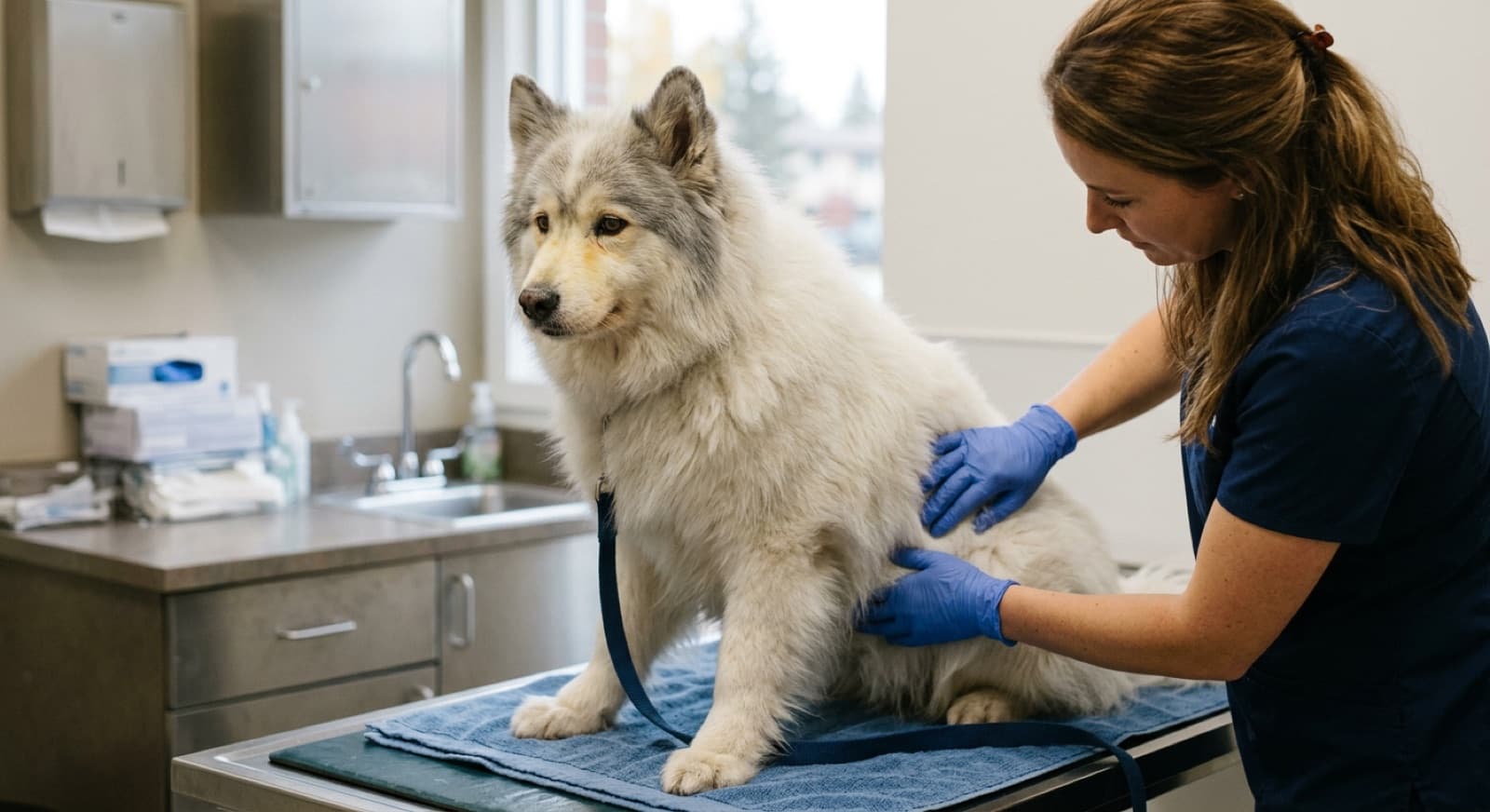
Samoyeds are bright, cheerful, double-coated working dogs with a health profile shaped by their northern heritage and a small breed-specific genetic pool. The American Kennel Club, the Samoyed Club of America Education and Research Foundation, and the AKC Canine Health Foundation all publish breed-specific health guidance highlighting kidney disease, endocrine, ophthalmic, and cardiac concerns. This article walks Calgary owners through what to ask your vet about at adoption and at every annual exam after that, what to watch for at home, and what belongs in the hands of a veterinarian rather than the internet.
Samoyed Hereditary Glomerulopathy (SHG): the breed-defining concern
SHG is an X-linked kidney disease found specifically in the Samoyed breed. Affected males develop progressive kidney failure by 1 to 2 years of age, often fatally. Carrier females develop a milder, later-onset form, typically in middle age (around 5 to 7 years or later). DNA testing is available, and asking about SHG status is one of the most important questions an adopter can put to a rescue or breeder.
SHG is an inherited disease of the glomerulus, the kidney filtering structure. The defective gene sits on the X chromosome, which gives the inheritance pattern its sex-linked character. Males have one X chromosome; if that X carries the SHG variant, the male is affected. Females have two X chromosomes; one healthy copy is generally enough to protect against the early-onset, severe form, but carrier females still develop a milder version of the disease later in life.
What to watch for, with same-day vet visit warranted:
- Sudden increase in thirst and urination in a young Samoyed (especially a male under age 2)
- Weight loss despite a normal appetite
- Reduced appetite or vomiting
- Lethargy or reluctance to exercise
- Pale gums or visible weakness
Diagnosis is by bloodwork (urea, creatinine, electrolytes), urinalysis (protein loss in the urine is an early signal), and sometimes kidney imaging or biopsy ordered by your vet. Internal medicine specialist consultation is common. Management is supportive and individualized; no medication cures SHG, and prognosis varies. Every treatment decision belongs with your Calgary veterinarian and the specialty team if referral is needed.
At adoption. Ask whether the rescue or breeder has SHG status documented for the dog, the parents, or any littermates. For a rescue Samoyed of unknown lineage, DNA testing through services such as Embark, Wisdom Panel, or veterinary genetics labs such as OptiGen can be discussed with your vet. For a male rescue puppy, early SHG status knowledge is the most valuable. For an adult female, status still informs long-term kidney monitoring priorities. Test results never substitute for ongoing veterinary care; they give your vet a head start.
Breeder note. Reputable breeders test breeding stock and avoid breeding carrier females to affected males, or breed only away from the trait entirely. If you are choosing between breeder and rescue, ask any breeder for documented SHG screening of both parents. Absence of documentation is itself an answer.
Diabetes mellitus in Samoyeds
The Samoyed is widely cited as having elevated diabetes prevalence compared to the general dog population. The AVMA owner reference on diabetes in pets describes the typical middle-age-onset picture. Diabetes is a lifelong condition that is manageable with daily commitment, but it changes the rhythm of the household and the budget.
Canine diabetes in Samoyeds is most commonly diagnosed between 5 and 10 years of age. The disease is characterized by inadequate insulin production or insulin resistance, which leaves blood glucose elevated. Unmanaged diabetes leads to weight loss, cataracts, urinary tract infections, and eventually diabetic ketoacidosis, which is a same-day Calgary emergency vet event.
Symptoms to discuss with your Calgary vet:
- Increased thirst (the water bowl empties noticeably faster)
- Increased urination (more frequent outside trips, larger volume, sometimes house-soiling in a previously trained dog)
- Weight loss despite a normal or increased appetite
- Lethargy or reduced enthusiasm for usual activities
- Cloudy eyes (cataracts develop quickly in diabetic dogs)
- Recurrent urinary tract infections
Diagnosis is by bloodwork (elevated glucose, fructosamine) and urinalysis (glucose and sometimes ketones in the urine) ordered by your vet. Management typically involves twice-daily insulin injections, a prescription diet, and regular glucose monitoring (sometimes home glucose curves, sometimes continuous glucose monitors). The specific insulin type, dose, monitoring schedule, and dietary plan are chosen and adjusted by your veterinarian. Self-adjusting insulin doses based on internet sources is genuinely dangerous; both hypoglycemia and hyperglycemia have serious consequences.
Calgary cost reality. Lifelong diabetes management involves insulin, syringes or pens, prescription diet, glucose curves, and more frequent vet visits than a healthy adult dog needs. Costs commonly run into thousands of dollars per year, with the exact figure depending on the insulin chosen, the dog’s weight, and monitoring intensity. Pet insurance enrolled before diabetes is diagnosed materially changes the math; insurance enrolled after diagnosis excludes diabetes as a pre-existing condition.
Owner-controllable prevention. Weight management is the single most important lever. Overweight Samoyeds carry a higher diabetes risk than lean ones, just as overweight dogs of any breed do. Body condition scoring at every Calgary vet visit, measured meals rather than free-feeding, and a regular exercise routine that respects winter cold and summer heat all matter.
Eye conditions: PRA, cataracts, and glaucoma
The Samoyed has several documented ophthalmic concerns: progressive retinal atrophy (PRA), hereditary cataracts, and glaucoma in some lines. Annual eye examinations, with results recorded in the OFA Eye Certification Registry where available, are reasonable for the breed.
Progressive retinal atrophy (PRA) is an inherited degenerative disease of the retina that causes gradual vision loss and eventual blindness. Early signs include reluctance to navigate in dim light, hesitation on stairs, and bumping into furniture in rooms the dog should know. DNA testing is available for some PRA variants through commercial labs such as Embark, Wisdom Panel, and OptiGen; the choice of which test and how to interpret it belongs with your vet. There is no cure for PRA, but Samoyeds adapt remarkably well to gradual vision loss in familiar home environments.
Hereditary cataracts are opacities in the lens that progress over months or years. They can develop in young adults or seniors. Diabetic Samoyeds develop cataracts quickly as a secondary consequence of diabetes, which is one more reason early diabetes detection matters. Diagnosis is by your vet or a referral ophthalmologist. Surgical correction is available at Calgary specialty centres when appropriate, and outcomes are generally good in healthy dogs.
Glaucoma is a sudden increase in intraocular pressure that is painful and can cause permanent blindness within hours if untreated. Emergency signs include a red eye, squinting, cloudy cornea, a visibly enlarged eyeball, or the dog pulling away when the head is touched near the eye. Glaucoma is a same-day Calgary emergency vet trip, not a wait-until-Monday situation.
Calgary owners can access veterinary ophthalmology through specialty practices such as VCA Canada West Veterinary Specialists and Western Veterinary Specialist and Emergency Centre. Your regular Calgary vet decides whether referral is appropriate and when.
Hip dysplasia in Samoyeds
Hip dysplasia is documented in the Samoyed and is included in OFA hip dysplasia breed statistics. Responsible breeders screen breeding stock through OFA or PennHIP. For rescue Samoyeds of unknown lineage, radiographs at your Calgary vet are reasonable at adoption, especially if the dog shows any gait irregularities.
Hip dysplasia is a developmental malformation of the hip joint where the ball and socket do not fit together correctly. Over time, the joint develops painful arthritis. The condition is influenced by genetics, growth rate, body weight, and exercise pattern during the growth phase. Samoyeds are a medium-sized breed with active working heritage, and the combination means hip health is part of long-term planning.
Symptoms to discuss with your Calgary vet:
- Bunny-hopping gait when running, where both rear legs push off together rather than alternating
- Reluctance to climb stairs, jump into the car, or get up onto the couch
- Hindlimb stiffness after rest that improves with movement
- Visible muscle wasting in the hindquarters
- A drop in willingness to walk far on Calgary off-leash trails or up the hills at Nose Hill Park
Diagnosis is by X-ray imaging scored against OFA or PennHIP standards, read by your Calgary vet or referral radiologist. Management ranges from conservative care (weight control, joint support recommended by your vet, physiotherapy, pain control your vet selects) through to surgical options for severe cases. Surgical decisions and rehabilitation plans belong with the specialty team at a Calgary centre such as Western Veterinary Specialist or another hospital your regular vet recommends.
Body weight is the most important owner-controllable factor. An overweight Samoyed puts more load through hips than a lean one of the same height. Body condition scoring on the 1 to 9 AVMA/WSAVA scale at every vet visit is more useful than the scale alone. Lean Samoyeds do better on every orthopedic measure across their lifespan.
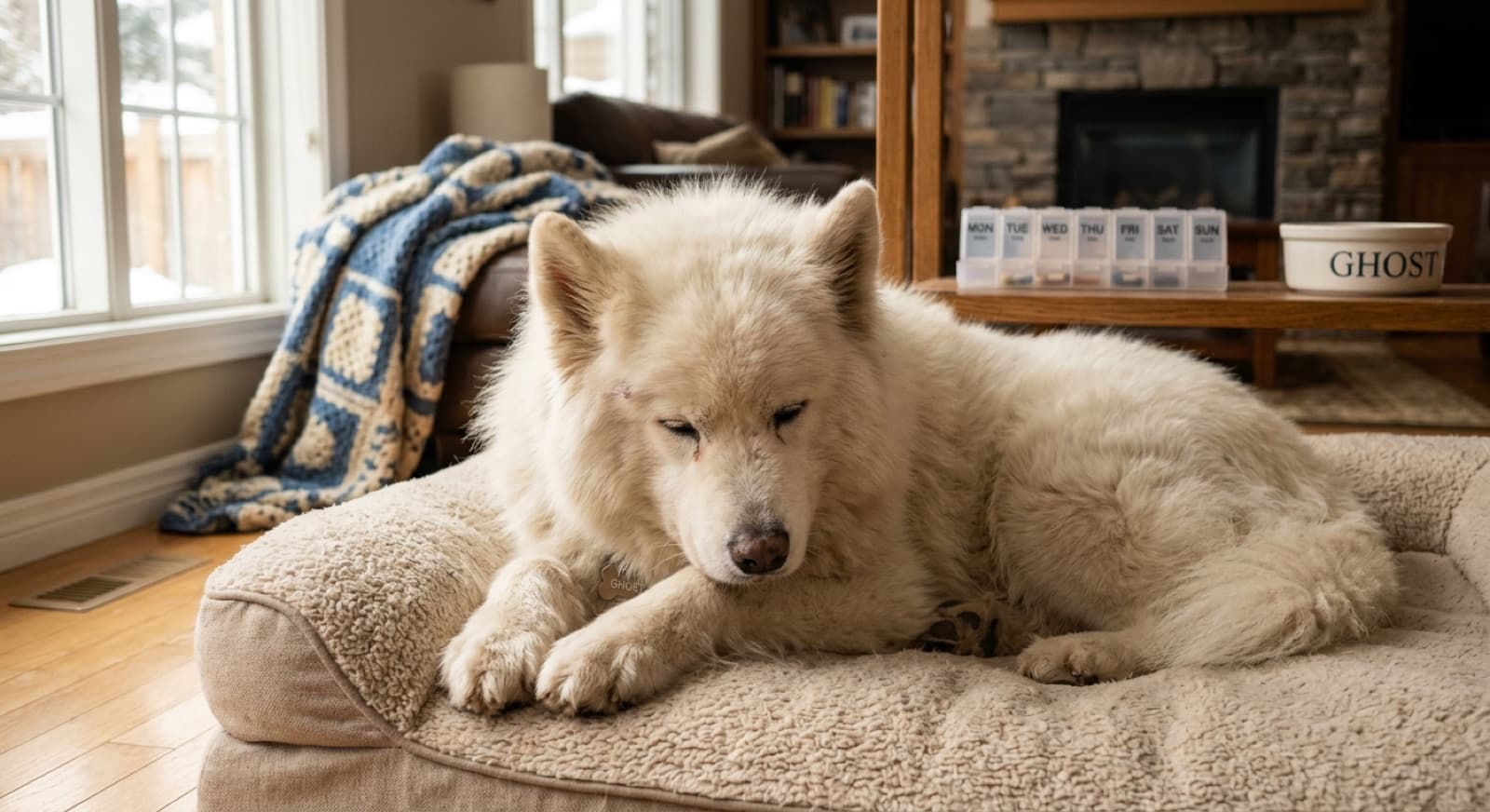
Hypothyroidism in older Samoyeds
Hypothyroidism is reported in Samoyeds alongside other northern double-coated breeds and is most commonly diagnosed in middle-aged and older dogs. The AVMA owner reference on canine hypothyroidism describes the typical presentation.
Symptoms to discuss with your Calgary vet:
- Unexplained weight gain on a normal diet
- Lethargy and reduced exercise tolerance
- Dry, flaky skin or a coat that thins and loses shine
- Symmetrical hair loss, especially on the flanks and tail
- Recurrent skin and ear infections that respond temporarily then return
- Cold intolerance, which is notable even in a breed bred for the Arctic
- Slower heart rate
- New anxiety, reactivity, or behavioural change
Diagnosis is by a full thyroid panel ordered by your Calgary vet, sometimes with confirmatory testing. Treatment is typically a daily oral thyroid hormone replacement, with formulation, dose, and recheck cadence chosen by your veterinarian. Treatment is usually lifelong. Do not start, stop, or adjust thyroid medication without vet direction. If your Samoyed is gaining weight or slowing down in mid-life more than typical aging would explain, ask your vet for a thyroid panel before assuming it is age.
Cardiac concerns: subaortic and pulmonic stenosis
Both subaortic stenosis and pulmonic stenosis are noted in the Samoyed breed. These are congenital narrowings near or within the heart valves that range from mild and clinically silent to severe and life-limiting. Annual cardiac auscultation at every vet visit is the practical first line of detection.
Subaortic stenosis (SAS) is a narrowing below the aortic valve that obstructs blood flow out of the left ventricle. Pulmonic stenosis is a similar narrowing on the right side, affecting blood flow to the lungs. Many cases are first identified as a heart murmur on routine auscultation, which is why having your Calgary vet listen carefully at every annual exam matters in this breed.
Signs that warrant a vet visit:
- Exercise intolerance or sudden refusal of activity the dog used to enjoy
- Fainting episodes (syncope), especially during or just after exercise
- Coughing at rest or unusual breathing patterns
- A heart murmur newly detected at a routine vet visit
- Lethargy disproportionate to age or activity
Diagnosis is typically by echocardiogram at a Calgary veterinary cardiologist, often after referral from your regular vet. Management depends on severity and lesion type; mild cases may need only monitoring, while moderate-to-severe cases may involve medication or interventional procedures, all chosen by the veterinary cardiology team. Breeding decisions for affected dogs are an entirely separate conversation that responsible breeders handle with cardiologist guidance.
If your Samoyed has a known cardiac diagnosis, exercise prescription, anesthesia planning for any future procedures, and dental work all involve the cardiology team. Calgary specialty cardiology is available at Western Veterinary Specialist Centre and VCA Canada West Veterinary Specialists.
Calgary veterinary access for a Samoyed
The single most useful thing a new Samoyed owner can do in the first week is build a Calgary veterinary plan before the dog has a problem. That means a regular vet you trust, a 24-hour emergency clinic identified and saved in your phone, and a short list of specialty referral options for the breed-specific conditions that may come up.
Calgary planning checklist:
- Regular vet: Choose a Calgary clinic with experience in medium double-coated working breeds. Ask whether the practice has worked with Samoyeds and is comfortable with the breed-specific kidney, endocrine, and ophthalmic priorities. Use the Canadian Veterinary Medical Association directory if you need a starting point.
- 24-hour emergency clinic: Calgary has several distributed across NW, NE, SW, and SE. Identify the closest one to your home, save the address, and drive the route once in daylight so the path is in your head.
- Specialty referral options: Calgary specialty centres including Western Veterinary Specialist and Emergency Centre and VCA Canada West Veterinary Specialists handle internal medicine, ophthalmology, cardiology, dermatology, and orthopedic surgery. You do not need to choose one in advance, but knowing they exist and that your regular vet can refer is useful.
- Pet insurance: Enrol while the Samoyed is young and symptom-free. Compare Canadian providers on deductible, reimbursement, per-condition limits, and whether conditions like diabetes or SHG are subject to any breed-specific exclusions.
- Microchip and ID: Standard for any dog and especially relevant during chinook windstorms or fireworks near Stampede.
- Calgary-specific seasonal preparation: Winter paw protection for ice melt on icy sidewalks, summer coat care (never shave a Samoyed flat), and a grooming kit for the spring and fall coat-blow seasons.
Pet insurance ROI for a Samoyed
Pet insurance is generally a strong consideration for Samoyeds because the breed health profile includes several conditions whose lifetime management cost can easily run into thousands of dollars. SHG kidney disease management, diabetes (twice-daily insulin and prescription diet for life), cataract surgery, hip dysplasia surgical consultation, and lifelong thyroid medication all add up. Any one of these conditions can change the calculation; combinations of two or three are not unusual in a 12 to 14 year lifespan.
The lever that matters most is enrolling early. Every Canadian provider excludes pre-existing conditions. A Samoyed enrolled at 8 weeks old with no symptoms qualifies for the broadest coverage; a Samoyed enrolled at 6 years old after a diagnosis of diabetes will have diabetes excluded from coverage indefinitely. Calgary premiums vary by provider, age, and breed, so request real quotes from several Canadian insurers and compare deductible, reimbursement (typically 70 to 90 percent), and per-condition versus annual limits side by side.
Questions to ask any insurer before enrolling a Samoyed:
- Are hereditary and congenital conditions covered, or excluded?
- Are bilateral conditions (both eyes for cataracts, both hips for dysplasia) treated as one claim or two?
- Is there a per-condition lifetime cap or only an annual cap?
- How are pre-existing conditions defined, and what counts as evidence of pre-existence?
- Are diagnostics (bloodwork, urinalysis, imaging) covered, or only treatments?
Samoyed screening schedule by life stage
The breed-specific conditions above each have a typical onset window, which gives a reasonable framework for what to ask your Calgary vet about and when. The specific tests, the timing, and any modifications based on your individual dog’s history are decisions for your veterinarian.
Puppy (under 12 months):
- Standard vaccination series, parasite prevention, neuter or spay conversation
- SHG DNA testing conversation, especially for males of unknown lineage
- PRA DNA testing conversation
- Cardiac auscultation at every visit (congenital lesions often detected here)
- Body condition scoring established as a baseline
Young adult (1 to 4 years):
- Annual wellness exam with full physical and dental check
- Annual cardiac auscultation
- Baseline bloodwork including kidney values, especially for males
- Annual eye exam (OFA Eye Certification where available)
- Hip radiograph conversation if any gait irregularity appears
Middle-aged (5 to 8 years):
- Annual or twice-yearly wellness exams
- Annual full bloodwork including thyroid panel and kidney panel
- Diabetes screening (fasting glucose, urinalysis) if any symptoms appear
- Annual eye exam
- Cardiac auscultation; echocardiogram if any new murmur is detected
Senior (8+ years):
- Twice-yearly wellness exams
- Full senior bloodwork twice yearly
- Annual eye exam (cataracts and glaucoma can develop in seniors)
- Cancer screening conversations; new lumps or lameness warrant prompt vet visits
- Joint support and mobility aids: orthopedic bed, traction rugs on hardwood, ramps for stairs and the car
- Body condition scoring at every visit (overweight seniors do worse on every front)
- Quality-of-life conversations started long before they feel needed
Emergency signs that warrant immediate vet attention
These signs are same-day Calgary emergency vet visits. Do not wait, do not Google, do not ask the rescue’s Facebook group. Drive to your nearest 24-hour clinic and call ahead so they are ready.
Kidney signs (suspect SHG or acute kidney injury):
- Sudden severe increase in thirst and urination in a young Samoyed
- Vomiting plus reduced appetite and lethargy
- Pale gums or visible weakness
Diabetes-related emergencies:
- A diagnosed diabetic Samoyed who suddenly becomes weak, disoriented, or collapses (possible hypoglycemia from too much insulin or skipped meal)
- A diagnosed diabetic with vomiting, severe lethargy, and rapid breathing (possible diabetic ketoacidosis)
Eye emergencies:
- Sudden cloudiness, blue-grey corneal change, or a film over the eye
- Persistent squinting, especially with redness or swelling
- A visibly enlarged or painful eye (possible glaucoma)
- Sudden vision loss in an apparently healthy dog
Cardiac emergencies:
- Fainting or collapse, especially during or just after exercise
- Sudden breathing difficulty, blue-tinged gums, or open-mouth breathing at rest
- A diagnosed cardiac patient who suddenly worsens
Heat-related emergencies. Despite the cold-adapted heritage, Samoyeds can overheat in Calgary summer because the double coat traps heat. Excessive panting that does not settle, drooling thicker than usual, bright red or pale gums, weakness, vomiting, disorientation, or collapse all need a same-day emergency vet visit. For the full summer-safety playbook, see our Samoyed summer heat safety guide; never shave a Samoyed flat to keep them cool.
Considering a Samoyed in Calgary?
The health profile above is the conversation every Samoyed adopter should have with their vet at the first visit, not the third. Browse adoptable Samoyeds in Calgary and read the matching breed-fit guides before you bring the dog home.
See Calgary Samoyeds available now →Frequently Asked Questions
What are the most common Samoyed health problems?↓
What is Samoyed Hereditary Glomerulopathy (SHG)?↓
Are Samoyeds prone to diabetes?↓
What eye conditions affect Samoyeds?↓
Do Samoyeds get hip dysplasia?↓
Are Samoyeds prone to hypothyroidism?↓
What cardiac issues are seen in Samoyeds?↓
How long do Samoyeds live?↓
Is pet insurance worth it for a Samoyed?↓
Should a rescue Samoyed be DNA tested for SHG?↓
Continue reading
Samoyed adoption Calgary
The full Calgary Samoyed adoption guide: rescues, costs, lifespan reality, why Sams end up in rescue, and where to apply.
Is a Samoyed right for you?
Honest Calgary self-assessment: coat work, exercise needs, vocal tendencies, climate fit, and who the breed is really for.
Samoyed grooming and shedding
Brushing schedule, coat-blow management, professional grooming costs, and why you never shave a Samoyed.
Browse Calgary Samoyeds
Currently available Samoyeds and Sam mixes across Calgary rescues, refreshed regularly.
New dog? Start with these care guides
Everything a new adopter needs to set up a safe, happy home.