The short answer
For most Calgary adopters, the Samoyed is right if four conditions hold. One: someone is home most days (work-from-home, retired, flexible schedule, or daycare-funded). Two: daily brushing sounds like a calm ritual, not a chore. Three: you accept the summer reality above 20C and adjust your routine. Four: you can budget $500 to $1,200 a year for grooming on top of food and vet care. The breed is gentle with kids, generally non-aggressive, exceptionally winter-built, and one of the friendliest Arctic working dogs. The deal-breaker is the workload, not the temperament. If those four conditions fit, keep reading. If even one is shaky, our resources hub covers steadier first-dog options.
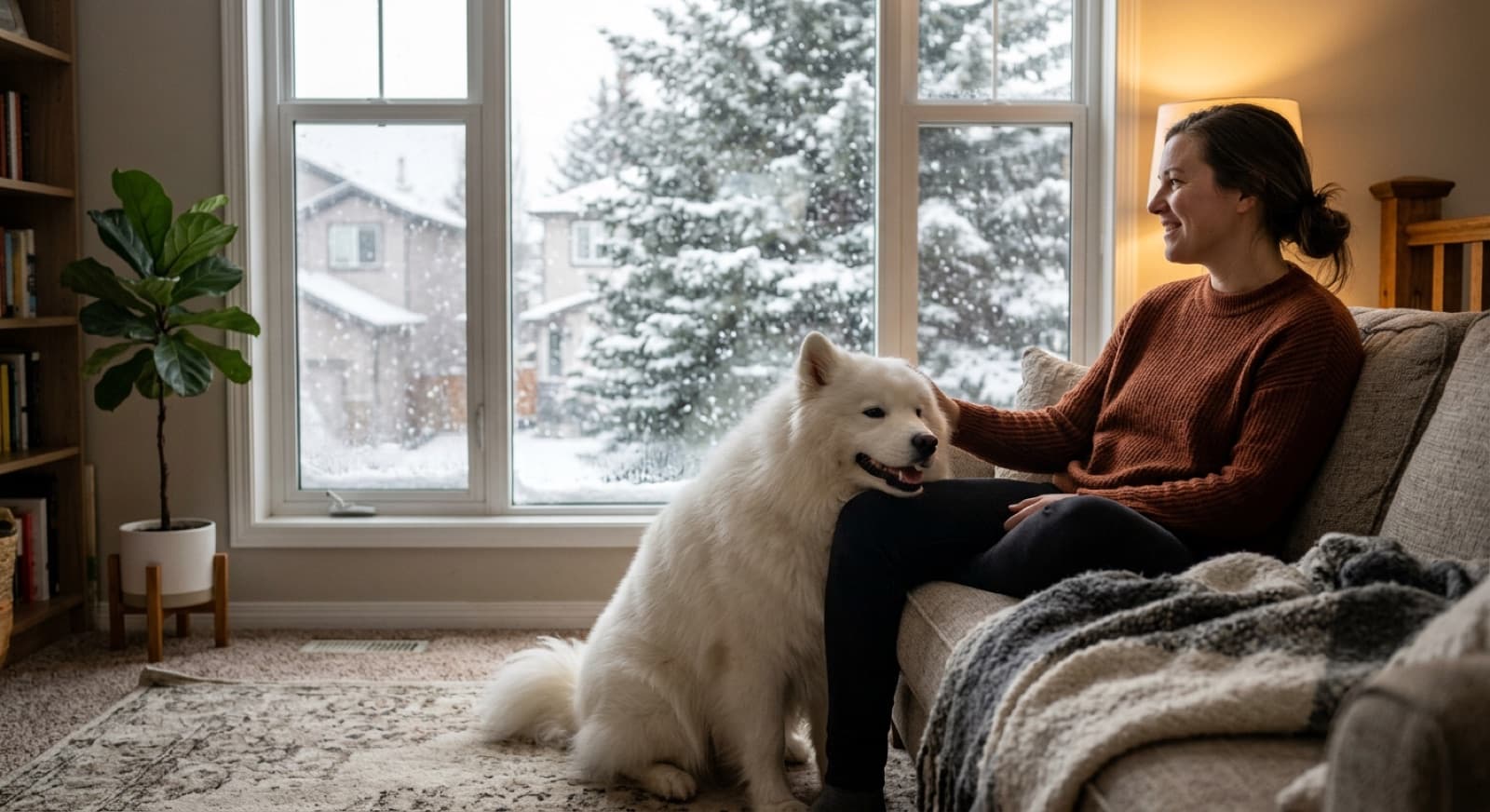
Honest Pros: Why People Love the Samoyed
Genuinely winter-built
The Samoyed was bred by the Samoyedic people of Siberia for sledding, herding reindeer, and sleeping inside the family tent for warmth. The breed thrives in a Calgary winter the way most dogs thrive in spring. -20C with light snow is a great walk day. -30C with the right paw protection is still workable. If you are a winter-loving Calgarian who walks year-round at Nose Hill or along the Bow River pathway, the Samoyed is one of the best breed matches in the country.
Gentle with kids and family-oriented
Samoyeds were raised inside Siberian family tents alongside children, and the family-bonded gentleness shows. Most Samoyeds are patient with kids, tolerate household noise, and love being included in family activity. They are not aloof, not standoffish, and not one-person dogs. The breed wants to be in the room with you. For a 35 to 65 lb dog, the social fit with active families is exceptional.
Intelligent and trainable with the right method
Samoyeds are smart, problem-solvers, and quick to learn. The catch: they are also independent thinkers from a working-dog heritage, so they ask “why” before complying. Force-free positive-reinforcement training works beautifully; old-school dominance training backfires. With a force-free trainer like Raising Canine or Pup City Pup Academy, most Samoyeds master basic obedience quickly and enjoy ongoing trick training as enrichment.
Generally non-aggressive
The Samoyed is one of the least aggressive breeds in dogdom. The breed was bred to live in close quarters with people and other dogs in Siberian camps, and aggression toward humans was selected out for centuries. Most Samoyeds are friendly with strangers, dog-social, and gentle in handling. This makes the breed approachable to first-time large-breed owners who may be intimidated by guarding breeds.
Beautiful and conversation-starting
No way around it: Samoyeds turn heads. The fluffy white coat, the famous “Sammy smile,” and the plumed tail draw attention everywhere. Calgary owners report being stopped on every walk and asked about the breed. If you enjoy talking about your dog, the Samoyed delivers. If you prefer quiet anonymous walks, the breed’s visibility is something to budget for.
Healthy when responsibly bred
Compared to many large breeds, the well-bred Samoyed holds up well. Lifespan runs 12 to 14 years, longer than many large breeds. Hereditary issues exist (kidney disease, hip dysplasia, eye conditions), but health-tested lines from reputable breeders or rescue dogs from temperament-evaluated programs typically live full active lives. The Samoyed Club of Canada publishes a health screening checklist that responsible breeders follow.
Highly bonded family companions
Samoyeds form intense bonds with their household. They want to be in the room with their people, follow you between rooms, and lean against you on the couch. For owners who want a dog that genuinely shares the home rather than living parallel to it, the breed is one of the most rewarding choices. The downside (separation anxiety risk) is real, but the upside is genuine companionship.
Honest Cons: What the Smiling Photos Do Not Show
Heavy daily grooming workload
15 to 30 minutes of brushing every day during normal coat. 30 to 60 minutes daily during the spring and fall coat blow, which lasts 3 to 6 weeks each season. Professional grooming sessions every 6 to 8 weeks at $80 to $130 each. Annual grooming budget of $500 to $1,200 in Calgary. The coat cannot be shaved (shaving damages regrowth). If daily brushing sounds like a chore, the breed is the wrong fit. If it sounds like a calm shared ritual, you will love it. There is no middle ground.
Vocal nature
Samoyeds talk. They woo, sing, mumble, complain, and announce arrivals. The breed is not as bark-prone as a Husky’s howling, but they are notably more vocal than most non-Arctic breeds. Calgary condo and townhouse owners need to factor this in. Apartment owners with thin walls should reconsider. The vocalising is part of breed identity, not a training failure, and force-free methods can manage but not eliminate it.
Separation anxiety prone
The same family bonding that makes Samoyeds wonderful companions makes them prone to separation anxiety. A Samoyed left alone for an 8-hour workday five days a week is set up to develop barking, destructive chewing, house soiling, and stress behaviours. The breed needs a someone-home-most-of-the-day household, or a reliable daycare like Pup City Pup Academy or a midday dog-walker. This is the single biggest reason Samoyeds end up in rescue.
Summer heat hostility above 20C
The double coat that thrives at -30C punishes the dog in summer heat. Above 20C requires real planning. Above 25C means no hard exercise outdoors. Above 28C means indoors with air conditioning or active cooling. Hot asphalt is a paw burn risk. Calgary July and August are genuinely hostile for the breed. Plan for early-morning walks before 8 AM, late-evening walks after 8 PM, and midday rest indoors. This is not optional Samoyed ownership.
Demanding daily exercise needs
60 to 90 minutes of daily exercise plus mental enrichment is the baseline. Sled-dog heritage means the breed needs to move and to use its brain. Two short walks around the block do not cut it. Calgary owners who succeed long-term combine off-leash time at Nose Hill or Fish Creek, structured neighbourhood walks, and indoor enrichment (scent games, puzzle feeders, basic trick training). Underexercised Samoyeds dig, chew, vocalise, and develop nuisance behaviours.
Expensive grooming budget
$500 to $1,200 a year in Calgary on professional grooming alone, on top of $80 to $200 a year in at-home brushes, undercoat rakes, slicker brushes, and dematting tools. Replacement grooming tools every few years. Optional daycare and dog-walking add several thousand more per year for full-workday owners. Total cost-of-ownership for a Samoyed in Calgary is meaningfully higher than for a Lab or Golden of the same size.
Hereditary kidney disease in some lines
Samoyed Hereditary Glomerulopathy (SHG) is a breed-specific kidney disease passed through certain lines, and it is one reason the Samoyed Club of Canada and the Canadian Kennel Club emphasise health-tested breeding. Affected dogs typically show signs by 8 to 12 months in males and later in carrier females. Responsible breeders test breeding pairs and refuse to breed affected lines. Rescue Samoyeds may have unknown parental data — a kidney panel at intake (BUN, creatinine, urine protein) is a reasonable diligence step. The breed is also predisposed to diabetes mellitus, progressive retinal atrophy (PRA), cataracts, hip dysplasia, and hypothyroidism. None are inevitable, but they are worth knowing.
Prey drive on small animals
From the Arctic working heritage, Samoyeds carry meaningful prey drive toward squirrels, rabbits, small dogs in some cases, and any animal that runs. Calgary off-leash time needs a strong recall (built with a force-free trainer) and a careful read of the environment. Small pets in the home (rabbits, hamsters, guinea pigs, birds) are usually a poor match. Cats raised with a Samoyed from puppyhood often coexist, but introducing a Samoyed to a resident cat takes care.
Who Samoyeds Are RIGHT For
Active households who love winter
If your weekends already include winter walks at Nose Hill, Fish Creek, Bowmont, or Edworthy, you have already proven the lifestyle fit. The breed is built to walk with you year-round, especially through Calgary’s long winter. Active families with a steady walking routine are the best match.
Work-from-home or flexible-schedule households
Someone home most of the day is the single most predictive factor of Samoyed success. Work-from-home setups, retirees, shift workers with a flexible structure, or households with one stay-home adult fit the breed’s family-bonded temperament. If both adults work full days outside the home, you need a real daycare or dog-walker plan before committing.
Families without severe-allergy members
Samoyeds are sometimes marketed as “hypoallergenic,” which is misleading. They are lower-dander than some breeds when well-groomed, but the breed produces significant hair, dander, and saliva. Severe-allergy households should test exposure with a foster trial before committing. Mild seasonal-allergy households often manage with daily brushing and air filtration.
Owners with a daily-brushing-as-quality-time mindset
If brushing your dog for 15 to 30 minutes a day sounds like a calm bonding ritual, the Samoyed is a wonderful breed. If it sounds like an unwelcome chore on top of a busy day, the breed will frustrate you within months. Honest self-knowledge matters here.
Owners who can budget $500 to $1,200 a year for grooming
On top of food, vet care, and standard supplies. Samoyed cost of ownership is meaningfully higher than for a Lab or Golden of the same size. If the grooming budget is tight, the breed is the wrong fit. Calgary food bank programs help low-income owners with food, but grooming budgets are personal responsibility.
Who Samoyeds Are NOT Right For
Apartment-bound full-workday households without daycare
The single most common Samoyed rescue intake is a dog from a household with two adults working 9-to-5 outside the home, no daycare, and a small apartment. The breed develops separation anxiety, the neighbours complain about vocalising, and the surrender happens within 12 months. If this is your setup, choose a different breed or wait until your work situation changes.
Low-activity lifestyle
If your idea of dog ownership is twice-daily 15-minute leash walks around the block, the Samoyed is the wrong breed. 60 to 90 minutes of exercise plus mental enrichment is the baseline. The breed needs to move. Underexercised Samoyeds develop behavioural issues that are entirely preventable with a proper exercise routine.
Households with kids under 5 and limited supervision capacity
Samoyeds are gentle with kids, but they are also 35 to 65 lbs of exuberant fluff who can knock toddlers over during play. The breed is not the wrong pick for families with young kids, but it does require an adult who can actively supervise interactions, teach the kids to respect the dog’s space, and intervene when play escalates. Households where both parents are stretched thin may want to wait until kids are 5+.
Hot-climate vacation regulars
If your household routinely travels to Phoenix, Palm Springs, or Mexico in summer, taking a Samoyed along is genuinely risky. Boarding the dog repeatedly is expensive and stressful. If hot-climate travel is non-negotiable, choose a breed that travels easier.
Owners expecting a calm low-maintenance breed
The smiling Instagram Samoyed is not low-maintenance. The breed is friendly and gentle, but the workload (brushing, exercise, training, summer planning, grooming budget) is real and ongoing for 12 to 14 years. Anyone expecting a chill couch dog will be disappointed.
Severe-allergy households
Samoyeds shed heavily, produce dander, and the “hypoallergenic” label is a myth. Severe-allergy household members should foster a Samoyed for 2 to 4 weeks before adopting, with allergy testing if symptoms appear. Better to know before adoption than to surrender a settled dog.
Adult vs Puppy: Which Samoyed Should You Adopt?
For most Calgary adopters, an adult Samoyed is the safer pick. The rescue has already evaluated how the dog does with kids, cats, other dogs, strangers, vets, alone time, and grooming. You match temperament to your home instead of betting on a developing one. Adult Samoyeds also arrive past the puppy chaos: full-volume vocalising practice, mouthing, jumping, and the household upheaval of the 6 to 16 week critical socialisation window.
A Samoyed puppy is the right pick if:
- You have experience socialising medium-to-large breed puppies and can execute the full 6 to 16 week plan.
- You have time at home during the window (parental leave, summer off, work-from-home).
- You are committed to a force-free trainer and a puppy class from week 10.
- You accept the puppy-stage workload: full-volume vocalising practice, mouthing, jumping, household chaos.
- You want to shape the dog from the start.
For first-time Samoyed owners specifically, an adult between 2 and 5 years is the sweet spot: past the puppy chaos, plenty of life ahead, temperament already revealed. Rescues like Calgary Humane Society, AARCS, and BARCS will help you find the right match if a Samoyed shows up in their inventory. Breed-specific Samoyed rescue is rare in Western Canada, so general rescues are usually where Calgary Samoyeds end up.
The 6 to 16 Week Critical Socialisation Window
Every puppy has a developmental window between roughly 6 and 16 weeks where exposure to new people, dogs, surfaces, sounds, environments, and handling shapes lifelong sociability. The Samoyed is forgiving enough that a missed window does not usually create reactivity (unlike some guardian breeds), but it does shape adult confidence, recall reliability, and grooming tolerance for life.
If you adopt a Samoyed puppy in Calgary, the socialisation plan looks like this:
- Daily controlled positive exposure to new humans (different ages, sizes, voices, hats, beards, mobility aids, kids if relevant).
- Gentle handling practice every day: paws touched, ears handled, mouth opened briefly, tail and rump touched, brush introduced positively.
- New surfaces: gravel, grass, tile, hardwood, snow, ice, plastic tarp, metal grates.
- New sounds: vacuum, hairdryer, doorbell, traffic, fireworks (recorded at low volume), grooming clippers.
- Puppy class with a force-free trainer like Raising Canine or Pup City Pup Academy. Avoid old-school dominance trainers.
- Vet handling practice: weekly “happy visits” to the clinic for a treat and no procedure, building positive vet association.
- Grooming practice from day one: brush, comb, dryer, nail Dremel introduced gradually and paired with treats. The Samoyed coat is a lifelong daily relationship; build it positively from puppyhood.
If you cannot commit to this from week 6 through week 16, adopt an adult Samoyed instead. The Samoyed Club of Canada and the Canadian Kennel Club both publish breed-specific puppy literature; use it as a checklist.

The “I Want One” Reality Check: Daily Time Math
Most Samoyed adoption regret comes from underestimating the daily time investment. Run the actual numbers on your week before committing:
- Brushing: 15 to 30 minutes a day during normal coat. 30 to 60 minutes a day during the spring and fall coat blow (roughly 3 to 6 weeks each season). Multiply by 365.
- Exercise: 60 to 90 minutes a day. Split between morning and evening walks, off-leash time once a week at Nose Hill, Fish Creek, Bowmont, or Edworthy. Plus indoor enrichment on rest days.
- Training and mental enrichment: 15 to 30 minutes a day of trick training, scent games, puzzle feeders, or basic obedience refreshers.
- Professional grooming: Every 6 to 8 weeks, $80 to $130 per session. Add transport time (Calgary salons book weeks ahead in coat-blow season).
- Summer routine shift: May through August, walks shift to before 8 AM and after 8 PM. Plan your evenings and mornings around the dog.
- Vet visits: Annual wellness, plus eye and kidney monitoring as appropriate. Older dogs need more.
Combined daily minimum, conservative: roughly 90 minutes to 2 hours of dog-focused time, every single day, for the next 12 to 14 years. Coat blow weeks push higher. Compare honestly to the time you actually have.
If the math works, the breed is rewarding. If it does not, the dog will pay the cost in the form of an unkempt coat, an under-exercised mind, or a surrender to rescue.
Foster-to-adopt is the safest test of fit
Calgary-area Samoyed adoptions through reputable rescues often offer a 2 to 4 week foster trial. You meet the daily brushing rhythm, the vocalising volume, the exercise demand, the household bonding intensity, and the Calgary winter coat handling in real life. If the trial fits, you adopt. If not, the dog returns to foster with no fee lost. This is the safest way to know.
See Available Samoyeds →10-Question Self-Assessment
Answer honestly. If you answer “no” or “not sure” to more than two, the Samoyed is probably not the right fit right now. That is useful information, not a judgment.
1. Is someone home most days, or do I have a real daycare plan?
Work-from-home, retired, flexible schedule, or budgeted daycare. Full workdays outside the home with no plan is the single biggest predictor of Samoyed surrender.
2. Does 15 to 30 minutes of daily brushing sound peaceful, not exhausting?
Be honest. If you read “daily brushing” and felt fatigue, the breed is the wrong fit. If you read it and felt “sure, in the morning with coffee,” you are aligned.
3. Can I budget $500 to $1,200 a year for professional grooming?
On top of food, vet care, and supplies. Total Samoyed cost-of-ownership is meaningfully higher than for a similar-sized Lab or Golden.
4. Do I have a real plan for Calgary summer heat above 20C?
Air conditioning, early-morning walks, late-evening walks, no midday exercise on heat-advisory days. No avoiding it. The Calgary summer plan is non-negotiable for the breed.
5. Can I provide 60 to 90 minutes of daily exercise plus mental enrichment?
Not just on weekends. Every day. Calgary off-leash spaces like Nose Hill, Fish Creek, Bowmont, and Edworthy help, but a steady year-round routine is the real test.
6. Is my household tolerant of a vocal dog?
Singing, talking, woo-ing, mumbling. Apartment dwellers and townhouse owners with shared walls need to factor in neighbour tolerance. Training can manage, but the breed talks.
7. Are my household’s allergies mild enough for a heavily-shedding breed?
The Samoyed is not hypoallergenic despite the marketing. Severe allergy household members should foster-trial before adopting. Mild seasonal allergies usually manage with daily brushing plus air filtration.
8. Am I willing to use force-free, positive-only training methods?
No alpha rolls, no leash pops, no e-collars. Samoyeds shut down or escalate with harsh handling. Force-free trainers like Raising Canine and Pup City Pup Academy are the Calgary go-to.
9. Do I have other small pets the Samoyed will need to coexist with?
Rabbits, hamsters, guinea pigs, birds: usually a poor mix because of prey drive. Cats raised with a Samoyed often coexist; introducing a Samoyed to a resident cat needs care. Other dogs are generally fine.
10. Am I ready for a 12 to 14 year commitment with potential kidney and hip vet costs?
Samoyed Hereditary Glomerulopathy, hip dysplasia, diabetes, PRA, cataracts, hypothyroidism. None are inevitable, but they are worth planning for. Pet insurance from a young age is often worth the math.
Calgary-Specific Factors
Calgary is unusually friendly to Samoyed ownership in some ways and hostile in others. The honest picture:
- Winter climate: The double coat is genuinely ideal. Most Samoyeds are comfortable down to -30C and many prefer cooler weather. No winter coat needed in most conditions, though booties on heavily salted Calgary sidewalks protect paw pads.
- Summer heat hostility: July and August Calgary heat advisories are the breed’s hardest stretch. Plan for air conditioning, early-morning and late-evening walks, and zero hard exercise above 25C.
- Off-leash spaces: Nose Hill, Fish Creek, Bowmont, and Edworthy work well for a Samoyed with a solid recall. The breed enjoys group play but the prey drive on small animals needs management. Build recall with a force-free trainer first.
- Grooming salon access: Calgary has plenty of double-coat-experienced groomers, but the best ones book 4 to 8 weeks ahead in spring and fall coat-blow season. Find a regular salon early and book the year out.
- Calgary winter pathway walking: The Bow River pathway, the Glenmore Reservoir loop, and most Calgary neighbourhoods are walkable year-round with a Samoyed. The breed will outlast you on most winter walks.
- Rescue availability: Pure-breed Samoyed rescues are rare in Western Canada, so most Calgary Samoyeds end up at general rescues like Calgary Humane Society, AARCS, BARCS, Pawsitive Match, ARF Alberta, Cochrane Humane, and occasionally Heaven Can Wait. Inventory turns over quickly when it appears.
Frequently Asked Questions
Are Samoyeds good for first-time owners?
Sometimes yes, with caveats. Samoyeds are generally non-aggressive, gentle with kids, and family-oriented, which makes them friendlier to new owners than most Arctic breeds. The catch is the workload: heavy daily brushing, separation anxiety prevention, summer heat planning, and a $500 to $1,200 annual grooming budget. The first-time owners who succeed with a Samoyed in Calgary tend to be home most of the day, enjoy daily brushing as bonding time, and accept the breed is a winter dog stuck living through a summer. If that lifestyle fits, a Samoyed can be a wonderful first dog. If you work full days outside the home with no daycare option, choose a different breed.
What are the biggest cons of owning a Samoyed?
Heavy daily grooming workload (15 to 30 minutes of brushing, more during coat blow), vocal nature with breed-specific singing and talking, separation anxiety risk if left alone full workdays, summer heat hostility above 20C, demanding daily exercise (60 to 90 minutes plus mental work), grooming budget of $500 to $1,200 a year, hereditary kidney disease (Samoyed Hereditary Glomerulopathy) in some lines, and prey drive toward small animals from the Arctic working heritage. None are deal-breakers alone. Together they explain why Samoyeds end up in rescue more often than the cheerful Instagram photos suggest.
Who should NOT get a Samoyed?
Apartment-bound owners working full days outside the home without daycare, low-activity households, families with toddlers who cannot manage gentle supervision, severe-allergy households, hot-climate vacation regulars, owners expecting a calm low-maintenance breed, and anyone unable to commit to 15+ minutes of daily brushing for the next 12 to 14 years. The Samoyed is a high-investment companion. A mismatch is not the dog's fault.
Are Samoyeds good with kids?
Yes, generally very good. Samoyeds were bred to live inside Siberian tents with families and children, and the gentle family-bonded temperament shows. Most Samoyeds are patient with kids, tolerate noise, and love being part of family activity. The caveat for households with kids under 5: Samoyeds are 35 to 65 lbs of exuberant fluff and can knock toddlers over during play. They also do not enjoy being grabbed, ear-pulled, or climbed on. With basic supervision and respect-based teaching, the breed is one of the better large-breed family choices.
Are Samoyeds good with other pets?
Mixed. Samoyeds are usually social with other dogs, especially when raised alongside them, and many do well in multi-dog homes. Cats are more nuanced: Samoyeds raised with cats from puppyhood often coexist peacefully, but the Arctic working heritage includes prey drive toward small animals, so introducing an adult Samoyed to a resident cat needs care. Small pets (rabbits, hamsters, guinea pigs, birds) are usually a poor match. Ask the rescue how the specific dog tests with cats and small animals before committing.
Are Samoyeds aggressive?
No. Samoyeds are one of the least aggressive breeds in dogdom. They were bred to live in close quarters with people and other dogs, and aggression toward humans was selected out of the breed for centuries. Most Samoyeds are friendly with strangers, dog-social, and gentle with handling. The behaviours that get misread as problems are barking, vocalising, jumping in greeting, and resource-protecting food bowls. Those are training issues, not aggression. A well-socialised, well-managed Samoyed is one of the gentlest large breeds available.
How bad is Samoyed grooming really?
Honestly, demanding. Plan on 15 to 30 minutes of brushing every day during normal coat, and 30 to 60 minutes daily during the spring and fall coat blow (the “blow” lasts roughly 3 to 6 weeks each season). Professional grooming runs $80 to $130 per session every 6 to 8 weeks, totalling $500 to $1,200 a year in Calgary. The coat must never be shaved. Shaving damages regrowth permanently. If daily brushing sounds like a chore rather than a quiet daily bonding ritual, a Samoyed is the wrong breed. If it sounds peaceful, the breed is genuinely rewarding.
How hot is too hot for a Samoyed in Calgary summer?
Above 20C requires real planning. Above 25C the dog should not be exercising hard outdoors. Above 28C the dog should be inside with air conditioning or active cooling (cooling mats, frozen treats, indoor enrichment). The thick double coat that makes a Samoyed thrive at -30C punishes the dog in summer heat. Walks shift to early morning (before 8 AM) and late evening (after 8 PM). Daytime is rest indoors. Hot asphalt is a paw burn risk. Test with the back of your hand for 5 seconds. If you cannot hold it, the dog cannot walk on it. This is not optional Samoyed ownership; it is the Calgary summer reality.
Should I adopt a Samoyed puppy or adult?
For most first-time Samoyed owners, an adult is the safer pick. A puppy means you carry the critical 6 to 16 week socialisation window personally, and Samoyed puppies are demanding (mouthing, jumping, full-volume vocalising, household chaos). An adult Samoyed arrives temperament-evaluated by the rescue: how it does with kids, cats, other dogs, strangers, vets, alone time, and grooming is known. You match temperament to your home instead of betting on a developing one. Experienced large-breed owners with time at home can do well with a puppy; new owners almost always do better with a known adult.
Sources and further reading
- Samoyed Club of Canada: breed standard, health screening recommendations, and ethical breeding guidelines.
- Canadian Kennel Club (CKC) at ckc.ca: breed group, registered breeders, and Canadian breed standards.
- American Kennel Club (AKC), Samoyed breed page: temperament, lifespan, and breed history.
- Samoyed Hereditary Glomerulopathy literature: veterinary research on the breed-specific kidney condition, screening, and inheritance patterns.
- Calgary Humane Society at calgaryhumane.ca: local adoption process and surrender support.
This article is informational only and not a substitute for veterinary, behavioural, or insurance advice. Consult a Calgary veterinarian, a force-free trainer, and your own grooming salon for personalised guidance.
Related Samoyed guides
Samoyed Adoption Calgary →
Where to find a rescue Samoyed in Calgary, real adoption costs, what reputable rescues assess, and the foster-trial route.
Samoyed Grooming and Shedding Calgary →
Daily brushing routine, the spring and fall coat blow, professional grooming costs, and the tools every Calgary Samoyed owner needs.
Samoyed Summer Heat Safety Calgary →
Walk timing, cooling strategies, hot-asphalt safety, and how to manage a winter dog through Calgary July and August.
Samoyeds for Adoption in Calgary →
Live listing of available Samoyeds and Samoyed mixes across Calgary rescues when inventory exists.
New dog? Start with these care guides
Everything a new adopter needs to set up a safe, happy home.