The short answer
The St. Bernard's key health concerns are bloat (GDV) from its deep chest, hip and elbow dysplasia, heart disease including dilated cardiomyopathy, and eye and eyelid problems (entropion and ectropion) tied to its loose facial skin. Like many giant breeds, it also carries an elevated risk of bone cancer. Heat sensitivity is a real practical concern, and lifespan is a giant-breed eight to ten years. This is general information, not veterinary advice: build a plan with a Calgary vet who knows giant breeds, keep the dog lean, know your nearest emergency vet for the bloat risk, and price pet insurance while your dog is young.
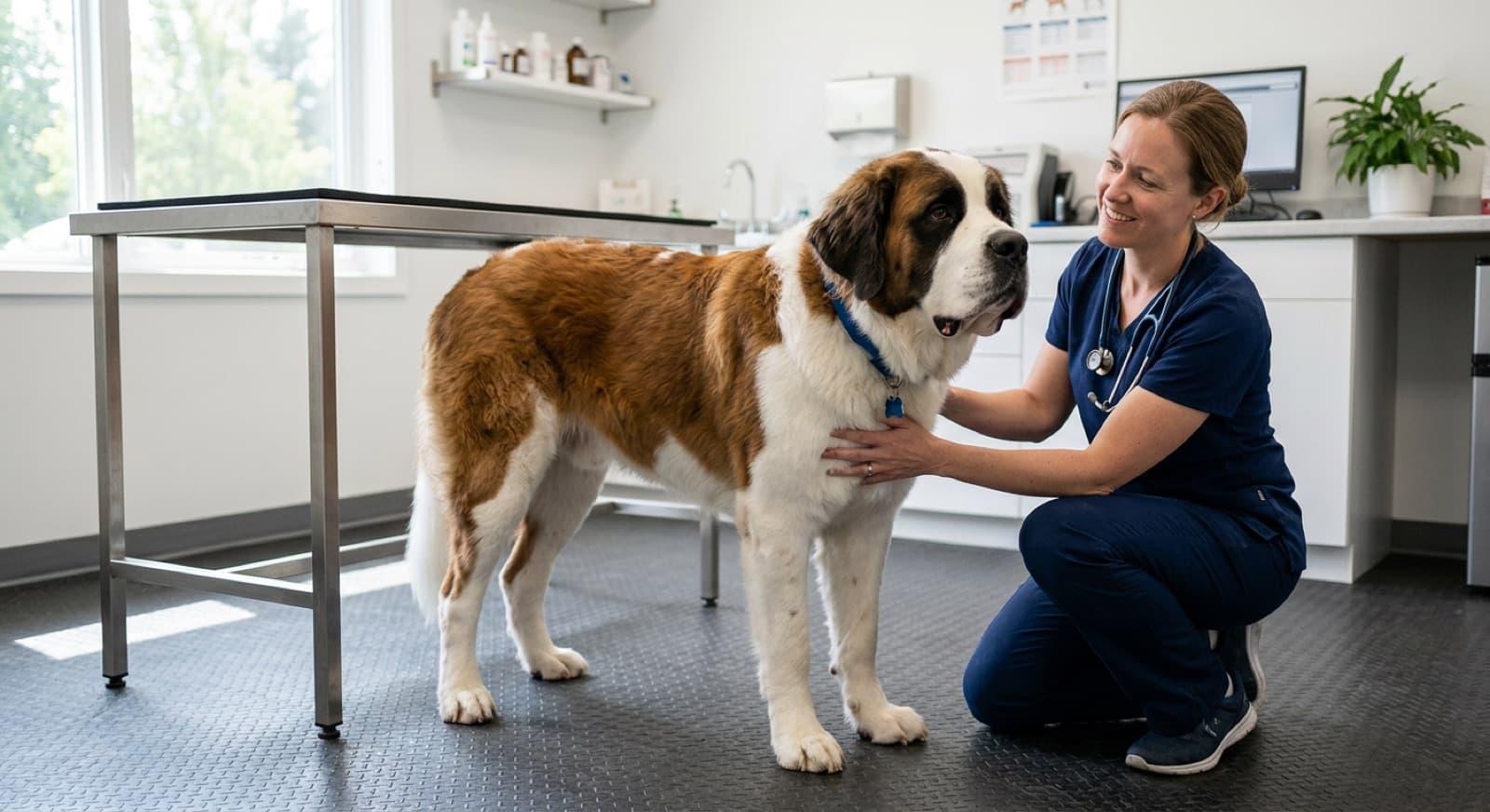
Loving a St. Bernard means accepting that a giant breed comes with a giant-breed health profile. The reassuring part is that the most important concerns are well understood and, in many cases, screened for by responsible breeders, so an informed owner can catch problems early. This guide walks through each with authoritative sources, then covers the giant-breed preventive care that gives a St. Bernard its best, healthiest years in Calgary.
Bloat (GDV): the deep-chested emergency
This is the one that can kill a St. Bernard in an afternoon. As a large, deep-chested breed, the Saint is among the dogs at real risk of bloat, or gastric dilatation-volvulus (GDV), where the stomach fills with gas and can twist on itself. According to the American Kennel Club, deep-chested dogs face the greatest risk, and without treatment a bloating dog can go into shock in only an hour or two.
Know the warning signs (per the AKC):
- An enlarging or visibly distended abdomen
- Retching, or trying to vomit with little or nothing coming up
- Drooling or salivation
- Restlessness and pacing
- Pain when the belly is touched
If you see these signs, this is a true emergency: go straight to a 24-hour vet, do not wait. Treatment involves deflating the stomach and, often, a gastropexy that tacks the stomach in place to prevent recurrence. Ask your Calgary vet whether a preventive gastropexy makes sense for your St. Bernard.
Heart, hips, and bones
Heart disease is an important concern, including dilated cardiomyopathy (DCM), in which the heart muscle weakens and the heart enlarges. It can be quiet early on, which is why regular vet checks matter, a vet may pick up a murmur or rhythm change before you notice anything. Take any exercise intolerance, coughing, or unusual tiredness seriously. Reputable breeders have hearts evaluated, and screening is registered through databases like the Orthopedic Foundation for Animals (OFA).
Like most giant breeds, St. Bernards are prone to hip and elbow dysplasia, and the OFA tracks that screening too. Keeping a Saint lean and avoiding high-impact exercise in a growing dog protects those joints for life. And as in many giant breeds, there is an elevated risk of bone cancer (osteosarcoma); any persistent limp, swelling, or lameness that does not resolve deserves prompt veterinary attention rather than a wait-and-see approach.
Eyes and heat sensitivity
The St. Bernard's loose, expressive facial skin comes with a cost: it predisposes the breed to eyelid conditions such as entropion, where the eyelid rolls inward, and ectropion, where it rolls outward or droops. Both can irritate the eye, and entropion may need surgical correction to stop the lashes rubbing the cornea. Many Saints also show tear staining and are prone to eye irritation. Squinting, redness, weepiness, or pawing at the face is a vet visit, and any correction belongs with your veterinarian.
Finally, a practical concern rather than a disease: heat sensitivity. The Saint's size and heavy coat make overheating a genuine risk. In a Calgary summer that means exercising in the cool of the morning or evening, providing shade and water, and never leaving the dog anywhere warm. Watch for heavy panting or distress and get out of the heat immediately if you see it. Managing summer is a daily part of keeping this breed healthy through the warm months.
Preventive care and insurance in Calgary
Giant-breed care rewards prevention. Keep your St. Bernard lean to protect its joints and heart, favour joint-friendly exercise over high-impact activity, and stay on top of vet visits so heart and eye issues are caught early. The American Kennel Club describes a genial giant, and keeping one well means respecting both the size and the specific risks.
The costs most likely to add up, heart care, orthopedic treatment, and bloat surgery, are the case for pet insurance. Price a few Canadian insurers while your dog is young and healthy, before anything becomes pre-existing, and read what each excludes. Know your nearest 24-hour emergency vet in advance. For the family-and-size side of living with a St. Bernard, see our family dog guide, and for the adoption picture, our St. Bernard adoption guide.
Considering a St. Bernard?
Adopting an adult through a rescue that has done a vet workup means much of the health history is already known, a real advantage with a giant breed that carries heart and bloat risk. See who is available across Calgary rescues.
See Calgary St. Bernards →Frequently Asked Questions
What health problems are St. Bernards prone to?↓
Are St. Bernards at risk of bloat?↓
Do St. Bernards have heart problems?↓
What eye problems do St. Bernards get?↓
How can I keep my St. Bernard healthy in Calgary?↓
Continue reading
Cost, commitment, lifespan, and who the breed suits.
Good with kids, and the size-and-space reality.
Live listings across Calgary rescues.
An alpine breed built for Calgary winters.
New dog? Start with these care guides
Everything a new adopter needs to set up a safe, happy home.