The short answer
The Staffordshire Bull Terrier (SBT) and American Pit Bull Terrier (APBT) are separate breeds. The SBT is a smaller British breed recognized by the Kennel Club in 1935 (24 to 38 lbs). The APBT is a larger American breed (30 to 65 lbs) recognized by the UKC and ADBA. The American Staffordshire Terrier is the AKC's parallel branch of the Pit Bull lineage. The American Bully is a newer UKC breed since 2013. All four share 19th-century bull-and-terrier ancestry. Calgary has no breed-specific legislation; all four are legal pets here.
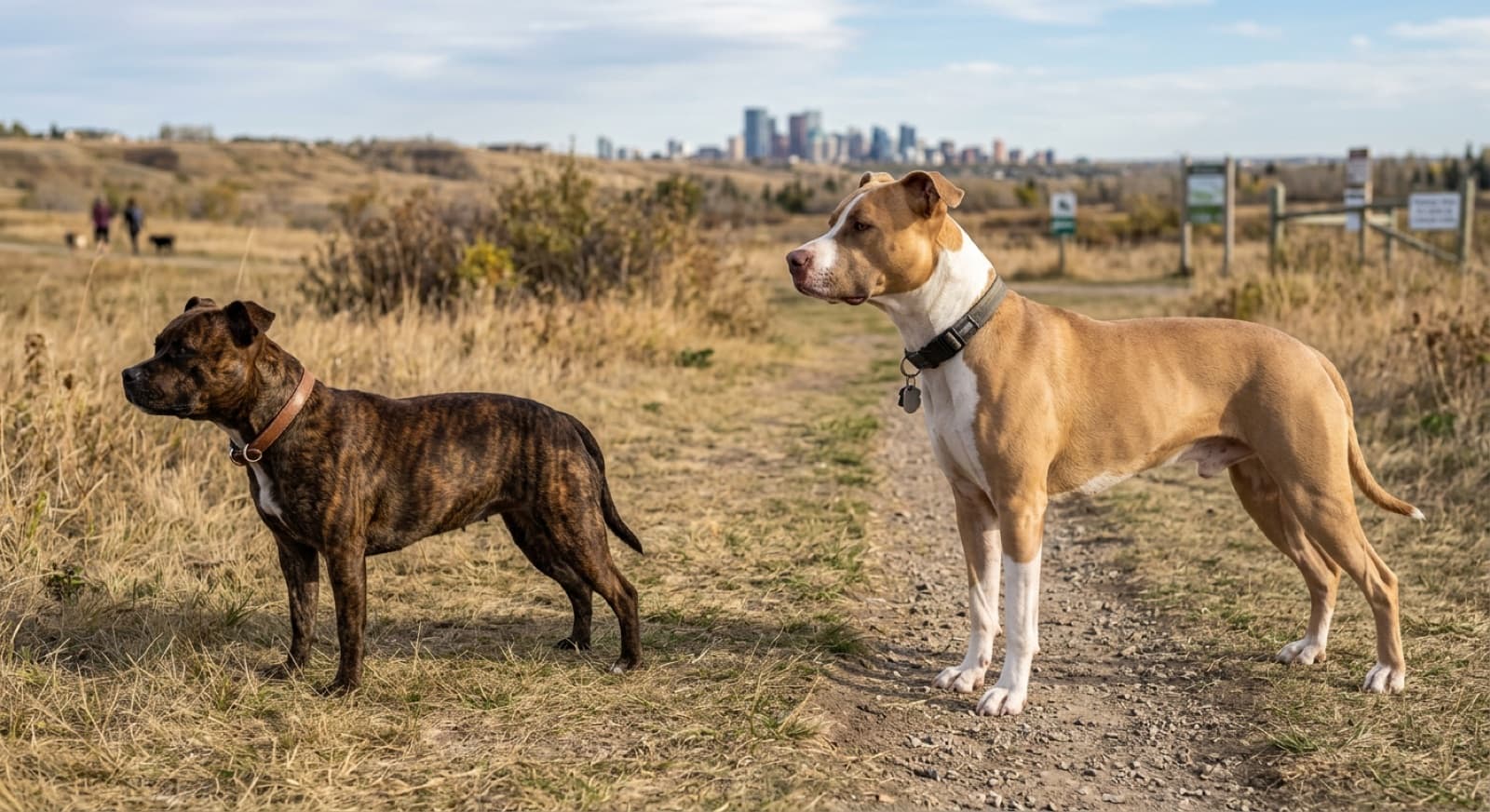
The four breeds in the bully cluster
The term “bully breed” covers four distinct breeds in the modern kennel-club world. Each has its own breed standard, its own country of origin, and its own registry path. The breeds share recent common ancestry but they are not interchangeable.
Staffordshire Bull Terrier (SBT)
Origin: England. Recognized by the Kennel Club in 1935. Recognized by the Canadian Kennel Club, the American Kennel Club, and the United Kennel Club. Adult size: 24 to 38 lbs, 14 to 16 inches at the shoulder. Built compact and muscular, with a broad head, short muzzle, and rose or half-pricked ears. Coat: short, smooth, in red, fawn, white, black, blue, or any of these with white; brindle is also accepted in any of these colours. Temperament described in the breed standard as bold, fearless, and totally reliable with people, with a strong nickname history as the Nanny Dog.
American Pit Bull Terrier (APBT)
Origin: United States, mid-1800s. Developed from bull-and-terrier stock brought from England and Ireland by settlers. Recognized by the United Kennel Club (1898) and the American Dog Breeders Association. Not recognized by the AKC or CKC. Adult size: 30 to 65 lbs, 17 to 21 inches at the shoulder. Athletic, leaner-built than the SBT, with longer legs and a more rectangular profile. Coat: short, in nearly any colour or pattern. Temperament: confident, athletic, people-oriented, with significant variation between working, conformation, and pet-bred lines.
American Staffordshire Terrier (AmStaff)
Origin: United States, parallel branch of the same lineage as the APBT. Recognized by the AKC in 1936 under the separate name American Staffordshire Terrier specifically to distinguish the show-line dogs from working APBT lines. Adult size: 40 to 70 lbs, 17 to 19 inches at the shoulder. Bulkier and slightly shorter than the APBT, with a heavier head and broader chest. Recognized by the AKC, CKC, and UKC. Coat: short, in most colours. The AmStaff and the APBT are sometimes registered as one dog with both registries (UKC-APBT, AKC-AmStaff dual registration) by owners whose lineage qualifies.
American Bully
Origin: United States, late 1980s to early 1990s. Bred from AmStaff and APBT stock with some bulldog crosses for a heavier, more compact build. Recognized by the UKC in 2013 and by the American Bully Kennel Club. Adult size varies widely by accepted variant (Pocket, Standard, Classic, XL): roughly 30 to 100+ lbs. Heaviest and stockiest of the four breeds, with the broadest chest and head and the most pronounced muscular build. Coat: short, in most colours and patterns. Temperament: described as confident but not aggressive, with a calmer baseline than the working-line APBT.
These four breeds are not the same dog. A rescue dog from a Calgary shelter labelled simply “Pit Bull mix” could fit any of the four descriptions, or be a cross between them, or be a cross with other breeds entirely. The label is a starting point, not a precise identification.
Visual differences: how to tell them apart
Once you have seen a few of each, the visual differences become clearer. Size is the single most reliable signal between the SBT and the other three. The table below summarizes the standard adult features.
| Trait | SBT | APBT | AmStaff | American Bully |
|---|---|---|---|---|
| Weight (adult) | 24 to 38 lbs | 30 to 65 lbs | 40 to 70 lbs | 30 to 100+ lbs |
| Height at shoulder | 14 to 16 in | 17 to 21 in | 17 to 19 in | 13 to 21 in (varies) |
| Build | Compact, muscular | Athletic, leaner | Bulkier, heavier | Stockiest, broadest |
| Head | Broad, short muzzle | Broad, longer muzzle | Broad, medium muzzle | Very broad, blocky |
| Country of origin | England | United States | United States | United States |
| Primary registries | KC, CKC, AKC, UKC | UKC, ADBA | AKC, CKC, UKC | UKC, ABKC |
| Year recognized | 1935 (KC) | 1898 (UKC) | 1936 (AKC) | 2013 (UKC) |
The single most useful visual signal for telling an SBT from the other three is size. An adult SBT next to an adult APBT or AmStaff looks noticeably smaller and shorter. The SBT's top line sits lower, the muzzle is shorter, and the overall impression is of a more compact dog. The APBT and AmStaff can be hard to tell apart by eye alone, particularly in well-bred conformation lines where the two breeds converge in appearance. The American Bully is the easiest of the four to identify visually because of the exaggerated muscular build, the very broad chest, and the often-shorter legs.
For a Calgary rescue dog whose paperwork says only “Pit Bull mix,” size and head shape are the two best clues for narrowing down which breed contributes most. A 30 lb compact dog with a short muzzle is more likely SBT-leaning. A 55 lb athletic dog with longer legs is more likely APBT or AmStaff. A 70 lb very broad dog with a heavy head is more likely American Bully or a cross.
The history split: one ancestor, two countries
All four breeds trace back to 19th-century bull-and-terrier crosses developed in England and Ireland. The original purpose of these crosses is well documented and worth acknowledging honestly: they were bred for bull-baiting and later for dog fighting, both of which were banned in the UK by the Cruelty to Animals Act 1835. After the bans, breeders shifted the dogs toward companion roles and into the show ring, and the breeds we recognize today emerged from that transition.
In England, the bull-and-terrier was refined into the Staffordshire Bull Terrier by selectively breeding for a smaller, more family-friendly dog. The breed was formally recognized by the Kennel Club in 1935 with a written breed standard emphasizing temperament reliability with people and children. The modern SBT has been bred away from any fighting heritage for nearly 90 years.
American settlers brought bull-and-terrier dogs to North America in the mid-1800s. In the United States, breeders selected for larger, taller, more athletic dogs suitable for farm work, hunting, and (regrettably) dog fighting in regions where the practice persisted into the late 1800s and beyond. The United Kennel Club recognized the breed as the American Pit Bull Terrier in 1898. When the American Kennel Club later wanted to register show-line dogs from the same lineage in 1936, it created the American Staffordshire Terrier as a separate name to distance the conformation-focused dogs from the working APBT label. The two registries (UKC-APBT, AKC-AmStaff) have maintained parallel breed registries for the same broad population ever since.
The American Bully is a much more recent breed, developed in the late 1980s through the 1990s by American breeders who wanted a heavier, more compact dog with a calmer temperament than the working APBT. The UKC accepted the breed in 2013 with a separate breed standard.
The relevant takeaway for adopters: the Staffordshire Bull Terrier and the American Pit Bull Terrier are not the same breed. They share ancestry from before 1850, and they have been on separate developmental paths for over a century in different countries with different breed clubs and different breed standards. Treating them as one breed is technically incorrect, and the distinction matters for insurance, registration, and breed-specific health screening.
Temperament: similarities and individual variation
The friendly-with-humans baseline is similar across all three of the older breeds. The American Temperament Test Society (ATTS) tracks pass rates for working-temperament evaluations, and Staffordshire Bull Terriers, American Pit Bull Terriers, and American Staffordshire Terriers all post pass rates that are at or above the average for many popular family breeds. ATTS data is not a perfect measure of family-pet suitability (the test evaluates a specific set of reactions to standardized stimuli), but the consistent pattern across multiple decades of testing is worth noting.
The Staffordshire Bull Terrier's historical nickname as the Nanny Dog reflects a British tradition of describing the breed as exceptionally tolerant and affectionate with children. That nickname is not an endorsement to leave any dog unsupervised with young children, and the responsible position is that no breed is a substitute for supervision around toddlers. But the temperament reputation is consistent with the breed standard and with the experience of most Staffy owners and rescues.
Dog-on-dog reactivity is the area where individual variation matters more than breed label. All four bully-cluster breeds can show same-sex reactivity, particularly in intact adults. Some lines and individual dogs are happy multi-dog household members; others do better as the only dog in a household. The honest assessment is to evaluate the individual dog, ideally through a meet-and-greet protocol with any existing resident dog, before adopting.
Force-free training works exceptionally well for all four breeds. The bully cluster is intelligent, food-motivated, and bonds strongly to a consistent handler. Calgary force-free trainers like Raising Canine and Pup City Pup Academy run continuous group classes that work well for bully-breed adolescence, which can be a bouncy and testing phase from roughly 8 to 18 months of age. The American Veterinary Society of Animal Behavior position statement on punishment-based training is worth reading before adding any aversive tool to a bully-breed training plan.
Early socialization between 8 and 16 weeks is critical for all four breeds. Bully-cluster dogs that miss socialization windows can develop adult reactivity that is harder to unwind than it would have been to prevent. Calgary puppy classes through Raising Canine or Pup City Pup Academy are worth the investment.
Calgary legal status: no breed-specific legislation
All four bully-cluster breeds are legal pets in Calgary. The City of Calgary Responsible Pet Ownership Bylaw contains no breed-specific legislation. Calgary regulates dogs based on the individual dog's behaviour and the owner's responsibility, not on the breed.
The Calgary model is often cited internationally as a successful alternative to breed-specific bans. The bylaw focuses on owner responsibility: licensing every dog, leash and off-leash rules, escalating consequences for dogs declared dangerous based on behaviour, and active animal-services enforcement. The result is a city where SBT, APBT, AmStaff, and American Bully dogs live as legal pets in homes, apartments, and rentals across every quadrant of the city.
What Calgary law requires for any bully-cluster owner:
- License the dog with the City of Calgary by 6 months of age.
- Keep the dog on leash in all public areas except designated off-leash parks.
- Follow off-leash rules at Calgary parks (recall control, picking up after the dog, supervising interactions).
- Accept liability for any harm the dog causes. Dangerous-dog declarations follow incidents, not breed labels.
For Calgary adopters from rescue, the bylaw is the same regardless of which bully-cluster breed (or mix) the dog turns out to be. A licensed, well-socialized, responsibly handled bully-breed dog is a normal Calgary pet.
Calgary insurance reality: disclose accurately
Disclose breed accurately when you apply for or renew home or tenant insurance. A denied claim later is a worse outcome than a higher premium or a longer broker search now.
Calgary home and tenant insurance for bully-cluster owners is variable. Some Canadian insurers group all four breeds together regardless of the SBT versus APBT distinction; some carve out the SBT as acceptable because of the smaller size and Kennel Club registration; some won't insure homes with any bully-cluster dog regardless of breed; and some ask only about bite history rather than breed.
The practical path for Calgary adopters:
- Confirm coverage in writing from your broker before adoption. A verbal “should be fine” from an agent is not the same as a written confirmation that the policy will accept the breed.
- Disclose breed honestly. Failing to disclose a breed the insurer would have flagged risks a denied claim later. The financial exposure of a denied liability claim involving a dog is much worse than the cost of a higher premium or an inconvenient broker switch.
- Shop multiple insurers if your first option declines. Brokers like Westland Insurance and BrokerLink work with a range of carriers; some have a bully-friendly carrier in their stable.
- Provide history: vaccination records, training class certificates, clean bite history, references from previous landlords or vets all help.
For deeper coverage of Calgary insurance and rental questions for bully-cluster owners, see our Pit Bull housing and insurance Calgary guide, which covers carrier names, disclosure templates, and rental application strategies in more detail.
Calgary rental reality: disclose breed honestly
Calgary rental availability for bully-cluster owners varies the same way insurance does. Many landlords accept SBT, APBT, AmStaff, and American Bully tenants without issue. Some rental listings carry blanket “no bully breeds” language that excludes all four. Some landlords have weight limits that admit smaller SBTs but exclude larger APBTs and AmStaffs.
The strategies that work for Calgary bully-breed renters:
- Disclose breed up front in the application. A landlord who learns the breed later can end a tenancy faster than one who agreed up front in writing.
- Prepare a pet resume: photo, breed, age, vaccination records, training class certificates, references from past landlords and your vet.
- Filter listings honestly. Skip ads that say “no bully breeds” rather than pushing for an exception; landlords who write that line are usually not movable.
- Consider private-landlord rentals over large management companies. Private landlords often make case-by-case decisions where companies apply blanket policies.
- Offer a pet deposit if your province allows it. (Alberta's Residential Tenancies Act caps total damage deposits at one month's rent including pet deposits; a non-refundable pet fee is not permitted under Alberta law.)
For the smaller SBT, rental acceptance tends to be easier because of the size and the breed's Kennel Club registration. Some landlords who write “no bully breeds” make an SBT exception when shown the breed standard and registration paperwork. For APBT, AmStaff, and American Bully, the rental search is usually longer and the honest disclosure path is more important.
DNA testing: useful clarity for unknown-origin rescues
For Calgary rescue adopters with a bully-cluster dog of unknown pedigree, a commercial DNA test (Embark or Wisdom Panel) can clarify ancestry. The tests work by comparing the dog's genetic markers against reference panels of known purebred dogs. Cost in Canada: roughly $130 to $200 per test as of 2026.
What DNA tests do well for bully-cluster dogs:
- Reliably identify whether a dog has bully-cluster ancestry versus other breeds.
- Identify clear non-bully contributions (Lab, German Shepherd, Husky, Boxer, etc.) that are often mistaken for “Pit mix” in shelter labelling.
- Catch health markers (Embark screens for over 200 genetic conditions including some that are line-relevant for bully breeds).
What DNA tests do less well:
- Distinguish between the closely related SBT, APBT, and AmStaff. The reference panels for these breeds share genetic markers because they share recent common ancestry, and a result of “American Pit Bull Terrier / American Staffordshire Terrier” is common rather than a clean single-breed call.
- Identify the American Bully precisely. The breed is newer and reference panels are smaller; Bully-mix calls are sometimes reported as APBT or AmStaff with a bulldog or boxer component.
For Calgary owners, the DNA test result is useful for three things: accurate insurance disclosure (you can show the insurer specifically what your dog tested as), accurate licensing with the City of Calgary, and breed-specific health screening planning with your vet. The behaviour, energy, and household fit of the individual dog matters more than the test result for day-to-day life.
Browse adoptable Staffordshire Bull Terriers in Calgary
Once you know the SBT is a separate breed from the larger APBT and AmStaff, the rescue conversation gets clearer. Calgary rescues regularly see Staffies and Staffy crosses, and the compact size makes the breed a strong fit for rental households.
See Available Staffies →Which breed is the right fit for a Calgary household
The household-fit question depends on three factors: size preference, exercise capacity, and housing situation. All four breeds can be wonderful Calgary pets in the right home.
Staffordshire Bull Terrier (SBT) fits best in:
- Apartment, condo, or rental households where the smaller size is an advantage.
- Families with children of any age (the breed's temperament reputation is strongest here).
- First-time bully-breed owners who want the friendliness without the larger size and longer rental search.
- Households committed to 60 to 75 minutes of daily exercise.
- Active urban households that walk to Calgary off-leash parks (Tom Campbell's Hill, Sue Higgins, Sandy Beach).
American Pit Bull Terrier (APBT) fits best in:
- Houses with fenced yards in any Calgary quadrant.
- Active households with 75 to 90 minutes of daily exercise capacity.
- Owners with experience handling athletic, high-confidence dogs.
- Households committed to early socialization and continuous training through adolescence.
- Owners who have already confirmed insurance and landlord acceptance for the breed.
American Staffordshire Terrier (AmStaff) fits best in:
- Similar households to the APBT, with slightly more tolerance for bulky build and less interest in athletic performance.
- Show-line households where AKC registration matters.
- Calmer family dogs (well-bred conformation AmStaffs run a touch calmer than working APBT lines).
American Bully fits best in:
- Households wanting a calmer, lower-exercise bully-cluster dog (60 minutes daily often satisfies an adult Bully).
- Owners drawn to the heavier, more compact build.
- Households prepared for breed-specific health screening (some Bully lines have brachycephalic-leaning conditions, hip dysplasia, and heart-condition risk).
For most Calgary households entering the bully cluster for the first time, the SBT is the easier match: smaller, more rental-friendly, slightly easier insurance, and the same warm bully temperament. For households with the space, exercise capacity, and insurance/rental setup already sorted, the APBT, AmStaff, and American Bully are all wonderful breeds with their own strengths.
The honest first conversation with any Calgary rescue should be about housing and insurance, not about the dog. Confirm acceptance for the specific breed before getting attached to a specific dog. Many adoption disappointments happen when an owner falls for a dog before checking whether the rental landlord or the insurer will agree.
Frequently Asked Questions
Are the Staffordshire Bull Terrier and American Pit Bull Terrier the same breed?
No. They are two distinct breeds with separate kennel club registrations, different countries of origin, different sizes, and different breed standards. The Staffordshire Bull Terrier (SBT) is a British breed recognized by the Kennel Club in 1935, with an adult weight range of 24 to 38 lbs and a height of 14 to 16 inches at the shoulder. The American Pit Bull Terrier (APBT) is an American breed recognized by the United Kennel Club and the American Dog Breeders Association, with an adult weight range of 30 to 65 lbs and a height of 17 to 21 inches. They share bull-and-terrier ancestry from 19th-century England but the populations have been separate for over a century. The American Staffordshire Terrier (AmStaff) is the American Kennel Club's parallel branch of the Pit Bull lineage, registered under a different name when the AKC accepted the breed in 1936.
Is the Staffordshire Bull Terrier legal in Calgary?
Yes. All four bully-cluster breeds (Staffordshire Bull Terrier, American Pit Bull Terrier, American Staffordshire Terrier, American Bully) are legal pets in Calgary. The City of Calgary Responsible Pet Ownership Bylaw contains no breed-specific legislation. Calgary regulates dogs based on the behaviour of the individual dog and the responsibility of the owner, not the breed. Owners must license their dog with the City, follow leash and off-leash rules, and are liable for any harm their dog causes regardless of breed.
Will my Calgary home insurance cover a Staffy or Pit Bull?
It varies by insurer. Some Canadian home and tenant insurers group all bully-cluster breeds together regardless of the registry distinction between SBT, APBT, AmStaff, and American Bully. Some will not write or renew a policy with any of these breeds in the home. Some insure all of them without restriction. A few insurers ask only about bite history rather than breed. The honest path is to disclose breed accurately at application or renewal time. Failing to disclose a breed the insurer would have flagged risks a denied claim later, which is a worse outcome than a higher premium or having to shop a different insurer. Ask your broker for written confirmation of breed acceptance before adopting.
Can I rent in Calgary with a Staffordshire Bull Terrier?
Many Calgary landlords allow it, but blanket bully breed bans are also common in rental listings. The phrase "no bully breeds" in a rental ad usually means the landlord will refuse SBT, APBT, AmStaff, and American Bully regardless of size or history. Disclose breed honestly when you apply. A landlord who learns the breed later can end a tenancy faster than one who agreed up front. Provide references from previous landlords, your vet, and a trainer if available. A pet resume with vaccination records, training class certificates, and references from past landlords meaningfully improves acceptance rates.
How big is a Staffordshire Bull Terrier compared to an American Pit Bull Terrier?
The Staffordshire Bull Terrier is the smaller breed. Adult SBTs weigh 24 to 38 lbs and stand 14 to 16 inches at the shoulder. The American Pit Bull Terrier is taller and heavier, weighing 30 to 65 lbs and standing 17 to 21 inches. The American Staffordshire Terrier is in a similar weight range to the APBT (40 to 70 lbs) but slightly shorter and bulkier. The American Bully, a newer UKC-recognized breed since 2013, is the heaviest-built of the four, with stockier proportions and wider chest. Side by side, an adult SBT next to an adult APBT looks like a noticeably smaller, more compact dog.
Are these breeds good with children?
All three of the older breeds (SBT, APBT, AmStaff) have documented friendly-with-people temperament reflected in American Temperament Test Society pass rates that are comparable to or higher than many popular family breeds. The Staffordshire Bull Terrier was historically nicknamed the Nanny Dog in Britain for child friendliness, though that informal name is not an endorsement to leave any dog unsupervised with young children. Like all dogs, individual temperament varies and supervision around young kids is required regardless of breed. Early socialization between 8 and 16 weeks, force-free training, and structured kid-dog interactions matter more than breed label for predicting how a specific dog will do with a specific family.
Are bully breeds dog-aggressive?
Dog-on-dog reactivity is variable and more individual than breed. Some lines and individual dogs within all four breeds show same-sex reactivity, particularly intact adults. Other individual dogs are happy multi-dog household members. Early socialization, neutering decisions, and ongoing handler training affect the outcome more than the breed label. A meet-and-greet protocol with any existing resident dog before adoption is sensible for any breed and especially worth doing carefully with adult bully-cluster dogs. Calgary off-leash parks see many SBT and APBT dogs every week without incident; many also see specific dogs who do better on long-line walks than in busy off-leash settings. The honest reading is to evaluate the individual dog, not assume the breed.
Will a DNA test tell me which breed my rescue dog actually is?
Yes, with some caveats. Commercial DNA tests (Embark, Wisdom Panel) can identify bully-cluster ancestry reasonably well but sometimes struggle to distinguish between SBT, APBT, and AmStaff because the breeds share recent common ancestry and overlapping genetic markers. A DNA test will reliably tell you whether a rescue dog has bully-cluster ancestry; it may give a probability split between the closely related breeds rather than a definitive single label. For Calgary owners, the DNA test result is useful for insurance disclosure, accurate licensing, and general curiosity. The behaviour, energy, and household fit of the individual dog matters more than the test result for day-to-day life.
Which breed registries recognize which dog?
The Staffordshire Bull Terrier is recognized by the Kennel Club (UK), the Canadian Kennel Club, the American Kennel Club, and the United Kennel Club. The American Pit Bull Terrier is recognized by the United Kennel Club and the American Dog Breeders Association but not by the AKC or CKC. The American Staffordshire Terrier is recognized by the AKC, CKC, and UKC as a separate breed from the APBT despite shared ancestry. The American Bully is recognized by the UKC since 2013 and by the American Bully Kennel Club. A rescue dog without paperwork can fit any of these descriptions; the registry distinction matters mostly for show breeders and is less practical for adoption households.
Which is the right breed for a typical Calgary household?
Most Calgary households do well with the Staffordshire Bull Terrier when they choose within the bully cluster, because the smaller size makes apartment and rental life easier, the exercise demand is moderate (60 to 75 minutes daily), and the breed is friendly and trainable. American Pit Bull Terrier and AmStaff households need a bit more space, more committed exercise (75 to 90 minutes daily), and a more careful insurance and rental search. American Bully suits households who like the heavier build and lower exercise need (60 minutes daily). The honest first question is housing: confirm insurance and landlord acceptance for the specific breed before getting attached to a dog.
Why does it matter that they are different breeds if Calgary has no BSL?
Three reasons. First, accurate breed identification matters for honest insurance disclosure, which protects your coverage. Second, the breeds have different health profiles: SBT has higher rates of L-2 hydroxyglutaric aciduria and specific eye conditions; APBT and AmStaff have higher rates of hip dysplasia and certain heart conditions; American Bully has brachycephalic-leaning conditions in some lines. Knowing which breed you have helps your vet plan appropriate screening. Third, accurate licensing with the City of Calgary keeps records honest. Calgary does not penalize any of these breeds, but registering an APBT as a Lab mix to dodge a perceived issue creates problems if a bite incident or insurance claim ever comes up.
Adoptable Staffies in Calgary
Live listings of Staffordshire Bull Terriers and Staffy crosses from the Calgary rescue network, updated regularly.
Adoptable Pit Bulls in Calgary
Live listings of American Pit Bull Terriers, AmStaffs, and Bully crosses from Calgary shelters and rescues.
Staffy Adoption Calgary
Rescue sources, real adoption costs, surrender patterns, and rescue verification for Calgary Staffy adopters.
Pit Bull Adoption Calgary
Rescue sources, real adoption costs, Calgary insurance disclosure templates, and rental application strategies.
New dog? Start with these care guides
Everything a new adopter needs to set up a safe, happy home.