The short answer
Pure-breed Staffordshire Bull Terriers are uncommon in Calgary rescue but Staffy-type mixes are regular intake. Apply broadly to Calgary Humane Society, AARCS, BARCS, Pawsitive Match, ARF Alberta, Cochrane Humane Society, and Heaven Can Wait. Adoption fees are typically $400 to $700 versus $1,500 to $3,000 for a breeder puppy. The breed is legal in Calgary (no breed-specific legislation), but insurance and landlord restrictions are the real walls. The Staffy is a distinct British breed from the larger American Pit Bull Terrier: 24 to 38 lbs, standardised by the UK Kennel Club in 1935, with a 12 to 14 year lifespan and a documented “Nanny Dog” reputation with children.
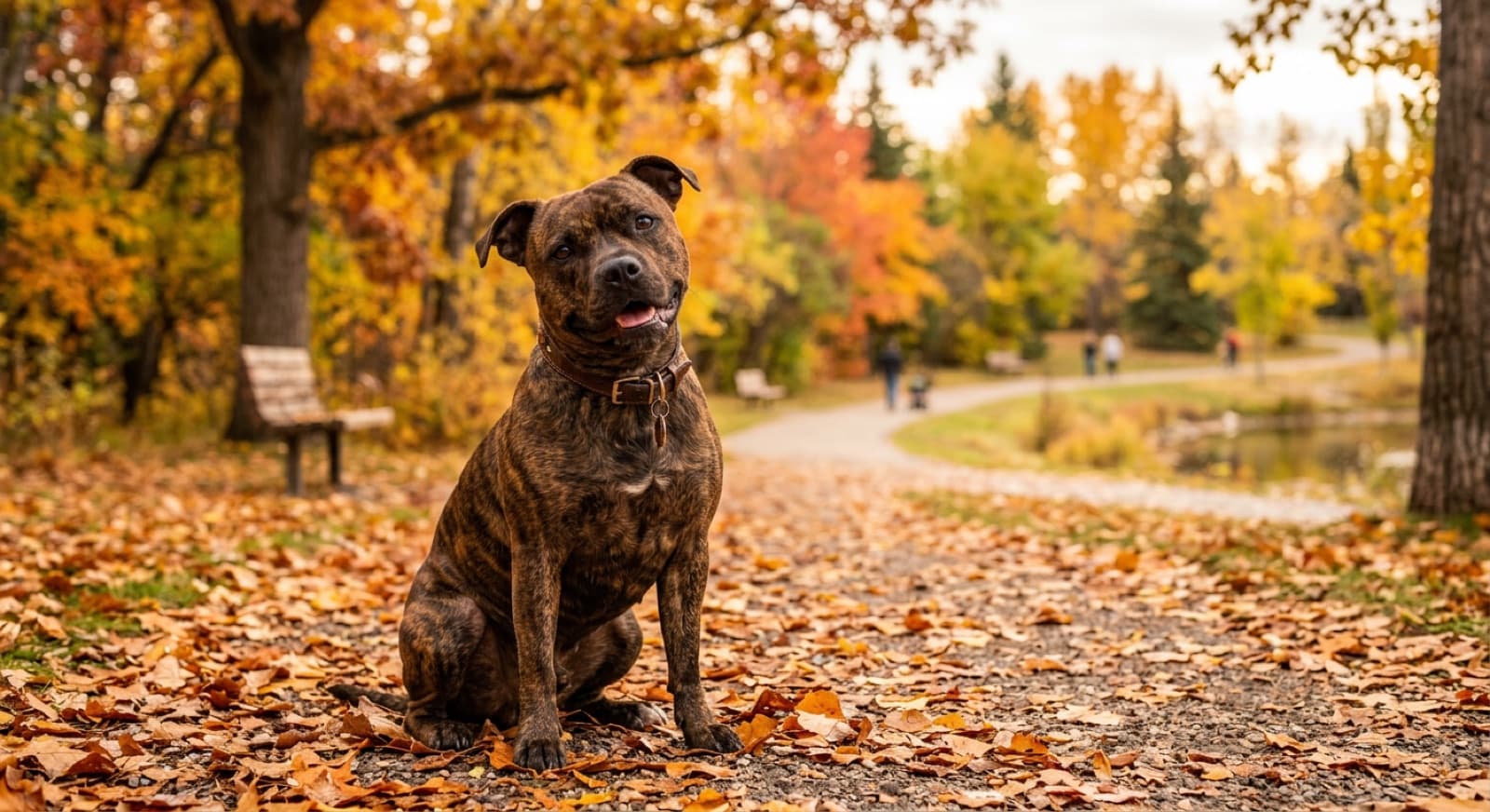
The Staffordshire Bull Terrier was developed in 1800s England by crossing the Old English Bulldog with terriers of the time. Breeders in the Staffordshire region of the English Midlands selected for a compact, athletic dog used in cellar-rat work and the gambling pit sports of the era (historical context, not endorsement). When Britain banned pit sports in the 1830s, the breed transitioned into a working farm dog and a family companion, and over the next century selective breeding shifted decisively toward temperament and away from the historical use. The UK Kennel Club standardised the breed in 1935, and the breed has been recognised by the Canadian Kennel Club and the American Kennel Club for decades. Today the Staffy is a 24 to 38 lb medium dog, 14 to 16 inches at the shoulder, with a 12 to 14 year lifespan and a documented affectionate temperament that earned the historical British nickname “Nanny Dog.” This guide covers where Staffies appear in Calgary rescue, what they actually cost to live with, the insurance and landlord realities, and how the Staffy differs from the larger American Pit Bull Terrier.
The Staffordshire Bull Terrier at a glance
The Staffy is a recognised purebred with a documented working heritage in Britain. The breed is muscular and athletic, with a broad head, short single coat in brindle, red, fawn, white, or black-and-white, and a smile that owners universally describe as the breed's defining feature. Adult dogs are compact but heavy for their size; a 30 lb Staffy is denser and more solidly built than a 30 lb Spaniel. The breed standard describes the temperament as “bold, fearless, totally reliable” with “great intelligence and affection, especially with children.”
| Trait | Typical range |
|---|---|
| Adult weight | 24 to 38 lbs (females smaller, males larger) |
| Height | 14 to 16 inches at the shoulder |
| Lifespan | 12 to 14 years |
| Coat | Short single coat; brindle, red, fawn, white, or black-and-white |
| Energy level | Moderate-high; athletic but settles indoors |
| Exercise needs | 60 to 90 minutes daily plus mental work |
| Temperament | Affectionate, courageous, intelligent, family-bonded, biddable, friendly with people including strangers |
The dog you actually live with is human-focused, soft with family, and physically dense in a way that surprises first-time owners. A 30 lb Staffy can pull a leash harder than a 50 lb Spaniel because the build is bull-derived rather than terrier-derived. The breed is well-known for the lean into family life; Staffies want to be in the room with you, on the couch beside you, and often under the blanket with you. The friendliness with people, including strangers, is documented in the breed standard and reflected in foster home reports: Staffies generally do not make good guard dogs because they greet strangers as new friends rather than as threats.
Where to adopt a Staffordshire Bull Terrier in Calgary
Calgary Staffy rescue intake splits between pure-breed Staffies (uncommon) and Staffy-type mixes (regular). The breed is moderately popular in Britain but less common in Canada, so pure-breed intake from Canadian Kennel Club lineage is thin. The wider bull-and-terrier family (Staffy mixes, Pit Bull mixes, American Staffordshire mixes) is the most consistently available group at every Calgary rescue. The strategy is the same as for any working breed: apply broadly to every local rescue, register with the national breed network, and set up alerts on the LocalPetFinder breed page.
Calgary-area rescues to monitor:
- Calgary Humane Society: the largest local shelter; receives Staffy mixes throughout the year. Foster-tested kid and dog compatibility usually published in the listing.
- AARCS: foster-based; structured “good with” evaluations matter for a bull-and-terrier breed where dog-on-dog history is critical.
- BARCS Rescue: Calgary foster network; bull-and-terrier breeds and mixes are a regular share of intake.
- Pawsitive Match: Calgary foster-based; bully-breed advocates and structured foster placements.
- ARF Alberta: Calgary foster network; broad medium-dog inventory including Staffy types.
- Cochrane Humane Society: Cochrane-based, serves the Calgary region; rural surrenders frequently include bull-breed mixes.
- Heaven Can Wait: High River-based, Calgary placement common.
- Calgary Animal Services: the municipal facility; bull-breed mixes appear regularly in stray intake.
The single best move is to set up notifications on the LocalPetFinder Staffordshire Bull Terrier breed page. Live listings from all Calgary rescues land there as they appear, and sound foster-tested Staffies often have applications in within days.
The Staffordshire Bull Terrier Club of Canada maintains a rescue referral system for owner-surrendered pedigree dogs. The network favours applicants who can credibly show they understand the breed, the bull-and-terrier family dynamics, and the practical insurance and landlord realities of owning the breed in Canada. For Calgary applicants this often means a pet resume that includes prior bully-breed experience, training certifications, and a clear plan for housing and insurance.
What does a Staffordshire Bull Terrier cost in Calgary?
Calgary fees vary by rescue and what is included. The realistic ranges below are directional, not quotes:
| Source | Fee range | Typically includes |
|---|---|---|
| Calgary Humane Society | $400 to $600 | Spay or neuter, vaccinations, microchip, vet exam |
| AARCS | $500 to $700 | Spay or neuter, vaccinations, microchip, foster history |
| BARCS / Pawsitive Match / ARF Alberta | $500 to $700 | Spay or neuter, vaccinations, microchip, foster notes |
| Calgary Animal Services | $200 to $400 | Vaccinations, microchip; spay or neuter often pending |
| CKC-registered breeder puppy | $1,500 to $3,000 | Health-tested parents (L-2-HGA, HC, hips), contract, 6 to 18 month waitlist |
The adoption fee is the entry cost. Annual care for a Staffy in Calgary runs roughly in line with a typical medium breed, with a few line items that are higher than average:
- Winter coat (real budget item). The short single coat means Calgary winter requires insulation. Below minus 10 degrees Celsius, a fitted coat is necessary for any outdoor session longer than a potty break. Below minus 20 the coat is mandatory; below minus 30 outdoor time is reduced to brief potty breaks plus indoor enrichment. Budget $80 to $150 for a coat that fits a Staffy chest properly. The breed's broad shoulders and narrow waist make off-the-shelf sizing tricky.
- Food. $55 to $95 per month for a 24 to 38 lb active dog. The breed can develop food sensitivities, so single-protein options are worth considering if skin issues appear.
- Vet and preventive care. Roughly $500 to $900 per year for routine wellness, vaccines, parasite prevention, and dental. Calgary specialty care for dermatology or orthopedic concerns is available through Western Veterinary Specialist Centre and VCA Canada West.
- Pet insurance. Pet insurance is worth considering for any medium working breed, but with Staffies the carrier selection matters more. Some carriers exclude bull-and-terrier breeds from coverage entirely; others charge a higher premium. Budget $50 to $90 per month and shop carriers carefully before binding.
- Home insurance. Separate from pet insurance. Some Calgary home insurance carriers list the Staffy as a restricted breed and either exclude liability for dog bites or refuse coverage entirely. Square One, Sonnet, and TD have all been used by Calgary bully-breed owners; ask each carrier for their breed-restriction list before binding the policy. Annual cost varies but expect a $50 to $200 surcharge over the no-dog baseline.
- Active-dog gear. A well-fitted Y-front harness (the Staffy chest is broad and a flat collar slips off easily under load), 6 to 8 foot leash, 15 to 30 foot biothane long line for recall work, and a flirt pole for daily enrichment. Budget $200 to $400 in the first month.
- Training. A force-free trainer experienced with bully breeds is worth the investment in year one. Raising Canine and Pup City Pup Academy are two Calgary force-free options. Budget $400 to $900 for a structured group or private package. Canine Good Neighbour certification is worth pursuing; it strengthens both insurance and rental applications.
- Calgary dog licence. Required for every dog three months and older under the Responsible Pet Ownership Bylaw 23M2006. A small annual fee that improves recovery odds if your dog ever gets out.
First-year totals typically land between $2,500 and $4,500 once you add gear, training, vet, food, insurance surcharges, and licence on top of the adoption fee. The premium over a non-restricted breed is usually $300 to $600 a year in insurance and rental costs. For a full breakdown of lifetime ownership cost in Calgary, see our Calgary adoption costs guide.
Why Staffordshire Bull Terriers end up in Calgary rescue
Staffy surrenders to Calgary rescues are dominated by 2 to 5 year old young adults whose previous family hit a wall that was not about the dog. The dog itself is usually sound. Understanding the patterns helps you build a household where surrender does not happen.
- Insurance refusal walls. Many Canadian home insurance carriers group all bull-and-terrier breeds together. A family that bought their Staffy without checking carrier policy discovers at renewal that the new insurer will not cover the house with that dog. Some families surrender rather than re-shop carriers. Doing the carrier work before adoption avoids this.
- Landlord and condo restrictions. Calgary landlords frequently apply bull-and-terrier breed restrictions, often more restrictive than the no-breed-specific-legislation municipal bylaw. A move from a house to a condo can become a surrender event because the condo board breed list rules out Staffies.
- Dog-on-dog reactivity. The breed standard acknowledges variable dog-reactivity, particularly between same-sex pairs. A second-dog addition to a household with an existing Staffy can become a serious behaviour challenge, and households without behaviour support sometimes surrender rather than work through it.
- Activity-demand misjudgment. Staffies are athletic and need 60 to 90 minutes daily. Owners who imagined a couch-dog and discovered an athletic terrier-derived breed sometimes surrender at month three when the destructive boredom hits.
- Medical surrender. Skin conditions (allergies, demodectic mange) and chronic ear issues drive a smaller share of surrenders. The cost of a serious allergy work-up plus ongoing management can be $1,500 to $3,000.
- Lifestyle changes. Babies, moves, divorces, owner illness. Common across breeds.
None of these are problems with the breed. They are problems with insurance, housing, and household readiness. The two highest-impact moves an adopter can make before applying: call two or three home insurance carriers to confirm they cover Staffies, and confirm rental or condo board approval in writing.
The 1800s origin: a Staffordshire working breed
The Staffordshire Bull Terrier was developed in early 1800s England by crossing the Old English Bulldog (a heavier dog than the modern English Bulldog) with various terriers in the Staffordshire region of the West Midlands. The crosses produced a smaller, faster, more agile bull-and-terrier dog that was used in cellar-rat work, ratting contests, and the gambling pit sports of the era (historical context, not endorsement). When the British Parliament banned blood sports in the Cruelty to Animals Act of 1835, dog-fighting moved underground but the legal use of bull-and-terrier dogs shifted toward farm work, ratting, and family companionship.
Over the next century, selective breeding moved the Staffy decisively toward temperament. Breeders prioritised dogs who were soft with people, particularly with children, while retaining the courage and physical density of the working type. The UK Kennel Club recognised and standardised the Staffordshire Bull Terrier as a distinct breed in 1935. The breed was already widely owned in working-class British households at that point, and the “Nanny Dog” nickname (referring to the breed's documented patience and affection with children) dates from that era of British domestic family ownership. The AKC followed with recognition in 1974 and the CKC has recognised the breed for decades.
The Staffy's historical working heritage matters for Calgary adopters because it sets the baseline build and energy level. A Staffy is physically dense, athletic, and capable of much more work than a casual owner expects. The temperament is human-focused and family-bonded. The dog-on-dog dimension is variable and worth foster-evaluating before any same-sex pairing. The breed is genetically and historically distinct from the larger American Pit Bull Terrier, the AKC-recognised American Staffordshire Terrier, and the toy-sized American Bully, all of which share the same 1800s English bull-and-terrier ancestor but diverged into separate breeds with separate registries.
Staffy vs American Pit Bull Terrier: a quick comparison
The single most common point of confusion for Calgary adopters is whether a Staffy is the same as a Pit Bull. The short answer is no: they are distinct breeds with separate registries, separate breed standards, and noticeably different size. The longer answer involves three related breeds plus the catch-all term “Pit Bull”:
| Breed | Weight | Origin | Registry |
|---|---|---|---|
| Staffordshire Bull Terrier | 24 to 38 lbs | British, 1800s; standardised 1935 | UK KC, CKC, AKC |
| American Pit Bull Terrier | 30 to 65 lbs | American, 1800s English imports | UKC, ADBA (not AKC or CKC) |
| American Staffordshire Terrier | 40 to 70 lbs | American show line of Pit Bull lineage | AKC, CKC |
| American Bully | 30 to 120+ lbs (varies by category) | American, 1990s offshoot | UKC, ABKC |
All four share a common ancestor in the bull-and-terrier crosses of 1800s England. They diverged through a hundred years of separate breeding programs in Britain (the Staffy) and the United States (the other three). In a Calgary rescue context, a dog labelled “Pit Bull mix” or “Staffy mix” or “bully mix” is often genetically ambiguous: the foster home assessment matters more than the breed label. The deeper differentiator article on Staffy vs Pit Bull comparison covers how to tell the breeds apart in person, what each breed needs that the other does not, and why the distinction matters for Calgary insurance and rental searches.
Staffy temperament: affectionate, courageous, biddable
The Staffy is documented in the breed standard as “bold, fearless, totally reliable” and “of great intelligence and affection, especially with children.” In practice this translates to a dog that wants to be on the couch with family, in the bed under the blanket, and underfoot in the kitchen. Staffies do not tolerate isolation well. A household that leaves a young Staffy alone nine hours daily often discovers separation anxiety by month two: vocalisation, crate destruction, and stress-related skin issues are the common signs. Crate training and a structured alone-time routine from week one of placement help most.
The breed is biddable and food-motivated, which makes training fast in the right hands. Staffies are sensitive to harsh handling; punishment-based methods shut them down quickly and erode the family bond that defines the breed. Force-free training with a qualified Calgary trainer (Raising Canine and Pup City Pup Academy are two well-known options) is the right path. Canine Good Neighbour certification is worth pursuing as a household goal because it doubles as a credible signal for landlords and insurers.
Friendliness with people, including strangers, is a documented breed feature. Staffies generally greet new humans as new friends. This makes them poor guard dogs (which is a feature, not a bug, for most families) and excellent therapy candidates when paired with the right handler. The dog-on-dog dimension is variable: some Staffies live happily with another opposite-sex dog of compatible temperament; same-sex pairings, particularly intact same-sex pairings, are more challenging and benefit from professional behaviour support before the second dog arrives. Foster-tested compatibility from a Calgary rescue is the most reliable predictor.
Calgary climate fit: short coat needs winter planning
The Staffy was developed in temperate British weather and does not have a Calgary winter coat. The short single coat is light on insulation and the breed has minimal undercoat. Below minus 10 degrees Celsius any outdoor session longer than a potty break requires a fitted dog coat. Below minus 20 the coat is mandatory; below minus 25 to minus 30 outdoor time is reduced to brief potty breaks plus indoor enrichment. This is a real budget item, not a luxury. A well-fitted coat that handles the broad Staffy chest and narrow waist runs $80 to $150 and is worn most days from November to March.
Practical Calgary winter routine:
- Winter coat below minus 10 degrees Celsius. The breed's broad shoulders and narrow waist make off-the-shelf sizing tricky; budget time to try several coats before settling on one that fits.
- Booties on salted Beltline, Inglewood, and downtown sidewalks. Calgary sidewalk salt irritates the bare pad and the breed's low body clearance means salt contact is constant. A paw rinse on return is the minimum if booties are not your dog's style.
- Below minus 25 to minus 30, exercise becomes brief outdoor potty breaks plus indoor enrichment. Flirt-pole work, scent games, structured training, and weekly daycare carry many Calgary Staffies through the coldest weeks.
- Chinook caveat. Calgary chinooks swing temperature 20 to 30 degrees in hours and the windchill effect is real. A plus 5 chinook morning with 60 km/h winds feels colder than a minus 5 calm morning, particularly for a short-coated breed. Check actual feels-like before committing to a long off-leash outing.
Summer is the easier season for a Staffy in Calgary. The breed handles heat reasonably well up to about 22 degrees Celsius. Above 25 degrees, the muscular build and broader head shape mean heat dissipation is harder; walk before 8am or after 8pm. The breed loves swimming when introduced early; the Bow River, Glenmore Reservoir, and Sandy Beach are natural Calgary playgrounds from May through September. A Staffy is not a brachycephalic breed (unlike a Bulldog), so heat tolerance is meaningfully better than a French Bulldog or English Bulldog, but the dense muscle mass still warrants caution above 25 degrees.
The “Nanny Dog” nickname: tradition with a caveat
The Staffy carries the historical British nickname “Nanny Dog” because of the breed's documented affection and patience with children in working-class British households from the 1930s through the post-war era. The nickname reflects a real breed-level temperament feature acknowledged in the UK Kennel Club standard. Foster home reports from Calgary rescues regularly describe Staffies as soft with kids, tolerant of typical child handling, and emotionally bonded to family children. The breed-level affection toward children is genuine.
The important caveat: the nickname is not a guarantee for any individual dog. Every Calgary parent adopting a Staffy should follow the standard gradual-introduction and supervised-interaction protocol used with any dog and child. No dog of any breed should be left unsupervised with a young child. The breed-level temperament tilts toward kid-friendly, which is a strong starting point, but the individual dog matters more than the breed reputation. Foster-tested kid compatibility from a Calgary rescue is the best predictor of household fit. If you have young children, ask the rescue specifically about the foster home's observations of the dog around children, not just whether the dog is “good with kids” in general.
The breed's human-friendliness extends to strangers, which is a feature for most families and a limitation for owners who wanted a guard dog. Staffies generally do not guard. They greet. This is the temperament the breed was selected for after the 1835 ban on pit sports, and it is the temperament that earned the “Nanny Dog” reputation in the first place.
Calgary insurance and rental reality: do the work before adopting
The Calgary Responsible Pet Ownership Bylaw 23M2006 has no breed-specific legislation. The bylaw regulates individual dog behaviour, not breed identity, and is widely cited as a model approach. Staffordshire Bull Terriers, American Pit Bull Terriers, American Staffordshire Terriers, and bully mixes are all legal to own in Calgary as long as the owner meets standard licensing, leashing, off-leash-area, and behaviour requirements. The legal status of the breed is settled.
The practical status is more complicated. Private insurance and private landlord policies often group all bull-and-terrier breeds together under restricted-breed lists. The walls that surrender Staffies to Calgary rescues are almost always insurance and housing walls, not legal walls. Two pieces of homework before adopting:
- Call two or three home insurance carriers and ask specifically whether the Staffy is covered. Disclose the breed honestly. Misrepresentation can void the policy. Carriers that Calgary bully-breed owners have used include Square One, Sonnet, and TD Insurance, but lists change frequently, so verify with the carrier directly. Some carriers exclude the breed from liability coverage even if they accept the policy; ask specifically about dog-bite liability.
- Confirm rental or condo approval in writing before signing an adoption application. Get the landlord's pet policy in writing. Get the condo board's breed list if the dog will live in a condo. A pet resume that includes vaccination records, training certifications, Canine Good Neighbour certification, and foster home references improves your odds significantly. Houses for rent and small private landlords are usually more flexible than corporate property management.
Disclosing breed honestly is the right move on both fronts. An insurer that finds out at claim time that a covered dog was actually a Staffy can deny the claim and void the policy. A landlord who discovers an undisclosed breed restriction violation can terminate tenancy. The short-term inconvenience of doing the carrier and landlord work before adopting is much smaller than the long-term cost of finding out later.
Browse adoptable Staffordshire Bull Terriers in Calgary
See current Staffies and Staffy-type mixes across Calgary rescues in one place. If your household has done the insurance and rental homework and you are ready for an affectionate, biddable, family-bonded bull-and-terrier breed, a Staffy is one of the best matches in the Calgary rescue system. Listings update regularly.
See Available Staffies →Frequently Asked Questions
Where can I adopt a Staffordshire Bull Terrier near me in Calgary?↓
How much does it cost to adopt a Staffordshire Bull Terrier in Calgary?↓
Are Staffordshire Bull Terriers banned in Calgary?↓
Will home insurance cover a Staffordshire Bull Terrier in Calgary?↓
Can I rent in Calgary with a Staffordshire Bull Terrier?↓
Are Staffordshire Bull Terriers good with kids?↓
Are Staffies good with other dogs?↓
How much exercise does a Staffordshire Bull Terrier need?↓
How easy is it to train a Staffordshire Bull Terrier?↓
What is the difference between a Staffordshire Bull Terrier and a Pit Bull?↓
Are Staffordshire Bull Terrier breeder waitlists long in Calgary?↓
Should I adopt a Staffordshire Bull Terrier or buy from a breeder?↓
Continue reading
Adoptable Staffordshire Bull Terriers in Calgary
Live Staffy and Staffy-mix listings across Calgary rescues, refreshed regularly. Set up notifications for new arrivals.
Staffy vs Pit Bull comparison
How to tell the breeds apart in person, what each needs that the other does not, and why the distinction matters for Calgary insurance and rental searches.
Staffordshire Bull Terrier health issues
L-2-HGA, hereditary cataracts, hip dysplasia, skin allergies, demodectic mange, and the Calgary specialty vets who handle each.
Pit Bull adoption in Calgary
The larger American cousin of the Staffy. Adoption sources, costs, insurance and rental reality, and how the breeds compare for Calgary family fit.
New dog? Start with these care guides
Everything a new adopter needs to set up a safe, happy home.