The short answer
A Westie needs 4 to 5 thorough brushings a week (daily during the spring and fall coat blow), a professional hand strip or clip every 6 to 8 weeks ($60 to $130 a Calgary session), and an owner who knows the breed carries elevated atopic dermatitis risk. Hand stripping preserves the harsh white coat. Clipping is easier on the dog and the wallet but softens the coat over time. Plan $780 to $1,500 a year for routine care and add $600 to $2,000 if your dog develops chronic skin disease. Pet insurance from day one is the financial difference maker.
This article is informational only and does not replace veterinary advice. Skin conditions, allergy diagnosis, and medication choices are veterinary work. Consult your Calgary veterinarian for individualised guidance for your dog.
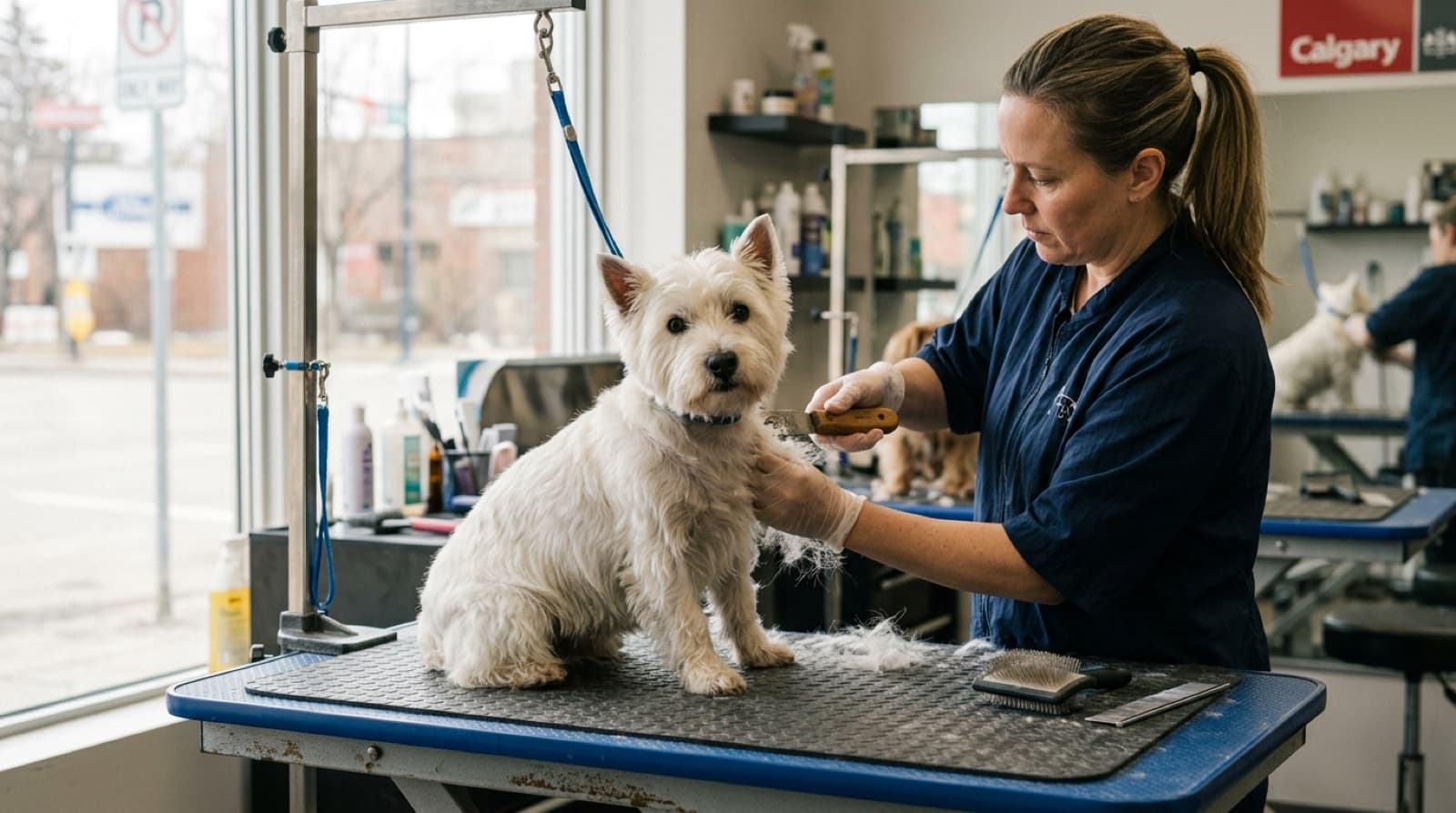
Why the Westie coat is unique
Most short legged terriers were developed to work. The West Highland White Terrier (developed in the Scottish Highlands in the 19th century for going to ground on fox and badger) was bred for a specific coat function: a harsh outer guard layer that shed dirt and resisted moisture, over a soft dense undercoat that insulated against cold and wet. The breed colour is fixed white at the W locus, which is part of why the coat looks the way it does.
That double coat structure is what makes Westie grooming different from a fluffy poodle cross or a single coated terrier. The harsh outer hairs naturally die off in a regular cycle and need to be removed (by hand stripping) to keep the new harsh growth coming in. The soft undercoat sheds twice a year heavily and lightly throughout the year. Two coat types living together on one dog, both shedding on their own schedule.
There is also a colour reality to live with. White coats yellow from saliva, urine, soil contact, sun exposure, and food residue. A clipped coat yellows faster than a hand stripped one because the soft inner hair surfaces are exposed at the coat tip rather than the harsh guard surfaces. Calgary winter is friendly to whiteness (dogs stay drier and cleaner indoors more often) and Calgary summer is when most yellowing happens.
None of this is a reason to skip the breed. It is a reason to know the workload before adopting. The harsh white double coat is the Westie signature and the maintenance is part of the package.
Hand stripping versus clipping
This is the defining grooming decision for any Westie owner. Both are valid. They produce different coats, different costs, and different long term skin outcomes.
Hand stripping. The groomer pulls out the dead outer guard hairs by hand or with a stripping knife. The new harsh coat comes in underneath cleanly. The breed coat texture stays intact. The colour stays brighter white. The skin breathes better because the natural coat shedding cycle is preserved. Calgary salons charge $80 to $130 per hand strip session, and the cycle runs 6 to 8 weeks. Hand stripping is the breed standard answer for a Westie with healthy skin and a reasonable temperament for the work.
Clipping. The groomer uses electric clippers to shave the outer coat off at a chosen length. Easier on the dog who dislikes pulling. Faster session, lower cost ($60 to $95 a Calgary session). The trade off: the coat softens over time as the harsh outer hairs no longer cycle naturally. The colour often dulls toward beige or pale yellow as the softer hair surfaces stain more. Some skin experts argue that clipping is gentler for dogs with chronic atopic dermatitis because the pulling involved in stripping can flare sensitive skin. Other groomers strongly disagree and prefer hand stripping for skin breathability.
How to choose:
- Healthy skin, tolerates handling, owner wants breed standard look: hand strip.
- Healthy skin, dog dislikes pulling, owner wants lower cost: clip.
- Diagnosed atopic dermatitis, vet has weighed in: follow your vet and groomer's combined recommendation; either can work.
- Senior Westie with skin getting more fragile: clip is usually kinder.
- Show coat ambitions: hand strip exclusively.
Both choices are defensible. The wrong answer is doing nothing for 6 months and ending up at a $120 to $160 shave down because the coat matted out. Pick a path, stick with the 6 to 8 week cadence, and adjust over the first year as you learn your dog.
The home brushing routine
Daily or near daily brushing is the second pillar of Westie care, alongside the professional grooming cadence. 5 to 10 minutes 4 to 5 times a week is the sustainable minimum for most adults. 10 minutes daily during spring and fall coat blow is the realistic peak.
The basic sequence:
- Slicker brush, line brushing. Part the coat with one hand and brush the section underneath. Move from the skin outward in short strokes. Work systematically from chest to hips, then down each leg, then the head and tail. This is the difference between brushing the top of the coat (which feels productive but does not prevent matts) and brushing the layer near the skin (which is where matts actually form).
- Pin brush pass. The pin brush goes through the full coat depth and lifts dead undercoat that the slicker missed. Useful especially during coat blow.
- Metal comb check. A fine to wide metal comb tells you whether the coat is clear at skin level. If the comb glides through, you are done. If it catches, go back with the slicker.
- Focus zones. Behind the ears, under the armpits, along the inner thighs, around the collar, at the base of the tail, and around the beard. These zones matt fastest. Give them an extra 30 seconds each.
- Reward. Treat at the end every time. Most Westies tolerate the routine well if it starts early and stays gentle.
The full at home kit runs $80 to $150 once and lasts for years:
- Medium slicker brush ($25 to $40)
- Pin brush ($15 to $25)
- Metal comb, fine and wide ($15 to $25)
- Detangling spray ($10 to $20)
- Gentle hypoallergenic shampoo (your groomer or vet picks the brand for your dog)
- Ear cleaning solution (vet recommended only)
- Nail clipper or grinder ($20 to $50)
Specific brands are a groomer and vet conversation, not a website pick. The structure above is the kit; the brand choices are personal to your dog.
The atopic dermatitis reality
Westies are one of the breeds most strongly associated with canine atopic dermatitis, an allergic inflammatory skin condition triggered by environmental allergens (pollen, dust mites, mould, sometimes food components). The American College of Veterinary Dermatology includes Westies on its list of breeds with elevated genetic predisposition. The American Animal Hospital Association covers atopic dermatitis as a chronic disease requiring long term veterinary management.
The Calgary picture: prairie grass pollen runs heavy from late spring through early fall, dust mites peak indoors during winter when houses are sealed up, and mould spikes in spring melt and after wet weather. Most Westies with atopic disease show their first signs between 1 and 3 years old, often seasonal at first and progressing toward year round as the dog ages.
The pattern that should prompt a vet visit:
- Itchy paws. The dog licks, chews, or worries front paws for long stretches. Saliva staining turns the white paws brownish.
- Recurrent ear infections. Two or more in a year is a strong signal of underlying atopic disease.
- Hot spots. Red, weeping patches that come and go, often on the face, belly, or armpits.
- Face rubbing. The dog drags the muzzle along the carpet or furniture.
- Belly redness. The skin on the belly or inner thighs flushes pink to red, sometimes with small bumps.
- Scratching with the back paws. Constant scratching at the side of the head or behind the ears.
- Hair thinning. Patches where the coat thins or breaks from chewing or licking.
Atopic dermatitis is a clinical diagnosis. Your vet rules out other causes (parasites, contact irritants, food allergens through elimination diet trial) and confirms the picture through exam, history, and sometimes intradermal allergy testing. Do not start over the counter allergy treatments, supplement protocols, or boutique diets without your vet involved. Cornell University's Riney Canine Health Center maintains owner-facing material on chronic skin conditions for further reading.
Treatment is individual to each dog and beyond the scope of a website. Your vet builds a plan; modern atopic care has improved meaningfully over the last decade. The point of this section is recognition, not treatment.
Calgary specific skin care lifestyle
Calgary's climate creates a handful of specific Westie care considerations that owners in milder coastal cities do not face the same way.
Bathing cadence. Every 4 to 6 weeks for most adult Westies, usually paired with the professional groom. Dry Calgary winter air already pulls moisture from skin and coat; over bathing strips the natural oils that defend against environmental dryness. Medicated baths on a vet prescribed schedule are the exception and follow your vet's protocol exactly.
Winter paw care. Calgary sidewalks get heavy salt and ice melt application from November through March. The chemicals can irritate paw pads and dry the skin between toes. Rinse paws with lukewarm water after walks (a quick towel pat works for short outings; a brief paw soak helps after longer ones), keep paw pad hair trimmed short to prevent ice and salt build up, and watch for cracking or redness between the toes. Some Westies tolerate boots well; many do not.
Summer paw care. Hot pavement burns paw pads. The 7 second rule (place the back of your hand on the pavement for 7 seconds; if you cannot keep it there, it is too hot for paws) is a reasonable test. Walk early morning or late evening on hot days. Bow River pathways and Edworthy Park grass trails are kinder to paws than direct pavement on summer afternoons.
Chinook season. Chinooks swing Calgary temperatures by 20 to 30 degrees within hours. The practical effect on Westie coat care: rapid wet to dry to wet cycles can tangle the coat and irritate sensitive skin. Towel dry thoroughly after wet outings, especially in the shoulder seasons (October to November, March to April) when the chinook melt-and-freeze pattern is most active.
Pricked ear care. Westies have small upright ears, which is a structural advantage. Airflow into the canal is excellent and base ear infection risk is lower than droopy eared breeds like Cocker Spaniels. Lift the flap and inspect once a week. Healthy Westie ears are pale pink with minimal wax and no smell. Recurrent ear infections in a Westie are usually a sign of underlying atopic disease, not a primary ear problem; bring them to the vet rather than treat them locally.
Coat colour management. Bow River and Fish Creek Park trails have soil and grass that stain a white coat fast in summer. Wiping paws and belly after off leash time, and using a coat brightening shampoo at bath time, helps keep the white bright. Some yellowing is inevitable in an active Westie and not a health issue.
When to escalate to a veterinary dermatologist
Chronic itch, recurrent ear infections, repeating hot spots, or failure to respond to two or three rounds of standard treatment all warrant a dermatology referral. Westies are a breed where specialist involvement often shortens the path to a working management plan.
Your regular Calgary vet is the first stop for any skin or ear issue and handles most routine cases. The reasons to ask for a referral to veterinary dermatology:
- Standard treatment has failed. Two or three medication courses have not controlled the itch or the skin infections keep returning.
- Recurrent ear infections. More than two ear infections in 12 months, especially with similar pattern each time.
- Food trial guidance needed. Your vet wants specialist input on which hydrolysed or novel protein diet to trial and how strictly to enforce it.
- Intradermal allergy testing. Identifying specific environmental allergens (grass pollen, dust mites, mould) requires specialist equipment and interpretation.
- Immunotherapy candidacy. Allergen specific immunotherapy (similar to allergy shots in humans) can be effective for atopic dogs and is typically initiated through a dermatologist.
- Severe or worsening disease. Significant skin damage, secondary infections that resist treatment, or quality of life concerns.
Calgary specialty options:
- Western Veterinary Specialist Centre. Multi-specialty hospital with dermatology services available by referral.
- VCA Canada West Veterinary Specialists. Specialty hospital with dermatology referral capacity in the Calgary area.
- Calgary Pet Wellness and Spay or Neuter Clinic. Lower cost general practice option that can serve as a budget conscious first stop for routine skin exams and follow ups, then refer up if needed.
Typical Calgary cost ranges:
- Routine vet skin exam with cytology and medication: $200 to $400 per visit.
- Specialty dermatology initial workup: $400 to $800.
- Intradermal allergy testing: $400 to $700 (one time).
- Allergen specific immunotherapy: $50 to $150 a month ongoing.
- Annual atopic care total (medication, recheck visits, baths): $600 to $2,000 for a moderate case.
Pet insurance enrolled before any skin diagnosis covers most of this. Insurance enrolled after diagnosis excludes the atopic dermatitis as a pre existing condition. This is the single strongest financial argument for insuring a Westie from puppyhood or from the day a rescue dog comes home. See the Westie health issues guide for the full pet insurance ROI breakdown for the breed.
Browse adoptable Westies in Calgary
Most Calgary Westies in rescue are between 2 and 7 years old. The adult coat is fully established, the temperament is set, and any skin history is on record with the rescue. That visibility lets you plan grooming and skin care for a known dog rather than guessing how a puppy will develop. The Calgary climate is forgiving for the breed, and the rescue network can match you with a Westie whose care needs fit your household.
See Available Westies →The Calgary winter coat strategy
Westies handle Calgary winter better than most owners expect because the double coat does its job. The strategy across the season:
November through March (deep winter): keep the coat slightly longer than summer length for insulation. Hand stripped Westies retain their full coat function. Clipped Westies should be left at a 1 to 1.5 inch body length rather than a close summer clip. Most healthy adult Westies handle walks down to about minus 15 degrees Celsius without a jacket; below that, a fitted winter coat helps, especially for seniors or dogs with thinner coats. Senior Westies and Westies with active atopic dermatitis may need a jacket sooner.
May through September (summer): a slightly shorter clip or maintenance hand strip keeps the dog cool. Resist the urge to shave fully. Westie coats provide some sun protection and a complete shave exposes the skin to sunburn risk on bright prairie days. A 0.75 to 1 inch summer body length with the legs and belly tidied up works well for most Calgary Westies.
April and October (shoulder seasons): chinook activity peaks. Layer for variability. Carry a removable jacket on walks. Towel dry thoroughly after any wet outing because the alternating wet and dry of chinook melt cycles tangles coats and irritates skin.
Paw pad hair gets long fast on Westies in winter and traps ice and salt between the pads. Ask your groomer to trim paw pad hair short at every winter groom. This is the single most impactful Calgary specific paw care change for Westie owners; many dogs who appear to refuse winter walks are actually dealing with ice balls between the toes, and a paw pad trim solves it instantly.
The cost of grooming neglect
Most Calgary Westie owners learn the maintenance math the hard way at their second or third groom appointment. They skipped brushing during a busy stretch, brought the dog in expecting a routine $80 groom, and got told the dog had to be shaved down because the matts were too deep to safely brush out.
The cost picture, neglect versus routine:
- Routine clip or strip every 6 to 8 weeks: $60 to $130 a session, $500 to $900 a year.
- Shave down after matting: $120 to $160 for the reset visit, plus 2 to 3 months of regrowth where the coat is too short to be the breed look.
- Chronic skin vet visits (preventable share): $200 to $400 a visit, often 3 to 6 visits a year if skin is neglected. Allergic disease is genetic and not fully preventable, but consistent skin care reduces flares.
- Groomer aversive dog: harder to quantify but real. Westies who have a difficult shave down session sometimes develop anxiety around future grooming visits, which compounds the workload at every appointment thereafter.
The fix is prevention. Daily or near daily brushing during the coat change window, 4 to 5 sessions a week as an adult, and 6 to 8 week professional cadence locked in. The dogs who do best at the groomer are the dogs who do not need anything dramatic done because the owner kept the coat clear at home.
The puppy to adult coat transition
The Westie coat changes meaningfully between roughly 6 and 14 months. The soft puppy coat sheds out and the harsh adult double coat replaces it. During this window, two coats live on the dog at once, and the matting risk is at its lifetime peak.
The brushing cadence through the transition:
- Months 1 to 5: 3 to 4 light brushings a week. The puppy coat is soft and short, so the goal is habit building and conditioning the puppy to enjoy the routine.
- Months 6 to 14: daily brushing, 5 to 10 minutes. This is non negotiable. The harsh adult coat is coming in underneath the puppy coat and the two layers tangle fast. Most owners who end up at an interim shave down at 10 to 12 months missed the daily routine somewhere in this window.
- Months 14+: back to 4 to 5 brushings a week (sustainable adult cadence), with daily during the spring and fall coat blow.
Professional grooming through the transition:
- First puppy groom: around 12 to 16 weeks after the full vaccination series. A gentle introduction visit. Light tidy, bath, blow dry. No major clipping or stripping. The goal is positive first experience, not a finished cut.
- 3 to 6 months: grooms every 6 to 8 weeks. Building tolerance to the full routine.
- 6 to 14 months: grooms every 6 weeks. This is the window where hand strip work properly starts (the first hand strip is usually around 9 to 12 months when the adult coat has come in enough to grip).
- 14 months+: settle into the every 6 to 8 week routine that holds for the rest of the dog's life.
The coat change is also when the hand strip versus clip decision becomes concrete rather than theoretical. Talk to your groomer at the first hand strip attempt about whether your specific dog's coat texture and temperament are well suited to stripping or whether clipping makes more sense.
Frequently Asked Questions
How often does a Westie need professional grooming in Calgary?
Every 6 to 8 weeks is the standard cadence for both hand stripped and clipped Westies. Hand strip sessions usually fall on the longer end of that window because the salon needs the outer coat long enough to pull. Clip sessions can flex slightly shorter if the coat grows fast on your individual dog. Calgary salons charge $60 to $110 for a routine clip and $80 to $130 for a hand strip. Owners who do good daily brushing at home can sometimes stretch to 8 to 10 weeks between professional visits, but skipping past that usually means a longer (and more expensive) reset visit when the dog finally goes in. Talk to your groomer about a cadence that fits your dog and your home routine; this is one of the easier things to dial in over the first year.
Should I hand strip or clip my Westie?
Hand stripping preserves the harsh white double coat the breed was developed for. The outer guard hairs stay coarse, the coat stays bright white, it sheds less, and the skin stays better ventilated. Clipping shaves the outer coat off with electric clippers. It is faster, easier on the dog who dislikes pulling, cheaper, and works fine cosmetically. The trade off is that clipped coats soften over time, often yellow more, and can change how the skin sheds dead hair and oils. For a Westie with healthy skin and a tolerant temperament, hand stripping is the breed standard answer. For a Westie with chronic skin issues, low pain tolerance, or an owner on a tighter budget, clipping is reasonable. Either choice is defensible. The wrong answer is doing nothing for 6 months and ending up at a shave down.
How much daily brushing does a Westie actually need?
Most adult Westies do well on 5 to 10 minutes of brushing 4 to 5 times a week, and 10 minutes daily during the seasonal coat blow in spring and fall. Puppies through the coat change (months 6 to 14) need closer to daily attention because the harsh adult coat is coming in underneath the soft puppy coat and the two layers tangle fast. The brushing routine is a slicker brush followed by a metal comb pass to check that the coat is clear at skin level. Skipping a week as an adult is usually recoverable. Skipping a month risks matts and a reset groom. Skipping during coat blow almost always means matts.
How do I know if my Westie has atopic dermatitis?
Atopic dermatitis is a clinical diagnosis your vet makes, not something to assume from a website. The pattern that should send you for a vet visit is itchy paws (the dog licking or chewing front paws for long stretches), recurrent ear infections, hot spots that come and go, scratching at the face, belly, or armpits, and skin that turns pink or red with rubbing. Calgary Westies often start showing signs between 1 and 3 years old. The breed has a well-documented elevated risk for the condition. Diagnosis involves ruling out other causes (parasites, food allergens, contact irritants) and may include a referral to veterinary dermatology. Do not start over the counter allergy treatments or supplement protocols without your vet involved; the wrong approach can mask symptoms while underlying disease progresses.
When should I see a veterinary dermatologist?
Ask your regular Calgary vet for a referral when (a) standard treatment has not controlled itch and skin infection after two or three medication courses, (b) ear infections keep coming back, (c) hot spots appear in multiple body locations, or (d) a food allergen trial is needed and your vet wants specialist guidance on the protocol. Western Veterinary Specialist Centre and VCA Canada West Veterinary Specialists both offer dermatology services in the Calgary area. Expect a $400 to $800 initial workup including history, exam, cytology, and a treatment plan. The investment is worth it for chronic cases because dermatology vets see hundreds of allergy dogs a year and can shortcut months of trial and error your regular vet would otherwise navigate alone.
How often should I bathe my Westie?
Less often than most owners assume. Every 4 to 6 weeks is a reasonable baseline for a healthy adult Westie, often timed with a professional groom. Bathing more frequently strips the natural oils the coat and skin need to stay balanced, and dry winter Calgary air already pulls moisture from the skin. The exception is a Westie with diagnosed atopic dermatitis whose vet has prescribed a medicated shampoo on a specific schedule; follow the protocol your vet gives you. For routine washing, use a gentle hypoallergenic shampoo (your groomer or vet can recommend one for your dog), rinse thoroughly to avoid residue, and towel and air dry rather than blasting with a high heat dryer. Over bathing is one of the most common causes of dull, itchy Westie coats.
Why is my Westie turning yellow or beige?
White coats yellow from a few predictable sources: saliva on paws and around the mouth, urine on belly and back legs, soil and grass stains during outdoor play, sun exposure on the back over a long summer, and food residue around the muzzle. Hand stripped coats hold colour better than clipped coats because the harsh outer coat repels stains more than the softer clipped coat. Wiping paws and muzzle after meals and walks, and using a coat brightening shampoo at bath time (your groomer can recommend one), helps. Calgary winter is actually friendly to Westie whiteness because dogs stay drier and cleaner indoors more of the time. Summer is when the yellowing accelerates fastest.
Can I learn to hand strip my Westie myself?
Some owners do. It is a learnable skill with practice, and the upfront equipment cost is modest (a stripping knife and stripping stone run $30 to $80 total). The realistic learning curve is 1 to 2 years before your at home strip looks as good as a professional groomer. Most Calgary owners do partial work at home (touch ups, ear and tail tidies, between visit maintenance) and leave the full strip to a salon. If you want to learn properly, ask your groomer if they will teach you during a session; some are happy to walk an owner through the technique. The other option is to clip at home instead, which is easier to learn but moves you off the hand strip path long term.
How do I pick a Calgary groomer for my Westie?
Look for a groomer with terrier or breed standard experience specifically, not a generalist who clips everything the same way. Ask whether they hand strip Westies, what their typical strip and clip session looks like, how they handle a dog with sensitive skin, and what their shave down policy is. A good groomer will also examine the coat and skin at every visit and flag changes you might miss at home. Ask for before and after photos of Westies they have worked on. Calgary force free trainers like Raising Canine and Pup City Pup Academy often share groomer referrals from their client networks. Most owners settle on a groomer after one or two trial visits.
How often should I check my Westie ears?
Lift the ear flap and look inside once a week, and clean only if your vet has shown you the routine for your specific dog. Westie ears stand upright, which means they get much better airflow than droopy eared breeds and have lower base risk of ear infection. The flip side is that Westies are an allergy prone breed, and recurrent ear infections are one of the first signs of underlying atopic disease. If you see redness, swelling, dark discharge, or smell a yeasty or foul odour, book a vet visit rather than clean. Healthy Westie ears stay pale pink with minimal wax and no smell.
Could my Westie have food allergies?
Possibly, but food allergens are diagnosed through a controlled elimination diet trial under veterinary supervision, not by switching brands or trying a supplement. About 10 to 20 percent of itchy dogs have a food component contributing to the picture; the rest are reacting to environmental allergens (pollen, dust mites, mould). A proper food trial runs 8 to 12 weeks on a hydrolysed protein or novel protein diet your vet prescribes, with strict adherence (no treats, no chew toys with flavour, no human food scraps). Cutting corners on the trial invalidates the result. Do not jump to a grain free or boutique diet on your own; current veterinary nutrition research has flagged links between some boutique diets and heart disease, and the choice of trial diet matters.
What does a year of Westie grooming and skin care actually cost in Calgary?
For a healthy Westie with no chronic skin issues, plan for $500 to $900 in professional grooming (6 to 8 visits at $60 to $130 each depending on whether you hand strip or clip), plus $80 to $200 for at home brushes, combs, shampoo, and ear solution, plus $200 to $400 for the annual vet exam and bloodwork. Total $780 to $1,500 a year. For a Westie with diagnosed atopic dermatitis, add $600 to $2,000 in derm vet visits and ongoing medications over the year, and possibly more for a food trial. Pet insurance taken out at puppyhood or at adoption (before any skin diagnosis) covers most of the chronic skin spend; insurance taken out after diagnosis excludes the pre existing condition. This is the single strongest argument for insuring a Westie from day one.
Adoptable Westies in Calgary
Live listings of West Highland White Terriers from the Calgary rescue network, updated regularly.
Westie Adoption Calgary
The Calgary Westie adoption hub. Rescue sources, real costs, surrender patterns, and breeder verification.
Is a Westie Right for You?
Lifestyle fit, terrier temperament, Calgary climate match, and the grooming and skin workload reality.
Westie Health Issues Calgary
Inherited conditions, atopic dermatitis depth, Calgary specialty vet contacts, and pet insurance ROI for Westies.
New dog? Start with these care guides
Everything a new adopter needs to set up a safe, happy home.