The short answer
Westies typically weigh 15 to 22 lbs and live 12 to 16 years with proactive care. The breed has a recognisable health profile shaped by its narrow founding gene pool from Scottish working terriers. The most common conditions Calgary Westie owners encounter are atopic dermatitis (chronic itchy skin disease, the breed-defining issue), recurring ear infections (usually a secondary effect of the skin disease), Westie lung disease (canine idiopathic pulmonary fibrosis in seniors), Legg-Calve-Perthes disease (a juvenile hip condition), craniomandibular osteopathy (a puppy jaw disease), copper toxicosis (liver), patellar luxation, hereditary cataracts, and dental disease. A health-aware adopter who pairs early veterinary involvement with pet insurance enrolled before pre-existing conditions accumulate has strong levers to work with.
This article is informational only and is not veterinary advice. Always consult your Calgary veterinarian for individualised health guidance for your specific dog.
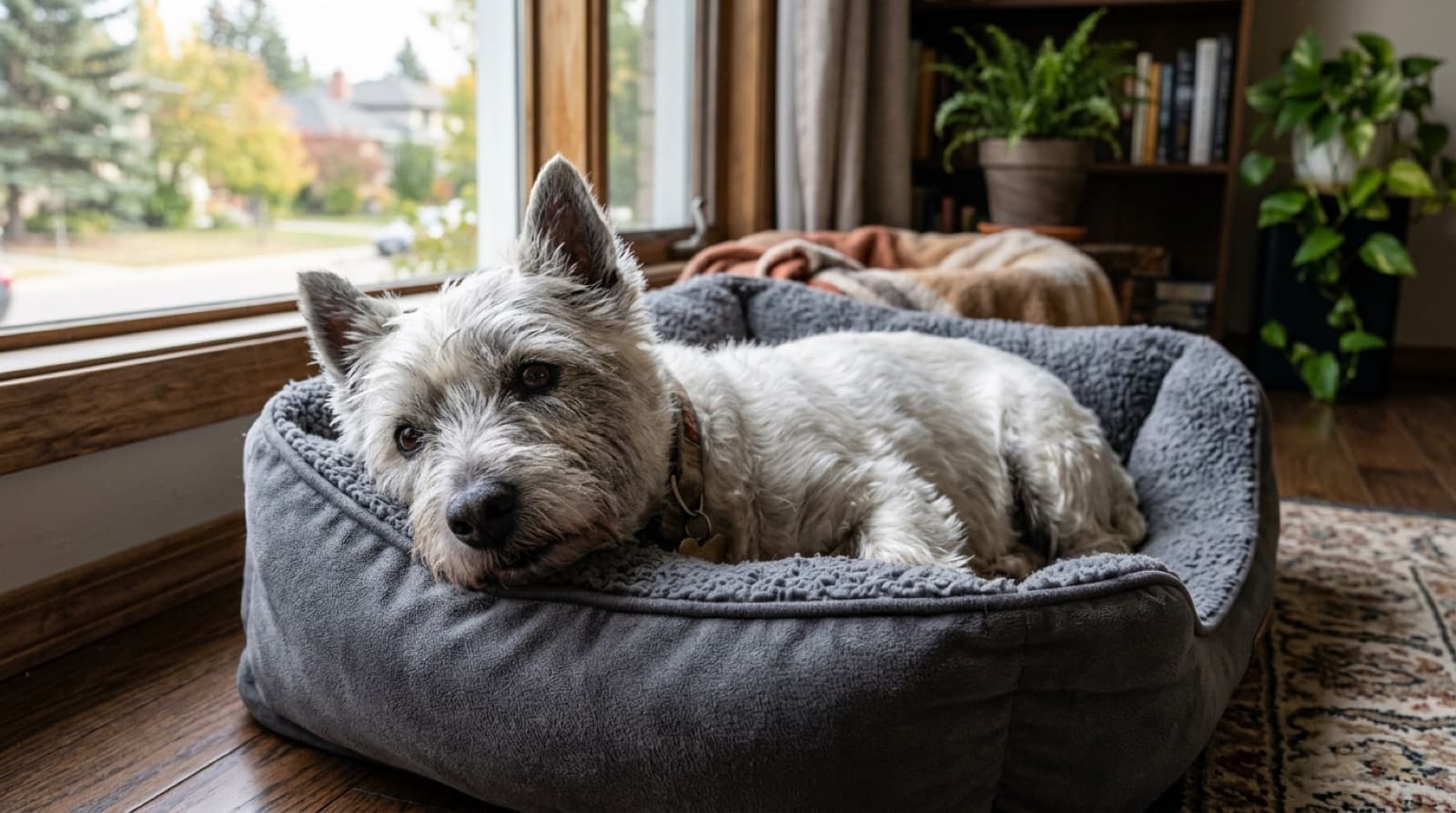
The West Highland White Terrier descends from Scottish working terriers bred for hunting small game in rocky highland terrain. The modern breed traces to a narrow founding population in the late 1800s, and that genetic bottleneck shapes Westie health today. Several breed-specific conditions are well-documented in the veterinary literature, and adopters who understand the patterns are better placed to catch issues early. This article walks Calgary owners through what to ask the vet about at adoption and at every annual exam after, what to watch for at home, and what belongs in veterinary hands rather than the internet. Sources include the Orthopedic Foundation for Animals (OFA), the AKC Canine Health Foundation, the Cornell Riney Canine Health Center, the American Animal Hospital Association, and the Canadian Kennel Club.
Why Westies have a distinct health profile
The Westie's health profile is not a coincidence. The breed was developed from a small founding population of Scottish terrier-type dogs in the late nineteenth century. That narrow gene pool means certain inherited conditions cluster in the breed at higher rates than in the general dog population. Atopic dermatitis, Westie lung disease, CMO, copper toxicosis, and Legg-Calve-Perthes are all over-represented in the breed.
For Calgary adopters working with an ethical breeder, the protective lever is documentation. A responsible Westie breeder tests breeding stock, discloses any history of breed conditions in the lines, and walks away from breeding pairings where risks stack unfavourably. For rescue adopters, the parental history is typically unknown. The right response is not despair. It is proactive management with a Calgary vet from week one, an annual wellness routine, attention to skin and ear care, and early pet insurance enrollment before any pre-existing conditions are documented.
The sections below cover what to ask about and what to watch for. Every diagnostic and treatment decision belongs with your Calgary veterinarian.
Atopic dermatitis: the breed-defining condition
If you adopt a Westie, plan for skin care as a possible lifelong commitment. Atopic dermatitis (allergic skin disease) is the breed-defining health concern. It is documented at higher rates in Westies than in most other breeds. Many Westies will need ongoing veterinary support for skin and ear issues across their lifespan.
Atopic dermatitis is an immune-mediated condition. The dog's immune system reacts to environmental allergens (pollens, dust mites, mould spores, certain proteins) that most dogs tolerate without issue. The result is chronic itching, inflammation, and secondary infections.
Calgary triggers to discuss with your vet:
- Spring tree and grass pollen (typically April through June)
- Summer weed and ragweed pollen (July through September)
- Year-round dust mites, especially in older Calgary homes
- Mould spores during damp spring and autumn weather
- Food protein sensitivities in some dogs (chicken, beef, dairy are common)
Symptoms to discuss with your Calgary vet:
- Persistent itching, especially the paws, belly, armpits, face, and ears
- Paw licking or chewing (sometimes obsessive)
- Face rubbing on carpet or furniture
- Recurring ear infections (a very common signal of underlying allergy)
- Red, inflamed, or thickened skin in the typical itch zones
- Yeasty or musty odour, especially from the paws or ear flaps
- Hair loss in patches, often from chronic licking and scratching
- Hot spots (acute moist dermatitis)
Diagnosis is veterinary work. Your Calgary vet will rule out parasites, infections, and food allergies first, often using a structured elimination process. Specialist referral to a veterinary dermatologist may follow for advanced workup, including intradermal allergy testing or serum allergy testing. Home elimination diets and over-the-counter products are no substitute for a proper workup.
Lifestyle implications are real. A Westie with atopic dermatitis often does best with frequent bathing in vet-recommended products, year-round attention to skin and coat condition, and proactive management of seasonal flares. Some Westies do well on the standard plan; others need referral-level care.
Westie lung disease (idiopathic pulmonary fibrosis)
A senior Westie with a new persistent cough is a same-week vet visit, not a wait-and-see. Canine idiopathic pulmonary fibrosis, sometimes called Westie lung disease, is a documented breed-specific concern affecting middle-aged to senior Westies. Earlier identification opens more management options.
Westie lung disease is a progressive scarring of the lung tissue (fibrosis) of unknown underlying cause. It restricts the ability of the lungs to expand and exchange oxygen. The condition typically appears in middle-aged to older Westies and progresses gradually.
Symptoms to discuss with your Calgary vet:
- A chronic dry cough that does not resolve with standard treatment
- Gradual exercise intolerance (the senior Westie who used to walk to Nose Hill Park now struggles with the driveway)
- Increased respiratory effort, especially after mild activity
- Audible crackles or wheezing (your vet hears these with a stethoscope)
- Blue or purple gum tinge in severe cases (a same-day emergency)
Diagnosis typically involves chest imaging, bloodwork, and sometimes referral to a veterinary internal medicine specialist. The Calgary referral centres for advanced workup are Western Veterinary Specialist Centre and VCA Canada West Veterinary Specialists. Management is individualised by your vet team. There is no cure, but earlier identification often opens more supportive options.
For Calgary owners, the practical signal is this. Any senior Westie with a new persistent cough warrants a vet visit. Coughs in small breeds are sometimes dismissed as tracheal collapse or kennel cough by owners. In a Westie, the differential includes Westie lung disease, and ruling it in or out matters.
Legg-Calve-Perthes disease (juvenile hip)
Legg-Calve-Perthes disease is a condition where the head of the femur loses its blood supply and collapses, causing hindlimb lameness. It affects almost exclusively small breeds, including Westies, Yorkies, and Toy and Miniature Poodles. Onset is typically between 4 and 12 months of age, so it is most often a puppy or young-adult concern.
Symptoms to discuss with your Calgary vet:
- Gradual hindlimb lameness in a young Westie, usually unilateral (one leg)
- A reluctance to put full weight on the affected leg
- Visible muscle wasting in the affected hindquarter
- Pain on hip manipulation during exam
- An increasingly bunny-hopping gait as compensation
Diagnosis is by X-ray. Surgical correction (femoral head ostectomy) at a Calgary specialty surgical centre such as Western Veterinary Specialist Centre has a very favourable outcome in most dogs. Rehabilitation and physical therapy after surgery help restore function. Surgical and rehabilitation decisions belong with the specialty team.
For Calgary adopters of young Westies, any persistent hindlimb lameness in a dog under 18 months warrants prompt veterinary attention. Earlier diagnosis can mean better outcomes.
Craniomandibular osteopathy (CMO)
Craniomandibular osteopathy is a developmental bone disease affecting the jaw and skull of young Westies. The body lays down excessive bone in the lower jaw and surrounding skull bones, causing pain and difficulty eating. It is sometimes called Westie jaw or lion jaw. CMO is documented in West Highland White Terriers, Cairn Terriers, and Scottish Terriers (the closely related Scottish working terrier family).
Symptoms typically appear between 3 and 8 months of age. Discuss with your Calgary vet:
- Visible jaw swelling, often firm and symmetrical
- Pain when eating, especially harder food
- Reluctance to open the mouth widely
- Drooling
- Fever in active flares
- Reduced appetite or weight loss in severe cases
Diagnosis is by physical exam and X-ray. Management is supportive: pain control, softened food, and time. Most affected dogs eventually outgrow active disease by about 12 months as bone development completes, though some retain a permanently thickened jaw. All medication and feeding-plan decisions belong with your Calgary vet.
For Calgary adopters of Westie puppies, any unexplained jaw swelling, drooling, or reluctance to eat in a 3 to 8 month old puppy is a same-week veterinary appointment.
Copper toxicosis (liver disease)
Copper toxicosis is an inherited condition in which the liver fails to excrete dietary copper normally. Copper accumulates in the liver over time, eventually causing liver damage. The condition is documented in West Highland White Terriers and several other breeds (Bedlington Terriers most famously). DNA testing exists for some forms, and ethical breeders may screen breeding stock.
Symptoms typically appear in middle age as liver damage accumulates. Discuss with your Calgary vet:
- Reduced appetite and weight loss over weeks to months
- Vomiting episodes
- Increased thirst and urination
- Lethargy
- Jaundice (yellow tinge to gums, eyes, or skin) in advanced disease
- Abdominal distension in late stages
Diagnosis uses bloodwork (liver enzymes), bile acid testing, ultrasound, and sometimes liver biopsy. Management is lifelong and individualised by your vet, often involving dietary copper restriction and medication. The earlier the diagnosis, the more options are open.
For Calgary Westie owners, including annual bloodwork from age 5 or 6 onward (with liver enzyme panels) is a reasonable preventive step to discuss with your vet. Any new vomiting episodes, appetite changes, or unexplained weight loss in a middle-aged Westie warrants a prompt veterinary visit.
Patellar luxation
Patellar luxation is a condition where the kneecap (patella) slips out of its normal groove on the femur, causing a hopping or skipping gait. It is common in many small breeds including Westies. Severity is graded 1 to 4 by your vet. Mild cases (grade 1 to 2) are often managed conservatively; more severe cases (grade 3 to 4) may benefit from surgical correction at a Calgary specialty surgical centre.
Signs to discuss with your Calgary vet:
- An intermittent skipping or hopping step in the hindlimb that resolves spontaneously
- A leg held up briefly during a walk then placed back down
- Reluctance to jump onto furniture or into the car
- Increasing lameness as the dog ages
Diagnosis is by physical examination and X-ray. Surgical decisions belong with your vet and a referral surgical team where indicated. Body weight is a meaningful owner-controllable factor; a lean Westie puts less load through hips and knees than an overweight one of the same height.
Cataracts and dental disease (senior concerns)
Hereditary cataracts are documented in West Highland White Terriers. Cataracts cloud the lens and can progress to vision loss. Some are managed conservatively; others are candidates for surgical removal at a veterinary ophthalmology referral centre. Annual eye examinations from age 5 onward are reasonable, and results can be recorded in the OFA Eye Certification Registry where available.
Signs include cloudiness visible in the pupil, bumping into furniture or objects, and reluctance to navigate stairs in low light. Any sudden squinting, redness, or apparent eye pain is a same-day Calgary vet visit, not a wait-and-see.
Dental disease is a standard small-breed concern that intensifies in Westies because of crowded teeth in a small jaw. Daily home dental care (brushing or vet-approved dental products) and annual professional dental cleaning under anaesthesia are reasonable starting points. Untreated dental disease in small dogs can cause pain, tooth loss, and systemic infection. Some Westies need more frequent professional cleanings; your vet will set the cadence based on each dog's oral exam.
The Calgary Westie annual health checklist
Use this as a starting point for the annual vet conversation. Your Calgary vet will adjust based on your individual dog's history and exam findings.
- Annual wellness exam with full physical, weight, body-condition score, and vaccination review
- Annual skin and coat examination looking for early signs of atopic dermatitis, secondary infections, and hot spots
- Annual ear-canal examination with otoscope; recurring ear issues often signal underlying allergic skin disease
- Annual dental check with professional dental cleaning under anaesthesia as your vet recommends
- Annual eye examination by a vet or veterinary ophthalmologist from age 5 onward (CERF or OFA Eye Certification Registry)
- OFA hip and patellar evaluation if any signs of hindlimb lameness
- Annual bloodwork from age 5 to 7 onward including a liver enzyme panel given the breed's copper toxicosis risk; your vet may recommend earlier for individual dogs
- Weight management: lean body condition is the single biggest owner-controllable health lever, especially given Westies' tendency to gain weight in winter when off-leash time at Nose Hill or Fish Creek Provincial Park drops
- Year-round flea and tick prevention with a product chosen by your vet (Alberta tick season runs roughly April through October, but Calgary chinooks can extend exposure)
Calgary specialty vet directory
Most Westie healthcare runs through a regular Calgary vet. Specialty referrals are typically vet-initiated for advanced cases. The centres below are the main Calgary referral options for orthopaedic surgery, internal medicine, ophthalmology, dermatology, and 24-hour emergency.
- Western Veterinary Specialist and Emergency Centre: multi-disciplinary specialty hospital with surgery, internal medicine, ophthalmology, dermatology, and 24-hour emergency. Common referral destination for Westie orthopaedic, dermatology, and complex internal medicine cases (including suspected Westie lung disease workup).
- VCA Canada West Veterinary Specialists: specialty referral centre with surgery, ophthalmology, internal medicine, and emergency services.
- Calgary Pet Wellness and Spay/Neuter Clinic: affordable wellness, vaccinations, and routine spay/neuter for adopters managing cost. A common first-week destination for new rescue Westie owners.
For after-hours emergencies (sudden respiratory distress, acute eye change, severe vomiting in a dog with possible copper toxicosis, suspected toxin ingestion), Calgary has 24-hour emergency veterinary services. Your regular vet's voicemail typically directs to the current after-hours option.
Pet insurance for Westies: when to enroll matters
Pet insurance is generally a strong consideration for Westies because atopic dermatitis is so common in the breed and skin-related claims can add up across the dog's lifespan. Workups, allergy testing, medicated baths, and long-term management cost real money.
The lever that matters most is enrolling early. Every Canadian provider excludes pre-existing conditions. A Westie enrolled at 8 weeks with no documented conditions qualifies for the broadest coverage. A Westie enrolled at age 5 after a single documented case of atopic dermatitis can have skin-related claims excluded indefinitely. The same logic applies to ear infections, orthopaedic findings, and any other documented condition.
This article does not endorse any specific provider. Coverage details, deductibles, reimbursement percentages, annual limits, and condition exclusions vary significantly between providers and policy tiers. Compare current policies carefully before choosing, and read the pre-existing condition language closely.
Browse adoptable Westies in Calgary
Health-aware adoption is achievable. A rescue Westie paired with a thorough first-week vet workup and early pet insurance enrollment is a realistic and rewarding path for many Calgary families.
See Available Westies →Adopting a rescue Westie with unknown health history
Most rescue Westies in Calgary arrive with limited parental health history. The rescue itself usually provides an intake exam, vaccinations brought current, and spay or neuter. Beyond that, the inheritable conditions discussed above are unknown until they appear or are screened for.
Ask the rescue:
- What veterinary records came with the dog from the previous owner or shelter
- What the intake physical found, especially skin, ears, eyes, jaw, and orthopaedic exam
- Any history of itching, skin treatment, or recurring ear infections
- Any known coughing, exercise intolerance, or respiratory concerns
- Any history of jaw swelling, lameness, or difficulty eating
- Spay or neuter status and date
- Vaccination status and dates
- Dental condition
- Any current medications and the reason
- Any behaviour notes (eating, sleeping, energy, prior household compatibility)
Plan a Calgary vet visit within the first week. A baseline workup is worth the cost regardless of what the rescue provides. Reasonable first-week items to discuss with your vet:
- Full physical exam with weight and body-condition score
- Skin and coat examination (paws, belly, armpits, face, ears)
- Otoscope ear-canal exam
- Dental exam
- Orthopaedic exam, including hip, knee, and patella range of motion
- Eye exam
- Baseline bloodwork (including liver enzymes given the breed's copper toxicosis risk)
- Vaccination review against your Calgary vet's standard schedule
- Parasite screening (faecal sample)
- Microchip status check
Enroll in pet insurance during this same first-week window if possible, before any new findings become documented and therefore pre-existing.
Senior Westie care (10+ years)
Westies commonly reach 12 to 16 years. The senior phase (roughly 10 onward for most Westies) brings predictable shifts. Arthritis from earlier orthopaedic wear becomes more obvious. Dental disease accumulates. Vision and hearing can decline. Cognitive changes (canine cognitive dysfunction, similar to dementia) appear in some dogs. Westie lung disease becomes a real differential for any new persistent cough. Weight management gets harder as activity drops.
Lifestyle modifications worth discussing with your vet: shorter, more frequent walks; non-slip flooring or runners on hardwood; ramps to the couch or bed instead of jumping; warmer indoor temperatures during Calgary winter chinooks and cold snaps; food-puzzle enrichment to keep the mind active; and a senior-appropriate diet selected with your vet.
Twice-yearly senior wellness exams with annual bloodwork are reasonable from age 7. Earlier detection of kidney, liver, thyroid, or other organ shifts lets your vet intervene sooner. The liver enzyme panel matters more in Westies than in many breeds because of copper toxicosis risk.
End-of-life conversations belong with your Calgary vet. Knowing in advance what quality-of-life signs you would consider, what hospice or palliative options exist, and what at-home euthanasia services your vet offers makes the eventual decision less overwhelming. Most Calgary vets are willing to have this conversation well before it is needed.
Anaesthesia considerations for Westies
Westies do not carry the MDR1 gene mutation that affects anaesthesia and certain medication safety in Australian Shepherds, Collies, and related herding breeds. Small-breed anaesthesia protocols still matter. Westies are small dogs, and small dogs lose body heat faster, metabolise some anaesthetic agents differently, and benefit from monitoring tailored to their size.
Reasonable preoperative steps to discuss with your vet before any elective procedure include standard bloodwork, a thorough cardiac auscultation, and a liver enzyme panel given the breed's copper toxicosis risk. If hypothyroidism is suspected from clinical signs, a thyroid panel before anaesthesia is reasonable. For senior Westies, chest imaging to screen for Westie lung disease may be discussed depending on signs.
All anaesthesia planning, drug selection, and monitoring decisions belong entirely with your Calgary veterinary team. Do not rely on internet protocols or breed forums for anaesthesia advice.
Frequently asked questions
What is the typical Westie lifespan?↓
What should I watch for with Westie atopic dermatitis?↓
How common is Westie lung disease?↓
What tests should a Westie breeder provide?↓
What should I ask a rescue about a Westie's health history?↓
When should I start pet insurance for a Westie?↓
What are the biggest lifetime cost worries for a Westie?↓
How often should a Westie see the vet?↓
How do I prevent ear infections in a Westie?↓
Should I DNA test for copper toxicosis in a Westie?↓
What is the recommended vaccination schedule for a Westie?↓
How often does a Westie need dental care?↓
Continue reading
Adoptable Westies in Calgary
Browse available West Highland White Terriers and Westie mixes from Calgary rescues, with shelter contact info and adoption next steps.
Westie adoption Calgary
The full Calgary Westie adoption guide: rescues, costs, why Westies end up in rescue, and the rescue vs breeder conversation.
Is a Westie right for you?
Honest Calgary self-assessment: skin-care commitment, grooming costs, terrier temperament, and who the breed is really for.
Westie grooming and skin care Calgary
Weekly skin and coat routine, Calgary grooming salon costs, hand-stripping vs clipping, and managing the atopic dermatitis reality.
New dog? Start with these care guides
Everything a new adopter needs to set up a safe, happy home.