The short answer
Trauma-history Rottweilers in Edmonton rescue usually show fear-based reactivity (defensive, wants the threat to go away) rather than offensive aggression (forward-driving, wants to engage). The two require different approaches. Plan on a 4-phase rehabilitation (decompression, bonding, training, reintegration) running 9 to 18 months. Confirm your Edmonton landlord and home insurance accept Rottweilers in writing before you adopt; both routinely impose breed restrictions. Engage an Edmonton force-free trainer within the first one to two weeks. The bond when it forms is intense.
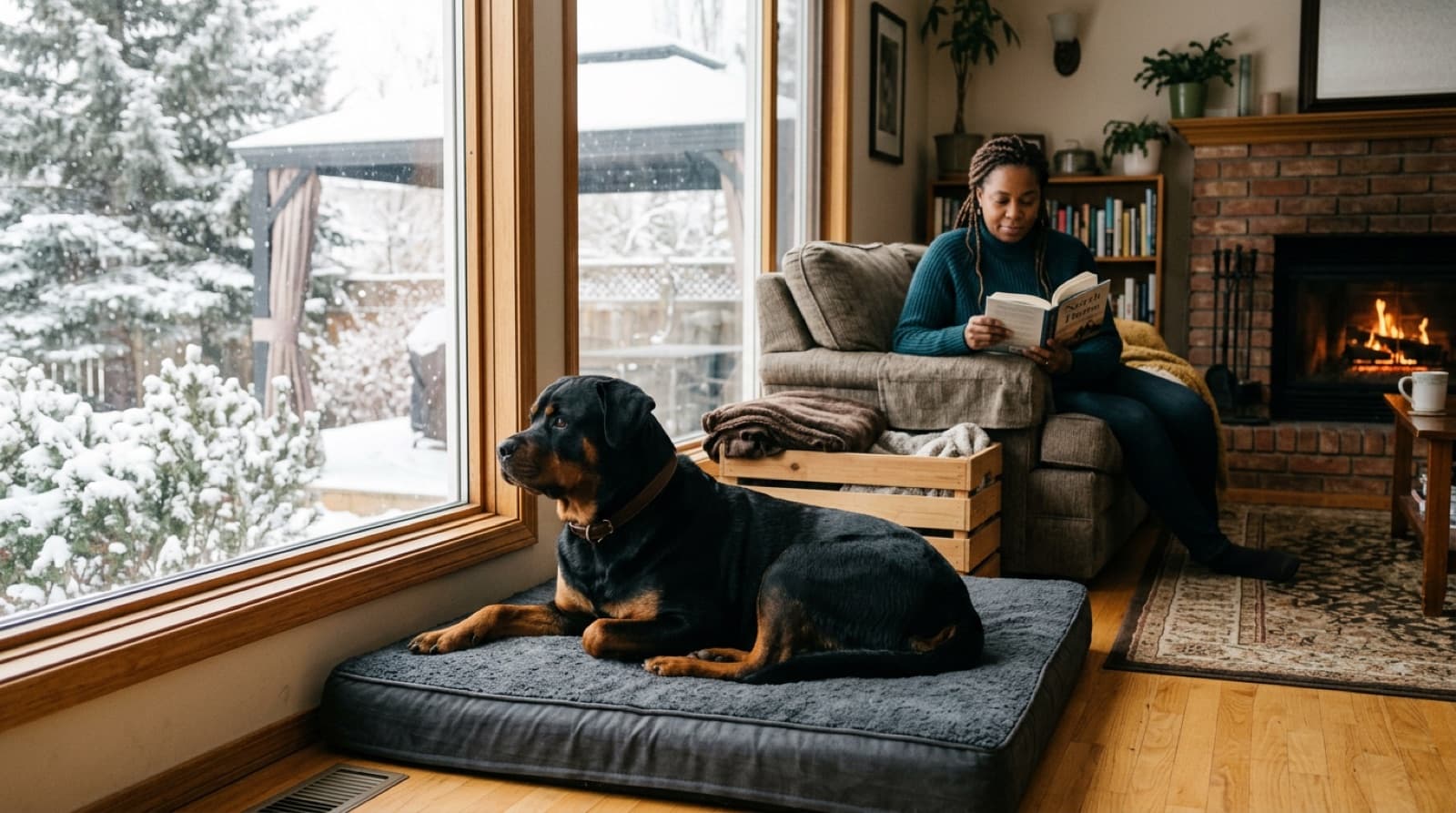
Edmonton rescue Rottweiler context
Rottweilers appear less often than German Shepherds in Edmonton rescue inventory but they show up regularly. The main pipelines:
- SCARS (Second Chance Animal Rescue Society): occasionally pulls Rottweilers and Rottweiler-crosses from northern Alberta partnerships. Stable temperament evaluations through foster placement.
- Edmonton Humane Society: sees Rottweiler owner surrenders fairly often, sometimes tied to landlord restrictions or unmet behaviour expectations. Ask directly what is known about the surrender reason.
- AHHRB (Alberta Homeward Hound Rescue Bureau): takes unclaimed Rottweilers from bylaw agencies across Sherwood Park, Strathcona County, Fort Saskatchewan, Leduc, Camrose, Tofield, and Edmonton.
- Hope Lives Here Animal Rescue, Zoe's Animal Rescue, GEARS: foster-based and occasionally place Rottweilers but inventory is smaller.
- Pit Bulls for Life Foundation (Stony Plain): takes some Rottweilers as part of their broader restricted-breed advocacy work.
The trauma profile varies by pipeline. SCARS dogs often arrive with rural neglect or chain-tether history. EHS surrenders sometimes carry the behaviour that led to the surrender. AHHRB strays have unknown prior socialisation. Read the foster temperament evaluation carefully and ask specifically about bite history, leash reactivity, food guarding, kid-safe history, and other-dog tolerance.
Rottweilers are not inherently aggressive
The American Kennel Club describes the Rottweiler as a calm, confident, and courageous dog with a self-assured aloofness toward strangers. The breed standard calls for a stable temperament. The Canadian Kennel Club breed standard echoes the same calm working temperament. Trauma-history Rottweilers in rescue usually show fear-based reactivity, which is a defensive response, not the offensive aggression people sometimes associate with the breed's reputation.
Fear-based reactivity is a defensive response: lunging, barking, snapping, or growling triggered by something the dog perceives as threatening. The intent is to make the threat go away. Body language usually shows stress: whale eye, tucked tail, lowered body, lip licking. The dog often retreats when given space.
Offensive aggression is a forward-driving response with intent to engage: tight posture, hard eye contact, no signs of stress retreat. The two responses look similar to the untrained eye but call for different approaches.
Force-free training and counter-conditioning resolve most fear-based reactivity over months. Offensive aggression is a board-certified veterinary behaviourist case from day one and the prognosis varies. Ask the rescue specifically about which the dog has shown in foster, and ask for the foster's notes on bite history including air snaps.
The 4 phases of Rottweiler rehabilitation
Phase 1, decompression (weeks 1 to 3): no demands, no visitors, predictable routine, safe space. The dog learns the house is safe before anything else happens. Bite risk is highest in this window; no forced interaction, no boundary testing, no introductions. The 333 rule first-three-days protocol applies.
Phase 2, bonding (weeks 4 to 12): the dog learns you are a source of safety. Basic positive-reinforcement training begins (sit, name response, hand target, come). The real personality emerges. Sometimes early behaviour patterns surface as the dog tests routine and trust. Engage a force-free trainer in this phase if you have not already.
Phase 3, training (months 3 to 9): foundation cues consolidate: sit, down, stay, recall, leave it, place, settle. Leash skills develop. Counter-conditioning protocols address any leash reactivity that has surfaced. The dog can be left alone for moderate periods. Routine handling (brushing, ear checks, harness on and off) becomes neutral.
Phase 4, reintegration (months 9 to 18+): gradual expansion of tolerated experiences. Longer walks, controlled visitor exposure, reliable cues in low-distraction environments. Full family integration. Lifestyle stabilisation. Severe trauma cases continue into year two with ongoing behaviourist support.
The bond when it forms is usually intense and lifelong. Edmonton Rottweiler owners often describe their trauma-history rescues as the most devoted dogs of their lives.
Edmonton rental and insurance reality
Confirm housing and insurance for the breed in writing before you adopt. Many Edmonton landlords and many Canadian home insurers exclude Rottweilers. Surprise discoveries after adoption are the cause of a meaningful fraction of Rottweiler returns to rescue.
Rental restrictions: many Edmonton landlords ban what they classify as restricted breeds, and Rottweilers usually appear on those lists alongside Pit Bulls, Doberman Pinschers, and sometimes German Shepherds and Akitas. Strata and condo boards may impose weight caps and breed bans that go beyond the building's general pet policy. Some landlords refuse the breed outright. Others require a substantial pet deposit. Some require liability insurance naming the landlord. Before you apply: get your landlord's written permission, confirm the breed restriction in your lease, and check your tenant insurance for any breed exclusions. If you own and live in a condo, read the bylaws and confirm with the board in writing.
Home insurance: many Canadian home and tenant insurance policies exclude specific breeds from liability coverage, and Rottweilers usually appear on those exclusion lists. Some insurers refuse to underwrite at all if a Rottweiler is in the home. Others write the policy but exclude any liability claim involving a dog bite. Call your insurer before adoption and ask in writing about breed-specific coverage. If your current insurer excludes Rottweilers, shop other carriers; some niche insurers specifically write Rottweiler and Pit Bull coverage.
The American Veterinary Medical Association position is that breed-specific policies are not supported by injury data, and the AVMA opposes breed-specific legislation as ineffective. The insurance market still reflects breed-specific exclusions despite the AVMA position, and that mismatch is something an Edmonton adopter has to navigate before bringing the dog home, not after.
Pet insurance for the dog: enroll before any behavioural issue is documented. Canadian carriers (Trupanion, Petsecure, Pets Plus Us, Sonnet) sometimes exclude Rottweilers and sometimes specifically write them. Read breed-specific clauses before committing. Premium runs $50 to $150 per month depending on age and policy.
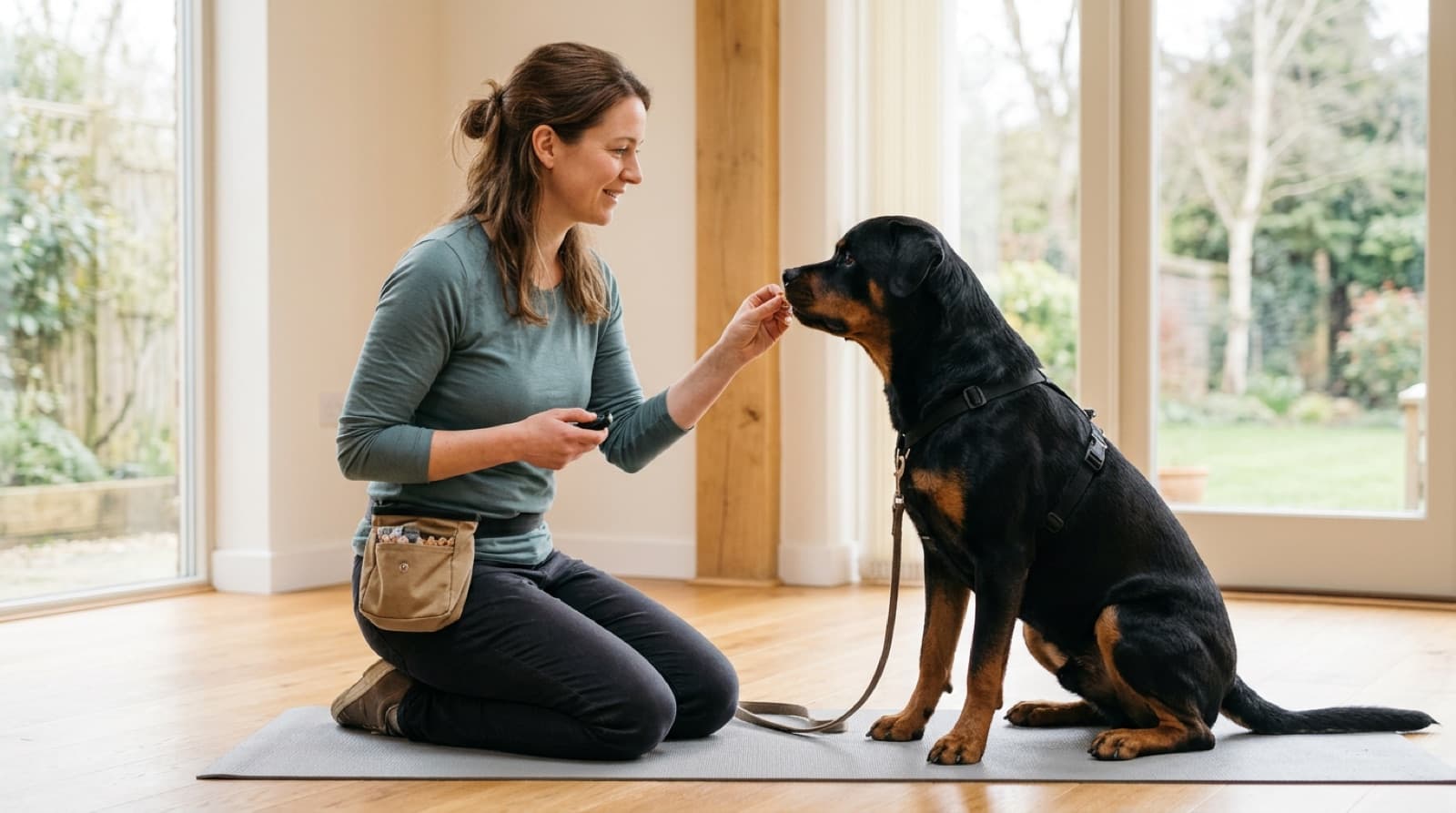
Counter-conditioning protocols for leash reactivity
Leash reactivity is the most common behavioural complaint in trauma-history rescue Rottweilers. Counter-conditioning changes the dog's emotional response to a trigger from fear or arousal to anticipation of something good.
Starting protocol:
- Identify the dog's reactive threshold (the distance at which the dog can see a trigger without going over threshold).
- Work below that threshold with high-value food rewards every time a trigger appears.
- Gradually decrease the distance as the dog's response shifts from arousal to looking back at you for the reward.
- Use a front-clip harness, not a collar, to manage the lunge response without choking the dog.
- Walk in low-distraction environments first (quiet residential streets at off-peak times) and build up to busier areas over months.
Edmonton force-free trainers for reactivity: look for certifications from CCPDT (CPDT-KA, CBCC-KA), the IAABC (CDBC), the Karen Pryor Academy, or Fear Free Pets. Ask specifically about Rottweiler or large-breed reactive-dog experience. Sessions run $80 to $150 private, $200 to $400 in group format. Plan for $500 to $2,000 in the first year for a moderately reactive trauma case.
Edmonton winter consideration: deep cold (-30C) limits the available outdoor exercise window for a 90-pound dog that needs both physical and mental work to settle. Reactive dogs build up frustration when exercise is limited; the spiral shows up as worsening leash reactivity on shorter winter walks. Mitigation: indoor enrichment (food puzzles, scent work, indoor fetch, basement training), short but more frequent outdoor trips, a coat (Rottweilers do not have heavy double coats), brief sniff walks. Build a daily decompression sniff into the routine year-round.
When to call a certified behaviourist
Trainers handle teaching cues and shaping behaviour. Certified veterinary behaviourists (Dip. ACVB) handle clinical-level behavioural conditions and prescribe medication when it is part of the plan. Call the behaviourist when you see:
- Bite incidents of any kind, including air snaps
- Severe persistent leash reactivity that does not respond to standard force-free protocols over three to six months
- True offensive aggression (not defensive fear)
- Self-harm behaviour
- Severe destructive behaviour when alone
- Breakdown of training progress
- Family safety concerns
Ask your primary vet for a referral. Telehealth options serve Alberta. Investment range $300 to $500 per session. Anti-anxiety medications (fluoxetine, trazodone, clomipramine) are sometimes part of severe-case protocols and are prescribed and monitored by the veterinary behaviourist. Medication does not replace training; it makes training accessible by lowering the dog's baseline anxiety so they can learn.
Bottom line
Likely to succeed if: stable housing with written landlord approval and breed-specific insurance coverage confirmed in writing, patience for the 4-phase rehabilitation timeline, force-free training commitment in the first year, pet insurance enrolled before adoption, an emergency medical fund, an Edmonton certified force-free trainer relationship (ideally one with reactivity or large-breed experience), careful reading of the foster temperament evaluation, and a long-term mindset.
Likely wrong if: cannot secure breed-specific housing or insurance, not willing to use force-free methods, impatient with slow progress, a first-time Rottweiler owner without breed-experienced mentorship, or a household with very young children needing constant supervision plus a severely reactive dog plus full-time work obligations.
The reward: intense devotion and a profound bond.
References used in this guide: American Kennel Club: Rottweiler; Canadian Kennel Club; AVMA dog-bite prevention; Certification Council for Professional Dog Trainers; International Association of Animal Behaviour Consultants; Cornell Riney Canine Health Center.
Browse adoptable Rottweilers in Edmonton
Foster-evaluated rescue Rottweilers from SCARS, Edmonton Humane Society, AHHRB, and Edmonton-area foster networks. Confirm landlord and insurance breed approval in writing before applying. Foster-to-adopt + force-free training + insurance enrolled early is the highest-success path. Listings update regularly.
See Available Dogs →Frequently Asked Questions
How common are rescue Rottweilers in Edmonton?
Less common than German Shepherds but they appear regularly. SCARS occasionally pulls Rottweiler and Rottweiler-cross dogs from northern Alberta partnerships. Edmonton Humane Society sees Rottweiler owner surrenders fairly often, sometimes tied to landlord restrictions or unmet behaviour expectations. AHHRB takes unclaimed Rottweilers from bylaw agencies across Sherwood Park, Strathcona County, Fort Saskatchewan, Leduc, Camrose, Tofield, and Edmonton. Foster-based rescues like Hope Lives Here Animal Rescue, Zoe's Animal Rescue, and GEARS occasionally place Rottweilers but the inventory is smaller. Pit Bulls for Life Foundation in Stony Plain takes some Rottweilers as part of their broader restricted-breed work.
Are Rottweilers inherently aggressive?
No. The American Kennel Club describes the Rottweiler as a calm, confident, and courageous dog with a self-assured aloofness toward strangers. The breed standard calls for a stable temperament. Trauma-history Rottweilers in rescue often show fear-based reactivity, not offensive aggression, and the distinction matters because the rehabilitation approach is completely different. A fearful Rottweiler is reacting to a perceived threat; an offensively aggressive dog is choosing to engage. Most Edmonton rescue Rottweilers fall in the fearful category, often the product of guard-trained aversive handling, neglected backyard living, or undersocialisation. Force-free training and patience usually resolve fear-based reactivity; offensive aggression is a behaviourist case from day one.
What is fear-based reactivity versus aggression?
Fear-based reactivity is a defensive response: lunging, barking, snapping, or growling triggered by something the dog perceives as threatening. The intent is to make the threat go away, not to engage. Body language usually shows stress (whale eye, tucked tail, lowered body, lip licking) and the dog often retreats if given space. Offensive aggression is a forward-driving response with intent to engage: tight posture, hard eye contact, no signs of stress retreat. The two look similar to the untrained eye but the response is different. Force-free training and counter-conditioning resolve most fear-based reactivity over months. Offensive aggression is a board-certified veterinary behaviourist case and the prognosis varies. Ask the rescue specifically about which the dog has shown in foster.
What are the 4 phases of Rottweiler rehabilitation?
Phase 1, decompression (weeks 1 to 3): no demands, no visitors, predictable routine, safe space. Phase 2, bonding (weeks 4 to 12): the dog learns you are a source of safety; basic positive-reinforcement training begins; the real personality emerges. Phase 3, training (months 3 to 9): foundation cues consolidate (sit, down, stay, recall, leave it, place, settle), leash skills develop, counter-conditioning protocols address any leash reactivity that has surfaced. Phase 4, reintegration (months 9 to 18+): gradual expansion of tolerated experiences (longer walks, controlled visitor exposure, reliable cues in low-distraction environments), full family integration, lifestyle stabilisation. Severe trauma cases continue into year two with ongoing behaviourist support. The bond when it forms is usually intense and often described by Edmonton Rottweiler owners as the most devoted dog of their lives.
Why do Edmonton rental restrictions matter for Rottweilers?
Many Edmonton landlords ban what they classify as restricted breeds, and Rottweilers usually appear on those lists alongside Pit Bulls, Doberman Pinschers, and sometimes German Shepherds and Akitas. Strata and condo boards may impose weight caps and breed bans that go beyond the building's pet policy. Some landlords refuse the breed outright; others require a substantial pet deposit; some require liability insurance naming the landlord. Before you apply to adopt a Rottweiler, get your landlord's written permission, confirm the breed restriction in your lease, and check your tenant insurance for any breed exclusions. If you own and live in a condo, read the bylaws and confirm with the board in writing. Rescues will sometimes decline an application that cannot demonstrate housing stability for the breed, and the reason is exactly this.
Will my home insurance cover a rescue Rottweiler in Edmonton?
Many Canadian home and tenant insurance policies exclude specific breeds from liability coverage, and Rottweilers usually appear on those exclusion lists. Some insurers refuse to underwrite the policy at all if a Rottweiler is in the home; others write the policy but exclude any liability claim involving a dog bite. Call your insurer before adoption and ask in writing about your breed-specific coverage. If your current insurer excludes Rottweilers, shop other carriers; some niche insurers specifically write Rottweiler and Pit Bull coverage. Confirm in writing before bringing the dog home. The cost of a bite incident without insurance can be six figures, so this is not a corner to cut. The American Veterinary Medical Association documents that breed-specific policies are not supported by injury data, but the insurance market still reflects them.
What counter-conditioning protocol works for Rottweiler leash reactivity?
Leash reactivity is the most common behavioural complaint in trauma-history rescue Rottweilers. Counter-conditioning means changing the dog's emotional response to the trigger from fear or arousal to anticipation of something good. The starting protocol: identify the dog's reactive threshold (the distance at which the dog can see a trigger without going over threshold), work below that threshold with high-value food rewards every time a trigger appears, gradually decrease the distance as the dog's response shifts from arousal to looking back at you for the reward. Use a front-clip harness, not a collar, to manage the lunge response without choking the dog. Walk in low-distraction environments first (quiet residential streets at off-peak times) and build up to busier areas over months. Edmonton certified force-free trainers run reactive-dog group classes that are valuable for Rottweiler-experienced sessions; ask for one with Rottweiler-specific or large-breed experience. Sessions run $80 to $150 private, $200 to $400 in group format. Plan for $500 to $2,000 in the first year for a moderately reactive trauma case.
How does Edmonton winter affect rescue Rottweiler rehabilitation?
Edmonton winters (often -30C in deep cold snaps) shorten the available outdoor exercise window, which is a real challenge for a 90-pound dog that needs both physical and mental work to settle. Reactive dogs build up frustration when exercise is limited, and the spiral can show up as resource guarding, leash reactivity worsening on the shorter winter walks, or increased anxiety overall. The mitigation: invest in indoor enrichment (food puzzles, scent work, indoor fetch in a long hallway, basement training sessions), short but more frequent outdoor trips, a quality coat for the dog (Rottweilers do not have heavy double coats and are not cold-weather dogs), and brief sniff walks rather than long route walks. Keep walks under 20 minutes in deep cold. Build a daily decompression sniff into the routine year-round; it does more for behavioural settling than a long aerobic walk does. Plan for a behavioural rehabilitation that may slow in February and accelerate again in April.
When should I enroll pet insurance for a rescue Rottweiler?
Before any behavioural issue is documented. Pet insurance policies in Canada commonly exclude behavioural conditions diagnosed before policy effective date as pre-existing, and they treat anything noted in the vet record as documentation. If your rescue Rottweiler has a known bite history, known reactivity, or a foster temperament evaluation that flags fear-based behaviour, those notes may surface during the insurance application and limit coverage. The standard recommendation: enroll insurance the day you bring the dog home, before the first vet visit if at all possible, and disclose only what is on the medical record. Trupanion, Petsecure, Pets Plus Us, and Sonnet are the most common Canadian carriers; some specifically underwrite Rottweilers and some exclude them. Read the breed-specific clauses before you commit. Premium runs $50 to $150 per month for a Rottweiler depending on age and policy. The lifetime payoff on a trauma case is usually substantial.
When does a Rottweiler trauma case need a board-certified behaviourist?
Call a board-certified veterinary behaviourist (Dip. ACVB) for bite incidents of any kind including air snaps, severe persistent leash reactivity that does not respond to standard force-free protocols over three to six months, true offensive aggression (not defensive fear), self-harm behaviour, severe destructive behaviour when alone, breakdown of training progress, or family safety concerns. The distinction from a certified trainer matters: trainers handle teaching cues and shaping behaviour; veterinary behaviourists handle clinical-level behavioural conditions and prescribe medication when it is part of the plan. Ask your primary vet for a referral. Telehealth options serve Alberta. Investment range $300 to $500 per session. Anti-anxiety medications (fluoxetine, trazodone, clomipramine) are sometimes part of the protocol for severe cases and are prescribed and monitored by the veterinary behaviourist. Medication does not replace training; it makes training accessible by lowering the dog's baseline anxiety so they can learn.
What are realistic costs for a trauma-history Rottweiler in Edmonton?
Adoption fee from an Edmonton rescue runs roughly $300 to $700. Initial setup (crate, bedding, front-clip harness, quality food, force-free trainer foundation consult, vet baseline exam, pet insurance enrolment) runs $600 to $1,800. Force-free trainer engagement in the first year runs $500 to $2,500 for a moderately reactive case, more if leash reactivity is the primary issue. Pet insurance runs $50 to $150 per month and should be enrolled before any behavioural documentation. Annual care including food, vet, and insurance runs $2,500 to $5,500 (Rottweilers eat more than mid-size dogs). Build an emergency medical fund of $5,000 to $15,000; Rottweilers have elevated cancer rates and orthopaedic conditions like hip dysplasia. Veterinary behaviourist consultations for severe cases run $300 to $500 per session.
Bottom line on a trauma-history Rottweiler in Edmonton?
Likely to succeed if you have stable housing with written landlord approval and breed-specific insurance coverage confirmed in writing, patience for the 4-phase rehabilitation timeline, force-free training commitment in the first year, pet insurance enrolled before adoption, an emergency medical fund, an Edmonton certified force-free trainer relationship (ideally one with reactivity or large-breed experience), careful reading of the foster temperament evaluation, and a long-term mindset. Likely wrong if you cannot secure breed-specific housing or insurance, are not willing to use force-free methods, are impatient with slow progress, are a first-time Rottweiler owner without breed-experienced mentorship, or have a household with very young children needing constant supervision plus a severely reactive dog plus full-time work obligations. The reward when it works is intense devotion and a profound bond.
Rottweiler Adoption Edmonton
Rescue sources, costs, lifestyle fit, and the full Edmonton Rottweiler adoption overview.
Rottweiler Housing & Insurance Edmonton
Landlord approval, condo bylaws, and home insurance reality for the breed.
Best Dog Rescues Edmonton
SCARS, EHS, Zoe's, GEARS, Hope Lives Here, and AHHRB compared by adopter persona.
All Edmonton Adoptable Dogs
Live listings of rescue dogs from Edmonton-area shelters and foster networks.
New dog? Start with these care guides
Everything a new adopter needs to set up a safe, happy home.