The short answer
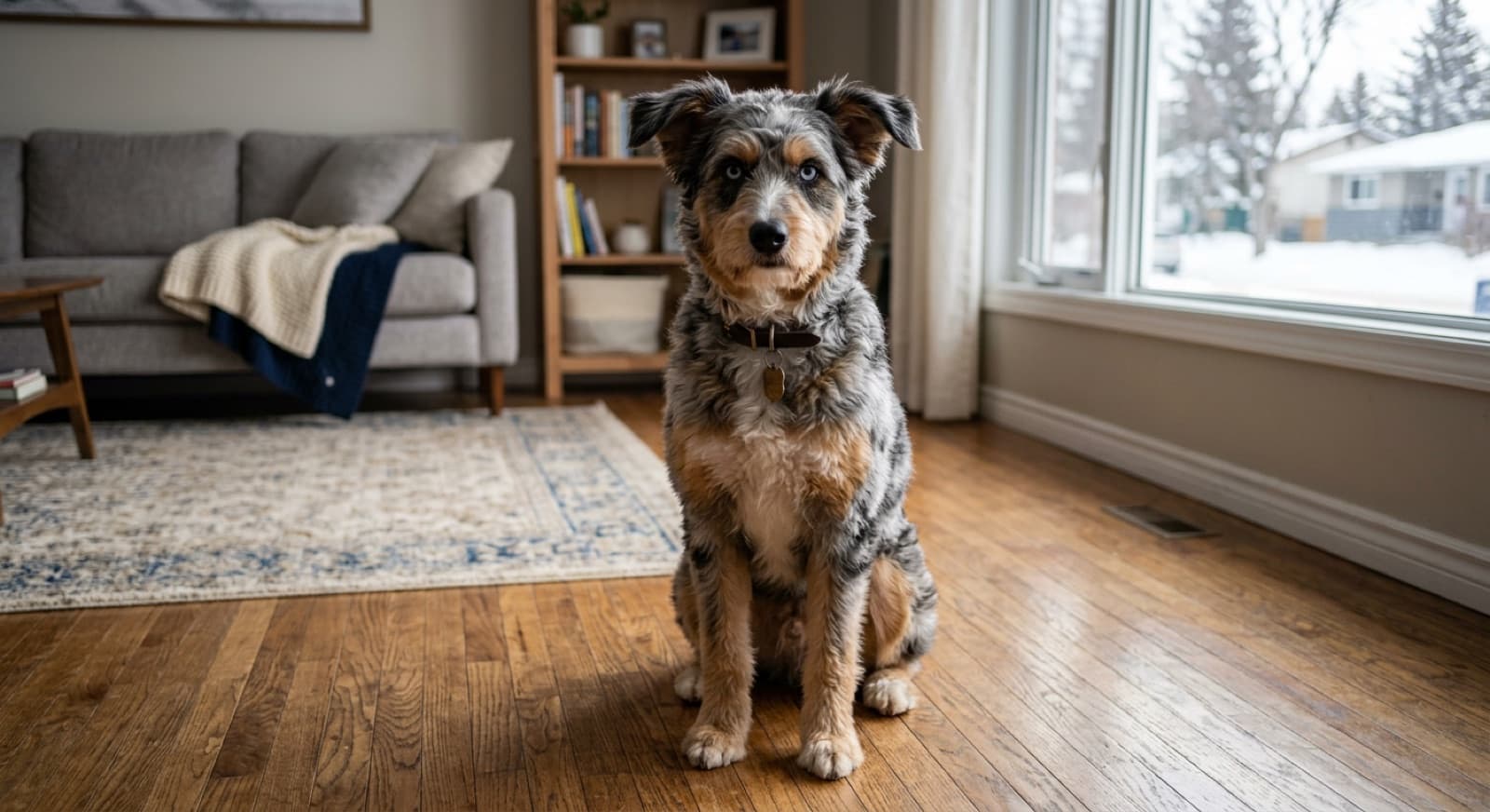
Adopt from Edmonton rescue ($500 to $900). Aussiedoodles appear occasionally through SCARS, Edmonton Humane Society, Zoe's Animal Rescue, AHHRB, and AARCS Edmonton fosters. MDR1 DNA test at first vet visit is the most important Aussiedoodle-specific safety step (herding-breed drug sensitivity affects metabolism of certain medications). Two size categories: Mini (25-40 lbs, Mini Poodle cross) and Standard (40-65 lbs, Standard Poodle cross). Herding instinct redirection through force-free training: nipping at heels, chasing moving things, intense visual focus. Excellent Edmonton winter dog; summer heat above 25C is the bigger challenge. Grooming every 6 to 8 weeks ($600 to $1,200/year). 12 to 15 year lifespan.
Browse adoptable doodles in Edmonton
Aussiedoodles and Aussiedoodle mixes appear regularly. Foster home observation of herding behaviour and MDR1 status is gold.
See Available Dogs →MDR1: the breed-defining safety concern
MDR1 (Multidrug Resistance 1) is a genetic mutation common in herding breeds including Australian Shepherds. The mutation affects drug metabolism and can cause severe or fatal reactions to medications safe in other breeds. Aussiedoodles inherit MDR1 risk from the Aussie parent.
Drugs affected by MDR1 include some heartworm preventatives, some chemotherapy drugs, some anti-parasite medications, and some sedatives. The American Kennel Club and major veterinary teaching hospitals publish lists of affected drugs.
Practical implication for Edmonton Aussiedoodle adopters:
- Run the MDR1 DNA test at the first vet visit if status is unknown from the rescue (typically $60 to $120)
- Results identify whether the dog has zero, one, or two copies of the mutation
- Edmonton vets familiar with herding breeds know to ask about MDR1 status before prescribing affected drugs
- Document MDR1 status on the dog's medical file; share with any boarding facility, daycare, or emergency vet
- Pet insurance enrolled at adoption helps if MDR1-related drug complications occur
Ethical breeders MDR1-test breeding parents and select against the mutation. For Edmonton rescue Aussiedoodles, ask the rescue if MDR1 testing has been done; if not, schedule it at the first vet visit. The Canadian Kennel Club registers Australian Shepherd and Standard Poodle as separate purebreds; Aussiedoodle is not CKC-recognised because the genetics remain variable.
Frequently Asked Questions
Where can I adopt an Aussiedoodle in Edmonton?
Aussiedoodles appear in Edmonton rescue occasionally and place quickly when listed. SCARS (Second Chance Animal Rescue Society), Edmonton Humane Society, Zoe's Animal Rescue, AHHRB (Alberta Homeward Hound Rescue Bureau), and AARCS Edmonton fosters all see Aussiedoodles and doodle crosses through the year. The breed is less common in rescue than Goldendoodle or Labradoodle but more common than Bernedoodle. National doodle and herding-breed rescue networks coordinate placement across Canada when foster homes are available. Many Edmonton Aussiedoodles are surrendered between 12 and 24 months when the herding-breed energy and grooming commitment exceed original owner expectations. Aussiedoodle mixes (Aussiedoodle-Lab, Aussiedoodle-Border Collie, Aussiedoodle-Goldendoodle) appear with similar frequency.
What is the Aussiedoodle origin?
The Aussiedoodle is a cross between Australian Shepherd and Standard or Miniature Poodle, first intentionally bred in the early 2000s. The intent was a low-shedding herding-breed companion with the Aussie's intelligence and the Poodle's coat. Despite the name, the Australian Shepherd was actually developed in the western United States in the 19th century from European herding stock; the breed is not Australian. Adult Aussiedoodles vary in size based on the Poodle parent: Mini Aussiedoodle (Mini Poodle cross) typically 25 to 40 lbs; Standard Aussiedoodle (Standard Poodle cross) typically 40 to 65 lbs. The breed is not CKC or AKC-recognised because the genetics remain variable across lines.
How much does it cost to adopt an Aussiedoodle in Edmonton?
Edmonton rescue adoption fees for Aussiedoodles typically run $500 to $900 covering spay/neuter, current vaccinations, microchip, and a baseline vet workup. The fee is well below ethical breeder pricing ($2,500 to $5,000 for a properly health-tested Aussiedoodle puppy from a breeder with OFA hip and elbow tested parents, eye certification, and MDR1 DNA testing). Initial setup costs after adoption: medium dog harness ($40 to $80), 6-ft leash, slicker brush and stainless comb ($30 to $80), food bowls. Annual ownership cost $2,000 to $3,200: quality food ($400 to $700), routine veterinary care ($500 to $800), pet insurance ($400 to $700), grooming every 6 to 8 weeks at Edmonton groomer prices of $80 to $150 per visit ($600 to $1,200/year), Edmonton dog licence (confirm current fee with the City of Edmonton).
What is MDR1 testing and why does it matter for Aussiedoodles?
MDR1 (Multidrug Resistance 1) is a genetic mutation common in herding breeds including Australian Shepherds. The mutation affects how the dog metabolises certain drugs (some heartworm preventatives, some chemotherapy drugs, some anti-parasite medications, some sedatives) and can cause severe or fatal reactions to medications that are safe in other breeds. Aussiedoodles inherit MDR1 risk from the Australian Shepherd parent; ethical breeders MDR1-test parents and select against the mutation. For Edmonton rescue Aussiedoodles with unknown MDR1 status, the DNA test is widely available and worth running at the first vet visit (typically $60 to $120). Edmonton vets familiar with herding breeds know to ask about MDR1 status before prescribing affected drugs. Pet insurance enrolled at adoption helps if MDR1-related drug complications occur. The MDR1 risk is one of the most important breed-specific facts to know for Aussiedoodle ownership.
How does the herding instinct show up in Aussiedoodles?
Aussiedoodles inherit varying degrees of herding behaviour from the Australian Shepherd parent. The most common manifestation is nipping at heels (the breed evolved to nip at cattle to move them; the same instinct redirects to children, joggers, other dogs, and bicycles). Chasing moving things (squirrels, cyclists, cars) is also common. Some Aussiedoodles show more subtle herding tendencies (circling family members, blocking doorways, intense visual focus on movement). Force-free training redirection works well because Aussiedoodles are highly trainable; harsh training methods backfire substantially. Working with an Edmonton trainer (CCPDT, KPA, IAABC, or Fear Free certified) familiar with herding breeds matters for first-time owners. Foster home observation of herding behaviour is gold; ask explicitly during the phone screen about observed nipping, chasing, and reactivity to moving things.
What are the size differences between Mini and Standard Aussiedoodles?
Two size categories based on Poodle parent. Mini Aussiedoodle: 25 to 40 lbs adult weight, Miniature Poodle cross. More manageable size for apartment or condo living and easier physical handling. Standard Aussiedoodle: 40 to 65 lbs adult weight, Standard Poodle cross. Larger and proportionally more food, exercise, and medical investment. The Australian Shepherd influence is similar across both sizes; the Poodle parent determines adult Aussiedoodle size. For Edmonton rescue puppies, foster home size projection matters; adult Aussiedoodles have established size. Toy Aussiedoodle (under 20 lbs, Toy Poodle cross) is sometimes marketed but less common; the smaller size adds compounded toy-Poodle health risks (luxating patella, hypoglycemia in puppies) on top of MDR1 concerns.
Are Aussiedoodles good first dogs for Edmonton families?
Conditional yes for households who commit to the herding-breed reality. Aussiedoodles are generally affectionate, intelligent, family-oriented, friendly with most children when properly introduced, sociable with other dogs, highly trainable, and fun for dog sports. The breed-specific demands: vocal and high-energy (60 to 90 minutes daily structured exercise plus mental enrichment), herding instinct redirection (force-free training to manage nipping and chasing), MDR1 testing and awareness, grooming every 6 to 8 weeks ($600 to $1,200/year). Adult Aussiedoodles from Edmonton rescue (3+ years) often skip the most intense adolescent phase and arrive with documented temperament. First-time owners with active lifestyles and willingness to commit to force-free training within 4 weeks of adoption typically succeed.
How does Aussiedoodle grooming work in Edmonton?
Similar to other doodle crosses but with Aussie coat influence in some dogs. Most Aussiedoodles have wavy fleece coats that shed lightly to moderately; F1B Aussiedoodles (75% Poodle backcross) tend to have tighter curls with less shedding. Weekly brushing baseline (20 to 30 minutes with slicker brush and stainless comb); daily brushing for tight-curly coats. Professional grooming every 6 to 8 weeks at Edmonton groomer prices of $80 to $150 per visit ($600 to $1,200/year). Many owners maintain a shorter "puppy cut" trim. Watch for matting in problem areas (ears, armpits, tail feathering, behind hind legs). Edmonton dry winter air (15-25% indoor humidity from furnace heat) can dry coat and skin; a humidifier helps. Bath every 6 to 8 weeks. Nail trim every 3 to 4 weeks. Never shave to skin (the double coat regulates temperature).
How do Aussiedoodles handle Edmonton winters?
Excellently. The Australian Shepherd parent has a dense double coat developed for variable mountain weather; Aussiedoodles inherit substantial cold tolerance. Healthy adult Aussiedoodles tolerate -25C walks for 30 to 45 minutes without a coat. Booties help on heavily salted Edmonton sidewalks (salt accumulates in coats). The breed enjoys snow and most Aussiedoodles are enthusiastic about winter activity. Edmonton dry winter (15-25% indoor humidity from furnace heat) can dry coat and skin; a humidifier helps. Watch for ice-ball buildup between paw pads and in leg feathering after walks. Summer heat above 25C is more challenging than winter cold because of the dense coat; modify exercise to early morning or evening during Edmonton heat waves. The breed thrives in Edmonton winter active routines.
What are common Aussiedoodle health issues to plan for?
The breed lifespan is 12 to 15 years. Breed-specific health concerns inherited from both parents: MDR1 mutation (the breed-defining concern; DNA test widely available), hip and elbow dysplasia (both parent breeds; OFA-tested parents are responsible breeding), eye conditions including Collie Eye Anomaly inherited from Aussie line, progressive retinal atrophy inherited from Poodle line, cataracts in some lines, epilepsy in some lines, autoimmune disorders, Addison's disease in some Poodle-influenced lines, allergies common. Pet insurance enrolled at adoption is valuable. Edmonton specialty ophthalmology and neurology referrals available; WCVM Saskatoon handles complex cases.
What are common Aussiedoodle mixes in Edmonton rescue?
Aussiedoodle-Lab cross (45 to 70 lbs, friendlier outgoing temperament than purebred Aussiedoodle, common in Edmonton rescue), Aussiedoodle-Border Collie cross (35 to 55 lbs, very high working drive, requires substantial exercise and mental work), Aussiedoodle-Goldendoodle cross (40 to 70 lbs, two-doodle mix), Aussiedoodle-Husky cross (40 to 65 lbs, dramatic coat colours, high energy), Aussiedoodle-Australian Shepherd cross (closer to purebred Aussie in temperament). All these mixes appear in Edmonton rescue at the same $500 to $900 fee range. Mixed-breed Aussiedoodles inherit MDR1 risk from any Aussie or Collie ancestry; DNA testing remains worthwhile. Foster home should disclose energy observation, herding behaviour, and any MDR1 status documentation during the phone screen.
Bottom line for Edmonton Aussiedoodle adoption?
Aussiedoodles are wonderful Edmonton companions for active households committed to herding-breed management. Affectionate, intelligent, highly trainable, family-friendly, excellent for dog sports, well-adapted to Edmonton winter, 12 to 15 year lifespan. The breed-specific demands that determine fit: MDR1 testing at first vet visit (the most important Aussiedoodle-specific safety step), 60 to 90 minutes daily structured exercise plus mental enrichment, force-free training to redirect herding instinct, grooming every 6 to 8 weeks ($600 to $1,200/year), summer heat management above 25C. Adopt from SCARS, Edmonton Humane Society, Zoe's, AHHRB, AARCS Edmonton fosters; $500 to $900 fee covers spay/neuter, vaccines, microchip, baseline workup. Aussiedoodle mixes (Aussiedoodle-Lab, Aussiedoodle-Goldendoodle) appear with similar frequency and are equally well-suited candidates. Adult adoption (3+ years) skips the adolescent energy peak.
Adoptable Dogs in Edmonton
Live listings from SCARS, EHS, Zoe's, AHHRB, and AARCS Edmonton fosters.
Australian Shepherd Adoption Edmonton
Aussie parent breed; many Aussiedoodle traits and MDR1 risk inherit from this side.
Sheltie Adoption Edmonton
Another MDR1-affected herding breed; similar testing framework and force-free training approach.
Goldendoodle Adoption Edmonton
Related doodle cross; similar generation framework and grooming reality, no MDR1 concern.
New dog? Start with these care guides
Everything a new adopter needs to set up a safe, happy home.