The short answer
Edmonton Goldendoodle adoption is real because of the pandemic-puppy surrender wave. The Edmonton Humane Society, AARCS Edmonton fosters, Zoe's Animal Rescue, and AHHRB list Doodles steadily. Fees run $400 to $700. The 2020 to 2022 buying boom and rural Alberta and Saskatchewan doodle-mill output now drive 2 to 4 year old adolescent surrenders. Grooming is the number one surrender trigger: $150 to $220 every six to eight weeks plus daily brushing is required, not optional. F1B Doodles (75 percent Poodle) are more reliably low-shed than F1. The hypoallergenic claim is overstated.
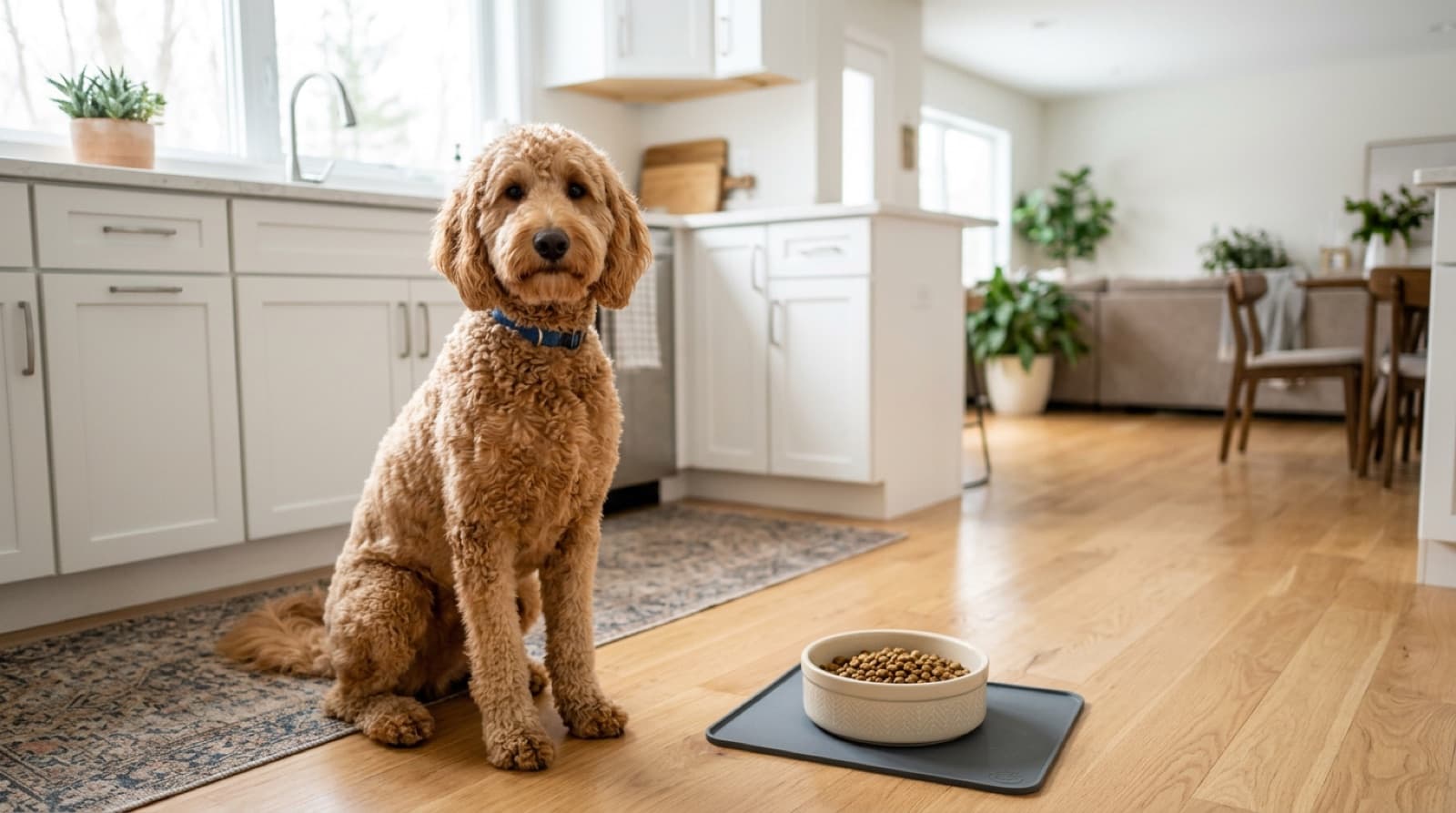
The pandemic-puppy surrender wave hits Edmonton Doodles
The Doodle market in Canada ran historically hot between 2020 and 2022. Demand spiked during pandemic lockdowns. Families wanted a friendly, low-shed family dog, ethical breeders ran multi-year waitlists, and the gap got filled by backyard breeders selling F1 and F1B Doodles for $1,500 to $3,500. Out-of-province transports moved Doodles into Alberta in volume. Buyers paid the premium because everyone wanted a family dog and Doodles were one of the most-requested breed types.
Those puppies are now 2 to 4 year old adolescents, and the surrender wave is hitting Edmonton rescue in steady volume. The triggers are predictable and rarely about the dog:
- Lifestyle reversal. Owners who worked from home through the pandemic returned to office full time for eight to nine hour days. A Doodle alone for that long develops boredom-driven destruction, separation anxiety, and the chewing that pushes the household over the edge.
- Grooming overwhelm. The Doodle coat matures around eight to fifteen months. Many original buyers underestimated the daily brushing and every-six-to-eight-week professional grooming cost. By month twelve to eighteen the matting has compounded, the groomer is recommending a full shave-down, and the household decides the dog needs a different home.
- Exercise mismatch. Most Doodles inherit retriever or working-dog energy and need a real hour of daily activity. Owners who expected the calm family Doodle without budgeting for adolescent energy run out of patience between months ten and eighteen.
- Post-pandemic financial pressure. Households that bought a $3,500 puppy in 2021 face higher mortgage payments, return-to-office costs, and inflation. The Doodle grooming bill is one of the discretionary cuts.
- Allergies in the household. The hypoallergenic claim does not survive contact with reality for many F1 Doodles. Adopters who developed allergies despite the low-shed promise surrender after months of trying to make it work.
- Move into a building that does not accommodate. Edmonton condo and rental moves can expose weight restrictions on standard-size Doodles (50 to 70 pounds) that were not a factor in the original house.
These 2 to 4 year old Doodles are usually sound, friendly, and trainable. They need an active household that understands the grooming reality, a schedule that does not leave them alone for nine hours, and a budget for ongoing care. They are not difficult dogs; they were the right dogs in the wrong original homes. Adopters who can match the breed's actual needs get a Doodle in their prime with eight to twelve years of life ahead.
The Alberta and Saskatchewan doodle-mill reality
Rural Alberta and Saskatchewan produce a significant share of the Doodles entering Edmonton homes (and Edmonton rescue). The reasons are economic: a backyard breeder can run two or three Standard Poodle females plus a male Golden Retriever, produce two litters of eight F1 Goldendoodle puppies per year per female, and clear $30,000 to $60,000 in cash. Setup cost is low. Health testing is minimal. Buyer demand has been steady for a decade.
The output quality varies wildly. Some rural breeders produce genuinely well-socialised puppies from healthy parents. Many do not. Common patterns in surrendered Doodles from these pipelines:
- No hip, elbow, eye, or cardiac testing on parents. Hip dysplasia, elbow dysplasia, cataracts, PRA, and subvalvular aortic stenosis can all be screened in the parents; almost no rural Doodle breeders run the panel. Puppies inherit risk that becomes visible at 18 to 36 months.
- Coat lottery. F1 Doodles vary dramatically within litters. Some puppies inherit a Poodle-curly low-shed coat; siblings inherit a wavy moderate-shed coat. The advertised low-shed claim survives in marketing but not in every puppy.
- Limited early socialisation. Farm-raised puppies often lack exposure to traffic noise, vacuums, strollers, household sounds, and varied surfaces that a city-raised dog needs. Adopters often see this in the first month as startle responses.
- Misrepresented generation labels. F1B and multigen labels are unregulated. Some rural breeders mislabel their dogs to justify higher pricing.
- No buyer screening. Ethical Doodle breeders interview buyers, ask about lifestyle and exercise capacity, and take dogs back at any age. Rural cash-only operations sell to anyone with the deposit.
For adoption, this pipeline is the upstream feed. Most Edmonton rescue Doodles came from a backyard breeder or doodle mill originally, then entered rescue care when the original buyer reached their limit. The rescue is the filter that turns a poorly-bred puppy into a vetted, behaviour-assessed, fostered dog ready for a stable home. Adopting is the answer to the doodle-mill problem.
If you are considering buying a Doodle puppy instead of adopting, the warning is clear: most Alberta and Saskatchewan Doodle breeders cannot pass an ethical-breeder check. Only consider breeders who do OFA hip and elbow plus eye CERF plus relevant cardiac testing on both parents, who allow home visits to meet both parents, who take dogs back at any age, who never sell through Kijiji or Facebook, and who run real waitlists. The 2026 Canadian Kennel Club does not recognise Doodles as a breed at all, so there is no formal registry to verify pedigree. See guidance from the American Kennel Club on Poodle parentage for what the parent breeds should look like at a glance.
Edmonton rescues that consistently list Doodles
Doodles and Doodle mixes appear across most Edmonton-area rescues thanks to the pandemic surrender pipeline. Inventory rotates fast; set up alerts and check current Edmonton listings before fixating on a single rescue.
- Edmonton Humane Society (EHS): the city's largest shelter and the most consistent source of Doodle intake. EHS sees Doodles primarily through urban owner-surrender tied to grooming overwhelm or lifestyle reversal. The centralised facility lets adopters meet the dog in person, and the EHS behaviour team writes detailed temperament assessments covering energy level, kid tolerance, and any flagged medical findings. Doodle turnover at EHS is fast; same-day applications usually win.
- AARCS (Alberta Animal Rescue Crew Society): headquartered in Calgary with Edmonton-area foster homes. AARCS tags each dog with its current foster location, so Edmonton-foster Doodles surface on Edmonton listings. AARCS foster notes explicitly cover kid tolerance, multi-pet compatibility, exercise capacity, and any known medical history. Doodles at AARCS often come from owner-surrender or rural Alberta intake that routes through the foster network.
- Zoe's Animal Rescue: long-running Edmonton foster-based rescue. Lower volume than EHS but a steady source for Doodles, especially from downsizing or owner life-change pipelines. Zoe's foster write-ups are among the most thorough in Edmonton, which matters for matching a Doodle's actual coat type and energy level to the right adopter.
- Alberta Homeward Hound Rescue Bureau (AHHRB): Edmonton-area foster-based rescue. AHHRB lists every dog as Mixed Breed by policy, so Doodles and Doodle-cross dogs are identified by photo and description rather than a breed tag. Always worth checking even when a search for Goldendoodle returns nothing.
- GEARS (Greater Edmonton Animal Rescue Society) and Hope Lives Here Animal Rescue: both Edmonton-area rescues with smaller rotating inventories that occasionally list Doodles or Doodle mixes. Lower frequency than the rescues above but worth following. Doodle-Lab and Doodle-Aussie crosses appear here more often than purebred Goldendoodles.
Adopters sometimes ask whether there is a dedicated Doodle rescue based in Edmonton. As of writing we cannot verify an Edmonton-based Doodle-specific rescue with current adoptable listings. If you see a Doodle-rescue name on social media, verify it through Canada Revenue Agency charitable registry, a real Alberta address, public-facing vet references, and a current adoptable-dog list before sending money. Most Edmonton Doodle adopters find their dog through the five rescues above.
What an Edmonton rescue Doodle actually costs
Edmonton rescue adoption fees for Doodles generally land between $400 and $700, with senior Doodles often reduced to $300 to $500. The fee is a partial recovery on medical work the rescue already absorbed, not a sale price. A typical Doodle adoption fee covers:
- Spay or neuter surgery. Standalone at an Edmonton vet clinic, spay or neuter for a medium-to-large breed runs $400 to $700.
- Core vaccinations. DAPP and rabies at minimum. Bordetella often included if the dog has been boarded.
- Microchip implant and registration. Required for licensed dogs under City of Edmonton Animal Care and Control Bylaw 21244.
- Deworming, flea, and tick treatment. Standard intake processing.
- Basic vet workup. Physical exam, bloodwork for older dogs, fecal screen, and any breed-specific assessments the rescue elects to run.
- Grooming intake, often. Many Doodles arrive at rescue with significant matting that requires a full groom or partial shave-down. The rescue absorbs that cost; the fee reflects part of it.
Stacked at retail Edmonton vet pricing, those services cost $1,000 to $2,500. The rescue fee is a partial recovery; the rest is subsidised by donations.
Beyond the adoption fee, plan on ongoing Doodle costs of $3,500 to $5,500 per year. Food for a 40 to 70 pound Doodle runs $80 to $130 per month for quality kibble. Routine vet care averages $500 to $1,000 per year. Pet insurance for a young adult Doodle in Edmonton runs $50 to $90 per month and is worth enrolling in the first week before any pre-existing conditions appear in vet records.
The grooming line item is the one that surprises new Doodle owners. Professional grooming every six to eight weeks at $150 to $220 in Edmonton works out to $1,300 to $1,900 per year. At-home tool investment for the first year (slicker brush, metal comb, dematter, plus shampoo and conditioner if you bathe between groomer visits) runs another $80 to $150. Senior Doodles often need extra sanitary and ear-area trim attention, sometimes at smaller add-on cost between full grooms. Compare the adoption math to a Doodle puppy from a rural Alberta breeder at $2,500 to $4,500, which comes with none of the vet work the rescue dog already has and the same coat-care commitment regardless of source.
F1, F1B, F2, multigen explained for Edmonton adopters
Generation labels describe genetic mix. They matter less for adoption than for purchase because a rescue Doodle's adult coat tells you the truth that a puppy generation label cannot. Still, knowing the system helps decode foster notes and rescue intake records.
- F1 (first generation): Poodle bred to non-Poodle (Golden Retriever, Labrador, Bernese, etc.). Typically 50/50. The coat is a lottery within litters. Some puppies inherit a Poodle-curly low-shed coat, others inherit a wavy moderate-shed coat closer to the non-Poodle parent. F1 Doodles vary the most in adult appearance and shedding.
- F1B (first-generation backcross): F1 Doodle bred back to a Poodle. Typically 75 percent Poodle. The coat is more reliably curly and low-shedding. F1B is considered the most allergy-friendly generation for Doodle buyers and the easiest to predict on coat type. Most Edmonton adopters who want a reliably low-shed Doodle look for F1B markers in the foster notes or visible coat type at adult age.
- F2 (second generation): Two F1 Doodles bred together. The coat is the most variable of any generation; outcomes range from very Poodle-like to very retriever-like even within a single litter.
- F2B and F2BB: F2 Doodle bred to F1B or F2 bred to F1B, etc. Higher Poodle percentage; more reliable coat type than F2 but still some variability.
- Multigen (F3 and beyond): Generations bred for consistency in coat type and temperament. Multigen Goldendoodles, when bred by responsible programs, are the most predictable for coat and temperament. Most rescue Doodles labelled multigen come from breeders who continued past F2 for that reason.
For Edmonton rescue adopters: most Doodles arrive without generation documentation because the original buyer was not given papers, the breeder did not track lineage, or the records were lost in surrender. The foster will describe the coat as straight, wavy, or curly, will tell you what the daily shedding looks like, and will share the grooming schedule the foster has been keeping. That information is more reliable than any label. If you specifically need a low-allergen dog, ask the foster directly about shedding, dander, and any allergic reactions the foster or visitors have had with this dog. Adult coat trumps generation label every time.
The hypoallergenic reality
No dog breed is truly hypoallergenic. Doodles inherit lower-allergen traits from their Poodle parent in proportion to their Poodle percentage, which is why F1B Doodles are generally easier on allergic households than F1 Doodles. But lower allergen is not no allergen, and individual variation within litters is significant.
The honest mechanics: dog allergens come from dander, saliva, and urine proteins (specifically Can f 1, Can f 2, and Can f 5 in research literature), not hair itself. A low-shed coat reduces but does not eliminate environmental allergen load because the dog still produces dander and saliva. Households with mild seasonal allergies often manage a Doodle well. Households with severe dog-specific allergies sometimes react to a Doodle as much as to a higher-shedding breed.
For allergy-prone Edmonton adopters, the testing protocol is:
- Spend an hour minimum with the specific Doodle. Sit in a room with the dog, pet the dog, let the dog be on a lap. Note any throat, eye, or skin response.
- Visit the foster home twice if possible. Allergens accumulate. A second visit a few days later tells you whether ongoing exposure builds a reaction.
- Ask about an overnight trial. Some Edmonton rescues will permit a one-night foster trial for households with allergy concerns. This is the highest-fidelity test and prevents the harder outcome of adopting then returning.
- Avoid F1 if reactions developed with other dogs. Prioritise F1B, multigen, or a Poodle directly if low allergen is a hard requirement.
- Consult an allergist before adopting. Specific allergen testing identifies whether you react to dog dander broadly or to specific proteins; this changes the breed decision.
The hardest outcome is adopting a Doodle, discovering allergies after a month of close contact, and returning the dog. Rescues see this regularly with Doodles and it is hard on the dog. Verify the fit before committing.
Browse adoptable Edmonton Goldendoodles and Doodle mixes
Current Edmonton listings from EHS, AARCS Edmonton fosters, Zoe's, AHHRB, GEARS, and Hope Lives Here in one place. Doodle inventory rotates fast; set up listing alerts so you catch them the day they appear.
See Edmonton Adoptable Dogs →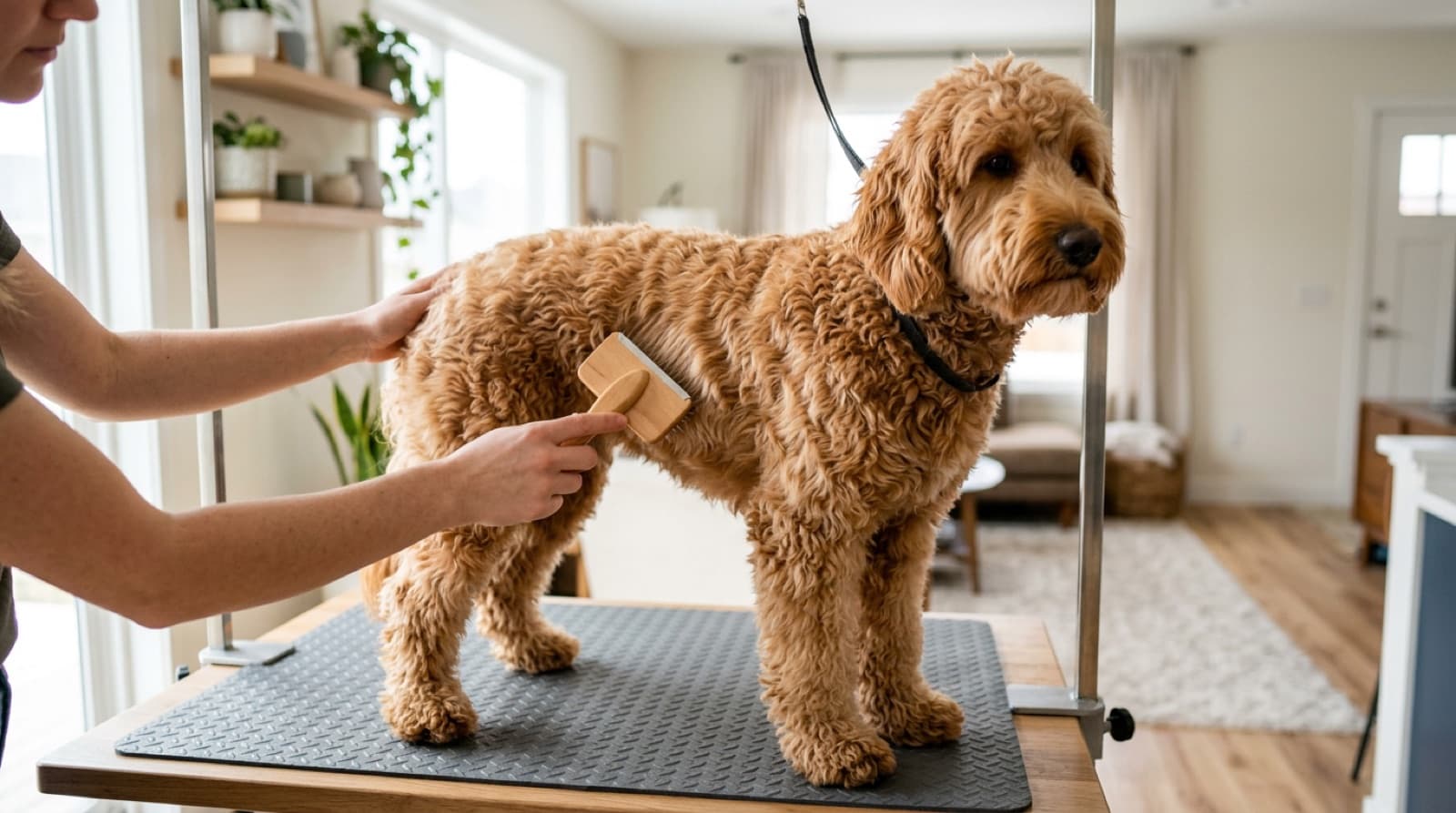
What Edmonton rescues evaluate in a Doodle application
Doodle applications are screened for grooming readiness and lifestyle fit. Edmonton rescues are not worried about whether you love Doodles; everyone does. They are worried about whether the placement will last through adolescence and the realities of coat maintenance. The screening typically covers:
- Grooming budget and routine commitment. The rescue will ask whether you have a groomer lined up, what your home brushing routine plan is, and whether a $200 every six weeks bill fits your budget. A specific answer wins applications.
- Daily exercise capacity. Most Doodles need 60 to 90 minutes of activity per day. The rescue will ask what your typical weekday looks like, who walks the dog, and what your winter plan is. River-valley walks at Mill Creek Ravine, Terwillegar, or Hawrelak fit a Doodle well.
- Time alone. Doodles are companion dogs and bond closely. A 50-hour-a-week work-from-office schedule with no midday check is harder than a hybrid schedule, retiree home, or work-from-home household. The rescue will ask directly.
- Household structure and kid age. Most Doodles are great with kids, with the caveat that adolescent Doodles can be mouthy and jumpy with toddlers. Foster notes flag specific dogs that need older-kid households.
- Existing pets. Most Doodles get along well with other dogs and cats with proper introduction. Same-sex large-dog dynamics get more scrutiny.
- Allergies in the household. The rescue will ask about any known dog allergies and may recommend a trial visit before formal application. Honesty here protects the dog from a return.
- Housing approval. If you rent or live in a condo, the rescue will ask for written confirmation that the dog is approved at the dog's adult weight. Edmonton condo weight caps can affect standard-size Doodles in the 50 to 70 pound range.
- Long-term commitment. Doodles live 10 to 14 years. The rescue will ask about your life situation over that horizon. Major upcoming changes (planned move, new baby, career change) come up in the conversation.
Specificity wins applications. “We have an Edmonton groomer scheduled for the first month, brush daily for fifteen minutes, work from home four days a week, and walk every morning along Mill Creek Ravine” is much stronger than “we love Doodles and will take great care of the dog.” The rescue is trying to determine whether the placement will survive adolescence. A specific plan signals a realistic commitment.
How to apply prepared and apply fast
Edmonton Doodle adoptions move fast because demand is steady and inventory rotates quickly. Most placements go to applicants who applied within hours of the listing going live. The serious applicants have everything ready before a Doodle lists. The typical sequence:
- Set up listing alerts on every Edmonton rescue. Register on EHS, AARCS, Zoe's, AHHRB, GEARS, and Hope Lives Here. Alerts catch listings the day they appear.
- Get your application materials ready in advance. Vet contact ready if you have other pets, landlord or condo board approval in writing if you rent or live in a condo, pet insurance research done with a specific provider in mind, two non-family references with current phone numbers, and a written summary of your weekly schedule and grooming plan.
- Find a specific dog you want to apply for. Read the entire foster write-up: coat type, energy level, kid tolerance, dog tolerance, known medical history, grooming notes. Watch any available videos.
- Submit the application same day. Expect 45 to 60 minutes for a thorough Doodle application. Same-day applications are reviewed first.
- Phone screen with the foster or shelter. The conversation that decides most placements. Be honest about your schedule, exercise capacity, grooming routine, and household. The foster has lived with the dog and will tell you what they see.
- Meet-and-greet. At the foster's home, the shelter, or a neutral location. Bring everyone in the household, including kids and other dogs if relevant.
- Reference and home check. Most rescues call two references. Smaller foster-based rescues sometimes do a brief home visit before approval.
- Adoption contract and fee. Standard contracts specify return-to-rescue terms if you cannot keep the dog. Read it before signing.
Realistic timeline from application to dog-in-your-house is one to three weeks for a Doodle placement. Multiple applications on the same dog are normal; if you are not selected, ask the rescue to keep your application on file for similar dogs.
The first 30 days with an Edmonton rescue Doodle
The 3-3-3 decompression principle (three days to start settling, three weeks to learn the routine, three months to fully bond) applies to Doodles. Most Doodles move through the early phases quickly because the breed defaults to social and household-oriented. Practical week-one priorities for an Edmonton rescue Doodle:
- Book the first groomer appointment for week two or three. Most rescue Doodles arrive freshly groomed or recently shaved at intake; the next maintenance groom lands at week six to eight. Establish the relationship early.
- Start daily brushing from day one. Fifteen minutes a day, slicker brush plus metal comb. The dog learns to tolerate it as part of the routine. Doodles who never learn to enjoy brushing are harder to maintain long-term.
- Establish a daily exercise routine. Two walks a day, 30 to 45 minutes each for an adult, plus mental enrichment. Senior Doodles scale down to two 20 to 30 minute walks. The Edmonton river-valley system (Terwillegar, Mill Creek Ravine, Hawrelak, Capilano, Whitemud) fits Doodle energy needs through every season.
- License the dog with the City of Edmonton. Required for any dog over six months under the Animal Care and Control Bylaw 21244. Tags should be visible on the collar from day one. Information is on the City of Edmonton dogs page.
- Microchip registration verification. Confirm the chip is registered to your contact information. Most rescues handle the transfer; verify directly with the chip registry.
- Pet insurance enrolment. Enrol in the first week before any pre-existing conditions appear in vet records. Doodles inherit risk from both parent breeds (hips, eyes, skin, cardiac, cancer); coverage that includes oncology and orthopaedic care matters.
- Ear cleaning routine. Doodles are prone to ear infections because the floppy ear and coat hair trap moisture. Clean ears every one to two weeks; check for redness, odour, or head-shaking. Address early.
- Vet check in week one. Establish your relationship with an Edmonton vet and a baseline. Ask about breed-specific risks (hips and elbows, eye conditions, allergic skin disease, dental disease for smaller Doodles).
- Crate train from night one. Even Doodles who arrive house-trained benefit from crate routine for the first month. Separation anxiety often peaks at week two when you return to your normal work schedule.
- Same routes, same routine for the first two weeks. Predictability speeds settling. Save dog parks, new friends, and travel for after week three.
By week three the routine is established. By month three the bond is solid and the household has adapted. Use the first 90 days as a non-decision window. Most early concerns resolve with consistency and time. Detailed guidance in the first week rescue dog guide.
Frequently asked questions
Where can I adopt a Goldendoodle near me in Edmonton?
Goldendoodles and Doodle mixes are not rare in Edmonton rescue thanks to the pandemic-puppy surrender wave. The Edmonton Humane Society lists Doodles steadily, mostly from urban owner-surrenders tied to grooming overwhelm or lifestyle reversal. AARCS, headquartered in Calgary, tags Edmonton-foster Doodles so they surface on Edmonton listings. Zoe's Animal Rescue takes in Doodles from downsizing and rehoming pipelines. AHHRB lists Doodle-type crosses under generic Mixed Breed labels, so check photos rather than breed tags. GEARS and Hope Lives Here see them occasionally. SCARS rarely lists purebred Doodles because northern intake skews to working breeds. Inventory rotates fast on this breed type; same-day applications usually win.
Why are so many Doodles in Edmonton rescue right now?
Three stacked patterns. First, the 2020 to 2022 pandemic-puppy boom saw thousands of Doodles bought during lockdowns when families wanted a low-shed family dog and had time at home. Those puppies are now two to four year old adults, and the surrender wave is hitting Edmonton rescue. Second, rural Alberta and Saskatchewan backyard breeders pumped out F1 and F1B Doodles during the boom at $1,500 to $3,500 per puppy, with variable temperament and minimal health testing. Those dogs are entering the surrender pipeline now. Third, grooming cost is the number one surrender driver after lifestyle reversal: Edmonton owners who underestimated the $150 to $220 every six to eight weeks plus daily brushing are reaching their limit at adolescence when the coat first matures.
What does an Edmonton Doodle adoption cost?
Edmonton rescue adoption fees for Doodles typically run $400 to $700. Goldendoodles, Bernedoodles, and Sheepadoodles fall at the higher end ($500 to $700) reflecting their popularity. Smaller Doodles like Cavapoos and Cockapoos run $400 to $600. Senior Doodles (eight years and up) often have reduced fees of $300 to $500. The fee covers spay or neuter, core vaccinations, microchip registration under Edmonton Animal Care and Control Bylaw 21244, deworming, flea and tick treatment, and a basic vet workup. Beyond the adoption fee, plan for $80 to $130 per month of food, $150 to $220 every six to eight weeks for professional grooming, $500 to $1,000 per year of routine vet care, and pet insurance at $50 to $90 per month for a young adult Doodle. Annual cost averages $3,500 to $5,500.
What do F1, F1B, F2, and multigen Doodle generations mean?
Generation labels describe the genetic mix. F1 is a first-generation Doodle (Poodle bred to Golden Retriever or other breed), typically 50/50. The coat is a lottery: some puppies inherit a wavy moderate-shed coat, others a Poodle-curly low-shed coat. F1B is an F1 Doodle bred back to a Poodle, typically 75 percent Poodle, with a more reliably curly low-shed coat. F1B is the most predictable for allergy-prone households. F2 is two F1 Doodles bred together; coat outcomes are the most variable of all generations. F2B is F2 bred to F1B. Multigen (F3+) is generations bred for consistency in coat and temperament. Important caveats for Edmonton adopters: most rescue Doodles arrive without generation documentation, and individual variation within any generation is significant. The adult coat on a rescue Doodle tells you the truth that a puppy generation label cannot.
Is the "hypoallergenic" Doodle claim real?
Overstated. No dog breed is truly hypoallergenic. Doodles inherit lower-allergen traits from the Poodle parent in proportion to their Poodle percentage, which is why F1B Doodles (75 percent Poodle) are considered more allergy-friendly than F1 Doodles (50 percent Poodle). But "lower allergen" is not "no allergen," and individual variation within litters is significant. Dog allergens come from dander, saliva, and urine proteins, not hair itself. A low-shed coat reduces but does not eliminate environmental allergen load. Allergy-prone adopters should spend time with the specific Doodle they want to adopt (an hour minimum, ideally a trial overnight at the foster home) before committing. Allergic reactions can develop or worsen after weeks of close contact, and returning a Doodle for allergies after a month is harder on the dog than verifying the fit before adoption.
How can I avoid doodle-mill or backyard breeder Doodles?
Most Edmonton rescue Doodles came from a backyard breeder or doodle mill originally, which is a feature of adoption rather than a problem. The surrender pipeline brings these dogs into rescue care where they get medical attention, behaviour assessment, and a foster home before being placed. The rescue is your filter. The real warning applies to purchase, not adoption. If you are tempted to buy a Doodle puppy instead of adopting, the doodle mill reality in Alberta and Saskatchewan is significant: high-volume operations producing F1 and F1B Doodles with minimal hip, elbow, eye, or cardiac testing on either parent, often advertised on Kijiji or Facebook with stock photos and waitlists collected through e-transfer deposits. If you do buy, only consider breeders who test both parents through OFA, allow farm visits to meet both parents, provide written health guarantees, take dogs back at any age, and have legitimate waitlists. Most "Goldendoodle breeders" in rural Alberta cannot meet these criteria.
What grooming commitment does a Doodle actually require?
Real and ongoing. A Doodle coat is the most maintenance-intensive part of owning the breed. Daily brushing is required, not optional, especially on F1B and curlier coats that mat quickly. Skipped grooming for two weeks produces tight mats at the armpits, behind the ears, and on the legs that often require shaving down at the groomer. Professional grooming is required every six to eight weeks at $150 to $220 in Edmonton (more for larger Doodles or severely matted dogs). At-home tools needed: a slicker brush, a metal comb, and a dematter for catching early mats. Senior Doodles often need extra ear and sanitary trim attention. Owners who cannot commit to the routine usually surrender within the first eighteen months. The honest read: if a $200 grooming bill every six weeks plus fifteen minutes of brushing every day feels like too much, a Doodle is the wrong breed regardless of allergies or low-shed claims.
Are Doodles good with kids and other pets?
Usually yes. Both parent breeds (Poodle plus Golden Retriever or other retrievers) tend to be family-friendly, and most Doodles inherit a social, gentle temperament. Foster notes are the truth for any specific dog. Edmonton rescues note kid tolerance, dog tolerance, and cat compatibility from foster home observations. Doodles can be exuberant as adolescents (eight to eighteen months), with jumping, mouthing, and zoomies that work better with older kids (six and up) than toddlers. Doodle-Bernese crosses tend to be calmer; Aussiedoodles and Sheepadoodles inherit working-dog drive that pushes toward herding kids. Multi-pet households work well for most Doodles with proper introduction. Same-sex dynamics between two adult large Doodles can be tricky; mixed pairings usually work better.
Should I adopt a Doodle puppy or an adult?
For most Edmonton households, an adult Doodle is the better fit. Adolescent Doodles (eight to eighteen months) are the most commonly surrendered group, which means rescue inventory skews to young adults rather than puppies. Benefits of an adult Doodle: the coat type is known (no F1 lottery), basic training is often established, the fee is lower, and the dog is genuinely a rescue placement rather than a puppy-mill alternative. The trade-off: any behaviour quirks from the original household come with the dog, and an adolescent Doodle still needs structure and a year or more of consistent training. Senior Doodles (eight years and up) are often the calmest companions in Edmonton rescue. They settle quickly, fit retiree households well, and come with established household manners. The medical reality (joint issues, allergies, dental disease) is real and worth planning for.
How long do Doodles wait in Edmonton rescue?
Less time than you might expect. Goldendoodles and Bernedoodles usually place within one to three weeks of listing, often with multiple applications on day one. Smaller Doodles (Cavapoo, Cockapoo, Maltipoo) sometimes place within days because retiree adopters and small-home households specifically look for them. Aussiedoodles and Sheepadoodles wait slightly longer because the exercise commitment narrows the pool. The longest-waiting Doodles in Edmonton rescue are those with active medical needs (severe matting on intake, untreated allergies, hip dysplasia), flagged kid-tolerance concerns, or behavioural issues from poor early socialisation. Most Doodle adopters need to set up listing alerts and apply the day a dog appears.
Related Edmonton Goldendoodle guides
Edmonton Adoptable Dogs
Current Edmonton-area Goldendoodle, Doodle-mix, and family-friendly dog listings from EHS, AARCS Edmonton fosters, Zoe's, AHHRB, GEARS, and Hope Lives Here.
Poodle and Doodle Health Issues
Poodle and doodle health issues to plan for: Addison’s disease, bloat in Standard Poodles, skin and ear problems, knees and heart valves in small Poodles, and epilepsy.
How to Groom a Goldendoodle
A Goldendoodle grooming guide: why low-shed is not low-maintenance, the coat change matting crisis, the F1 vs F1b coat lottery, line brushing, and cost.
Goldendoodle Behaviour & Training Edmonton
Doodle adolescence (8 to 18 months), the jumping and mouthing phase, separation anxiety prevention, the force-free Edmonton trainer ladder, and the grooming-tolerance training that decides whether the placement lasts.
Find your Edmonton rescue Doodle
Browse current Edmonton-area Goldendoodle and Doodle-mix listings. Inventory rotates fast; alerts and same-day applications win.
Browse All Edmonton Dogs →New dog? Start with these care guides
Everything a new adopter needs to set up a safe, happy home.