The short answer
Adopt from Edmonton rescue ($400 to $700). Australian Cattle Dogs appear regularly in Edmonton rescue because of rural Alberta's ranch heritage; SCARS is the strongest source (pulls from northern Alberta communities). Heeler mixes (Texas Heeler, Border Heeler, Heeler-Lab) appear with similar frequency. Herding-nipping instinct is the breed identity: nipping at heels, chasing moving things, herding family members. Force-free training redirects the instinct to acceptable outlets (herding ball games, scent work, agility). Substantial exercise commitment: 90 to 120 minutes daily structured activity. Excellent Edmonton winter dog; summer heat above 25C is the bigger challenge. Not safe with cats in most cases. Working ranch retirees (5+ years from working ranch backgrounds) often arrive with calmer adult temperaments. 12 to 16 year lifespan.
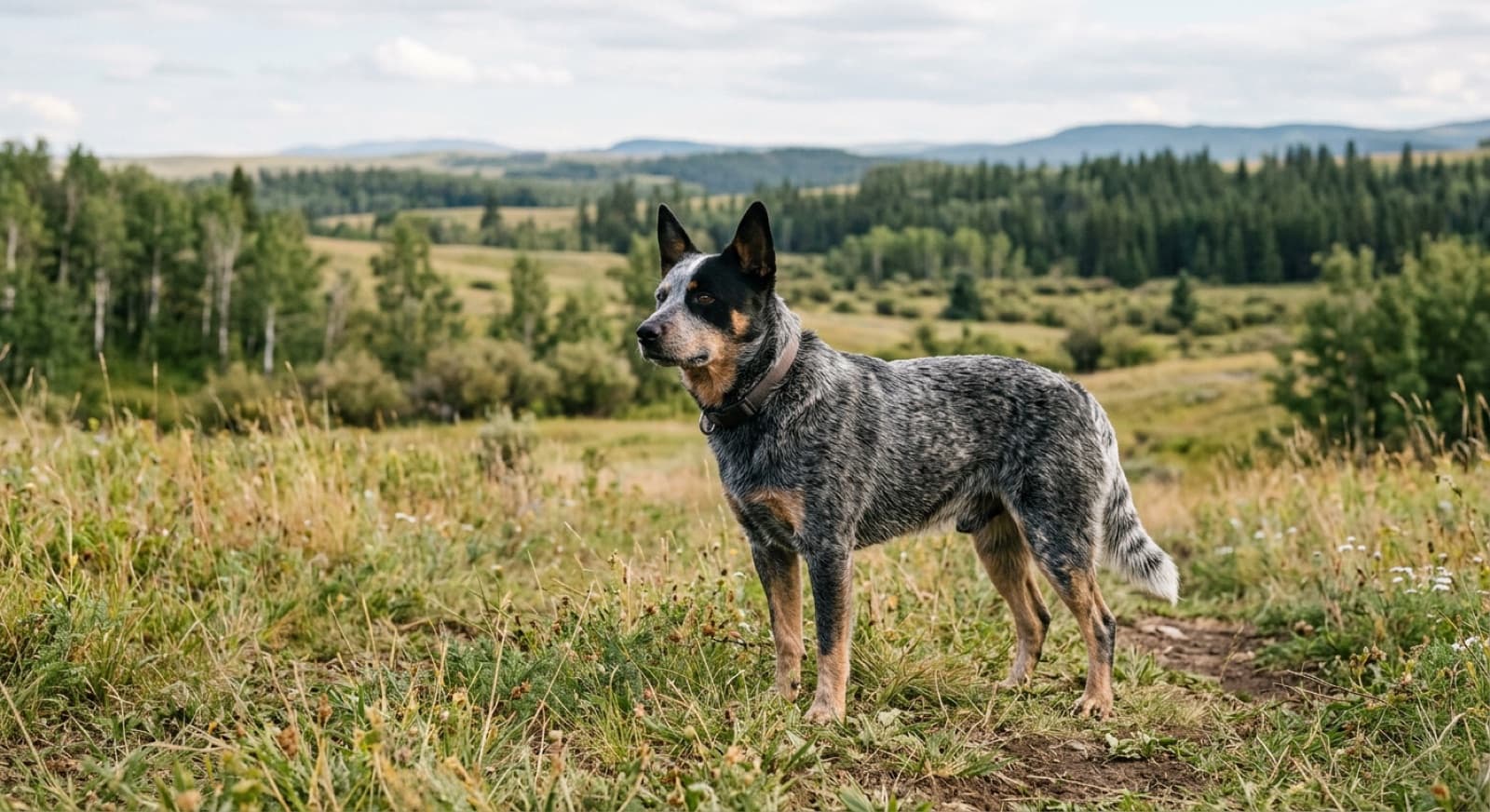
Browse adoptable Heelers in Edmonton
Heelers and Heeler mixes appear regularly. SCARS pulls from northern Alberta ranch communities. Foster-home observation of nipping behaviour and family fit is gold.
See Available Dogs →The herding-nipping reality
The Australian Cattle Dog was specifically bred to nip at the heels of cattle. The instinct activates on family members, children, joggers, cyclists, and small fast animals. This is the breed identity, not a behaviour problem to fix.
Without intentional training redirection, Heelers will nip at human heels during play, chase moving children with intent to herd, and target joggers or bicycles. The nipping activates intensely during arousal (play, excitement, frustration).
Force-free training redirection works because Heelers are highly intelligent and motivated. Replace the heel-nipping target with acceptable outlets:
- Herding ball games (Treibball or similar)
- Lure courses where available
- Structured fetch with rules around taking turns and impulse control
- Scent work and nose-work training
- Agility, rally, or other dog sport classes
- Frisbee or disc work
Working with an Edmonton force-free trainer (CCPDT, KPA, IAABC, or Fear Free certified) familiar with herding breeds matters substantially. Many Edmonton families surrender Heelers because the nipping behaviour was underestimated; foster-home observation of the dog's herding behaviour is the most reliable predictor for family fit. The American Kennel Club breed standard describes the working-drive temperament. The Canadian Kennel Club registers the breed in the Herding Group.
Frequently Asked Questions
Where can I adopt a Blue Heeler in Edmonton?
Australian Cattle Dogs (Blue Heelers and Red Heelers) appear in Edmonton rescue regularly because the breed is common across rural Alberta working ranches and many retired or surplus dogs enter the rescue system. SCARS (Second Chance Animal Rescue Society) is a particularly strong source because they pull heavily from northern Alberta communities where Cattle Dogs are common working stock. Edmonton Humane Society, Zoe's Animal Rescue, AHHRB (Alberta Homeward Hound Rescue Bureau), and AARCS Edmonton fosters all see Heelers and Heeler crosses through the year. National herding-breed and working-dog rescue networks coordinate placement across Canada. Many Edmonton Heelers are surrendered between 12 and 36 months when owners realise the working-dog energy and herding-nipping instinct exceed what they expected. Heeler crosses (Texas Heeler, Border Heeler, Heeler-Lab, Heeler-Pit) appear with similar frequency to purebreds.
What is the Blue Heeler origin?
The Australian Cattle Dog (Blue Heeler / Red Heeler is a colour distinction within the same breed) was developed in 19th-century Australia by crossing British droving dogs with the dingo to create a working dog capable of moving cattle across vast Australian outback distances. The breed is genuinely working-stock with very high drive, intelligence, and physical stamina; the working heritage shows up in every individual dog regardless of whether the dog is used for actual herding. Blue Heeler refers to dogs with blue (grey-blue mottled) coats; Red Heeler refers to dogs with red speckled coats; both are the same breed. Adult Australian Cattle Dogs typically weigh 35 to 50 lbs (males 40 to 50, females 35 to 45) and stand 17 to 20 inches at the shoulder. The breed lives 12 to 16 years.
How much does it cost to adopt a Blue Heeler in Edmonton?
Edmonton rescue adoption fees for Australian Cattle Dogs typically run $400 to $700 covering spay/neuter, current vaccinations, microchip, and a baseline vet workup. The fee is well below ethical breeder pricing ($1,500 to $3,000 for a properly health-tested Heeler puppy from a CKC-registered breeder with parents OFA hip and elbow tested, eye certified, and BAER deafness tested). Initial setup costs after adoption: medium dog harness ($40 to $80), 6-ft leash, slicker brush and undercoat rake ($30 to $80), nail clippers, food bowls. Annual ownership cost $1,800 to $2,800: quality food ($400 to $600), routine veterinary care ($400 to $700), pet insurance ($400 to $700), grooming optional (short double coat needs no professional grooming), Edmonton dog licence (confirm current fee with the City of Edmonton). The working-dog exercise infrastructure (dog daycare, sport training classes) often represents a larger ongoing cost than the dog itself.
How does the herding-nipping instinct show up in Heelers?
Consistently and intensely. The Australian Cattle Dog was specifically bred to nip at the heels of cattle to move them (hence the name "Heeler"). The instinct activates on family members, children, joggers, cyclists, other dogs, and small fast animals. Without intentional training redirection, Heelers will nip at human heels during play, chase moving children with intent to herd, and target joggers or bicycles. The nipping is the breed-defining behaviour, not a behaviour problem to fix; force-free training redirects the instinct to acceptable outlets (herding ball games, lure courses, structured fetch, scent work). Many Edmonton families surrender Heelers because the nipping behaviour was underestimated; foster home observation of the dog's herding behaviour is the most reliable predictor for family fit. Edmonton force-free trainers (CCPDT, KPA, IAABC, or Fear Free certified) familiar with herding breeds matter substantially.
Are Heelers good first dogs for Edmonton families?
Generally not, but case-by-case based on owner preparation. The breed-specific demands typically exceed first-time owner capacity: very high exercise needs (90 to 120 minutes daily structured activity for an adult Heeler), strong herding-nipping instinct requiring active redirection, intense intelligence that needs daily mental enrichment, independence that can be misread as stubbornness, and protective instincts that need careful socialisation. Adult Heelers from Edmonton rescue (3+ years) with documented foster-home temperament observation CAN be appropriate first-large-breed matches for active households with realistic expectations and willingness to commit to force-free training within 4 weeks. Working ranch retirees (Heelers who have worked cattle and are placed into pet homes after their working career) often arrive with calmer adult temperaments than young Heelers from non-working backgrounds. Foster home should disclose the dog's working background and observed family fit during the phone screen.
What are common Heeler mixes in Edmonton rescue?
Texas Heeler (Australian Cattle Dog + Australian Shepherd; 35 to 60 lbs; combines two herding breeds; very high working drive and intelligence), Border Heeler (Cattle Dog + Border Collie; 30 to 55 lbs; the herding-breed crossover; among the most intense working drives of any cross), Heeler-Lab (40 to 70 lbs; friendlier outgoing temperament than purebred Heeler; common in Edmonton rescue), Heeler-Pit (40 to 60 lbs; athletic guardian-influence; bully-breed insurance considerations may apply), Heeler-Husky (40 to 60 lbs; dramatic coat colours; high exercise needs from both lines), Heeler-German Shepherd (50 to 80 lbs; substantial working-breed mix; needs experienced handler). All these mixes appear in Edmonton rescue at the same $400 to $700 fee range. Mixed-breed Heelers often have slightly less extreme nipping intensity because of the second-breed influence; the cross can be a better first-Heeler match. Foster home should disclose energy observation, herding behaviour, recall reliability, and any nipping history during the phone screen.
How do Heelers handle Edmonton winters?
Excellently. The Australian Cattle Dog double coat (dense undercoat plus longer outer coat) provides substantial insulation; the breed was developed for variable Australian conditions including cold mountainous areas as well as hot outback. Healthy adult Heelers tolerate -25C walks for 30 to 45 minutes without a coat. Booties help on heavily salted Edmonton sidewalks (salt accumulates in the dense coat and irritates paws). The breed enjoys snow and most Heelers thrive in Edmonton winter activity. Edmonton dry winter (15-25% indoor humidity from furnace heat) can dry coat and skin; a humidifier helps. Watch for ice-ball buildup between paw pads after walks. The high-energy working drive means Edmonton winter is not a barrier to exercise; structured outdoor activity at -20C is genuinely pleasant for the breed. Summer heat above 25C is more challenging because of the dense coat; modify exercise to early morning or evening during Edmonton heat waves.
What are common Heeler health issues to plan for?
The breed lifespan is 12 to 16 years. Breed-specific health concerns: hip and elbow dysplasia (OFA-tested parents are responsible breeding), progressive retinal atrophy and other eye conditions (eye certification matters), congenital deafness (BAER testing of parents is critical; some lines carry deafness genes; bilateral deafness affects roughly a few percent of the breed in some lines), Collie Eye Anomaly in some lines, MDR1 mutation in some lines with herding-breed ancestry (DNA testing worthwhile if MDR1 status is unknown), allergies common, hypothyroidism in some lines. Pet insurance enrolled at adoption is valuable. Edmonton specialty ophthalmology and orthopedic referrals available; WCVM Saskatoon handles complex cases. The breed is generally hardy and longer-lived than many working breeds.
How much exercise does a Heeler really need?
Substantially more than most adopters expect. Adult Heelers need 90 to 120 minutes of vigorous daily activity, ideally split across two or three sessions. This is not leashed walking; the breed needs off-leash running, herding-ball games, scent work, structured fetch, agility, or other high-intensity activity. Without it, the dog becomes destructive, anxious, or both. Edmonton infrastructure: Edmonton off-leash dog areas (Hawrelak, Terwillegar, Mill Creek, Whitemud, Buena Vista) suit Heelers year-round. The breed excels at dog sports (agility, herding trials where available, scent work, dock diving, flyball, frisbee) and Edmonton dog sport clubs welcome Heelers. Winter -25C cold snaps require modified routines: shorter outdoor durations plus indoor enrichment substitution (puzzle feeders, training sessions, scent games, structured tug). A bored under-exercised Heeler in a small condo through January is the classic Edmonton Heeler surrender story.
Are Heelers good with cats and other dogs?
Other dogs case-by-case; cats generally no. Heelers can be sociable with other dogs of similar size when properly introduced, particularly if they grew up with the other dog. Same-sex Heeler aggression is documented in some lines; multi-Heeler households of the same sex require careful management. Cats and small animals are different: the prey drive and herding-nipping instinct activate on cats; most Heelers are not safe with cats. Some individual Heelers raised with cats from puppy stage tolerate cats they grew up with, but this is not the breed norm. Households with cats, rabbits, ferrets, or other small pets should approach Heeler adoption carefully; foster home observation of cat-tolerance is the most reliable predictor. Multi-pet Edmonton households should plan for physical separation when unsupervised initially and accept that the management may be permanent.
How long does it take to adopt a Heeler in Edmonton?
Typically 1 to 4 months for a Heeler or Heeler mix from Edmonton rescue. Heelers are reasonably common because of the rural Alberta ranch heritage; SCARS in particular intakes Heelers regularly. Set up email alerts at multiple rescues (SCARS, Edmonton Humane Society, Zoe's Animal Rescue, AARCS, AHHRB) with broad keywords: Heeler, Blue Heeler, Red Heeler, Australian Cattle Dog, ACD, Texas Heeler, Border Heeler, Heeler mix, herding dog. Apply within 24 to 48 hours when a match appears. Adult and senior Heelers (5+ years) often have shorter wait times than puppies because puppy demand exceeds supply but adult demand reflects the realistic exercise commitment. Working ranch retirees (Heelers placed into pet homes after their working careers) are sometimes available and often have calmer adult temperaments.
Bottom line for Edmonton Heeler adoption?
Australian Cattle Dogs are extraordinary Edmonton companions for active households who commit to the working-breed routine. Loyal, intelligent, athletic, dignified, excellent at dog sports, well-adapted to Edmonton winter, 12 to 16 year lifespan. The breed-specific demands that determine fit: 90 to 120 minutes daily structured exercise (the dominant adoption-fit question), force-free training to redirect the herding-nipping instinct, mental enrichment to channel the working intelligence, no cats or small animals in most cases, household tolerance of the protective and same-sex-selective tendencies. Adopt from SCARS, Edmonton Humane Society, Zoe's, AHHRB, AARCS Edmonton fosters; $400 to $700 fee covers spay/neuter, vaccines, microchip, baseline workup. Heeler mixes (Texas Heeler, Border Heeler, Heeler-Lab, Heeler-Pit) are equally well-suited candidates and often have less extreme intensity. Adult adoption (3+ years) skips the adolescent energy peak; working ranch retirees (5+ years) often arrive with calm adult temperaments and documented working history.
Adoptable Dogs in Edmonton
Live listings from SCARS, EHS, Zoe's, AHHRB, and AARCS Edmonton fosters.
Australian Shepherd Adoption Edmonton
Closely related herding breed; Texas Heeler is a common Heeler-Aussie cross.
Border Collie Adoption Edmonton
Highest working-drive herding breed; Border Heeler is a common cross with similar intensity.
Sheltie Adoption Edmonton
Smaller herding breed; similar instinct redirection and force-free training approach.
New dog? Start with these care guides
Everything a new adopter needs to set up a safe, happy home.