The short answer
Cane Corso adolescence runs 6 to 30 months, with peak reactivity from 12 to 24 months. This is the surrender-risk window for the breed and the stretch where most placements fail. The playbook is force-free training credentialed through CCPDT or IAABC, hypothyroidism and pain rule-out as step zero (see the Cane Corso health guide), drag-line work in place of off-leash parks, and a structured Edmonton routine that survives five winter months. Aversive tools are contraindicated by AVSAB behaviour science and create real injury risk in a 130 lb guardian breed. Escalate to an IAABC consultant or DACVB behaviourist for any bite, escalating resource guarding, or stranger fear.
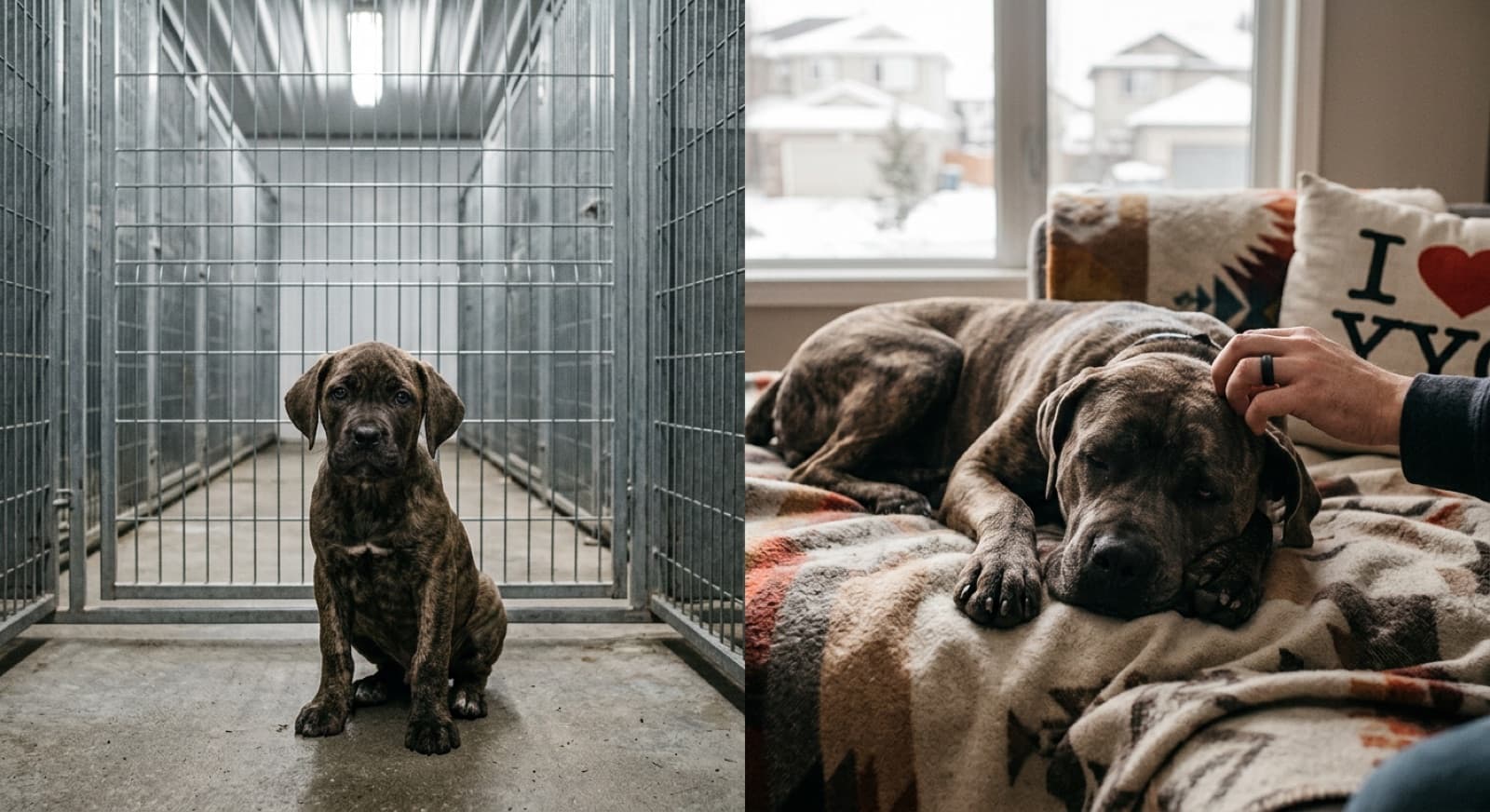
What happens between 6 and 30 months
The adolescent Cane Corso is not the puppy you raised and is not yet the adult you will live with. Hormones shift. The amygdala is still consolidating. Cortisol baselines run higher. Triggers that the six-month puppy walked past at 30 feet now produce a reaction at 60. The dog who came when called at five months hesitates at 14 months, then refuses at 18 months, then comes again at 22 months under a structured rebuild. None of this is the dog being difficult on purpose. It is normal developmental neurobiology in a breed selected across centuries for guardianship, large-game work, and discriminating arousal.
6 to 12 months: adolescence starts, size catches up
The dog is 50 to 90 lb by 12 months and growing fast on a giant-breed timeline. Recall regresses for the first time. Adolescent reactivity emerges as alert-barking at the doorbell, suspicion of strangers in the entryway, and watchfulness toward dogs on the street. Counter-surfing becomes possible because the dog can now reach the kitchen counter without standing on hind legs. The Cane Corso's natural handler partnership means most of this can still be redirected with consistent structure, but the work is heavier than at four months and the body is bigger.
12 to 24 months: the peak reactivity window
This is the hard part. The dog is 90 to 140 lb, physically a full Italian Mastiff, neurologically still adolescent, emotionally still settling. Reactivity peaks. Stranger suspicion sharpens. Leash reactivity to other dogs emerges or intensifies. Resource guarding can surface even in dogs who showed no sign at eight months. Threshold sensitivity in crowded public spaces drops. Off-leash recall is least reliable. This is when most Cane Corso surrenders happen and also when most owners conclude they have a problem dog. They usually have an adolescent dog whose body is now 130 lb.
24 to 30 months: starting to bend
Structural maturity finishes. Drive is still high. Reactivity is still active but responds better to consistent training. Owners who pushed through the 12 to 24 month window start seeing returns. Dogs adopted from rescue at this age often settle faster than dogs adopted at 16 months because the worst of the developmental peak is past.
30 to 36 months: the adult emerges
This is the calm, devoted, watchful Cane Corso the breed is famous for. Reliable obedience around expected distractions. Reactivity manageable with consistent handling. Full temperament maturation completes later than for Doberman or Boxer; some working-line Corsos take to 36 months to finish settling, occasionally longer. The adolescent who was lunging at every passing leash dog at 16 months is now the dog who lies at your feet between training sessions and watches the door from a place of confidence rather than arousal.
The whole arc is six months to about 36 months. The hardest window is 12 to 24. Owners who surrender at 18 months pull the plug just before the dog starts to settle, which is what makes the Edmonton Cane Corso surrender pattern so frustrating to local rescues. Read the cluster sibling on Cane Corso adoption in Edmonton for how the adolescent surrender wave interacts with local intake.
Step zero: rule out medical causes
Before any behavioural diagnosis or training plan, rule out medical contributors. The Cane Corso has two that matter most for behaviour change: hypothyroidism and pain. The full medical picture for the breed lives in the sibling Cane Corso health issues guide; this section covers the behaviour-specific rule-out.
Hypothyroidism
Hypothyroidism is overrepresented in the Cane Corso and can present as sudden behaviour change: new reactivity, anxiety, irritability, or aggression that was not there six months earlier. A basic thyroid panel (total T4 plus free T4 by equilibrium dialysis and TSH) costs around $150 to $250 at most Edmonton vets and rules it out cleanly. When low thyroid is the cause, treatment is daily oral levothyroxine, the response shows within four to eight weeks, and the behaviour change often resolves alongside. Skipping this step means potentially running a 12-week behaviour modification program for a medical problem the dog still has. Every credentialed behaviour consultant will ask whether thyroid has been checked before starting work.
Pain
Orthopaedic pain, dental disease, ear infections, and gastrointestinal pain all change behaviour. Hip dysplasia and elbow dysplasia are common in the breed and can produce pain that the dog cannot vocalise. A Cane Corso with early hip arthritis may snap when touched on the hindquarters or refuse to sit on command. A dog with a low-grade ear infection may snap when the head is approached. The vet workup for sudden reactivity should include a full orthopaedic palpation, a dental check, and an otoscope look at both ears. If the reactivity has a pain trigger, the training plan starts with treating the pain, not desensitisation. Untreated pain plus aversive correction is the fastest way to produce a bite history.
Force-free is the only methodology for a Cane Corso
The American Veterinary Society of Animal Behavior (AVSAB) position statement on humane dog training is explicit: aversive tools like prong collars, choke chains, shock or e-collars, and alpha rolls are associated with increased fear, anxiety, and aggression in dogs. For guardian-perception breeds with already-elevated arousal, the harm signal is amplified. For a 100 to 150 lb Italian Mastiff, the risk passes a different threshold than for a 30 lb breed, because the consequences of an escalated bite response are physical and legal.
The mechanism is straightforward. A reactive adolescent Cane Corso barking at another dog across the street is signalling distress. A prong collar correction at that moment pairs the distress with pain. The dog learns that the appearance of another dog predicts pain, which intensifies the reactivity at the next exposure rather than reducing it. With a smaller dog, this still produces a reactive dog but rarely a dangerous one. With a 130 lb guardian breed, the trajectory frequently passes through air-snapping into a bite that breaks skin, often directed at the closest human rather than the trigger dog. Force-free protocols invert the pattern: the appearance of another dog predicts something good (food, distance, the handler's engagement), and the dog's emotional response to the trigger gradually shifts.
For an Edmonton Cane Corso owner, force-free is also the practical methodology because the bylaw environment is behaviour-based, not breed-based. City of Edmonton Bylaw 21244 covers dangerous-dog provisions on individual behaviour. A dog with a bite history is at real legal risk regardless of breed. Aversive tools that increase the probability of a bite (which they do, on the AVSAB evidence) create legal exposure as well as welfare harm, and a single bite report can trigger restricted-dog classification with mandatory muzzle, leash, and containment requirements for life.
Why aversive tools are extra-dangerous on Corsos
Three reasons specifically. First, the breed responds to pressure with escalation rather than submission. A pain-trained Corso who decides the handler is unsafe can produce a redirected bite that a smaller breed could not match in severity. Second, the trust damage is durable. Force-free trainers report 12 to 18 month repair timelines after aversive-tool exposure in guardian breeds, longer than for retrievers or hounds. Third, the body mechanics matter. A 130 lb dog lunging into a prong correction generates enough force to cause real injury to the dog (cervical and tracheal damage are documented), to the handler (shoulder dislocations and falls), and to bystanders if the leash slips.
Credentials that mean something
Dog training is unregulated in Alberta. Anyone can call themselves a trainer. The credentials that mean something are independent third-party certifications: CCPDT (Certification Council for Professional Dog Trainers), which administers the CPDT-KA and CPDT-KSA exams, and IAABC (International Association of Animal Behaviour Consultants), which credentials CDBC-level behaviour consultants on assessment portfolios and continuing education. For Cane Corsos specifically, ask whether the trainer has guardian-breed experience and whether they have worked with adolescent Corsos before. A trainer who only handles retrievers and herding breeds is not the right partner.
Puppy socialisation vs adolescent rebuild
The primary socialisation window for a puppy is 3 to 14 weeks. If you have a Cane Corso puppy in that window, the work is structured positive exposure to many people, environments, surfaces, sounds, and (carefully) other dogs. The AVSAB position on puppy socialisation is that the developmental benefit before 16 weeks outweighs the infectious-disease risk for puppies kept in low-risk environments. Most Edmonton force-free trainers run puppy socials and early-foundation classes for dogs as young as 8 weeks, vaccination caveats considered. The window does not reopen.
If you have adopted an adolescent or adult Cane Corso from rescue, the primary window is past. Recovery is still possible; it is just harder. The adolescent rebuild looks different from primary socialisation: less mass exposure, more controlled threshold work. A rescue Corso who missed early socialisation may show stranger suspicion, environmental neophobia, or noise sensitivity that the well-socialised puppy would not. The training plan accommodates this by managing distance and intensity rather than flooding the dog with exposure that the early-development gap left them unable to process.
Rescue foster notes that flag “needs experienced home” or “slow to warm to strangers” are signalling exactly this gap. An adult Cane Corso with this profile can become a settled, confident adult; the work is real and the timeline is 12 to 18 months rather than the 4 to 6 months that a well-socialised dog might need.
Adolescent training priorities
A Cane Corso in the 12 to 24 month window does not need 40 trained behaviours. It needs 8 reliable ones, layered into the dog's default routine. Skip the trick training during peak adolescence and concentrate on these.
- Loose-leash walking. The foundation skill, and the one that determines whether the dog is walkable at all once they hit 100 lb. Use a front-clip harness, reinforce check-ins every few steps, and shorten walks rather than allow practised pulling. Never a flat collar alone; the breed pulls hard enough to risk tracheal injury.
- Name response. The dog turns to look at you when you say their name. Practised 20 times a day in low-stimulation environments before any reactive context. Without this, every other skill collapses around distractions.
- Recall on a long-line. Rebuild from scratch on a 10 to 15 metre biothane long-line. Never call the dog away from something they want without paying well. Never call to punish. Recall regression at adolescence is normal; the rebuild is steady through to 30 months. Off-leash recall in unfenced spaces is not the goal for most Corsos; reliable long-line recall is.
- Place training. The dog goes to a designated bed or mat and stays until released. Useful for managing entryway reactivity, visitor management, and household calm. Replaces the “just shouting at the dog” default for most owners and is the foundation of the vestibule protocol for visitors.
- Default check-in. The dog learns to look at you whenever something new appears. Heavily reinforced in the early adolescent window so it becomes the default response to triggers later. The single most useful default behaviour for leash reactivity prevention.
- Drop and trade. The dog gives up an item when asked, in exchange for something better. The foundation of resource guarding prevention. Practised daily with low-value items first, built to higher-value items only when the dog is genuinely comfortable.
- Impulse control around food and doorways. Wait for permission before eating, ignore dropped food on cue, settle calmly during human meals, no door-bolting when the front door opens. Counters several adolescent failure modes at once and reduces the stranger-in-the-entryway flashpoint.
- Settle on a mat. The dog can relax on a designated mat in a busy household for 30 minutes at a time. Builds the off-switch that some Corsos struggle with through adolescence, particularly working-line dogs.
Layered properly, these eight skills cover most adolescent management. A CCPDT trainer running a six-week group class will hit most of them at the foundation level. Adolescents past the foundation class benefit from a private session every two to three weeks to layer skills into real-world contexts, particularly the vestibule protocol and the long-line recall.
Leash reactivity protocol
Leash reactivity to other dogs is the most common adolescent Cane Corso presentation. The protocol that works for most cases is threshold-based desensitisation plus counter-conditioning, sometimes referenced as LAT (Look At That) or BAT (Behaviour Adjustment Training) in the force-free literature. The three levers are distance, duration, and intensity.
Distance
The dog cannot learn at over-threshold. If the trigger is close enough that your Corso is barking, lunging, or unable to take food, the distance is wrong. Find the distance where the dog notices the trigger but can still take food and respond to a cue. That distance becomes your starting point. Many Edmonton Corso owners discover their starting threshold is 100 feet, not 20, particularly for an adolescent who already has a few practised lunges in their history.
Duration
Short exposures, repeated. A two-minute encounter at threshold distance is more useful than a 20-minute walk full of over-threshold encounters. As the dog stays under threshold, duration extends naturally. For Cane Corsos specifically, three short walks per day work better than one long walk because the cortisol baseline has time to settle between sessions.
Intensity
Calmer triggers first, harder triggers later. A still dog at distance is easier than a moving dog. A medium dog is usually easier than a bouncing puppy or an intact male. A leashed dog is easier than an off-leash one. Build the hierarchy from easy to hard, and only progress when the previous level is genuinely fluent. Skipping a step looks like a reactive lunge that sets training back two to four weeks.
This is methodology, not a step-by-step protocol for an individual dog. A reactive adolescent Cane Corso benefits from a force-free trainer running the actual plan, because the threshold work has to be calibrated to the specific dog. Owners who try to apply generic protocols from a YouTube video are usually surprised at how much closer their actual threshold is than they assumed, and the cost of getting it wrong with a 130 lb dog is higher than with a 30 lb one.
The 100 to 150 lb force-handling reality
Most training advice assumes a dog the handler can physically control. With an adolescent Cane Corso, that assumption breaks. A 130 lb adolescent who lunges sideways at an unexpected trigger can pull most adults off-balance. A handler who falls drops the leash. A dropped leash with a reactive Corso heading toward a trigger is the worst version of every story the rescues hear. The training methodology has to compensate.
Drag-line work
A 10 to 15 metre biothane long-line is the safety net for any open-space exposure during adolescence. The dog wears a properly fitted Y-front harness; the long-line clips to the back ring; the handler holds the long-line and gives the dog 5 to 10 metres of working distance. If the dog bolts, the long-line drags behind them, slowing them, and any nearby adult can step on it to stop the dog without grabbing a leash that the handler has already lost. The long-line is not a substitute for recall training; it is the layer underneath the recall training while it is being built.
Harness, not collar
A front-clip Y-front harness distributes lunge force across the chest rather than concentrating it on the trachea. For a 130 lb dog, the difference between a flat collar lunge and a chest-harness lunge is the difference between potential tracheal injury and a controlled redirect. Front-clip designs (Ruffwear Front Range, Balance Harness, Perfect Fit) work better than back-clip designs for reactive dogs because the geometry naturally turns the dog back toward the handler under load. Avoid Halti-style head halters on Corsos in the reactive phase; the cervical leverage produces injury risk when a heavy dog lunges hard.
Back-up handler
For the first 6 to 12 months with an adolescent Corso, walks in higher-density areas (any urban route during the day, the river-valley trails on summer evenings, anywhere near schools at pickup) benefit from two adults. One handles the leash; the other watches the environment and clears space. This sounds excessive until the first time a child runs out from a doorway 15 feet from your dog. A back-up handler is not a permanent need; it is a calibration tool while you learn what your specific dog needs in space management.
Environment management
Route choice does more work than any other intervention in the first six months. Quiet residential streets at off-peak hours beat busy commercial routes at any hour. Industrial-area sidewalks beat dog-park-adjacent paths. The river-valley trails are excellent at 6 AM in summer and largely impossible at 7 PM. Map your routes by trigger density rather than scenery. The dog cannot generalise calm behaviour learned in a chaotic environment, but they can generalise calm behaviour learned in a quiet one outward to gradually more challenging ones.
Resource guarding: trade-up, do not punish
Resource guarding emergence at 12 to 20 months is a common adolescent Cane Corso pattern. The dog stiffens over a chew, growls when approached near the food bowl, or snaps when an item is taken away. The instinctive owner response is to assert dominance: take the item, push the dog, punish the growl. This is the worst possible response on the behaviour-science evidence, and the consequences with a 130 lb dog are different from the consequences with a 30 lb dog.
Punishing the growl teaches the dog to skip the warning and go straight to a bite. The growl is information; the dog is communicating that they feel threatened over a resource. Removing the warning without changing the underlying emotion leaves you with a dog that bites without warning. This is how owners produce the bite-history Corsos that veterinary behaviourists later see, and how households end up with a dog that bites a child reaching for a dropped toy.
The trade-up protocol works the other direction. Approach with something better than what the dog has. Drop it. Walk away. The dog learns that human approach near a resource predicts something better, not loss. Practise daily with low-value items first. Build to higher-value items only when the dog is genuinely comfortable. Run the protocol under the supervision of a CCPDT trainer or IAABC behaviour consultant for the first weeks. If you have children in the household, treat resource guarding as a household-wide protocol from day one rather than a training-room exercise.
Resource guarding that responds to trade-up over four to eight weeks is a normal adolescent pattern that resolves. Resource guarding that escalates, generalises across more items, or progresses to snapping when approached at any distance warrants escalation to a veterinary behaviourist. The DACVB credential through the American College of Veterinary Behaviorists is the diagnostic and prescribing tier when training alone cannot solve the problem. Step zero of any escalation is re-running the medical rule-out (see the Cane Corso health guide) in case pain is driving the change.
Stranger reactivity and the vestibule protocol
Cane Corsos were bred to discriminate strangers. A well-raised adult Corso is watchful with new people, accepts introductions on the owner's cue, and settles once the visitor is established. An adolescent Corso who has not been guided through visitor management can produce barking, lunging, or worse at strangers in the entryway. This is the second most common adolescent presentation after leash reactivity and the one with the highest stakes because the trigger is a human, often a friend or family member, often inside the home.
Not every visitor is a safe exposure
The household rule for adolescent Corsos is that visitor exposure is curated. Family members and close friends who can follow the protocol are appropriate. Delivery drivers, contractors, and anyone unfamiliar with the household is not, until the foundation is in place. Children of family friends are managed carefully because their behaviour is harder to control. This is not anti-social; it is realistic risk management for a guardian-breed adolescent whose threshold is still being calibrated.
The vestibule protocol
Visitor arrives. Dog goes to a designated place (crate, mat, separate room) before the door opens. Visitor enters, settles in the living room, and is briefed on the rules. Dog is brought out on leash, given the opportunity to approach the visitor at the dog's own pace, and reinforced for calm investigation. Treats rain from the visitor at a distance the dog can handle. The visitor does not reach for the dog, lean over the dog, or stare. The dog returns to the place mat between investigations. The visit ends with the dog in the place, not roaming. Over three to five repetitions with the same visitor, the dog learns that visitors mean structured calm, not stranger-danger.
Controlled exposure on walks
The same principle applies on walks. The Corso does not need to meet every stranger who wants to say hello. “He's in training, please give us space” is a complete sentence and the right response to friendly strangers who reach for the dog. Reinforce neutral pass-bys; do not reinforce greetings unless they are calibrated to your dog's threshold. Many adult Corsos are perfectly happy to ignore strangers on walks for life, which is the safe and appropriate adult target rather than universal friendliness.
Browse adoptable Edmonton Cane Corsos and Corso mixes
Current Edmonton listings from EHS, AARCS Edmonton-foster dogs, AHHRB, Zoe's, SCARS, GEARS, and Hope Lives Here in one place. Foster temperament notes describe real adolescent behaviour and the training partnership the dog will need.
See Edmonton Adoptable Dogs →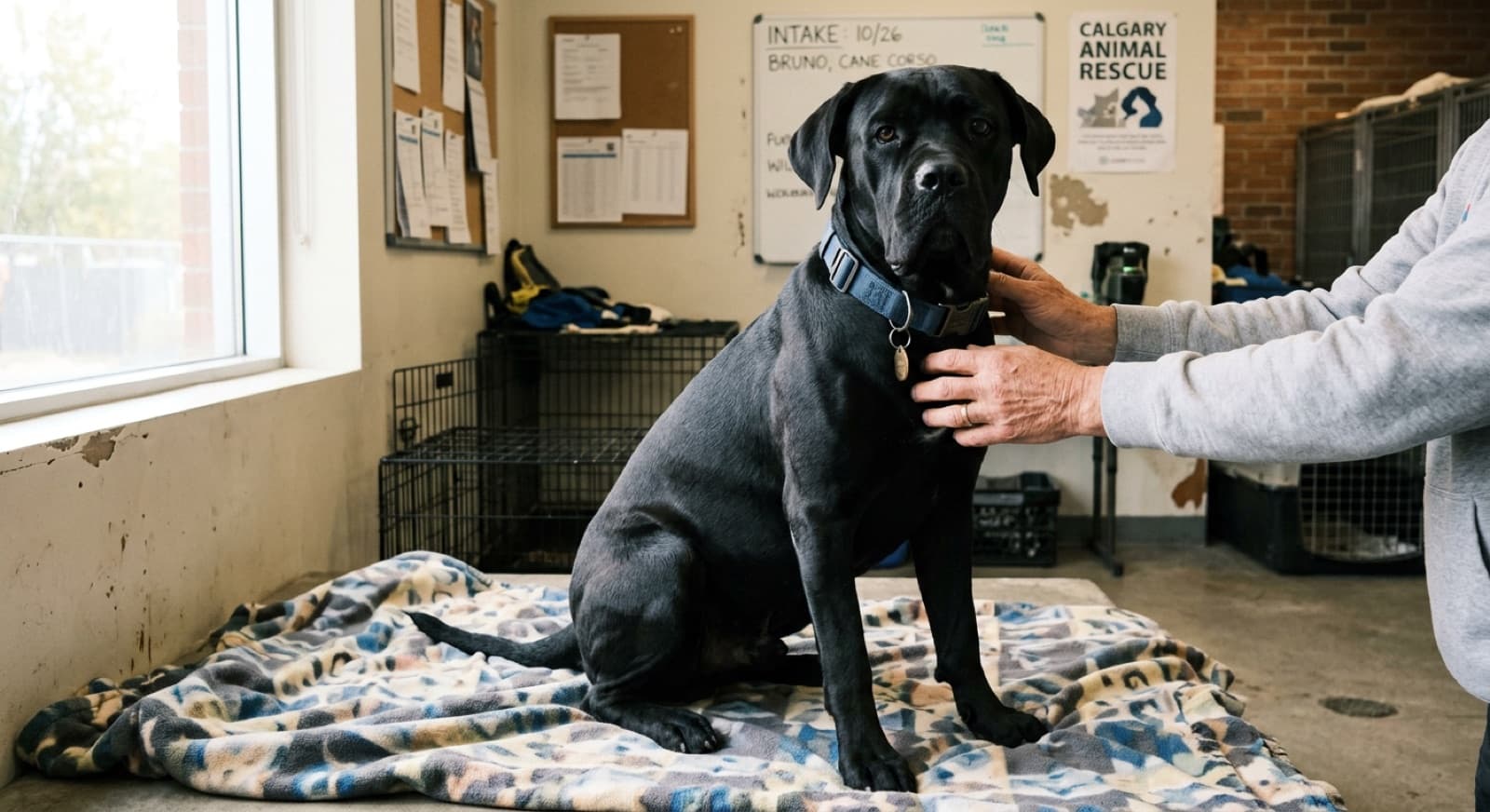
Bite force, bite history, and Bylaw 21244
Cane Corso bite force is high among domestic dogs. The exact PSI figures cited online are unreliable and vary wildly across sources; what is reliable is that a Cane Corso bite produces injuries at the severe end of the bite spectrum, and one bite incident is often enough for a reclassification under City of Edmonton Bylaw 21244. The bite-prevention culture in the household has to reflect this reality rather than minimise it.
Bylaw 21244 covers dangerous-dog provisions on individual behaviour. A dog can be declared dangerous after biting, attacking, or threatening a person or animal, regardless of breed. The classification carries serious consequences: mandatory leashing in public, muzzle requirements, secure containment specifications for the property, increased licensing fees, and fines that can run into thousands. For a Cane Corso, a single incident can produce a dangerous-dog designation that follows the dog for life and dramatically changes the household's options, including housing (most condo boards exclude designated-dangerous dogs entirely) and insurance (most carriers exclude dangerous-dog coverage outright).
The practical implication for an adolescent Corso owner is that prevention is the entire game. A growl that escalates to a snap is one incident from a bite. A bite incident is one report from a designation. A designation is permanent. The trade-up protocol is not optional. The vestibule protocol is not optional. The drag-line is not optional. Every preventive measure that looks excessive on a 30 lb dog looks proportionate on a 130 lb Corso who could be one phone call from a dangerous-dog hearing.
None of this means treating the dog as inherently dangerous. Well-raised Cane Corsos go their entire lives without a bite incident, and the breed's natural temperament with family and known visitors is gentle, devoted, and discerning. It means that the foundation work during adolescence has to assume the stakes the breed actually carries, not the stakes a Labrador adolescent would.
Group classes vs private training
For Cane Corsos, private training is more often the right format than for most breeds. The reasons are practical.
Group classes work for
- Puppy socialisation (8 to 16 weeks). The class is partly socialisation, partly foundation skills, and partly the puppy learning that other dogs at controlled distance are not a problem.
- Young adolescent foundation (4 to 10 months). The dog is still under the peak reactivity window. Group exposure to other dogs at controlled distance is a feature, and Corso puppies particularly benefit from structured exposure to other large-breed adolescents.
- Post-peak adolescent (30 months and up). The reactivity has settled enough that group settings are productive again, particularly for skill-building and the social aspect.
- Adult Corso skill-building. Rally obedience, scent detection, structured nosework, any low-arousal sport.
Private training works for
- Peak-adolescent reactive Corso (12 to 24 months with active reactivity). The reactive dog cannot learn in a room full of triggers, and the class cannot work around your dog.
- Resource guarding work. The protocol needs careful supervision and individual pacing.
- Stranger fear or visitor reactivity. The exposure work has to be controlled and run in the home.
- Owners who need handling coaching more than the dog needs new skills. Cane Corso training plans are often 70 percent owner training, 30 percent dog training.
Group class costs run $200 to $400 for six to eight weeks. Private sessions run $100 to $200 per hour. A typical adolescent Cane Corso case uses 8 to 12 private sessions over four to six months, so budget $900 to $2,400 for the path. This is part of the real cost of adopting an adolescent Corso in Edmonton and should be in the budget before adoption, not discovered later.
Edmonton-specific training environments
Edmonton geography and seasonality shape the training year in ways warm-climate guides do not capture.
Winter exposure gaps
From late November through early April, outdoor public exposure shrinks significantly. The Cane Corso is a short-coated breed and tolerates real cold poorly without a coat. On -25 to -35 degrees Celsius days, walks become 15 to 25 minute potty-and-stretch sessions, not training opportunities. The adolescent loses five months of structured outdoor exposure work each year. Plan winter to be heavy on indoor training (puzzle feeders, scent games, name response drills, place training, settle on a mat) and light on the outdoor reactivity work that defines the spring-through-fall season.
Spring re-socialisation
March and April are re-socialisation months for every Edmonton Cane Corso owner. After five months of reduced exposure, the dog re-emerges with rusty thresholds. Triggers that were manageable in October now produce reactions. Treat March and April as a structured rebuild: shorter walks, lower-density routes, more reinforcement, more distance from triggers. The dog catches up to last fall's baseline by May or June. Skipping this rebuild and assuming the dog will pick up where October left off is one of the most common Edmonton Corso training mistakes and produces an April incident that owners spend the summer recovering from.
Summer over-arousal
Late June through August stack three arousal pressures: heat, longer daylight that extends evening walk time, and the higher density of dogs and people in river-valley spaces. An adolescent Cane Corso with reactivity issues may regress in summer because every walk encounters more triggers at closer distance. Move exercise to early morning and late evening, both for heat management and for lower trigger density. Avoid the busy off-leash zones entirely; long-line work on quieter trail segments is the right format.
Edmonton off-leash park calculus
Off-leash parks are a low-yield, high-risk environment for an adolescent Cane Corso, and they are unsafe for many adult Corsos as well. The combination of unknown dogs at close range, owners who do not control their dogs, and the social pressure that prevents you from leaving quickly is exactly the setup that entrenches reactivity and creates bite incidents. One bad encounter can produce a bite report that follows the dog for life. The Edmonton off-leash parks guide covers which trails work for which dog stages. For most adolescent Corsos, the right substitute is long-line river-valley work and (when budget allows) hourly fenced-rental sessions at private facilities.
Condo and apartment trigger density
For Cane Corso owners in Edmonton condos and apartments, the trigger density is real: elevators with unknown dogs, hallway encounters at close range, neighbours visible through the door, delivery sounds at unpredictable intervals. The training plan has to account for the building. Defer elevator socialisation until after foundation work. Use the stairwell when possible. Reinforce calm entries and exits. The sibling Cane Corso housing and insurance guide covers the housing layer of this picture; the training layer is that high-trigger buildings amplify every adolescent reactivity issue and slow the timeline by months.
When to escalate to a veterinary behaviourist
For Cane Corsos, the escalation threshold to a veterinary behaviourist (DACVB) is lower than for smaller breeds because the consequences of an unmanaged behaviour problem are higher. A force-free trainer handles foundation skills and most normal-adolescent reactivity. An IAABC behaviour consultant handles entrenched reactivity, generalised behaviour modification, and resource guarding that has not responded to trade-up protocols. A DACVB handles the cases that need diagnosis of a behavioural disorder and often medication alongside training.
Escalate to a DACVB for any of these:
- Any actual bite that breaks skin or holds. This is behaviourist territory, not trainer territory, regardless of context. For a Cane Corso, this is also potentially Bylaw 21244 territory; document the incident, the trigger, and the trajectory immediately.
- Sleep-startle response that includes snapping when touched while sleeping, even after repeat exposure during waking hours.
- Resource guarding that escalates over weeks rather than settling under a trade-up protocol, generalises across many items, or progresses to bite attempts.
- Stranger reactivity that escalates rather than reducing under controlled exposure, particularly if it generalises to family-known visitors after several successful introductions.
- Generalised anxiety that prevents the dog from settling anywhere, including at home with no triggers present.
- Severe noise phobia (thunderstorms, fireworks) that produces self-injury or full panic, which can spiral into broader anxiety for Corsos.
- Predatory drift on cats or small dogs that includes bite-and-shake. This is not a household management issue.
- Sudden behaviour change with no obvious environmental cause, after thyroid and pain have been ruled out.
The closest DACVB-staffed program for Edmonton is the Western College of Veterinary Medicine at the University of Saskatchewan in Saskatoon. Consultations may run through referral from your primary vet, or by telehealth. Expect $400 to $800 for an initial workup and a structured follow-up plan, with medication costs additional. For genuinely dangerous behaviour or for any case that has produced a bite, this is the right tier and the earliest call wins.
Day-to-day adolescent management
The structured day for an adolescent Cane Corso looks something like this. Details vary by household; the components are non-negotiable.
- Morning walk, 30 to 45 minutes. Loose-leash work on a front-clip harness, name-response drills, threshold practice when triggers appear. Off-peak hours when possible.
- Breakfast as enrichment. Puzzle feeder, snuffle mat, or scattered on a clean towel. Not free-fed from a bowl.
- Mid-morning training session, 5 to 10 minutes. Two or three skills, high reinforcement rate, end before the dog disengages.
- Midday potty break or short walk. For owners who can break up the day, this is the high-value slot for a Corso who runs higher daily energy than a Mastiff would.
- Settle on a mat during work hours. Crate, designated bed, or place. Builds the off-switch that working-line Corsos can struggle with through adolescence.
- Late afternoon walk, 30 to 45 minutes. Often the highest-arousal slot of the day. Lower-density routes if reactivity is active.
- Dinner as enrichment. Same pattern as breakfast. The orthopaedic and bloat picture for the breed is covered in the health guide; floor-level feeding at consistent times is fine.
- Evening training session, 5 to 10 minutes. Skill layering, no new triggers, end on a win.
- Vestibule rehearsal. If a family member is coming home, the dog goes to the place mat before the door opens. Repetition builds the protocol into the dog's default.
- Settle on a mat during human evening time. The off-switch reinforced daily.
- Last potty break, 9 to 10 PM. Short and structured.
- One structured outing per week. A longer river-valley trail walk on a drag-line, a fenced-rental session, a low-density public space exposure. Building real-world generalisation under controlled conditions.
Total time: about 100 to 130 minutes of structured handler input daily. Some of this overlaps with normal household routine. Owners who get to month four and find the dog is settling and the routine has become automatic are the owners whose Corsos turn into the famous adult Italian Mastiffs of the breed by month 30 to 36.
Red flags: when to call for help today
Most adolescent Cane Corso behaviour is normal and finite. A smaller subset is genuine crisis behaviour. The triggers below should produce a same-week call to either an IAABC behaviour consultant or a veterinary behaviourist, not a wait-and-see approach. With a 130 lb guardian breed, “wait and see” is the most expensive option.
- Any bite to a human that breaks skin or holds, regardless of context. Document immediately for both behavioural and bylaw purposes.
- Growling that escalates over weeks rather than reducing with management.
- Sleep-startle snapping that does not resolve with awake-state desensitisation.
- Predatory bite-and-shake on a cat, a small dog, or wildlife.
- Sustained barrier frustration at fences or windows that escalates to door destruction or self-injury.
- Generalised inability to settle for more than a few minutes at a time in a quiet home.
- Severe noise phobia producing self-injury or full panic.
- Reactivity that intensifies over a 12 week period of consistent training, rather than reducing.
- Stranger fear that escalates at known visitors after several successful introductions.
- Sudden behaviour change in an adult dog with no environmental cause, after thyroid and pain have been ruled out.
Calling early is always cheaper than calling late. A behaviour consultant who sees the case at the growl stage is solving a different problem than the one who sees it at the bite stage. The Edmonton rescue intake conversations that go worst are the ones where the owner waited 18 months before asking for help.
Multi-handler household coordination
For guardian breeds, household consistency matters more than for retrievers or hounds. A Cane Corso who learns one set of rules from one adult and a different set from another adult does not split the difference; the dog tests every rule with every adult until they discover which adult enforces which rule. The result looks like inconsistent training but is actually inconsistent humans.
Three practical implications. First, every adult in the household needs to attend the trainer sessions, not just one. The training is largely owner training; absent adults end up reinforcing the wrong defaults. Second, the rules are written down and visible. Door protocol, mealtime protocol, visitor protocol, place protocol; agreed in advance, applied identically by every adult. Third, the lightest adult in the home needs a realistic plan for handling the dog when reactivity appears. If one adult cannot physically manage the dog on a reactive day, that adult should not be the only one walking the dog through high-trigger environments during adolescence.
Household consensus is also one of the most important factors that Edmonton rescues evaluate at the application stage. A Cane Corso adoption that fails fast is usually one where one adult wanted the dog and the rest of the household did not, and the protocols collapsed because half the adults were not bought in.
The “I want a Corso for protection” reframe
A meaningful share of Cane Corso applications come from adopters who want a protection dog. The reality is that pet Cane Corsos are not active-defence dogs and should not be trained to be one. The Italian Mastiff was selected as a property guardian whose presence and discrimination deter threats, not a personal-protection dog who actively engages on cue. The two profiles are different breeds within the breed and require different training trajectories.
Active-protection work is a specialised discipline run by professional decoy-trainers over 18 to 30 months at $15,000 to $50,000. The dogs are selected from working lines, raised with structured drive-building, and require lifelong handler maintenance. They are not pets in the conventional sense. Trying to add bite work or sharpening protocols at home produces a dog that bites the wrong target at the wrong time and creates serious legal exposure under Bylaw 21244. The Canadian Veterinary Medical Association does not support do-it-yourself protection training and most credentialed force-free trainers will refuse the work.
The natural watchfulness of a calm, well-raised Cane Corso is the protection most households actually need. A 130 lb dog who notices everything, takes cues from their owner, and discriminates real threats from delivery drivers and joggers is a far more useful family guardian than a sharpened pet who escalates inappropriately. If active-defence work is the real goal, work with a credentialed Working Dog Club program from a dedicated working-line dog, not the household pet rescued at 14 months from an Edmonton foster home.
The bylaw context: behaviour, not breed
Alberta has no breed-specific legislation, and City of Edmonton Animal Care and Control Bylaw 21244 treats Cane Corsos the same as every other breed. The dangerous-dog provisions are behaviour-based: a dog can be declared dangerous after biting, attacking, or threatening a person or animal, regardless of breed. The classification carries serious consequences (mandatory leashing, muzzle in public, secure containment requirements, fines that can run into thousands).
For the Cane Corso owner, this is the practical case for force-free training. A bite incident creates legal exposure that no corrected-quickly-with-a-prong-collar story solves. The behaviour-modification record matters if there is ever a complaint. A dog whose owner can demonstrate ongoing work with a credentialed CCPDT trainer or IAABC consultant is in a different position than a dog whose owner cannot. The sibling Cane Corso housing and insurance guide covers the private-actor liability picture that runs alongside the bylaw context.
Frequently asked questions
How do I train an adolescent Cane Corso in Edmonton?
Start with three things before any obedience plan. Confirm hypothyroidism and pain have been ruled out by a vet. Find a force-free trainer credentialed through CCPDT or IAABC who has worked with guardian breeds before. Build a daily structure of 60 to 90 minutes of physical exercise plus 20 to 30 minutes of mental work, anchored by a 10 to 15 metre drag-line for any open-space exposure. Group classes work for puppies under 12 months. Adolescents in the 12 to 24 month peak do better in private sessions because the dog cannot learn at over-threshold and the class cannot work around your dog. Edmonton winter shrinks public exposure for almost five months, so spring re-socialisation is a real part of every Cane Corso year, not optional.
When does Cane Corso adolescence start and end?
Roughly 6 to 30 months, with the hardest stretch between 12 and 24 months. Full temperament maturation extends to 2 or 3 years for the breed, longer than Doberman or Boxer. The dog is physically close to adult size by 14 months, neurologically still adolescent through 24, and emotionally still settling through 30. Reactivity peaks, recall regresses, resource guarding can surface for the first time, and stranger suspicion sharpens. Most well-handled Corsos settle by 30 to 36 months. The work you do between 12 and 24 months builds the steady adult Italian Mastiff the breed is famous for.
Should I use a prong collar or e-collar on my Cane Corso?
No. The American Veterinary Society of Animal Behavior position on humane training is explicit: aversive tools like prong collars, choke chains, and shock collars are associated with increased fear and aggression in dogs. For a Cane Corso the risk is amplified. A 130 lb dog that learns punishment is the language of training will use that language back, and the fight-back response in guardian breeds is severe rather than submissive. Aversive corrections also create durable trust damage that takes 12 to 18 months to repair. Force-free methodology credentialed through CCPDT or IAABC is the safer and more effective starting point. Trainers who recommend prongs or e-collars for an adolescent Corso are working outside current behaviour science and creating injury risk for the household.
My adolescent Cane Corso is suddenly reactive on leash. What do I do first?
Book a vet visit before any behaviour consult. Hypothyroidism is overrepresented in Cane Corsos and can present as sudden behaviour change including reactivity, anxiety, and irritability. A basic thyroid panel (T4 plus free T4 and TSH) rules it out for around $150 to $250. Pain (orthopaedic, dental, ear) is the other medical contributor worth checking, and the breed-specific cardiac and hip-elbow risk profile means a giant-frame physical workup is warranted. The sibling Cane Corso health guide covers the full medical picture. Once medical is clear, work with a force-free trainer or IAABC behaviour consultant on a threshold-based protocol. Manage distance and intensity in the meantime with a front-clip harness, a drag-line, and route choices that avoid high-trigger density.
Can I take my Cane Corso to off-leash parks during adolescence?
Generally no, and many Corsos never become safe off-leash park dogs as adults. Off-leash parks combine unknown dogs at close range, owners who do not control their dogs, and the social pressure that prevents you from leaving quickly. For a 130 lb guardian breed, one bad incident can produce a bite report under City of Edmonton Bylaw 21244 and entrench reactivity for months. Long-leash river-valley trail walks deliver the same physical exercise with controlled exposure. Many Edmonton Cane Corso owners skip off-leash parks for life and run hourly fenced-rental sessions instead, or one-on-one play with vetted dog friends in private yards.
When should I escalate from a trainer to a veterinary behaviourist?
The threshold is lower for a Cane Corso than for smaller breeds because the consequences of a bite are higher. Any bite that breaks skin or holds. Sleep-startle response where the dog snaps when touched while sleeping, even after repeat awake-state desensitisation. Resource guarding that escalates over weeks rather than settling under a trade-up protocol. Generalised anxiety that prevents the dog from settling at home. Severe stranger fear that progresses to bite attempts. Predatory drift on cats or small dogs with bite-and-shake. Veterinary behaviourists are board-certified through the American College of Veterinary Behaviorists (DACVB) and can diagnose behavioural disorders and prescribe medication. The Western College of Veterinary Medicine in Saskatoon is the closest DACVB-staffed program; consultations run by referral or telehealth.
Do Edmonton winters affect Cane Corso training?
Yes, significantly. The Cane Corso has a short single coat (some lines a slight undercoat) and feels Edmonton cold worse than a Rottweiler. On -25 to -35 degrees Celsius days, walks become 15 to 25 minute potty-and-stretch sessions, not training opportunities. Five months of reduced public-space exposure means the dog re-emerges in March or April with rusty thresholds. Spring re-socialisation is a real part of every Edmonton Cane Corso year. Treat March and April as a structured rebuild with shorter walks, lower-density routes, and more distance from triggers. Skipping this rebuild and assuming the dog will pick up where October left off is one of the most common Edmonton Corso training mistakes.
My Cane Corso growled at a visitor in our home. Is this a crisis?
Not automatically a crisis, but a stop-sign that demands a plan today. A 130 lb guardian breed signalling distress at a stranger needs management before it escalates. The wrong response is punishment, which teaches the dog to skip the warning and go straight to a bite. The right response is a vestibule protocol: dog goes to a designated place or crate before any visitor enters, leash on, controlled greeting only after the visitor is settled, treats raining from the visitor at a distance the dog can handle. Not every visitor is a safe exposure. Family yes, contractor no, child of family friend not until thresholds are tested. If growling escalates to lunging or air-snapping, escalate to an IAABC consultant immediately, not next month.
How much will Cane Corso adolescent training cost in Edmonton?
A six to eight week force-free group obedience class runs $200 to $400. Private sessions with a CCPDT or IAABC-credentialed trainer run $100 to $200 per hour, and adolescent reactivity work typically needs 8 to 12 sessions, so budget $900 to $2,400. An IAABC behaviour consultant for entrenched reactivity runs $150 to $300 per hour, $1,800 to $3,500 for a full case. A DACVB veterinary behaviourist consultation runs $400 to $800 for the initial workup plus medication and follow-up. The cost is higher than Doberman or Boxer training because Cane Corso work usually involves more private sessions and a behaviourist relationship. Build the training line item into the adoption budget from day one. Assuming you will not need it is the most expensive mistake an Edmonton Cane Corso owner can make.
I want a Cane Corso for protection. Is that a good fit?
Almost never, for two reasons. Real protection training is a specialised discipline run by professional decoy-trainers over 18 to 30 months at $15,000 to $50,000, and it produces a dog that requires lifelong handler maintenance. A pet Cane Corso raised with calm structure and force-free methodology is already a present, watchful, family-loyal guardian whose presence deters most opportunistic threats. Trying to add bite work or sharpening protocols at home produces a dog that bites the wrong target at the wrong time and creates serious legal exposure under City of Edmonton Bylaw 21244. The natural temperament of the breed is the protection. The training adds reliability, not aggression. If active-defence work is the real goal, work with a credentialed Working Dog Club program, not the household pet.
Will the adolescent reactivity actually settle?
In most cases, yes, but the timeline is longer than Doberman. By 30 to 36 months, with consistent force-free training and managed exposure, the typical pet-line Cane Corso shows the steady, devoted temperament the breed is famous for. The exceptions are dogs with confirmed bite history, severe generalised anxiety, or medical contributors that were never ruled out. The single biggest predictor of the settled adult Corso is what the owner does between months 12 and 24. The work pays off later, but it has to happen on the schedule, and a household that waits 18 months before starting structured training will spend the next 18 months catching up.
Related Edmonton Cane Corso guides
Edmonton Adoptable Dogs
Current Edmonton-area Cane Corso, Corso-mix, and working-breed listings from EHS, AARCS Edmonton fosters, AHHRB, Zoe's, SCARS, GEARS, and Hope Lives Here.
Cane Corso Adoption Edmonton
The rescue-first Cane Corso adoption guide: local intake patterns, real fees, common mixes, cropping and docking ethics, and the 4 to 8 month timeline.
Cane Corso Health Issues: Joints, Heart, Bloat
Cane Corso health issues to plan for: hip and elbow dysplasia, heart screening, bloat, bone cancer, eyelid problems and the breed club’s recommended tests.
Cane Corso Housing & Insurance Edmonton
Condo restricted-breed lists, written landlord addenda, insurance carriers that do and do not flag the breed, and how to clear the paperwork before applying.
Find your Edmonton rescue Cane Corso
Browse current Edmonton-area Cane Corso and Corso-mix listings. Foster temperament notes describe real adolescent behaviour and the training partnership the dog needs.
Browse All Edmonton Dogs →New dog? Start with these care guides
Everything a new adopter needs to set up a safe, happy home.